
Why Synthetic Video Became a Core Teaching and Research Skill
Text-to-video systems crossed a practical threshold. A teacher who once needed a stock library, an animator, and a week of editing can now describe a twelve-second scene and get usable footage in minutes. A researcher who once studied human media production can now study a model's implicit understanding of physics, causality, and narrative. Both shifts are real, and both are routinely overestimated.
The gap between demo and delivery is almost never the model. It is the workflow. Teams that get reliable results treat generative video like any other production pipeline: they define the outcome first, storyboard second, generate in controlled batches, and review against a rubric. Teams that struggle prompt the same idea fifteen times, pick the least-bad clip, and quietly abandon the project three weeks later with nothing to show.
This guide is deliberately tool-neutral, because the models you use will change faster than the process around them. Whether you are building a lecture module, a stimulus set for a psychology experiment, or a student assignment, the same stages apply. The goal is not to master one interface. It is to build a repeatable method that survives the next release cycle.
How Video Models Actually Behave
You do not need the mathematics to use these tools well, but you do need a working mental model of what you are controlling and what you are merely suggesting.
From prompt to frames
Most current systems convert your prompt into a semantic representation, then denoise a compressed video representation over many steps, guided by temporal layers that try to keep adjacent frames coherent. Some architectures generate keyframes and interpolate between them; others generate the whole clip jointly. The practical consequence is the same in both cases: the model optimizes for plausibility, not for your intent. It will happily produce a beautiful scene that ignores your instruction about camera angle, because a gorgeous wide shot is a perfectly plausible answer to almost any prompt.
This is why prompt writing is closer to art direction than to programming. You are not issuing commands; you are shaping a probability distribution and then selecting from it.
The control surfaces that matter most
Think of each generation as a point in a multidimensional space. The dimensions that carry the most weight:
- Text prompt — subject, action, setting, lighting, lens, mood, pacing.
- Image or keyframe input — the strongest lever for identity and style.
- Motion and camera parameters — dolly, pan, orbit, handheld, locked-off.
- Duration and aspect ratio — short clips stay coherent; long clips drift.
- Seed — fixes a generation so you can iterate on one variable at a time.
- Negative guidance — suppresses recurring artifacts such as warped hands or stray text overlays.
Where models still fail
Hands and fine manipulation, legible on-screen text, precise timing against a musical beat, consistent interaction between two characters over more than a few seconds, and physical continuity such as an object remaining on a table between shots. These limits are stable enough to design around. Cut before the hand moves. Generate text as a separate overlay rather than asking the model to render it. Lock identity with reference images instead of adjectives. Write shots that a human editor can join cleanly even when the model's continuity is imperfect.
A Five-Stage Production Workflow
The following pipeline works for a three-minute lecture insert and for a fifteen-minute research stimulus film. It scales by adding shots, not by adding complexity.
Stage 1 — Start from an outcome, not a tool
Write one sentence: “After watching this clip, a student should be able to ___.” If a shot does not serve that sentence, cut it. Generative video is expensive in review time and cheap in generation time, the inverse of traditional production. That inversion means scope discipline matters more, not less. A tight ninety-second piece that lands beats a sprawling six-minute piece that nobody finishes.
Stage 2 — Storyboard before you prompt
A storyboard does not need to be art. A table with columns for shot number, duration, visual description, narration, and on-screen text is enough. This table becomes your shot list, your prompt source, and your editing plan simultaneously. Two rules save hours:
- Keep shots between three and eight seconds.
- Design transitions that hide model weaknesses: a cut on motion, a whip pan, a color flash, a match cut on a similar shape.
Also decide the emotional arc before generating anything. Knowing that shot four should feel uneasy tells you what to change when the first attempt feels neutral.
Stage 3 — Generate in controlled batches
Generate two or three variations per shot, not twenty. Change one variable at a time: lock the seed, then adjust camera language; keep the prompt, then swap the reference image. Name files with a consistent convention such as project_scene_shot_take so assembly is mechanical rather than archaeological. Keep a plain text log beside the footage listing prompt, seed, duration, and the reason you accepted a take.
Stage 4 — Assemble, add sound, and caption
Generated video is silent and usually has no narrative rhythm. Music, room tone, and a narration track do more for perceived quality than another generation pass. Add a simple ambience bed under every scene, even a quiet one, because silence reads as unfinished. Captions are non-negotiable for classroom use, and the choice between burned-in and soft subtitles is an accessibility decision, not a stylistic one.
Stage 5 — Review, disclose, and publish
Run a final check across four axes: factual accuracy, representation, bias, and disclosure. A one-line on-screen note stating which portions were synthesized protects both you and your institution, and it sets a norm that students will carry into their own work.
Consistency, Continuity, and Character Locking
The hardest problem in generative video is keeping a character, object, or location recognizable across shots. Techniques that work, roughly in order of impact:
Build a character bible. Front, three-quarter, and profile stills; wardrobe description; hair and eye color; two or three adjectives for demeanor. Reuse this text verbatim in every prompt rather than paraphrasing it each time.
Use reference images as anchors. Image-to-video and multi-image conditioning hold identity far better than text alone. Feed the same anchor image into every shot of a scene.
Reuse seeds within a scene. A fixed seed with a modified prompt often preserves lighting and palette even when composition changes.
Write a color script. Decide in advance that scene one is cool blue and scene three is warm amber. Consistent grading hides small continuity errors and gives the piece a professional shape.
Cut on motion. Transitions during movement mask frame-level differences between shots, because the eye tracks the action instead of comparing stills.
Keep shots short. Coherence degrades with duration. Two four-second shots with a cut frequently look better than one eight-second shot, and they give you more freedom in the edit.
For objects, the same logic applies at a smaller scale: describe the object with three fixed attributes and never vary the wording. For locations, generate a wide establishing still first and use it as a reference for every subsequent angle, so the room's geometry stays believable.
Designing Research Around Generative Video
Generative video is now an object of study as much as a tool. Three practices separate publishable work from anecdote.
Define your own task set
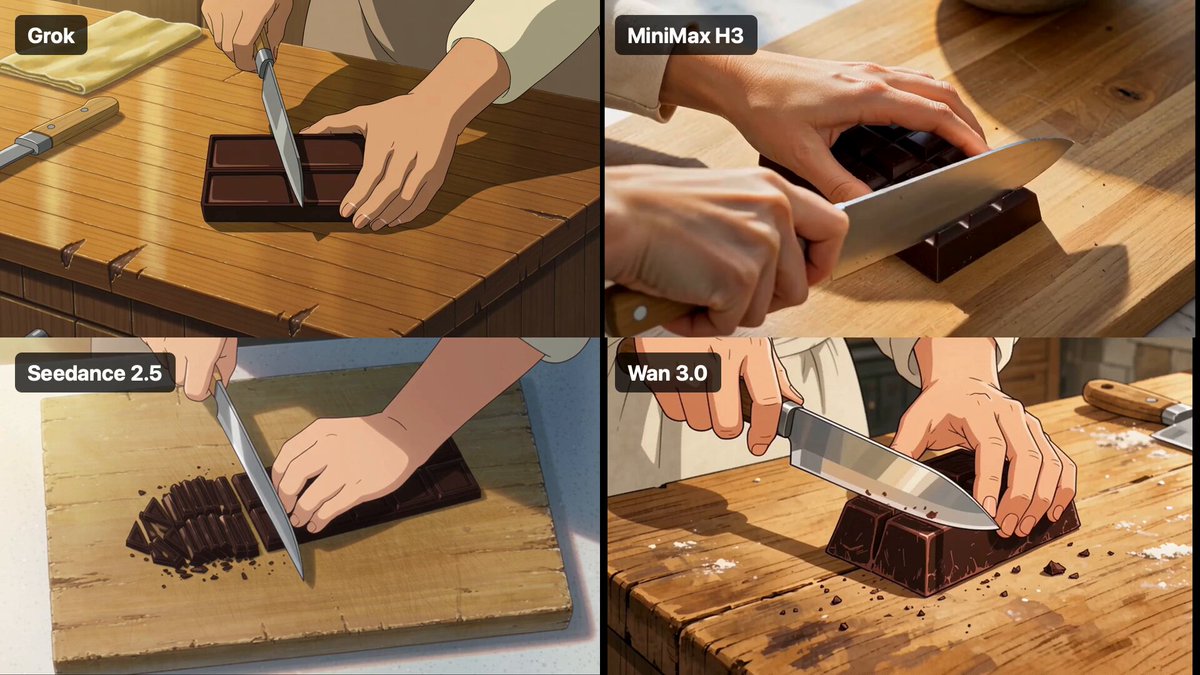
Public comparison boards measure narrow, often aesthetic preferences. For research, define tasks that match your actual question, for example depicting a two-person conversation with consistent wardrobe across four shots, or rendering a physical action such as pouring liquid under three different lighting conditions. Score outputs against a rubric you publish in advance. Small, well-designed task sets are far more informative than a broad sweep across many systems, and they are easier for reviewers to reason about.
Log everything for reproducibility
Record the model version, date of generation, prompt text verbatim, seed, resolution, duration, reference images, and the number of attempts before acceptance. Model behavior changes between releases, sometimes silently and without announcement. A results section without prompt logs is not reproducible, and reviewers increasingly ask for exactly this material.
Build a rubric that survives peer review
A workable rubric scores four dimensions on a five-point scale: prompt adherence, temporal coherence, visual quality, and suitability for the intended use. Add inter-rater reliability by having two coders score a subset independently, then report disagreements instead of averaging them away. In practice, disagreement between coders is often the most interesting finding in the whole study, because it reveals where the model's output is ambiguous rather than simply good or bad.
Classroom Exercises That Build Durable Skills
The six-shot story (90 minutes). Students write a six-shot sequence with no dialogue, generate it, and screen it. Assessment focuses on whether the story reads without narration. Most first attempts fail for narrative reasons, not technical ones, which is exactly the lesson.
Prompt ablation (45 minutes). Take one shot and change exactly one prompt element per iteration: lens, lighting, action, mood. Students document what the model actually responds to, which is usually not what they expect. The written record matters more than the footage.
The continuity challenge (two sessions). Same character, four locations, consistent wardrobe. This teaches reference images, seeds, and color scripting in a way that a lecture cannot.
The ethics tribunal (60 minutes). Give teams a scenario such as a synthesized historical figure, a student likeness, or a news-style clip, and have them argue disclosure, consent, and potential harm. Assign roles so that someone must defend the hardest position.
Critique swap. Students evaluate each other's clips using the same rubric from the research section. Peer scoring with a shared rubric builds evaluation literacy faster than any lecture, and it produces a shared vocabulary the whole class can use.
Ethics, Consent, and Institutional Policy
Copyright and training data
The legal picture varies by jurisdiction and is still moving. Practical guidance for institutions: avoid prompts that imitate a living artist's style by name, avoid reproducing trademarked characters, and keep a record of what was generated and why. When in doubt, treat output as usable for internal teaching but review it before public or commercial publication.
Likeness, consent, and student work
Do not generate identifiable real people without documented consent. For student projects, obtain written permission before using a classmate's face or voice as a reference. Never upload student work to a third-party service without checking the data-retention terms, because this is the most common institutional risk in classrooms that use generative video.
Accessibility and inclusion
Captions, audio description for visually dense sequences, sufficient contrast in on-screen text, and avoidance of rapid flashing. Generated footage often has low-contrast lighting; grade it deliberately rather than accepting the default look. Where narration carries essential information, provide a transcript as well as captions.
A policy checklist
- Which tools are approved, and under what data terms
- What must be disclosed, and where the disclosure appears
- Who reviews sensitive content before publication
- How student-generated media is stored, retained, and deleted
- What is out of scope entirely
Choosing Tools: A Decision Framework
Instead of chasing the newest release, score candidates against your actual constraints.
| Criterion | Why it matters | What to check |
|---|---|---|
| Shot-level control | Determines precision | Can you set camera and motion separately? |
| Reference conditioning | Determines consistency | Single-image or multi-image input? |
| Duration per generation | Determines shot design | Real usable length, not the marketed maximum |
| Editability | Determines iteration speed | Can you re-roll one shot without redoing the sequence? |
| Audio support | Determines post work | Native sound or a separate pipeline? |
| Export and licensing | Determines publication | Resolution, watermark, commercial rights |
| Data handling | Determines institutional approval | Retention, training opt-out, region |
A pragmatic stack: one strong text-to-video model for establishing shots, one image-to-video model for character work, a still-image generator for storyboards and reference sheets, and a conventional editor for assembly. Do not try to do everything in one tool. The editor, in particular, is where a collection of clips becomes a film.
A Six-Week Rollout Plan for a Department
Week one: pick a single course module and define one learning outcome. Week two: storyboard it with a colleague who teaches the same subject, so the storyboard gets a second opinion. Week three: generate and assemble a rough cut, accepting that it will be uneven. Week four: pilot it with a small group and collect structured feedback on comprehension, not on visual preference. Week five: revise the weakest shots and document what changed. Week six: write a one-page internal standard covering prompts, disclosure, storage, and review.
This cadence beats a semester-long tool evaluation because it produces usable material at every step. By the end, you have a module, a policy, and a team that has actually shipped something.
Common Mistakes and How to Fix Them
Prompting a paragraph. Long prompts dilute attention. Lead with subject and action, then add camera, lighting, and style in order of priority.
Skipping the storyboard. The most common cause of abandoned projects. Thirty minutes of planning saves hours of regeneration and an unknown amount of frustration.
Chasing one perfect clip. If five attempts fail, the shot is wrong, not the model. Simplify it or split it into two shots.
Ignoring audio. Silent clips feel unfinished even when the visuals are strong.
No versioning. Without file naming and prompt logs, you cannot rebuild a result you liked last week.
Treating output as final. Generated footage is raw material. Grading, pacing, and sound design make it watchable.
Over-designing the first shot. A meticulous opening scene eats the schedule. Start with the shots you can do quickly so you learn the model's behavior before spending time on the hard ones.
Forgetting disclosure. Undisclosed synthetic media damages trust more than imperfect visuals ever will.
FAQ
How long does a three-minute instructional video take? With a finished script and storyboard, plan two to four hours of generation and one to two hours of editing for a first pass. Review and revision typically double that, especially the first time you work with a given model.
Do I need formal prompt training? No, but keep a personal prompt library organized by shot type. Patterns repeat constantly: establishing shot, reaction shot, insert, transition. After a month you will be copying and adjusting rather than writing from scratch.
What resolution is realistic? Many systems output usable footage in the 720p to 1080p range. Upscaling helps, but the limiting factor for teaching is usually motion coherence, not pixel count. A slightly soft clip with believable movement reads better than a sharp clip with jittery hands.
Can generative video replace stock footage? For conceptual and illustrative sequences, often yes. For anything requiring factual accuracy, including real locations, real people, and documented events, no. The moment accuracy matters, filmed material wins.
How should students cite generated footage? Require the tool name, version, date, and the exact prompt in an appendix, plus an on-screen disclosure in the video itself. Treat it like any other method that must be documented.
Is it acceptable to use synthetic voices in narrated lessons? Generally yes with disclosure, provided the script is reviewed for accuracy and the voice is not an imitation of a specific identifiable person. Note in your policy whether synthetic narration is permitted for graded student work.
What about long-form narrative? Think in scenes, not minutes. Consistency tools hold across a handful of shots; longer pieces require disciplined continuity work and remain an active area of experimentation. A ten-minute piece is a reasonable ceiling for a small team.
How do we handle a model update that changes results? Freeze your project, re-run a small benchmark set of five shots you have scored before, and compare. If coherence dropped, keep the older workflow for the current project and test the new model on something non-critical.
Where should a beginner start? One shot, one sentence, one minute of footage. Learn what the model actually does before designing a curriculum around it. That single hour of experimentation prevents weeks of misplaced assumptions.
What is the biggest organizational risk? Not poor visuals. It is unclear policy about data retention and disclosure, which turns a manageable technical problem into an institutional one.
