
Beyond Basics: Advanced Video Editing from Premiere Pro to AI-Powered Montage
Aug 4, 2026
The New Frontier of Video Editing
The creative technology sector in 2025 is defined by the integration of AI into core production workflows. Traditional editing software remains powerful, but it now faces a new reality: AI can generate high-fidelity footage in minutes that previously required days of shooting and editing.
The transition from timeline-based editing to AI-orchestrated montage creation represents a fundamental shift. Creators who master both worlds — traditional precision and AI efficiency — hold a decisive advantage. Reports suggest efficiency gains averaging 40-60% for short-form content when AI tools are properly integrated into the workflow.
Hybrid Workflows: The Best of Both Worlds
Starting with Traditional NLE Control
Deep expertise in tools like Premiere Pro remains foundational. Advanced techniques like nested sequences, complex masking, Lumetri Scopes for exposure matching, and adjustment layers for global color shifts are skills that AI hasn't replaced — it has augmented them.
The most effective creators in 2025 don't abandon traditional tools. They use NLEs to structure the narrative and establish the creative vision, then leverage AI for asset generation and complex shots.
The Pre-Visualization Bridge
A powerful hybrid approach is creating rough animatics in Premiere Pro, then using those as blueprints for AI generation. You define the timing, pacing, and shot composition traditionally, then feed those parameters into an AI platform for asset creation.
Tools like https://domer.io/ai-video-generator excel at this: you describe the exact shot you need — focal length, lighting, camera movement — and receive production-ready footage that matches your timeline.
Advanced Prompt Engineering for Cinematic Control
Speaking the Language of Cinema
Advanced AI video creation requires going beyond simple descriptions. Effective prompts incorporate technical specifications:
- Focal length: "35mm prime lens" for a natural, cinematic look
- Lighting: "high-key Rembrandt lighting" for dramatic portraits
- Camera motion: "slow dolly in with subtle parallax"
- Color science: "Kodak 2383 film emulation"
Understanding which models excel at which tasks is essential. Some prioritize photorealism, others complex motion, others stylistic fidelity. The art is knowing when to switch.
Negative Prompting
As important as what you want is what you don't want. Explicitly excluding artifacts, facial distortions, or unwanted stylistic elements dramatically improves output quality.
The Consistency Challenge
Character Drift — Solved
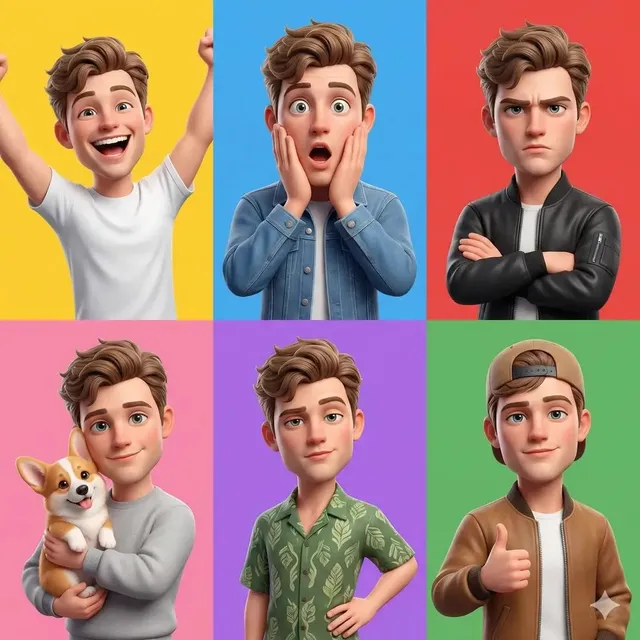
The biggest problem in AI video has been character inconsistency across separate generations. A character's face subtly changes between shots, breaking immersion.
Modern solutions use multi-reference image fusion — providing multiple reference images to lock down a character's appearance. Once established, this visual fingerprint persists across all generated shots, regardless of which model creates them.
Model Selection Strategy
Different scenes demand different approaches. Fluid crowd scenes might benefit from one model's physics understanding, while intimate close-ups need another's textural detail. The advanced editor knows when to switch models while maintaining visual coherence.
Practical Workflow Integration
The Create-Measure-Learn Cycle
- Create: Generate multiple variants using different models or prompt approaches
- Measure: Track engagement metrics — watch time, drop-off points, CTA clicks
- Learn: Feed insights back into your prompt engineering for the next iteration
Resource Management
High-quality generation requires significant compute. Smart creators match the model cost to the shot's importance. Hero shots justify premium resources; transition shots can use lighter models.
Conclusion
The line between traditional editing and AI generation is blurring. The future belongs to creators who can seamlessly integrate both — using NLE mastery for narrative structure and AI for unbounded creative generation. Start with https://domer.io/models/seedance-2-0 for motion-heavy content, and explore https://domer.io/ai-image-generator for complementary still assets. Master the tools, but never lose sight of the story.

Alexander
More Blogs
Read MoreVidu Q4 Alternatives: 4K AI Video Models Compared (2026)
Vidu Q4 alternatives compared: Kling 4.0, Seedance 2.5, Wan 3.0, and Runway Gen-4 — 4K support, input modes, durations, audio, and what each costs in credits on Domer.
Top 4K AI Image Generators in 2026: 5 Models Compared on Real Costs
The top 4K AI image generators on Domer compared: Flux 3 Klein, Nano Banana 2.1, GPT Image 2.5, GPT Image 2, and Nano Banana Pro — 4K credit costs, reference limits, and speed.
Nano Banana 2.1 vs GPT Image 2.5: Which Image Model Should You Use? (2026)
Nano Banana 2.1 vs GPT Image 2.5 Flare compared: credit costs per resolution, aspect ratios, reference images, text rendering, and which tasks fit each model.