
The idea of "generating cinema" with artificial intelligence has moved firmly from concept demonstrations into everyday creative practice. Filmmakers, content studios, and digital artists now have access to tools that translate a written description into a moving, coherent scene, and then stitch those scenes together into something that reads like a short film rather than a collection of random clips. The reach of these tools has expanded well beyond a handful of Western models to include strong contenders from Asia, each bringing a distinct style and technical focus.
This guide is a practical tour of the AI video generation landscape. You will learn how the major model families compare, how an AI director agent can plan a multi-scene narrative, how to keep characters and environments consistent across shots, and how to organize a production pipeline that produces professional-looking results without wasting time or budget. By the end, you should be able to take a rough idea and move it to a finished, publishable sequence with confidence.
Knowing the model landscape
Before you produce anything, it helps to understand what kinds of video generators are out there and what each does best. The broad categories are: premium photorealistic generators that prioritize visual fidelity and control, regional models that may excel at specific cultural or stylistic looks, and specialized tools tuned for particular tasks such as fast motion, stylized animation, or higher resolutions. None of these is universally the best; each is best for a specific kind of shot.
A useful way to think about them is by job rather than by name. Keep in your mental toolbox one model for photorealistic close-ups, one for action and motion continuity, one for stylized or animated aesthetics, and a fast one for quick idea exploration. When you face a scene, you reach for the model that fits the task. Test the same prompt on two or three models, because each interprets visual language slightly differently, and the differences are often what give your work personality.
From text to the first animated scene
The most common starting point is a text description. You describe what you want to see in motion, and the generator interprets that description to produce a sequence of frames. This mode is ideal for quickly testing ideas, comparing styles, and establishing a look and feel before committing to heavier production.
For your first attempts, keep the prompt to one to three sentences with a clear subject, a defined setting, and an explicit movement. After the first render, evaluate three things: composition (is the framing balanced?), coherence (does the subject stay stable across frames?), and pacing (does the motion feel natural for the purpose?). Use those observations to refine the prompt for the next attempt. The gap between a frustrating workflow and a smooth one is usually a matter of how precisely you describe the action, not which model you use.
Reading the wider global model picture
Part of what has made AI video generation feel like real cinema is the influx of capable models from outside the initial Western lineup. Asian models, in particular, have pushed the field forward with strong performance in photorealistic scenes and fluid motion, and they often bring a distinct aesthetic sensibility that is valuable when your story calls for it. That regional diversity is an advantage for global creators who need to match different cultural expectations in the same campaign.
Rather than locking onto a single favorite, treat the model library as a menu. For a piece aimed at an international audience, you might use a regional model for a specific stylized look and a general photorealistic model for the hero shots. The flexibility to mix across a global palette of generators is one of the reasons this workflow costs less and returns more than a traditional production setup.
Using an AI director to plan the narrative
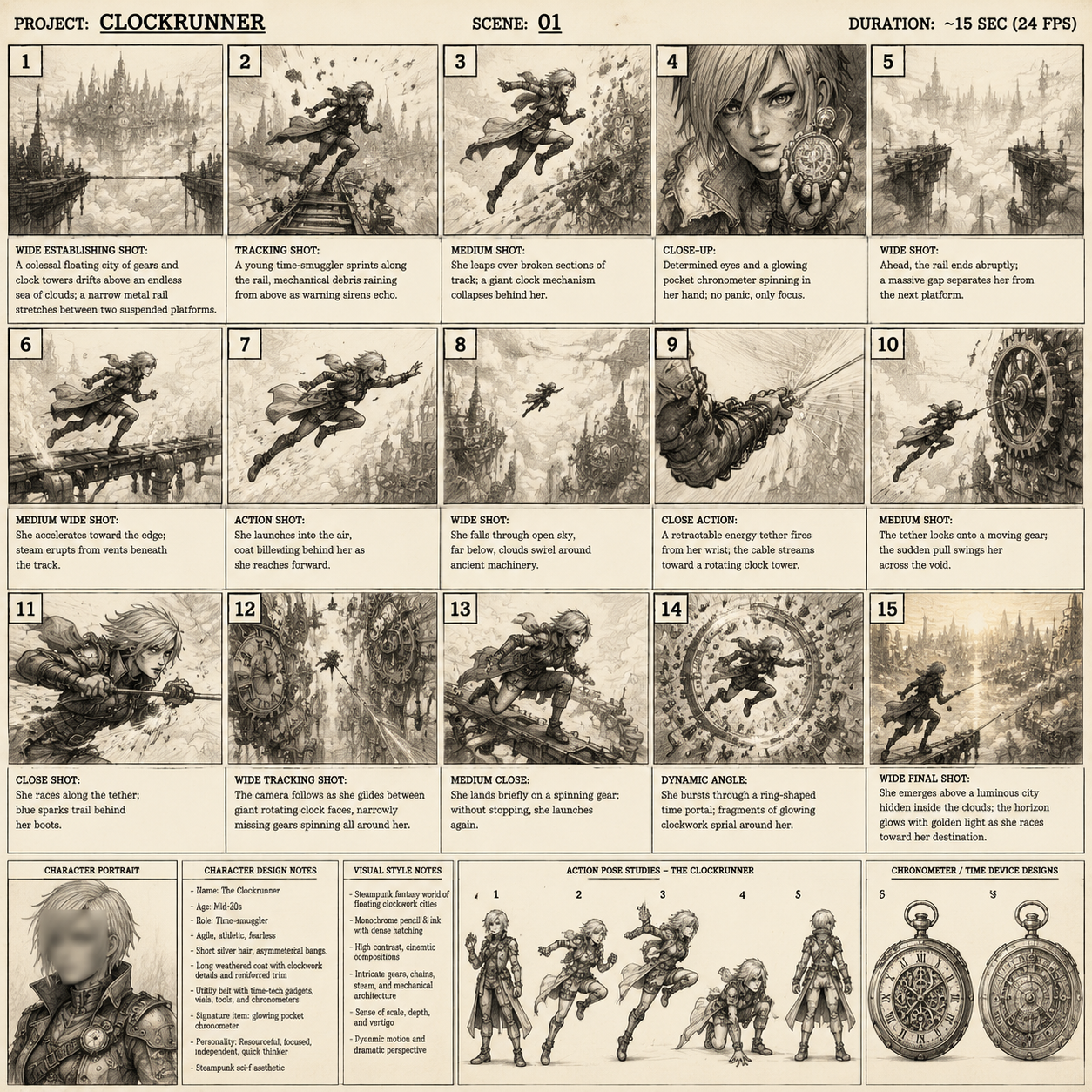
For projects with several scenes and a continuing story, an AI director agent can be a genuine productivity lever. Instead of starting from a blank timeline, you hand over your general idea, and the agent breaks it into story beats, proposes what happens in each scene, and keeps the narrative thread coherent from beginning to end. It works as an automated script supervisor that also helps with pacing and transitions.
This guided planning is most valuable when you are not building a single clip but a set of shots that form a complete piece, such as a short film, a commercial split into cuts, or a vertical story in several scenes. Structuring first, then generating, saves a lot of time and prevents the waste of producing shots that do not fit the story. When you need project-level control, such as keeping a scene consistent across multiple framings, the agent also helps manage the multi-image approach that keeps the same world throughout.
Managing project consistency with references
The classic frustration in AI video is that a character looks different from one shot to the next. The fix is a layered approach to consistency. First, create a single reference image of the character and use it as the anchor everywhere the character appears. Second, keep the central description identical in every prompt so the model has no room to reinterpret. Third, maintain reference images for other recurring elements such as props, logos, or specific backgrounds.
In parallel, you can use a keyframe or multi-frame approach: instead of generating the whole sequence blind, you define the start and end state and let the tool fill the motion between them. This gives you far more control over the timing and the composition. Combined with stored reference assets, organized in folders per character and project, this discipline eliminates most of the retouching that used to be a standard phase of AI production.
Making audio part of the film
A film is more than images. Dialogue, voiceovers, and music give a sequence a finished feel, and modern AI tools now help with this stage too. You can scaffold the sound design early: a synthesized voice for the narration, a draft music bed, and even basic sound effects. The benefit of doing audio early is that it sharpens the pacing of your edit, because you know how long each scene needs to breathe.
Treat this as an iterative loop. Generate the voiceover, place the music, then adjust the length of the visual shots to match. AI-generated audio is not a substitute for a composer, but it is an excellent placeholder and, for many short-form projects, good enough to ship. Working on sound in parallel with visuals keeps your production moving and prevents the common mistake of editing images first and then discovering the audio does not fit.
Structuring the pipeline in phases
The most efficient way to work is in phases, reserving the most expensive, slowest model for what really matters at the end. Start with style exploration using fast models to validate the visual direction. Then create and approve the references for characters and environments. Next, produce the final shots with the highest-quality model for the scenes that will air. Finally, assemble the edit, layer in text, music, and captions, and do the color pass.
This separation eliminates the biggest waste in AI production: spending premium capacity on ideas nobody has approved. When you test cheap and finalize expensive, total cost drops and perceived quality rises, because every stage was validated before the heavier investment. The bottleneck in a well-run pipeline moves away from generation time and onto creative decision-making, which is exactly where a human should spend their effort.
Working around common technical problems
Every pipeline hits friction points, and knowing the fixes keeps production moving. Face inconsistency between frames is corrected by strengthening the reference image and reducing prompt drift across scenes. Unnatural motion, where limbs or objects deform, responds to simplifying the requested movement and increasing the number of frames per scene.
Flickering light is usually the result of ambiguous lighting descriptions; be specific about the light source and time of day. And when a scene needs readable text, such as a logo or a sign, it is almost always better to add it in the edit than to ask the generator for it. With these corrections, the process becomes far more predictable, and you spend your time on craft rather than on rescue missions.
From previews to a finished piece
Part of the pleasure of this workflow is watching a rough idea become a finished sequence through previews and iterations. Start rough, evaluate feedback, refine, and build up. Because each stage is cheap to redo, you can afford to be bold: try a camera angle you would not have risked on a real set, test a bolder color grade, explore a style that is barely defined. The low cost of experimentation is exactly the advantage that makes this generation of tools feel like a true sandbox.
When you finally assemble the piece, review it the way an editor would: does the first shot pull attention? Does the rhythm hold? Are there dead moments? Polish the transitions, tighten the pacing, and then export at the right resolution for your distribution target. That final pass, done with the same critical eye you would bring to a conventional edit, is what turns a set of AI-generated clips into a real short film.
Frequently asked questions
What should a good video prompt contain? Four things: a clear subject, a defined setting, an explicit action, and an atmosphere of light and emotional tone. The more precise the motion and framing, the more predictable the result.
Do I need to master every tool available? No. The efficient choice is a small kit, one per type of task, learned well. Switching tools every week prevents you from building the repertoire that delivers consistent results.
How do I know a result is ready to publish? Run three checks: the composition is balanced, the character stays coherent between frames, and the motion serves the intent of the scene. If a flaw shows, fix the prompt rather than accept the take.
Can I combine takes from different models? Yes, when the visual language is compatible: color palette, light style, grain, and realism level. Compare the first takes from each model side by side before you start editing.
Planning for the edit from the very start
An often-overlooked advantage of thinking in shots is that it makes the edit stage far smoother. When you plan the framing, motion, and intended cut point of each scene before generation, the assembled cut flows naturally instead of fighting against material that was never designed to connect. Note the intended transition at the moment you generate each shot, and the editor's job becomes a matter of ordering rather than rescue. This small planning discipline is one of the cheapest ways to raise the professionalism of the final film.
Do I need a powerful computer to generate videos? Generally not. Generation happens in the cloud, so you need a stable connection and a modern browser to write prompts and download results.
Why does my character change appearance between shots? Pure text generation does not remember characters automatically. The fix is a single reference image used in every scene plus a constant central description in the prompt.
Which is better to start with: text or an image? Text is fast and great for exploring; an image offers full control by fixing the exact first frame. In serious production, use both in sequence: text to experiment, image to produce cleanly.
How long does a short video take to generate? From a few seconds to a few minutes per shot, depending on model and resolution. A phased pipeline keeps you from waiting on single shots while you could be editing.
Can I really use this for client work? Yes, and it is already common. The discipline of references, deliberate model choice, and a proper edit phase makes the output reliable enough for campaigns and short films.
Conclusion and next steps
AI video generation has grown out of the experimental phase and into a practical production skill. The key is the process: describe the idea precisely, lock in references, generate in phases, choose the right model for each task, and correct the typical problems with targeted prompt fixes. Done this way, you get consistent, professional-looking results that you can genuinely publish.
Start with a small, controlled project: one character, one setting, two shots. Collect what works, build your own reference library, and write notes for the future. Within a short time, the slowest part of your work will not be generation but deciding which creative direction to explore, and that is exactly where your energy belongs. The tool delivers the motion; the vision is yours.
