
Why Generator Choice Is Really a Workflow Decision
Most comparisons of AI image and video generation stall on isolated outputs: one breathtaking frame, a five-second clip with convincing water, a portrait whose skin texture survives a full-screen crop. Those samples are useful for calibration, but they predict very little about how a model behaves inside a real production pipeline. The questions that decide whether a project ships are duller and more structural: does the model hold a character's jacket color across twelve shots? Can you regenerate shot seven without rebuilding shots one through six? Does a small prompt change produce a small output change, or a completely different scene?
That is why the most useful comparison is not a leaderboard of pretty demos. It is a map of trade-offs. Every generator optimizes for something: photorealism, stylistic range, motion physics, speed, prompt obedience, or editing control. You cannot max out all of them at once, and the model that wins a visual quality test may lose badly on iteration cost.
This guide treats AI image and video generators as production tools rather than magic boxes. It walks through the criteria that actually matter, the workflow that keeps projects coherent, prompting patterns that survive when you switch models, and the decision framework that helps you pick a tool for a specific brief instead of chasing whatever trended this week.
The Evaluation Framework: Eight Criteria That Actually Matter
Before comparing any two tools, define what you are comparing. Ad hoc tests produce ad hoc conclusions. A consistent scorecard, even a rough one, turns subjective preference into a repeatable choice.
Output Fidelity and Temporal Consistency
Fidelity is the easiest criterion to judge and the least predictive. A model that renders a single striking frame may still fail at consistency: faces drift between shots, lighting flips direction, props teleport. Temporal consistency is where video models separate. Test it by generating a multi-shot sequence from a fixed character description and watching for drift at the cut points, not inside individual clips.
Motion Realism and Camera Control
Some models produce beautiful stillness that shatters the moment anything moves. Watch hands, hair, liquids, crowds, and fabric. Then test deliberate camera language: slow push-in, orbit, handheld sway, rack focus. Tools that accept camera direction as an explicit parameter give you far more editorial control than tools that only react to descriptive prose.
Prompt Adherence and Negative Control
A model with high visual polish but loose prompt adherence is expensive to steer. Give each candidate a test prompt with five concrete constraints: subject, wardrobe, location, lighting, and lens. Count how many survive. Then test negative instructions, such as removing text overlays or avoiding lens flares. Weak negative control means hours of regeneration.
Iteration Speed and Latency
Iteration speed shapes creative ambition. If a draft takes two minutes, you will explore five variations. If it takes twenty, you will explore one and defend it. Fast, cheap drafts plus a slow, expensive hero render is usually the best combination, so evaluate drafting and final passes separately.
Cost Predictability
Generation cost rarely behaves like a fixed price. It scales with resolution, clip length, upscaling, and retries. The dangerous variable is retry count, which depends on how controllable the model is. A cheaper model with poor prompt adherence can cost more per finished shot than a premium model that lands it in two attempts. Track cost per usable second, not cost per generation.
Editing, Export, and Post-Production Fit
Ask practical questions. What resolution and codec do you get? Are alpha channels or depth passes available? Can you export frame sequences? Does the output survive color grading, or does it fall apart when you push contrast? If your pipeline includes compositing, check whether the model respects reference images tightly enough to match an existing plate.
Licensing, Provenance, and Commercial Use
Rights terms differ substantially between tools and change over time. Check the current terms for commercial use, training data disclosure, watermarking, and whether outputs can be used in advertising or client work. For brand and broadcast projects, provenance and disclosure requirements are part of the brief, not an afterthought.
Accessibility and Learning Curve
A powerful tool with an opaque interface slows a team down. Look at how prompts, seeds, references, and settings are exposed. Seed control, saved presets, and reusable character references are not luxuries; they are the difference between a repeatable process and a slot machine.
The Current Landscape: Model Families and Their Strengths
The market is easier to reason about if you group tools by temperament rather than by brand.
Realism-first models. These prioritize photographic plausibility: natural depth of field, believable skin, physically sensible lighting. Runway's newer generations and Sora-style systems sit here. They are strong for product films, documentary-style inserts, and anything that must survive scrutiny next to real footage. The trade-off is often slower iteration and stricter prompt adherence demands.
Stylized and illustrative models. Flux variants, Midjourney, and similar image-first systems excel at art direction: graphic poster looks, painterly textures, anime aesthetics, and stylized 3D. They are excellent for storyboards and key art, and increasingly usable as conditioning inputs for video.
Fast drafting models. Some tools trade peak fidelity for speed and volume. Their value is exploration: mood boards, composition tests, and quick animatics. Use them to decide what to make, then move the winning frame into a heavier model.
Motion-specialized video models. Kling, Hailuo, Wan, Vidu, and comparable systems differ noticeably in how they handle physical motion, character stability, and image-to-video fidelity. Some are strong on human motion, others on camera moves, others on maintaining a reference image's identity over several seconds.
Image models as video inputs. In practice, the highest-quality video pipelines are image-led: generate or select a hero frame, refine it, then animate. This gives you precise control over composition before motion introduces entropy.
Images First, Video Second: The Hybrid Workflow
The most reliable pattern in AI video production is to solve composition with stills and motion with video. Stills are cheaper, faster, and easier to correct. Video is where errors become expensive.
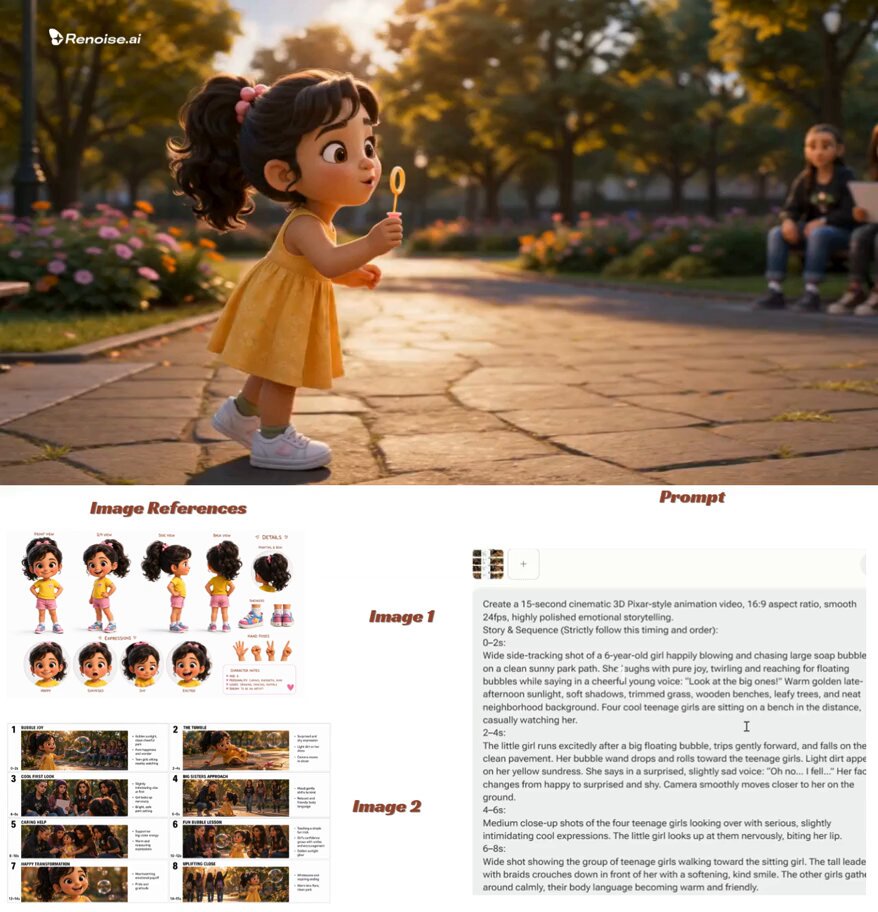
A practical hybrid loop looks like this: describe the scene in text, generate a batch of stills, pick the strongest composition, correct the details with inpainting or a targeted reference pass, then feed that frame into an image-to-video model with a modest motion instruction. Repeat per shot, then assemble.
The benefits compound. Because each shot starts from an approved frame, visual continuity becomes a matter of matching references rather than hoping a text prompt reproduces the same character twice. Because stills are cheap, you can explore ten compositions before committing. And because motion instructions are short, you reduce the chance that the model invents plot you did not ask for.
A Step-by-Step Production Workflow
Step 1: Write a Shot-Level Brief
Convert your script into a shot list with one line per shot: subject, action, environment, lighting, lens, duration, and emotional beat. Ambiguity in the brief becomes randomness in the output.
Step 2: Build a Visual Reference Kit
Collect or generate three to five reference images per recurring element: protagonist, wardrobe, key location, signature prop. Keep them small, clean, and consistent in lighting. These become your continuity anchors.
Step 3: Storyboard With Stills
Generate storyboard frames for every shot before touching video. Approve composition, framing, and screen direction. Editing decisions made here are nearly free; the same decisions made after video generation are not.
Step 4: Animate Selectively
Not every shot needs AI motion. Static frames with subtle parallax, real b-roll, or a simple push-in often read better than a generated moving shot. Reserve video generation for moments where motion carries meaning.
Step 5: Lock Characters With References
When animating, pass the approved frame plus a character reference where the tool supports it. Keep the motion prompt brief: what moves, how much, and in which direction. Overloaded motion prompts produce visual noise.
Step 6: Assemble and Grade
Cut in your editor, standardize color, add sound design early. Audio disguises small imperfections and exposes large ones; a shot that looks acceptable muted may look wrong once music sets the rhythm.
Step 7: Quality Control at Full Size
Review at final resolution on a real display. Artifacts invisible in thumbnails become obvious on a television. Check hands, teeth, text, edges between subject and background, and any place the camera crosses a complex object.
Prompting Patterns That Survive Model Switching
Prompts are not portable, but structure is. A layered prompt transfers across tools with minimal rewriting.
Start with subject and action in one sentence. Add environment and time of day. Add lighting as a physical description rather than an adjective: 'soft window light from camera left' beats 'beautiful lighting'. Add lens and framing language: '35mm, medium shot, slight low angle'. Add mood last.
Keep a small library of house phrases that describe your project's look, and reuse them verbatim so outputs stay in the same visual family. Avoid stacking contradictory instructions; models resolve conflicts unpredictably. When a shot fails, change one variable at a time and keep notes, because the same prompt will behave differently after a model update.
For motion prompts, favor verbs over adjectives: 'she turns her head slowly toward the window' works better than 'dramatic emotional moment'. Specify what should stay still, since stillness is often the hardest thing to get.
Budgeting and Iteration Discipline
Generation budgets are consumed by retries, not by ambition. The practical approach is to allocate spend by stage: a generous exploration budget for stills, a narrow budget for video drafts, and a small reserve for hero renders.
Set a stop rule per shot. If a shot does not land after a fixed number of attempts, change the input rather than the wording: simplify the composition, reduce the number of subjects, or animate a different frame. Repeating near-identical prompts is the most common way projects quietly burn their budget.
Track two numbers: usable seconds per attempt, and cost per usable second. They reveal which model is genuinely economical for your specific content, which often differs from the sticker price.
Common Mistakes and How to Avoid Them
Generating video before approving composition. Fix framing with stills. Motion hides nothing.
Treating prompts as set-and-forget. Prompts are drafts. Refine them like a script.
Ignoring sound and pacing. A weak shot inside a well-paced sequence is invisible. A strong shot inside a badly paced sequence is still a bad scene.
Assuming one model should do everything. The best pipelines split drafting, hero frames, and motion across different tools.
Skipping documentation. Save prompts, seeds, references, and settings per shot. Without a record, you cannot reproduce a win or debug a regression.
Overlooking rights and disclosure. Confirm commercial terms and any labeling obligations before delivery, not after.
Choosing the Right Tool for a Specific Brief
Match the tool to the job. For product and brand films where realism is non-negotiable, prioritize models with strong lighting physics and tight image-to-video adherence, and accept slower iteration. For social content that needs volume and speed, prioritize fast drafting models and a template-driven workflow. For narrative projects with recurring characters, prioritize reference support and consistency tools over peak fidelity. For concept work and pitch decks, prioritize stylistic range and rapid variation.
If you cannot decide, run a one-hour bake-off: three shots, the same prompts, two candidate tools, and a scorecard covering consistency, prompt adherence, latency, and cost per usable second. Empirical comparison beats brand loyalty every time.
Frequently Asked Questions
Do I need separate tools for images and video?
Usually yes. Image models remain the better place to solve composition, lighting, and look development, and most video models work best when seeded with an approved frame. Some suites bundle both, which reduces friction, but bundle quality varies per module.
How long should a generated clip be?
Short clips are more reliable. Aim for three to eight seconds per generation and build longer sequences in the edit. Longer generations tend to drift in identity, geometry, and lighting, and repairing drift costs more than cutting around it.
Why does the same prompt give different results later?
Models are updated, and hosting environments change. Minor wording shifts, different aspect ratios, and different seeds all alter output. Document your settings and treat every model as a moving target.
How do I keep a character consistent across shots?
Use reference images, keep wardrobe and lighting descriptions identical, avoid unnecessary scene changes, and animate from approved stills rather than from text alone. Consistency is an input-discipline problem more than a model problem.
Is a more expensive model always better?
No. Cost correlates with resolution, length, and compute, not with how well a tool fits your content. A mid-tier model that obeys prompts cleanly often produces cheaper finished seconds than a premium model that needs many attempts.
What should I check before commercial delivery?
Confirm the current license terms, commercial-use permissions, watermarking behavior, and any disclosure requirements. Also verify technically: resolution, frame rate, codec, and whether the output holds up after grading and compression.
Can AI video replace a camera crew?
For inserts, backgrounds, stylized sequences, and concept work, often yes. For performance-driven storytelling, live action still leads, and the most effective productions blend generated footage with real material rather than choosing one exclusively.
Final Takeaways
The generator comparison that matters is the one you run against your own brief. Pick criteria, run a small bake-off, and measure cost per usable second rather than per click. Build an image-led pipeline, lock continuity with references, animate selectively, and keep prompts layered and documented. Tools will keep changing; a disciplined workflow is the part you keep.
