
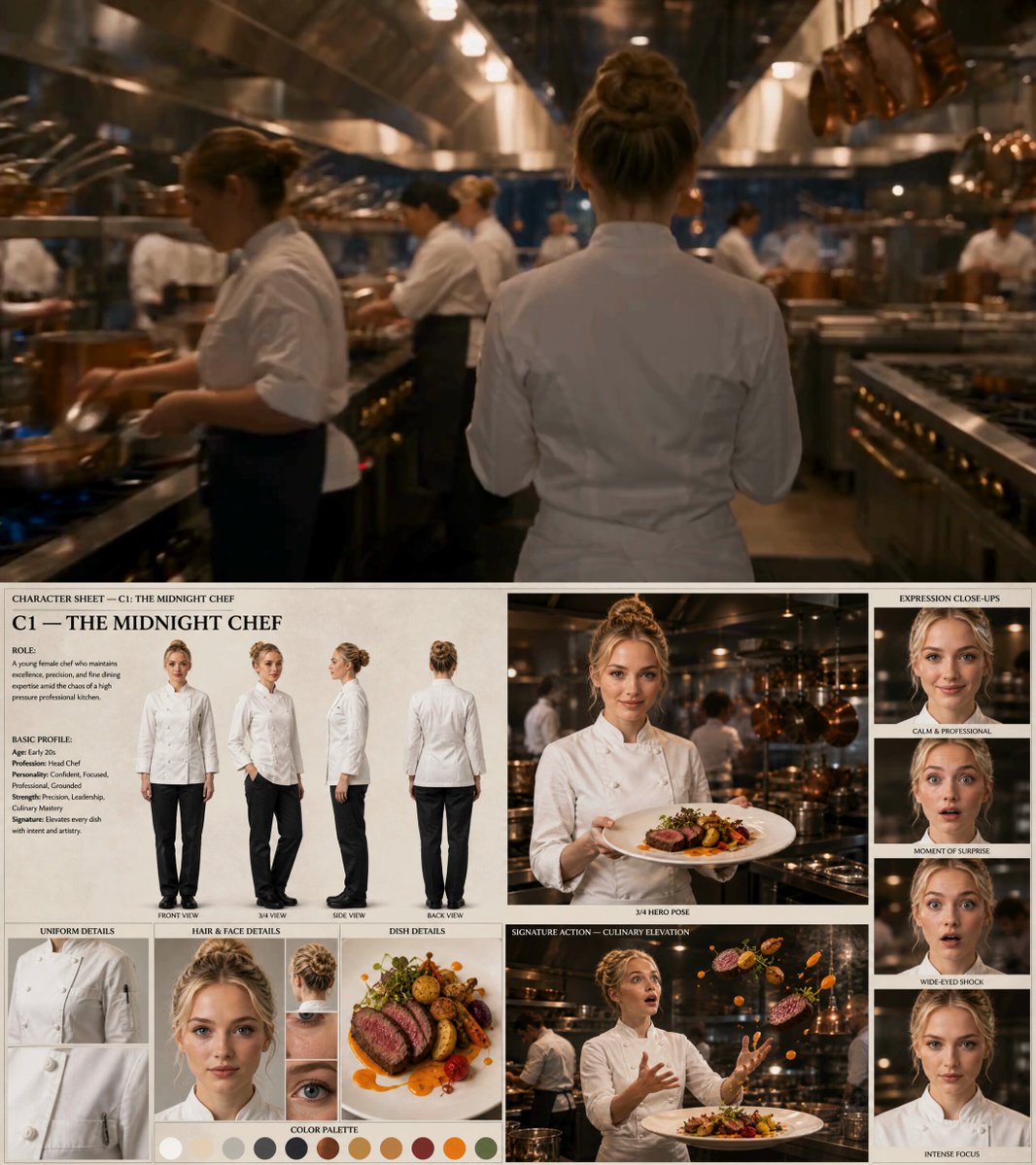
Most AI video projects do not fail because the video model is weak. They fail because the story, the shot plan, the prompt, and the edit were never designed as one system. A team generates thirty clips, loves four, and then discovers the four do not cut together: the lead character's jacket changed color, the light flipped from golden hour to fluorescent, and the camera drifted between handheld and locked-off energy mid-scene.
The answer is not a secret prompt string. It is a workflow that treats generation as one stage inside a longer pipeline. What follows is a tool-agnostic method for AI video storytelling — prompt construction, persona-driven direction, consistency control, model selection, queue management, and the finishing edit — that works whether you are shipping a 15-second vertical ad or a five-minute narrative short.
Why prompt quality is only one variable
Prompts get all the attention because they are the part you can see. Everything else — the shot list, the reference frames, the naming conventions, the review pass — is invisible in a screenshot but decisive in the output. Three variables usually matter more than prompt phrasing:
- Story clarity. A model cannot infer intent from a vague brief. If you cannot describe what the shot accomplishes in one sentence, no prompt will rescue it.
- Reference discipline. Character sheets, location plates, and color references do more for continuity than any adjective stack.
- Selection and sequencing. Ten mediocre generations edited tightly will beat thirty beautiful clips with no rhythm.
A useful mental model: the prompt is a lens, not a screenplay. It shapes how a single moment is rendered. The screenplay, shot list, and edit decide whether those moments mean anything.
The four layers of a repeatable AI video workflow
Separate the work into four layers and resist the urge to collapse them. Each layer has its own artifact, and each artifact can be reviewed independently.
Layer 1: Story and intent
Write a one-page treatment before touching a generator. Include the premise in a paragraph, the tone in three adjectives, the runtime target, and the emotional turn the piece must land. For short-form work the treatment might be five sentences; for narrative work it can be longer. Keep it in plain language — if it reads like a prompt, it is too early for that.
Layer 2: The shot plan
Convert the treatment into a numbered shot list. Each shot gets a slugline (interior or exterior, location, time of day), a duration, a camera intent, and a narrative purpose. Purpose is the column people skip and later regret. When the edit drags, the shots without a purpose are the ones that get cut, so identifying them early saves generation time.
Layer 3: The prompt
Only now do you write generation prompts, one per shot or per variation. Because the shot list already carries the structure, prompts can stay focused on rendering: subject, action, framing, light, texture, motion. See the anatomy section below for a reusable template.
Layer 4: Assembly
Plan for the edit before you generate: aspect ratios, safe areas for captions, and the target platform's loudness norms. Decide in advance whether you are delivering a single cut or a vertical, horizontal, and square family. Generating for one ratio and cropping later is the most common source of wasted renders.
Anatomy of a high-impact video prompt
High-performing prompts are dense but ordered. They read like a crew call sheet rather than a poem. Five ingredients do most of the work.
Subject, action, and setting
Lead with the who and the what. "A retired watchmaker repairs a pocket watch at a cluttered bench" beats "a craftsman scene." Name wardrobe, props, and age where they matter for continuity. Setting should include time of day and one sensory detail that anchors the world.
Camera and lens language
Models respond well to concrete camera vocabulary: slow dolly in, 35mm, shallow depth of field, low-angle, handheld tracking. Pick one dominant movement per shot. Two movements in one prompt usually produce mush in the middle of the clip.
Light, palette, and texture
Describe the light source before the mood. "Warm practical lamp from camera left, deep shadows, matte film grain" gives the model something physical to build. Color words alone, such as "moody," are too abstract to be reproducible.
Motion budget and duration
State how much happens. A shot with a single beat — a hand reaches, a head turns — holds together at five seconds. A shot with three beats needs a longer clip or a cut. If you generate longer clips than the action requires, you will spend the edit trimming dead air.
Negative constraints
Say what must not appear: no on-screen text, no extra fingers, no crowds in the background, no camera shake, no cutaways. Negatives are not magic, but they measurably reduce retries on shots with known failure modes.
A compact template:
[subject + wardrobe] [single action] in [setting, time of day],
[camera: framing, lens, movement], [light source + direction],
[palette + texture], [duration and one beat].
Avoid: [list of 3-5 constraints].
Fill it consistently across shots and the footage starts to feel like a single production rather than a sampler reel.
Persona prompting: what the "Dan prompt" pattern actually teaches
Persona-style prompts — the family of templates often shared as "Dan" prompts — became popular because they change the assistant's register. Instead of answering as a generic helper, the model responds as a named character with a defined expertise and voice. For video work, the useful takeaway is narrow and legitimate: role framing improves output structure.
Separate persona from policy
A persona changes tone, vocabulary, and the order in which information is presented. It does not change what a tool is allowed to do, and it should never be used to talk a system out of its guardrails. Treat persona prompts as a stylistic instrument, not a bypass.
Build a reusable director persona
Write a short director brief you paste at the start of planning sessions:
- Role: director of photography with a documentary background.
- Priorities: motivated lighting, one camera move per shot, continuity over novelty.
- Output format: numbered shot list with slugline, duration, camera, and purpose.
- Constraints: no on-screen text, no lens flares unless requested, no slow motion.
This does three things. It stabilizes the vocabulary across sessions, it forces structured output you can paste into a shot list, and it gives you a consistent voice when you ask for revisions. Swap the role (animation director, product film director) and the same scaffolding produces a different, equally usable plan.
Keep the persona brief under 150 words. Long personas eat context and start contradicting themselves.
Keeping characters, props, and style consistent
Continuity is where AI video projects live or die. The good news is that it is mostly a bookkeeping problem.
Reference images and keyframe control
Generate or source a small reference set per recurring element: one clean frame per character, one per location, one per key prop. Then use image-to-video or first-frame and last-frame control so each shot starts from a known visual state. Multi-image fusion — feeding a character reference and a location reference into the same generation — is the most reliable way to keep both stable in one shot.
A one-page style bible
Write down the decisions that must not drift:
- Palette: three named colors plus one accent.
- Light: direction, quality, and the time of day you are staying inside.
- Lens feel: focal range, grain level, contrast curve.
- Wardrobe and props: exact descriptions, no synonyms.
- Motion rule: how much camera movement is allowed per shot type.
Post it next to your shot list. Every prompt gets checked against it.
The continuity checklist
Before rendering a batch, confirm four things: the character description string is identical across prompts, the light direction matches neighboring shots, the aspect ratio is correct, and any text or signage is either absent or explicitly placed. These four checks catch most of the errors that surface only in the edit.
Choosing and routing models
Model choice matters less than routing. Most teams have access to several generators, each better at something.
Decision criteria that matter
- Motion coherence. Does the model hold anatomy and physics through a camera move?
- Prompt adherence. Does it respect negatives and specific framing?
- Stylistic range. Can it handle photoreal and stylized looks without collapsing into one house style?
- Image-to-video strength. How well does it preserve a reference frame?
- Duration and resolution. What clip length do you get without stitching?
- Iteration speed. How fast can you test ten variations?
Hybrid routing in practice
Assign tasks rather than loyalty. Use one model for photoreal character work, another for stylized product beats, and another for quick previz drafts where speed beats fidelity. Keep a routing note in your shot list so a collaborator can reproduce the pipeline. The practical benchmark: if you cannot explain why a shot used a particular model, you probably defaulted rather than chose.
Running generation at scale
Once prompts are stable, throughput becomes the constraint. Two habits keep a pipeline moving.
Batching and queue management
Group generations by reference set, not by shot number. A batch that shares a character reference and a location plate can run back-to-back with minimal resets. Longer or higher-resolution jobs should be queued separately so a single slow render does not block a review of everything else.
Versioning and naming
Adopt a naming scheme before you need it: project, scene, shot, take. Add a short suffix for model and aspect ratio. Store the prompt text alongside the clip. Weeks later, the prompt is the only thing that lets you regenerate a shot that almost worked.
The director's pass: edit, sound, pacing
Generation produces material. The edit produces meaning.
Cut for intent first: every shot should either advance the story or buy a beat of emotion. If it does neither, cut it. Then fix pacing — AI clips often start with a settling frame and end with drift, so trim aggressively at both ends. Add sound before you judge the picture; a sparse room tone, footsteps, and one music cue will improve perceived quality more than another render pass.
Finally, unify the look: a light grade, matched grain, and consistent sharpness hide small continuity differences. Do not over-grade. Heavy looks make repeated shots feel more alike, not less, and they date quickly.
Mistakes that cost the most time
- Prompting before planning. Rewriting prompts to fix a story problem never works.
- Chasing one perfect clip. Ten acceptable takes in an edit beat one flawless clip that does not match anything.
- Skipping references. Character drift is nearly always a missing reference image.
- Mixing aspect ratios mid-project. Decide the delivery family first.
- Ignoring audio. Sound design is not post-production garnish; it is pacing.
- No version history. Without saved prompts you will re-solve solved problems.
- Trusting a persona to fix scope. A director persona will happily plan thirty shots for a fifteen-second piece.
FAQ
Do I need a persona prompt at all?
No. It is an efficiency tool. If your shot list is already structured and consistent, the persona adds little.
How many generations per shot should I plan for?
Budget three to five for simple shots and eight or more for anything with a hand, a face close-up, or complex motion. Plan storage accordingly.
What is the single highest-leverage fix for consistency?
A locked character reference plus first-frame control. Description strings help, but images do the heavy lifting.
Can I use the same prompt across different models?
The structure transfers, the phrasing does not. Keep the shot list as the source of truth and rephrase per model, since each weights keywords differently.
How long should an AI-generated shot be?
Match length to the number of beats. One action, three to five seconds. Two or three actions: either extend the clip deliberately or split it into separate shots.
When should I stop iterating?
When the shot's purpose is served and the next fix is cosmetic. Keep a "good enough" threshold and move to the edit; pacing problems are usually more visible than rendering flaws.
AI video work rewards patience with structure more than clever phrasing. Build the four layers, keep a style bible, route models deliberately, and spend your last hour on the edit rather than on one more render.
