

Why the Last 24 Hours Matter More Than Last Month
Short-form video moves in waves. A sound, a visual gag, a caption format, or a camera trick can spike, peak, and fade inside a single day. By the time a monthly trend report lands in your inbox, the format it describes has already been recycled a hundred times by faster accounts. That gap between detection and publication is where most content calendars quietly lose their edge.
This is the core argument for building a rolling trend-intelligence workflow: a repeatable system that watches public signals, scores them, and converts the winners into original video briefs before the window closes. It is not about chasing every spike. It is about shortening the distance between noticing something and shipping your own take on it.
A useful mental model is the trend half-life. Broad, durable formats (fast cuts over a talking head, text-overlay storytelling, split-screen reactions) stay relevant for weeks or months. Micro-trends (a specific audio clip, a specific transition gimmick, a specific piece of slang) often have a half-life measured in hours. Your workflow should treat these two categories completely differently. Durable formats deserve planning and polish. Micro-trends deserve speed and a willingness to publish something 80 percent finished.
The rest of this guide walks through how modern trend analysis actually works under the hood, how to translate raw signals into a creative brief, what visual patterns show up in trending video, and how to run the whole loop as a production process rather than a scramble.
How a Trend Intelligence Pipeline Actually Works
Trend analysis platforms are often described as magic dashboards. In practice, they are pipelines with four distinct stages. Understanding each stage helps you judge whether a tool is genuinely useful or just a prettier way to display hashtags.
Collection and Normalization
The first stage is ingestion. The system continuously pulls public signals: video metadata (views, likes, shares, comment counts, publish timestamps), caption text, hashtags, audio identifiers, creator handles, and often the raw comment stream. Normalization is what makes those signals comparable. A platform that grows 200 percent overnight from a small base is not the same as one that grows 20 percent from a massive base, so raw counts get converted into rates, ratios, and normalized velocity scores.
Good pipelines also track the seed accounts. Micro-trends usually originate with a small cluster of early adopters before spilling into the mainstream. If you can identify the originating cluster, you gain hours of lead time compared with accounts that only see a trend once it reaches the recommendation feed.
Anomaly Detection and Velocity Scoring
The second stage answers a deceptively simple question: what changed? Anomaly detection compares current activity against an expected baseline for that creator, niche, and time of day. A video posted at 2 a.m. reaching 50,000 views by 6 a.m. is a much stronger signal than the same number achieved during peak evening hours.
Most useful systems track three numbers per trend: velocity (how fast engagement is accumulating), acceleration (whether that speed is increasing), and saturation (how many creators have already adopted the format). Velocity tells you the trend is real. Acceleration tells you it has not peaked. Saturation tells you whether there is still room to stand out. A trend with high velocity, rising acceleration, and low saturation is the ideal target. High velocity with high saturation means you are already late.
Sentiment and Audio Analysis
The third stage interprets meaning. Sentiment analysis classifies comment streams as positive, negative, amused, confused, or critical. This matters more than it sounds. A format can be popular and disliked at the same time, which usually means audiences are watching out of curiosity or secondhand embarrassment rather than genuine enthusiasm. Replicating a disliked format can damage a brand even while it generates views.
Audio analysis runs in parallel. Systems fingerprint tracks, detect remixes and sped-up variants, and track which songs are appearing in a rising number of uploads. Because audio is often the strongest single predictor of short-form performance, audio trend detection frequently surfaces a wave before visual trend detection catches up.
Micro-Trend Clustering
The final stage groups related signals into coherent clusters. A single audio clip, a specific transition, a caption template, and a niche hashtag might all belong to one emerging micro-trend. Clustering is what turns thousands of noisy data points into a handful of actionable concepts. Without it, you get a firehose. With it, you get a short list you can actually act on.
From Raw Signal to Creative Brief in Under an Hour
A trend list is not a content plan. The translation step is where most teams either win or stall, so it deserves its own process.
Score Trends for Fit, Not Just Size
For each candidate trend, run a quick fit audit against three criteria: audience relevance, brand safety, and production feasibility. Audience relevance asks whether your core viewers would recognize the reference. A trend that requires followers to know a niche gaming meme may flop on a general lifestyle account. Brand safety asks whether the format carries baggage, since certain sounds and templates are tightly associated with specific creators and can read as borrowed. Production feasibility asks whether you can execute the format convincingly with your current assets.
A simple scoring sheet works: rate each trend from one to five on reach potential, fit, and effort, then multiply. Trends that score high on reach but low on fit should be dropped, no matter how impressive the velocity number looks.
Mine the Comments and Captions for Language
The fastest way to make a trend feel native is to reuse its actual vocabulary. Comment sections are a free focus group. Look for the repeated phrases, inside jokes, and objections. If viewers keep commenting a specific counterpoint, your video can address it directly and inherit the conversation. If a caption template is part of the trend, keep the rhythm and sentence length but swap in your own subject matter.
Decide the Format Before You Write
Trend formats are rarely script-first. They are usually structure-first: a reveal, a before-and-after, a list, a reaction, a fake tutorial, a stitch, a duet response. Pick the structure first, then write the shortest script that fits it. A tight 12-second script beats a rambling 40-second one every time, and shorter scripts also mean faster generation and editing.
Reading Visual Style: What Trending Video Shares
Trend analysis is not only about topics. A huge portion of what makes a video feel current is visual grammar.
Composition and Multi-Image Consistency
Many of the strongest recent formats rely on combining multiple images or shots into a single coherent frame, then holding that composition steady while the subject changes. This approach, often called multi-image fusion, works because it delivers visual variety without the disorienting cuts that hurt retention on small screens.
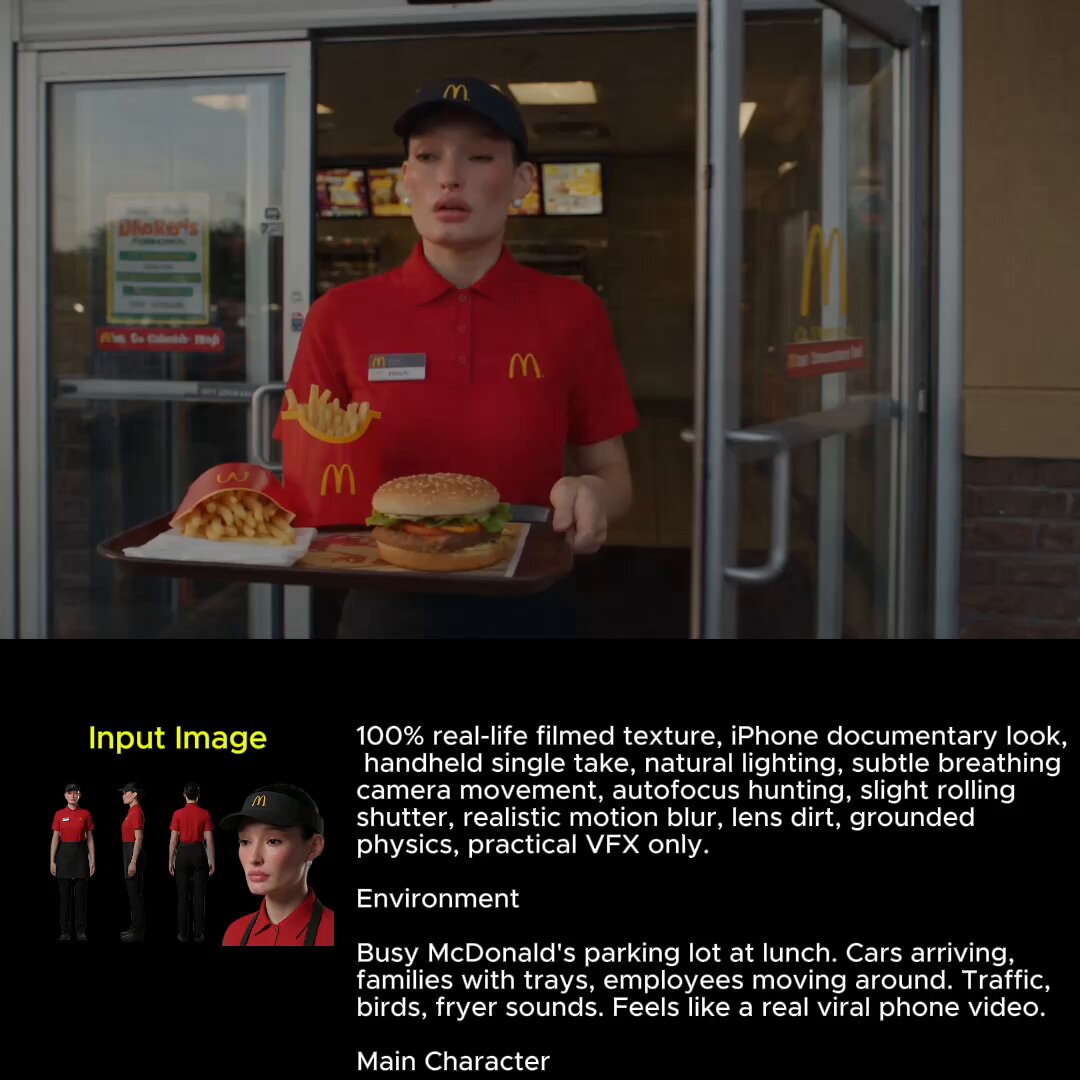
The production lesson is consistency. If a character, outfit, or product changes appearance between frames, the illusion collapses. When generating visuals with AI tools, lock a reference image or character description first and reuse it across every shot, then vary only the environment, the pose, and the lighting. Consistency is now a technical skill, not just an aesthetic preference.
Motion, Pacing, and Camera Language
Trending edits tend to share a few habits: a hook in the first second, a visual change every 1.5 to 3 seconds, and a payoff before the midpoint. AI video generation tools are good at producing short, controlled shots, so plan your clip list around three-to-five-second beats rather than one long continuous shot. Slow, drifting camera moves and subtle parallax generally survive compression and small screens better than fast whip pans, which turn into blur.
Color, Light, and Texture
Palette trends shift too. Warm, slightly desaturated grading reads as nostalgic. High-contrast neon reads as energetic. Clean, bright, evenly lit frames read as product-focused. Sampling the dominant palettes of currently performing videos in your niche gives you a defensible visual direction instead of guessing.
A Practical Production Workflow for Fast Turnaround
Here is a workflow you can run daily with a small team, or as a solo creator.
1. Morning Signal Sweep (20 to 30 minutes)
Review your trend dashboard for the last rolling window. Shortlist five to eight candidates. For each one, capture a screenshot, note the audio, note the structure, and write one line on why it is rising. Do not start producing yet.
2. Fit Scoring and Selection (15 minutes)
Apply the reach, fit, and effort scoring. Pick two trends to act on and one backup. Two is the sweet spot: enough to cover different audience segments, few enough to protect quality.
3. Brief Writing (20 minutes)
For each selected trend, write a one-page brief: the hook line, the structure, the shot list, the audio choice, the caption, and the success metric. The single most valuable line in the brief is the hook, so write three versions and pick the sharpest.
4. Asset Generation and Assembly (60 to 120 minutes)
Generate or record the visual assets, then edit to the beat. Keep a reusable template project with your fonts, lower thirds, and export presets so assembly is mechanical rather than creative work.
5. Publish and Log (10 minutes)
Publish, then log the post in a simple tracker with the trend it referenced, the publish time, and the trend saturation level at publish time. This log becomes the dataset you use to improve your own judgment.
6. Review Window (day after)
Check performance at the 24-hour mark. Compare against your baseline for that account. Note whether the trend was still accelerating when you published or already past peak. Over a few weeks, this reveals which signal thresholds actually work for your niche.
Choosing Your Tool Stack Without Getting Locked In
You need four capabilities: discovery, interpretation, generation, and editing. They do not have to come from the same vendor, and spreading them across vendors is usually healthier because each layer evolves at a different pace.
For discovery, look for rolling time windows rather than fixed daily reports, niche filtering, audio fingerprinting, and velocity plus saturation metrics. For interpretation, look for comment-level sentiment and the ability to export trend clusters as structured data. For generation, look for image-to-video, character consistency controls, and reasonable clip lengths for the formats you actually publish. For editing, the priority is a fast, template-driven timeline and presets that match your export targets.
Two evaluation criteria matter more than feature checklists. First, export friendliness: can you get the data out in a format you can sort and analyze yourself? Second, latency: how quickly does a new trend appear in the tool after it starts moving? A tool that surfaces trends six hours late is a history product, not a trend product.
Also plan for tool churn. Model capabilities change quickly, and a workflow that depends on one specific generator becomes fragile. Keep your prompts, shot lists, and reference images in a portable document so switching tools costs an afternoon rather than a rebuild.
Common Mistakes That Waste a Trend Window
Chasing saturated formats. If you have seen a trend five times in your own feed from large accounts, your audience has seen it twenty. Publishing into saturation rarely pays unless your execution is dramatically better or your angle is meaningfully different.
Copying instead of translating. The goal is not to reproduce a video, it is to apply a structure to your own subject matter. Direct copies underperform because audiences have already seen the original, and they also invite unfavorable comparisons.
Skipping the audience-fit check. A trend can be objectively huge and still be wrong for your account. Metrics do not know your positioning.
Letting production time exceed the half-life. If your workflow takes two days, you can only act on durable formats. If you want to surf micro-trends, you need a template pipeline that produces a finished video in a few hours.
Ignoring audio rights and platform norms. Reused audio is often fine within a platform's own library, but exported or repurposed content has different rules. Check the license before you build a campaign around a track.
Overproducing. Micro-trend video that looks too polished can read as an ad and lose the native feel that made the format work. Match the production level to the trend.
Measuring Whether a Trend Bet Worked
Views alone are a poor scorecard. Track four numbers per post: 24-hour view rate against your account baseline, average watch percentage, follower conversion (new follows per thousand views), and comment sentiment. A trend post that spikes views but tanks follower conversion may still be a net negative if it attracts an audience that never returns.
Use a simple attribution habit: label every post with the trend identifier and the saturation level at publish time. After a month, you will be able to answer questions like whether publishing at low saturation beats high saturation, whether audio-led or structure-led trends perform better for you, and how much production time is worth spending on a given format. That personal dataset is more valuable than any generic trend report, because it is calibrated to your audience.
Finally, keep a small percentage of your output outside the trend cycle. Trend-following grows reach, but original formats build identity. A practical split is roughly 70 percent trend-informed and 30 percent evergreen original work. That balance keeps your account responsive without making it feel derivative.
FAQ
How often should I check trend signals?
For short-form video, twice a day is a reasonable minimum: once in the morning to catch overnight waves, once in the late afternoon before the evening posting window. If you operate in a fast-moving niche, add a midday sweep.
Do I need a paid analytics platform?
Not necessarily. Platform-native insights plus manual observation of seed accounts can carry you a long way. Paid tools become worth it when you need cross-platform comparison, audio trend detection, or comment sentiment at scale.
What is the single strongest trend signal?
Rising acceleration combined with low saturation. Many creators watch velocity, which tells you a trend is already popular. Acceleration and saturation tell you whether the window is still open.
How many trends should I act on per week?
Pick two per day at most, and be willing to abandon one that loses momentum before you finish. Working on more than two in parallel usually means publishing late on all of them.
Can AI video tools keep up with micro-trends?
They help most at the asset stage: generating B-roll, variations, and stylized shots that would otherwise require a shoot. The bottleneck is usually scripting and editing, which template pipelines solve better than raw generation speed.
How do I avoid making content that feels like an ad?
Match the production register of the trend, lead with the hook rather than the product, and keep branding to the end frame or the caption. Native feel comes from structure, not from polish.
What if a trend conflicts with my brand values?
Skip it. Trend participation is optional, and a format that requires you to be unkind, misleading, or off-positioning costs more in audience trust than it returns in reach.
