
The gap between a lifeless AI clip and a genuinely cinematic one is almost never the model. It is the prompt. Two people can feed the exact same generator the exact same idea and get wildly different results, because one of them describes a wish while the other describes a scene. Prompting has quietly become the single most important discipline in AI video, and in this guide you will learn the architecture, sequencing, and model-awareness that turn a working prompt into a reliably good one.
Why Prompting Grew Into Its Own Profession
For a long time, text-to-video was a novelty you tried once and shelved. The models were inconsistent, physics was unreliable, and the outputs rarely matched the idea in your head. That has changed. Modern generators understand long narrative structures, physical plausibility, and coherent motion far better than their predecessors did, which means the limiting factor has shifted from the technology to the instructions you give it.
This is exactly why prompting became a craft. When the tool is powerful but literal, precision is everything. A good prompt is not just more words tossed at a model; it is a structured blueprint that tells the generator what to show, how it should look, how it should move, and what it should feel like. Learning to write one is a compounding skill that improves every video you will ever make.
The Architecture of an Effective Video Prompt
Most weak prompts fail for the same reason: they are unorganized. The model receives a jumble of thoughts and has to guess which ones matter. The fix is to treat the prompt as a short structured document, with clear functional parts. Break it into five blocks and fill them in order.
The first block is the subject: who or what is in the center of the frame, including distinctive traits that establish identity. The second block is the environment: where the scene happens and the objects and lighting that define it. The third is the action: what is happening, described with specific verbs. The fourth is the style and mood: color grade, art direction, emotional tone. The fifth is technical direction: camera angle, shot size, lens behavior, and motion.
This five-block structure works because it is the same hierarchy a human cinematographer uses. Subject first, because it anchors everything. Environment next, because it gives the subject context. Action after that, style after that, and technical control last. When you arrange information this way, the model has a much easier time separating primary information from decoration.
Balancing Weight: What Deserves Emphasis
Not every element in a prompt is equally important, and models struggle when everything is given the same emphasis. Decide the one or two elements that absolutely must be right, and give them the most detail. The rest can be described lightly. If every sentence is as detailed as every other, the model will average everything out and none of the details will land.
A good test is to read your prompt back and ask which two words, if lost, would most change the output. Those words are your priorities, and they deserve the specific, concrete language.
Managing Style Without Losing Visual Consistency
Style is seductive but dangerous. It is easy to fill a prompt with style keywords, but contradictory or vague style terms produce muddy results. The reliable approach is to pick one primary style reference and then a small number of reinforcing descriptors. If you want a noir look, say it directly and confirm it with lighting and palette clues, rather than piling on five near-synonyms.
Consistency across multiple clips comes from reusing the same style block verbatim. Copy your style descriptor into every prompt in a sequence. Small variations in wording may seem harmless, but they accumulate into scenes that no longer feel like they belong to the same film.
Sequencing Prompts Into a Narrative
A single great prompt produces a single great shot. A story needs more. The skill that separates thoughtful work from random clips is sequencing: deliberately linking prompts so that each shot continues the logic of the previous one.
Think in terms of visual continuity. If the camera is moving through a room in one shot, the next prompt should reference where the camera arrival point is, so the following shot starts where the last ended. If a character is walking stage left, the next shot respects that spatial logic. These small handoffs are what make a series of shots read as one continuous moment rather than a slideshow of unrelated images.
Building Story Arcs Across Multiple Clips
Work backward from the emotional payoff. Decide how you want the viewer to feel at the end, then design each shot cluster to build toward it. A standard rhythm is to open on a wide establishing image, move into increasingly intimate framing, peak on a telling detail, and close with a resolution that returns to the wider context. Repetition of a motif, such as a recurring object or a repeated camera behavior, gives the sequence structure.
You do not need a script for this, but a one-line beat list helps: three to five bumps that tell you what each part of the sequence should accomplish. Keep the list on screen while you write so every prompt serves the story and not just its own beauty.
Using Reference Input for Style and Composition
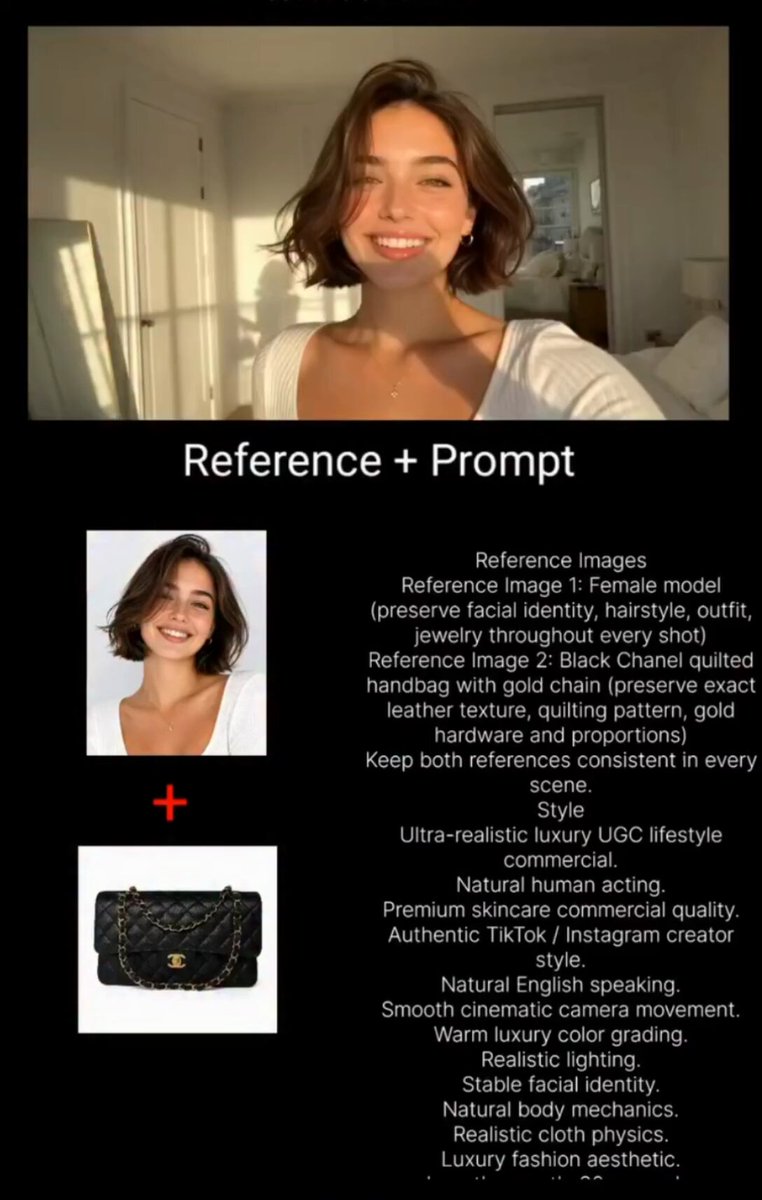
The most powerful prompting technique may not be text at all. Many generators now accept a reference image alongside the text prompt, and this changes the game for style and composition. Instead of describing a look that the model may interpret loosely, you show it a frame that already has that look.
Reference inputs excel at two jobs. The first is style transfer: adopt the color palette, art direction, and overall mood of an existing image. The second is composition: match framing, camera distance, and subject placement. When you want a specific visual language repeated across many shots, a strong reference image gives you a consistency that text alone rarely achieves.
The division of labor that works best is text for the subject and action, reference image for the look and layout. Let the text drive the story and the reference drive the style. If you try to overload the reference with story specifics or the text with style detail, each medium does the other's job poorly.
Model Awareness: Matching the Tool to the Job
Generators are not interchangeable, and ignoring model strengths is the fastest way to frustration. Before you commit time to a prompt, know what the model you are about to use is good at. Some prioritize fast drafts and iteration. Some chase physical realism with strong motion. Some deliver specific art styles with precision. Some handle long temporal coherence well enough for sustained scenes.
The practical workflow is to prototype fast and refine slow. Use a quick, economical model to check layout and pacing, then move your best prompts to a higher-fidelity model for the final render. This keeps your iteration cheap and your final results polished. Building a mental catalog of which model suits which task turns model selection from a guess into a deliberate choice.
Genre-Specific Prompting and Common Technical Hazards
Different genres need different priorities. Photorealistic work lives or dies on lighting and physical plausibility, so those descriptors carry the weight. Animated or stylized work depends on consistency of art direction across shots. Narrative or advertising work leans on continuity and emotional clarity. Write accordingly, and audit each prompt against the specific risk of its genre.
The most common technical failure is still animation drift, where elements subtly change between frames in ways the eye catches. Mitigate it with reference frames and by keeping your motion verbs simple and consistent. Watch also for prompt bloat, where a patchwork of additions makes the output crowded and incoherent. When a prompt stops reading cleanly, refactor it instead of adding another clause to the end.
Advanced Techniques: Negative Control and Sequential Anchoring
Once your five-block prompt is stable, two advanced techniques push quality higher. The first is negative control. Defining what you do not want is often as important as defining what you do want. Distracting artifacts, unwanted extra subjects, incorrect physics, or a change in palette can all be steered away by stating them clearly as exclusions. Many generation interfaces expose a negative prompt field precisely for this purpose. Keep your exclusions short and concrete; a list of three or four precise negatives beats a paragraph of vague ones.
The second technique is sequential anchoring. When you are producing a longer piece, treat the output of one step as the input direction for the next. A good workflow generates a key frame, checks it, then writes the next prompt with an explicit reference back to that frame, both in words and as an actual reference image. This creates a chain of accountability where each shot inherits the foundation of the one before it, rather than starting from scratch inside a vacuum. The payoff is a noticeable jump in coherence across the entire sequence, not just inside a single shot.
Building Prompt Library Habits That Save Time
The creators who improve fastest are not necessarily the most talented; they are the ones who reuse their own best work. Start a simple library of prompts organized by purpose: one section for establishing wide shots, one for intimate details, one for motion reveals, one for photoreal faces, one for stylized scenes. Whenever a prompt produces a result you genuinely like, drop it in with a one-line note about what it solved.
This habit compounds. A month in, you will be assembling most new prompts from proven components instead of writing everything from scratch. You will also have a vocabulary of your own taste that no tutorial can give you, because it is built from what actually works with your tooling and your subject matter. Treat the library as a living document, and prune entries that newer, better versions outperform.
Troubleshooting: When the Output Misses the Mark
Even with a strong architecture, results go wrong, and the fastest way to fix them is to diagnose before you regenerate. Work through a short decision tree. If the subject is wrong, the subject description is at fault, so rewrite that block alone. If the subject is right but the scene feels flat, the environment and lighting are underpowered. If the subject and scene are fine but the motion is unconvincing, the problem is in the action verb, so make it more physical and concrete. If the overall feel is off, the style block needs the work.
Resist the urge to rewrite the whole prompt. Every time you regenerate from a fully rewritten prompt, you lose the ability to see which adjustment changed the result, and you also lose the chance to build reliable cause-and-effect knowledge. Isolated edits may be slower on a single attempt, but they turn each miss into a lesson, and that knowledge is what makes your prompting skill compound over time.
A Simple Checklist Before You Render
Run your prompt through a quick five-point check before spending render time. One, is the subject unmistakable? Two, is the environment clear? Three, is the action a specific verb? Four, is the style a single, coherent reference? Five, is the camera and motion direction explicit? If any of the five is vague, tighten it first. This thirty-second habit removes most of the retry loops that eat creative time.
Frequently Asked Questions
How long should a prompt be? Long enough to be specific, short enough to stay legible. Usually a handful of tight clauses, not a paragraph of loose description.
Do I still need a reference image if my text is detailed? Text alone can work, but reference images dramatically improve style and composition consistency, especially across multiple shots.
Should I always use the most realistic model? No, match the model to the job. Spending a slower or costlier model on a simple draft wastes time and production budget.
Why does my video keep changing subtly between shots? Likely inconsistent wording or missing reference anchors. Reuse your style block verbatim and supply reference frames.
Take It For a Spin
Write one prompt using the five-block structure and render a single draft. Then change exactly one element, the camera movement, and see how much the same words can shift the feel. Then take that shot and build a three-clip sequence around it, reusing your style block and linking spatial logic between cuts. In a single session you will have moved from random clips to a deliberate, repeatable prompt-driven process that will only get sharper the more you practice.
