

AI Video Synthesis Workflow for Influencer Marketing Teams
Oct 15, 2026
Why legacy video personalization stalls at scale
Personalized video built its reputation on a simple promise: a familiar face, a first name, and a short message that feels like it was made for one person. For years, teams relied on webcam recording tools that stitched a pre-recorded clip together with a name overlay and a thumbnail. The approach still works for low-volume outreach, but it breaks down the moment a campaign needs hundreds of assets instead of dozens.
Influencer marketing raises the bar even higher. Audiences follow creators for tone, timing, editing rhythm, and visual identity — not for a template that swaps a first name into a headline. When a clip looks like a mail merge with a face attached, viewers read it as advertising and scroll past. That gap explains why campaign teams are moving away from recording-first workflows and toward directed synthesis, where the performance, the scene, and the edit are planned in software rather than captured in a single take.
The throughput ceiling
A presenter recording alone can produce roughly thirty to forty usable clips in a day before quality drops: energy flattens, eye contact wanders, and pickups pile up. Multiply that across five markets, three languages, and four product lines, and the schedule collapses. The bottleneck is not the camera. It is human stamina and calendar time.
The authenticity ceiling
Templates age badly. The same framing, the same gesture, the same three-second intro appears across hundreds of sends, and audiences learn to recognize the pattern within two seconds. Creator-led content survives because it varies: camera angles shift, pacing changes, jokes land differently. A rigid template removes exactly the variation that makes short-form video watchable.
Where the hidden cost sits
Teams often compare only the visible line items — recording time, editing hours, ad spend. The expensive part is usually the revision loop. Re-shooting a hero clip because a claim changed, a product photo was updated, or a legal reviewer flagged a phrase can cost an entire production day. Workflows that regenerate a scene in minutes rather than reshooting it in hours change how aggressively a team can test.
How AI-directed synthesis changes the production model
Directed synthesis treats a video the way a producer treats a shoot: a brief, a script, a shot list, reference material, a review pass, and a delivery spec. The difference is that the camera, the location, and the presenter availability stop being constraints. You direct a model instead of scheduling a crew.
That shift has three practical consequences. First, iteration becomes cheap, so creative testing moves earlier in the process. Second, consistency becomes an explicit engineering task rather than a happy accident of one shoot day. Third, localization stops being a separate project and becomes a variant of the same pipeline.
The best results come from teams that keep a human editorial layer in place. Synthesis handles volume and repetition; humans handle taste, claims, and timing. A campaign where nobody reviews the output is a campaign that ships embarrassing mistakes at scale.
What synthesis is genuinely good at
- Producing dozens of hook variants from one approved script
- Keeping a presenter or character visually identical across episodes
- Reshooting a line without rebuilding an entire set
- Translating and re-dubbing while preserving on-screen framing
- Filling b-roll, cutaways, and transitional shots that would otherwise need a second shoot
What still needs a human
- Deciding which claim is defensible
- Judging whether a joke lands or feels forced
- Choosing the final hook from a batch of twenty
- Managing talent relationships, usage rights, and disclosures
- Reading comments and community reaction for the next cycle
The core workflow: eight stages from brief to published cut
Every scalable campaign pipeline has the same skeleton. The names change, the tools change, but skipping a stage tends to reappear later as rework.
- Campaign brief — objective, audience, platform, offer, and the one sentence the viewer should remember.
- Persona and character definition — who appears on screen, how they speak, what they wear, what they never do.
- Script writing with delivery notes — not just words, but pacing, emphasis, and pause markers.
- Reference assembly — still images, wardrobe sets, lighting references, and environment plates.
- Shot planning — a shot list mapped to the script, with aspect ratios and durations.
- Generation and variant batching — multiple takes per beat, labeled clearly.
- Review and QA — continuity, claims, captions, audio, brand safety.
- Delivery and measurement — export specs per platform, then track retention by variant.
Teams that formalize these eight stages ship faster than teams that improvise, because the improvisation happens inside a known structure rather than replacing it.
Scripting for synthetic delivery
Writing for a generated presenter is not the same as writing for a teleprompter. Synthetic delivery is unforgiving about long sentences, nested clauses, and mid-sentence topic changes. Short beats win.
A practical format is a four-column script: timecode, spoken line, delivery note, and visual note. The spoken line stays under fourteen words where possible. The delivery note carries the emotional instruction — warm, skeptical, excited, dry. The visual note describes what the camera should be doing so the shot plan can be derived automatically.
Start with the hook matrix
Do not write one hook. Write eight to twelve, spanning different angles: curiosity, contrarian claim, result-first, problem-first, social proof, and direct address. Generate all of them as short variants, then let retention data pick the winner. This is the single highest-leverage habit in short-form video, and it is only affordable when generation is cheap.
Keep claims in a review queue
Anything numeric, comparative, or health-related should pass a human check before generation. Build a simple rule: if a sentence contains a number, a superlative, or a promise, it needs sign-off. This prevents the classic failure where twenty polished variants ship with an unverifiable claim baked into every one.
Write for the edit, not the take
Include intentional cut points. Mark where a jump cut should land, where a b-roll insert belongs, and where a caption should punctuate a beat. When the script already describes the edit, the assembly stage becomes mechanical instead of creative guesswork.
Character consistency and continuity systems
Consistency is where most teams either win or lose credibility. A creator who changes face shape between episode three and episode four loses the audience's trust faster than a weak script does.
Build a character bible. It should include front, three-quarter, and profile references under neutral lighting; a wardrobe list with two or three approved outfits; hair and accessory rules; a palette of preferred background environments; and a list of expressions the character should never use. Store it in one place and treat it as the single source of truth for every generation.
Lock the details that drift first
In practice, these are the elements that break continuity most often:
- Jewelry and accessories — earrings, glasses, watches, and necklines
- Hairline and part direction — subtle shifts read as a different person
- Skin tone under different lighting — warm indoor versus cool daylight
- Hand shape and gesture style — visible in close-ups and product holds
- Background geometry — window placement, shelf lines, plant positions
Multi-reference fusion in practice
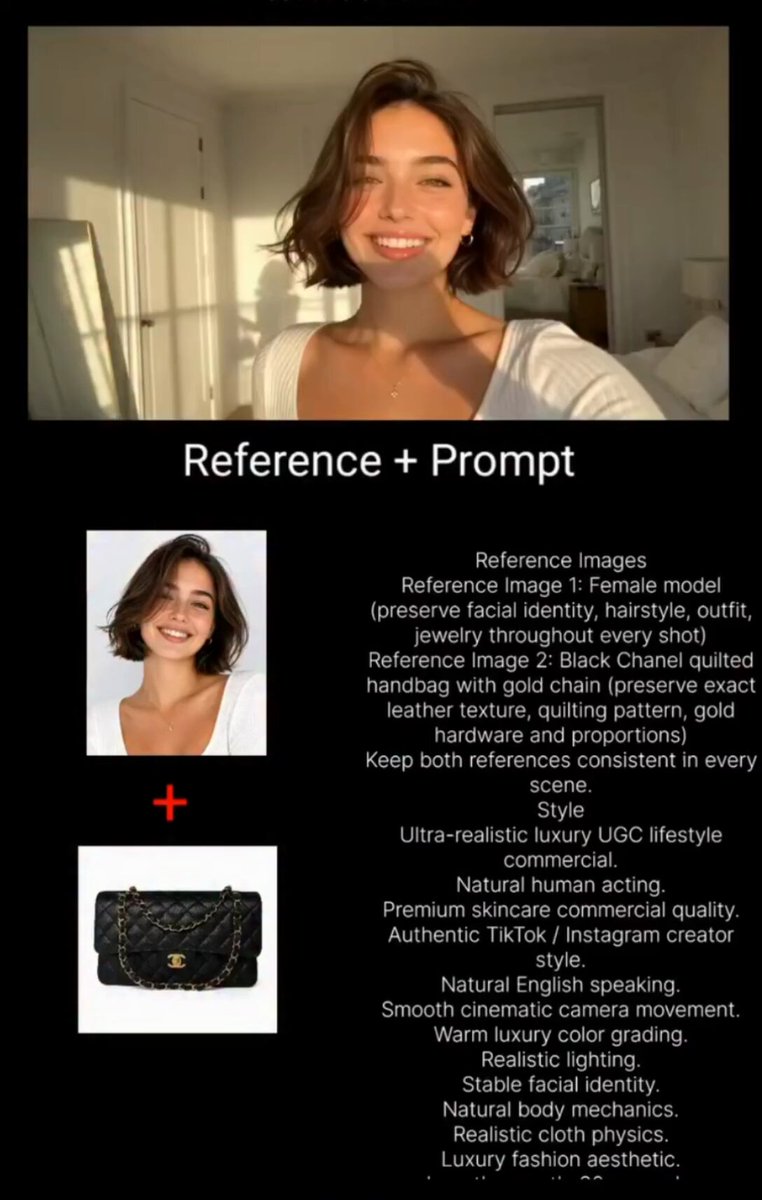
When a model supports several reference images at once, use them for different jobs rather than using five near-identical portraits. Feed one clean face reference, one full-body shot for proportions, one environment plate for the room, and one wardrobe close-up. This division of labor reduces the chance that a single blurred image contaminates the whole output.
Version your character assets
Name files with a date and a version number, and keep a changelog. When episode nine suddenly looks wrong, you want to know whether the reference set changed or the prompt did. Without versioning, every continuity bug turns into an hour of guessing.
Shot planning and scene composition
A shot list turns a script into a schedule. For synthesized campaigns, the shot list also describes camera behavior, because framing decisions made in text are what keep a series visually coherent.
Build a reusable shot library
Most creator content reuses a small vocabulary of shots: direct-to-camera medium, over-the-shoulder product hold, top-down flat lay, walking entry, reaction close-up, and result reveal. Codify these as templates with fixed focal lengths, heights, and durations. Reusing a shot library makes a series feel intentional and cuts planning time on every subsequent episode.
Match the platform before generation
Decide aspect ratio and safe zones up front. Vertical short-form needs headroom for on-screen text and a lower third that will not collide with platform interface elements. Square formats for feed placements and horizontal for embedded landing pages should be planned as separate renders, not cropped afterthoughts. Cropping a vertical composition into a horizontal frame usually amputates the composition.
Light with intent
Pick one lighting logic per series — soft window light, single-source key, or high-key studio — and stay in it. Mixing lighting styles between scenes is the fastest way to make a coherent series look like a compilation of unrelated clips.
Use environment continuity as a narrative device
Recurring locations help viewers orient quickly. A kitchen counter, a desk setup, or a specific outdoor bench can become a series signature. When a new scene appears, its novelty carries meaning instead of confusion.
QA, review loops, and common mistakes
Quality assurance for generated video is a checklist discipline, not a vibe check. Reviewers who watch passively miss continuity errors that a structured pass catches in minutes.
Run three passes in order. The first pass is technical: artifacts, hand anomalies, warped text, audio sync, frame rate, and export specs. The second pass is editorial: pacing, hook strength, clarity of the offer, and whether the call to action lands before attention drops. The third pass is compliance: claims, disclosures, usage rights, and platform policy.
Mistakes that cost the most time
- Generating before the script is locked. Every changed line invalidates finished scenes.
- Using one reference image for everything. Face, body, wardrobe, and environment need separate references.
- Batch-generating without labels. Twenty unnamed variants is not a test, it is a puzzle.
- Skipping captions. A large share of viewers watch muted; burned-in captions are not optional.
- Ignoring audio. Room tone, music ducking, and voice level consistency matter as much as visuals.
- Over-automating the review. A human must approve the final cut before it ships.
- Forgetting disclosure requirements. Where a platform or market requires labeling synthetic media, label it.
A five-minute pre-publish checklist
Check that the first two seconds contain a reason to keep watching. Confirm the product name is pronounced correctly. Verify captions match the spoken track word for word. Confirm the end card and link are current. Watch the whole video once without pausing — if you reach for the scrub bar, so will the audience.
Localization and multi-market variants
Localization is where synthesis pays for itself most obviously. Instead of booking a second shoot in a second market, you regenerate the same scene with a localized script and a localized presenter or voice.
Keep a glossary per market with product names, legal disclaimers, and terms that should never be translated. Idioms rarely survive literal translation; replace them with locally idiomatic equivalents rather than word-for-word swaps. Also check gesture culture: a hand sign that reads as friendly in one market may be rude in another.
For dubbed variants, preserve the original performance timing as a reference so lip movement and pacing stay plausible. Where perfect lip sync is impossible, prefer slight rephrasing that shortens the sentence over speeding up the audio unnaturally.
When to use synthesis — and when to shoot live
Synthesis is a tool, not a religion. The decision usually comes down to five criteria.
Volume. If you need more than roughly twenty variants per cycle, generation beats recording on almost every axis.
Shelf life. Evergreen explainers and repeating series formats suit synthesis well. Time-sensitive, news-driven, or personality-driven content often benefits from a real camera.
Talent dependency. If the creator's charisma is the product, protect it. Use synthesis for the supporting material — b-roll, cutaways, localized intros — rather than the hero performance.
Risk profile. Regulated categories with strict claim rules need a heavier review layer, which slows generation. Budget for it.
Budget shape. Live production concentrates cost into shoot days; synthesis spreads it across iteration and review. Choose the shape that matches your team's real capacity.
A hybrid approach is often the strongest: shoot the anchor performance live, then use synthesis for the thirty variants that test different hooks, offers, and markets.
Delivery, measurement, and the iteration loop
Publishing is the midpoint, not the finish line. Tag every variant with a consistent naming convention that encodes hook type, presenter, length, and market. Without that structure, retention data becomes unreadable within a week.
Track three metrics per variant: two-second hold rate, average watch time, and click-through on the call to action. Then feed the winners back into the next brief. The loop should be short enough that a winning hook from Monday appears in a new batch by Thursday.
Archive the losing variants too. They become a reference library for what your audience ignores, which is often more informative than the wins.
Frequently asked questions
How many reference images does a character need?
Four to six well-chosen references usually outperform twenty mediocre ones. Include one clean frontal portrait in neutral light, one three-quarter view, one full body for proportions, one wardrobe detail, and one environment plate.
Can generated scenes be mixed with live footage?
Yes, and this is often the smartest approach. Match grain, color temperature, and lens character during editing. Keep generated inserts short and place them where they support the live performance rather than replacing it.
How long does a sixty-second video take to produce?
Once the character and shot library exist, a single variant can move from script to published cut in a few hours of focused work, with most of that time spent in review rather than generation. The first video in a new series takes far longer because the reference set and shot templates are being built.
Do audiences notice that content is synthesized?
Some do, and the reaction depends on the promise being made. Viewers are forgiving of stylized, clearly designed content and much less forgiving of something that pretends to be an unedited real-world recording. Honest framing protects trust.
What about rights and consent?
Get written consent for any real person's likeness or voice, define the scope and duration of use, and keep that documentation with the character assets. Never generate a public figure's likeness for commercial content without explicit permission.
How do you keep a series from looking repetitive?
Vary the hook, the opening shot, and the pacing while keeping the character, lighting logic, and environment family stable. Change what the viewer notices first; keep what they recognize constant.
Which metrics actually matter?
For short-form influencer content, two-second hold rate and completion rate tell you more than views. Views measure distribution; holds measure whether the creative earned attention.
Is a fully automated pipeline realistic?
Not for anything customer-facing. Automation works for generation, versioning, captions, and export. Human judgment remains essential for claims, tone, and the final approval that protects your brand.
Putting it together
The teams getting the most from modern video synthesis are not the ones chasing the largest model library. They are the ones who treat the work like production: a locked script, a documented character, a reusable shot library, a disciplined review loop, and a measurement habit that feeds the next brief. Tools change quickly; that operating structure does not.
Start small. Pick one recurring series, build the character bible, define six shots, and produce four hook variants of a single thirty-second piece. Measure the hold rate. Then scale what worked, one stage at a time, keeping a human in the loop at the two points that matter most: the claim and the final cut.

Alexander
More Blogs
Read MoreVidu Q4 Alternatives: 4K AI Video Models Compared (2026)
Vidu Q4 alternatives compared: Kling 4.0, Seedance 2.5, Wan 3.0, and Runway Gen-4 — 4K support, input modes, durations, audio, and what each costs in credits on Domer.
Top 4K AI Image Generators in 2026: 5 Models Compared on Real Costs
The top 4K AI image generators on Domer compared: Flux 3 Klein, Nano Banana 2.1, GPT Image 2.5, GPT Image 2, and Nano Banana Pro — 4K credit costs, reference limits, and speed.
Nano Banana 2.1 vs GPT Image 2.5: Which Image Model Should You Use? (2026)
Nano Banana 2.1 vs GPT Image 2.5 Flare compared: credit costs per resolution, aspect ratios, reference images, text rendering, and which tasks fit each model.