

Why Text-to-Video Is Reshaping Animation Work
For most of the last century, animation was gated by labour. A minute of hand-drawn film could take a small studio weeks; a polished 3D short could consume months of modelling, rigging, lighting and rendering before a single frame reached an audience. Text-to-video models change the arithmetic. A written description can now become moving images in minutes, which means the first draft of a scene is no longer the expensive part of production.
That shift has a subtle consequence. The bottleneck has moved. It is no longer "can we render this?" but "can we describe this precisely, and keep it consistent across every shot?" Almost every practical difficulty in an AI animation pipeline — wobbly characters, drifting colour palettes, shots that refuse to cut together — traces back to that question. Understanding the tools is therefore less about memorising model names and more about building a repeatable workflow that survives iteration.
This guide covers what current models genuinely do well, how to choose between them, a step-by-step pipeline from script to final cut, and the mistakes that cost the most time.
What Text-to-Video Models Actually Do Well
Modern systems have crossed a threshold where short, well-specified shots are routinely usable in real projects. That does not mean every shot is easy. It means the failure modes have become predictable, and predictable problems can be engineered around.
Motion coherence and camera language
The biggest improvement in recent generations is physical plausibility. Objects keep their shape as they move, cloth settles instead of melting, and cameras obey something close to real optics. Prompts that read like camera directions — "slow dolly in, shallow depth of field, subject centred in the lower third" — now produce results that match the instruction often enough to be useful. This is a genuine change: earlier models responded to subject matter but largely ignored framing verbs.
Stylised animation and the limits of style transfer
Stylised output is where text-to-video is most convincing and most inconsistent. A prompt like "hand-painted watercolour animation, visible paper grain, muted ochre palette" can produce a gorgeous frame. The trouble is that the next shot, generated separately, will interpret "watercolour" slightly differently. Style is easier to establish than to maintain. Treat style as a parameter you enforce through reference images and fixed phrasing, not as something the model will remember.
Shot duration and resolution realities
The sweet spot for a single generation is a short beat: a few seconds of continuous action with one clear camera move. Longer requests exist, but quality tends to degrade as duration grows, because the model has more chances to drift. Professional practice is to build scenes from many short, controlled shots rather than one long take. That is also how live-action editing works, so the constraint is less limiting than it first appears.
Choosing the Right Model for the Shot You Need
Model selection is a matching problem, not a ranking problem. The best tool for a stylised character loop is rarely the best tool for a photoreal establishing shot.
| Shot type | What matters most | Typical strength |
|---|---|---|
| Photoreal establishing shot | Lighting realism, camera motion | High-fidelity diffusion models |
| Stylised character action | Silhouette clarity, style adherence | Animation-tuned models |
| Dialogue-free performance | Facial subtlety, eye movement | Models with strong temporal attention |
| Product or object rotation | Geometry stability | Image-to-video with strong reference locking |
| Background plates | Length, low cost per attempt | Lighter, faster models |
A few decision criteria matter more than benchmark charts:
- Control surfaces. Does the model accept reference images, depth maps, pose guides or camera parameters? A slightly weaker model with better controls usually beats a stronger model you cannot steer.
- Iteration cost. Speed matters more than peak quality during exploration. Generate rough passes on a fast model, then re-run only the winners on a premium one.
- Determinism. If you cannot reproduce a result with the same seed and prompt, consistency across shots becomes guesswork.
- Aspect ratio and delivery format. Vertical social cuts and widescreen cuts need different framing; check before you build a look around the wrong canvas.
A Practical End-to-End Animation Workflow
The following pipeline works whether you are producing a thirty-second social spot or a five-minute explainer.
Step 1 — Script to shot list
Write the script, then break it into shots, not sentences. Each shot should contain one action, one camera behaviour and one emotional beat. A useful rule: if you cannot describe the shot in one line, it is two shots. This step costs an hour and saves days, because text-to-video punishes ambiguity.
Step 2 — Lock the look before generating motion
Generate still frames first. Whether you use an image model or a single frame from a video model, settle on palette, lighting direction, lens character and character design as static images. Approving a look on a still is far cheaper than discovering a problem after twenty failed video attempts.
Step 3 — Write prompts in a consistent grammar
Adopt a fixed prompt structure and never vary it:
- Subject and action
- Setting and time of day
- Camera behaviour and lens
- Lighting and palette
- Style and medium
- Negative constraints (what must not appear)
Consistency comes from the parts you refuse to change. If shot three says "golden hour, warm rim light" and shot four says "sunset glow," the model has no reason to believe those are the same time of day.
Step 4 — Generate in batches, select ruthlessly
Run several variations per shot with different seeds, then judge them muted, at small size, at speed. You are looking for motion that reads, a silhouette that holds, and a beginning and end frame that can be cut against. Anything that only looks good paused is a liability.
Step 5 — Add motion control where the model allows it
Depth passes, pose skeletons and optical-flow guides turn a lottery into a lever. Even rough stick-figure guidance dramatically improves character consistency, because the model no longer has to invent the body mechanics.
Step 6 — Assemble, sound, and finish
Edit in a normal timeline: cut on action, keep shots short, and let sound carry continuity. Music and effects do more for perceived coherence than any post-processing trick. A gentle film grain, a consistent grade and matching black levels will hide small inter-shot differences better than re-rendering everything.
Solving the Consistency Problem
Character drift is the single most common complaint in AI animation, and it has several distinct causes that require different fixes.
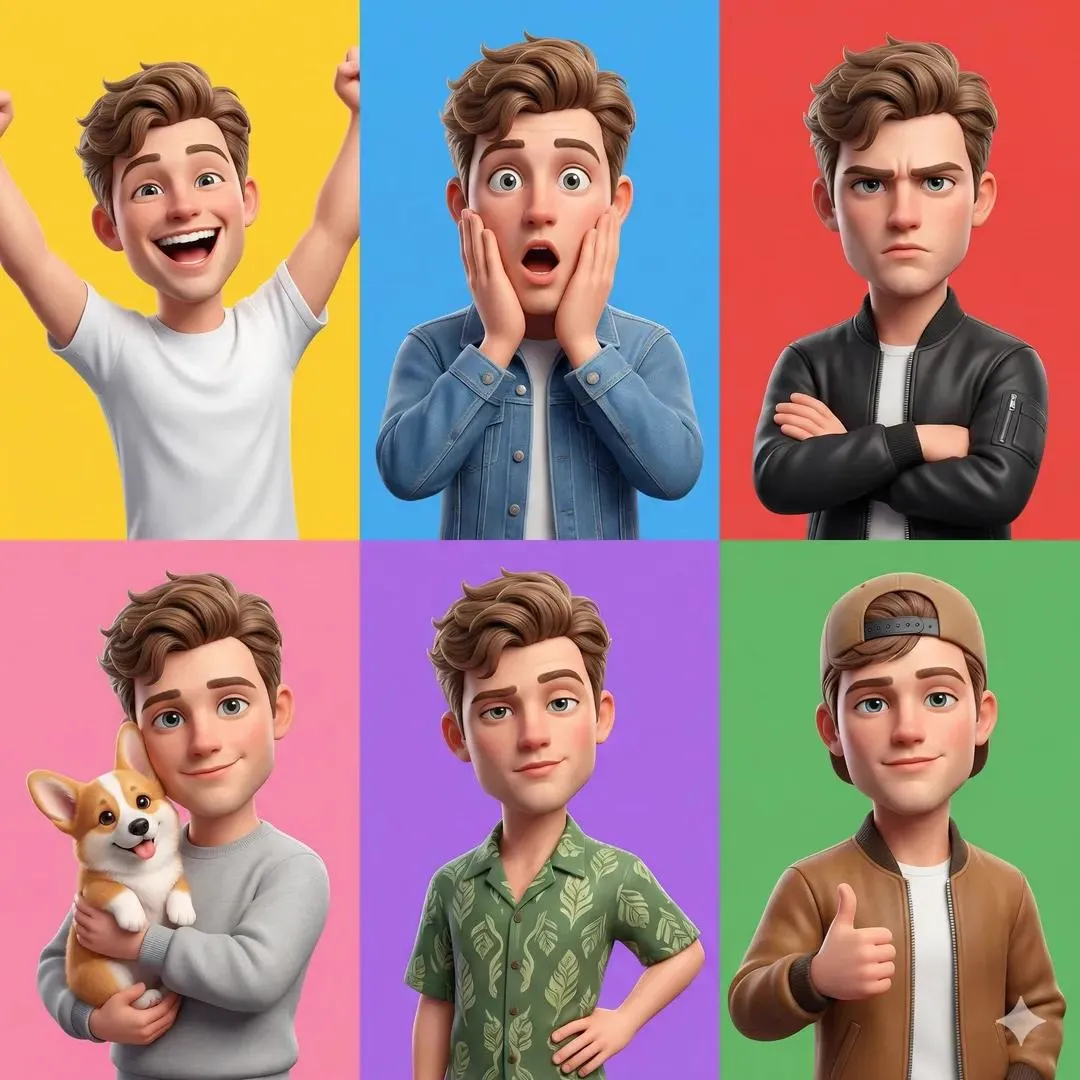
Identity drift happens when the model reinterprets a face between shots. Fix it with a locked reference image, a fixed character description string, and — where supported — identity-conditioning features rather than text alone.
Wardrobe and prop drift is usually a prompt problem. Name colours explicitly and repeat them verbatim. "Navy utility jacket with brass buttons" in every shot beats "her usual jacket."
Lighting drift is the easiest to fix and the most overlooked. Once you pick a light direction for a scene, treat it as a rule for every shot in that scene, including inserts and cutaways.
Motion style drift shows up when a character walks differently in each shot. Reference video or pose guidance solves this far more reliably than adjectives.
A practical trick: build a "scene bible" as a plain text file containing the character strings, palette hex codes, lens choices and lighting rules, then copy the relevant lines into every prompt. It feels mechanical. It works.
Video-to-Video and Animation Conversion
Not every project starts from text. Converting existing footage into animation is often faster and more controllable, and it splits into three approaches.
Style transfer with structure preservation keeps the original motion and camera work while changing the rendering. This is the most reliable route for dance, sport and action footage, where choreography matters more than invention.
Rotoscoping into stylised animation uses the source video as a motion reference and regenerates the subject. Results feel more hand-crafted but need tighter masking and more per-shot tuning.
Hybrid pipelines combine a video reference for movement with a text prompt for environment and lighting. This is where most commercial animation work is heading, because it keeps the performance while replacing the world around it.
In all three, keep the source at the highest quality you can and stabilise it before conversion. A shaky reference produces shaky animation, and the model will faithfully reproduce the flaws you were hoping it would fix.
Infrastructure, Queues, and Iteration Speed
Creative velocity is an infrastructure problem disguised as an artistic one. Three habits make the biggest difference.
Decouple exploration from production. Do rough passes on fast, cheap settings. Only the shots that survive the edit deserve a high-quality render. Teams that skip this step spend most of their time waiting.
Treat jobs as a queue, not a conversation. Submit batches, tag them by scene and shot number, and keep a log of prompt, seed and settings for every keeper. When a director asks for a variation, you want the recipe, not a memory.
Version your assets. Store generated clips with a naming convention that encodes scene, shot, take and prompt revision. Without it, you will re-generate work you already own, and you will not know which take the editor used.
Cloud rendering and priority queues help, but no amount of compute fixes a vague shot list. Pre-production is the cheapest optimisation available.
Common Mistakes and How to Avoid Them
Overloading a single prompt. Three actions in one shot produce mush. Split them.
Chasing realism when the project needs style. Photoreal humans still trigger uncanny-valley reactions in motion. A slightly stylised look is often more convincing and far easier to keep consistent.
Ignoring the edit until the end. Generate with the cut in mind: know the in-frame and out-frame, and leave a beat of handle at each end.
Judging on a single playback. Watch each take three times: once for motion, once for detail, once for how it cuts against its neighbours.
Neglecting sound. Silent AI footage feels artificial. Sound design is not polish; it is part of the illusion.
Skipping the negative prompt. Naming what you do not want — text overlays, extra limbs, lens flare, watermark artefacts — removes a large share of wasted attempts.
Where the Technology Is Heading
Three directions look most consequential. First, controllability is replacing raw fidelity as the competitive edge; the models that win will be the ones artists can steer precisely. Second, longer and more structured generation is arriving, which will shift effort from shot-by-shot assembly toward scene-level directing. Third, hybrid workflows that blend real footage, 3D layout and generative rendering are becoming the default rather than an experiment.
The practical implication for anyone building skills now is that prompt-writing alone is a shrinking advantage. What compounds is taste, shot literacy, reference discipline and pipeline design — the parts of filmmaking that were always hard. Text-to-video removed the rendering barrier; it did not remove the need to know what you are making.
FAQ
Do I need to be an animator to use these tools?
No, but you do need to think in shots. Editing literacy matters more than drawing skill for most projects.
How long should a single generated shot be?
Keep it short enough that the model cannot drift — typically a few seconds with one action and one camera move.
What is the fastest way to improve consistency?
Lock a reference image, freeze your prompt grammar, and repeat lighting and wardrobe descriptions verbatim across every shot in a scene.
Can I convert live-action footage into animation?
Yes. Stabilise the source, preserve the motion, and use style transfer or reference-guided regeneration depending on how much invention you need.
Should I generate everything in the highest quality available?
No. Explore cheaply, then re-render only the takes that survive the edit.
What is the biggest hidden cost in these workflows?
Iteration time. A clear shot list and a written scene bible cut more hours than any faster model.
Will these tools replace animation teams?
They replace specific bottlenecks — concept visualisation, previz, background plates, roto passes. Judgment, performance and editing remain human work.
How do I future-proof a pipeline built on fast-moving tools?
Keep your assets portable: plain-text shot lists, standard image references, conventional video codecs and a folder structure that outlives any single model. Tools will change; organised productions adapt in a day.
