
Why Citation Discipline Matters in AI-Assisted Ad Production
Advertising video has become the busiest lane in digital marketing. Brands now publish vertical cutdowns, six-second bumpers, longer YouTube pre-roll, and interactive variants of the same campaign, all within days of a creative brief landing. Generative models made that volume possible: a single marketer can storyboard, generate B-roll, synthesize a voice track, and assemble a rough cut before lunch. But speed quietly removes the paper trail that traditional production houses used to keep by habit, and that missing paper trail is where legal risk, client trust, and editorial credibility start to erode.
Citation discipline in ad video is not about academic formality for its own sake. It is about being able to answer three questions at any moment:
- Where did each factual claim in the script come from, and is that source still accurate?
- Which parts of the footage, audio, and motion were generated by a model, licensed from a library, or shot by a human?
- If a client, platform reviewer, or regulator asks for proof, can you produce it in under ten minutes?
This guide walks through a complete production workflow for AI-assisted advertising video that keeps attribution, licensing, and source documentation intact from brief to export. It treats referencing as an operational habit rather than a final-stage panic, and it assumes you are working with a mix of human-shot footage, stock libraries, generative video tools, synthetic voice, and licensed music.
Building a Source Log Before You Write a Single Prompt
The most reliable way to protect a campaign is to create the documentation layer first. Before generating anything, open a structured source log. A spreadsheet works, but a simple Markdown table inside the project folder keeps everything in one place and travels well between collaborators.
| Field | What to record | Example |
|---|---|---|
| Source ID | Short handle used in the script | S-014 |
| Type | Statistic, quote, visual, audio, model output | Statistic |
| Origin | Publisher, creator, or tool name | Industry research report |
| Location | URL, page number, or file path | Report PDF, p. 22 |
| Access date | When you actually read or downloaded it | Project start date |
| Rights status | Licensed, public domain, permission pending | Licensed for commercial use |
| Used in | Scene or shot number | Shot 7, voiceover line 3 |
| Notes | Caveats, expirations, restrictions | No derivative works allowed |
Two habits make this log useful instead of decorative. First, assign the source ID at the moment you save the material, not when you write the script. Second, add the source ID into your script document as an inline tag, so the claim and its origin never drift apart during revision. A line like "video consumption rose sharply across every measured market [S-014]" costs nothing to write and saves an hour of archaeology later.
The same log should include a separate tab for generative assets. Every model output deserves a row: which tool, which model version, which prompt, which seed or reference image, and what the tool's commercial terms say about using the output in paid media. Model terms change more often than most teams expect, so record the version you actually used rather than the version you remember using.
Choosing Generative Tools on Criteria, Not Hype Cycles
Tool selection drives everything downstream, including how much documentation you will need. A model that produces clean, controllable output with clear commercial terms is worth more to an ad workflow than a flashier model with ambiguous licensing. Evaluate candidates against six practical criteria.
1. Commercial rights clarity
Can you use the output in paid advertising, in every target market, without a separate negotiation? Is there a distinction between personal, internal, and commercial use? Write the answer in your source log with the date you checked it.
2. Output fidelity for your format
A model that excels at cinematic 16:9 landscape shots may struggle with 9:16 vertical framing where the subject must stay inside a safe area. Test each candidate against your actual delivery specs before committing.
3. Controllability and consistency
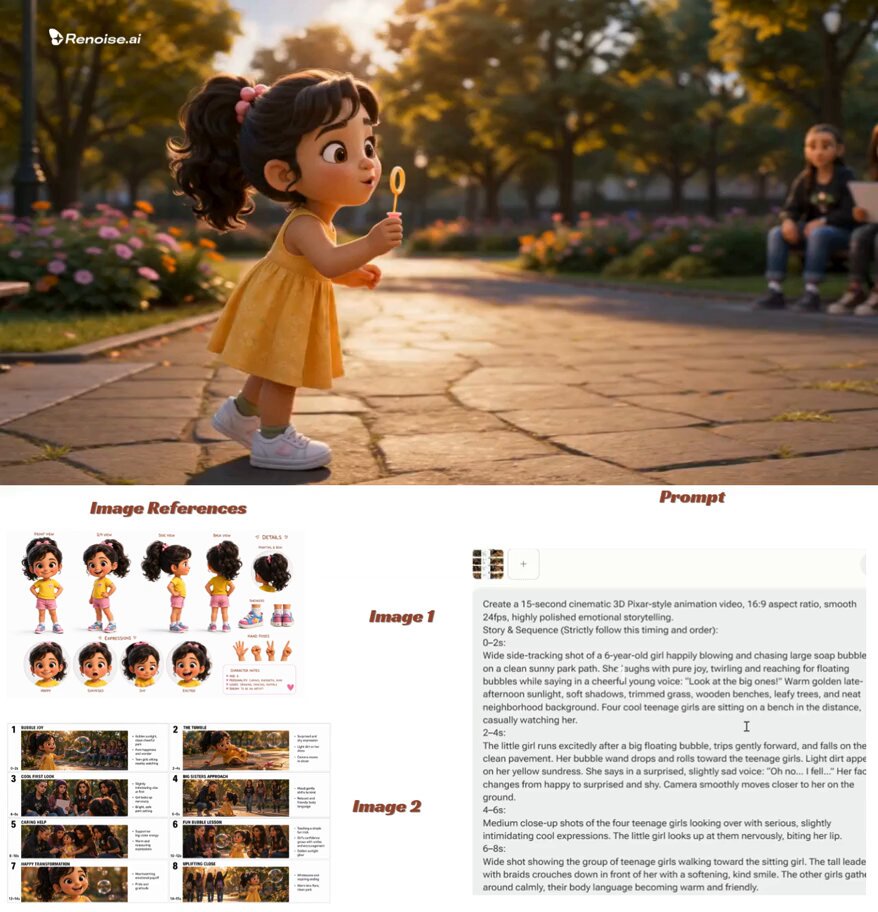
Ad campaigns need the same product, character, or location to appear across multiple shots. Tools that support reference images, character locking, or style presets reduce the number of generations you burn and make shot-to-shot continuity achievable.
4. Prompt transparency and provenance
Some tools store prompt history and generation metadata that you can export. That metadata is gold during review. If a tool gives you no way to reconstruct how a shot was made, you are accepting blind risk.
5. Integration with your edit pipeline
Codec support, alpha channels, frame rate handling, and resolution ceilings decide whether a generated clip drops cleanly into your timeline or needs three conversion passes.
6. Cost per usable second
Price the tool by the number of seconds that survive review, not by the number of seconds generated. A cheap model with a 10% hit rate is more expensive than a premium model with a 70% hit rate.
Run a one-day bake-off: same script beat, same shot list, three candidate tools. Score each on the criteria above, keep the winner for that specific shot type, and record the decision. Nothing is more wasteful than re-debating tool choice on every campaign.
Where Research Becomes Citation: Scripting for Advertising Video
Advertising scripts mix persuasion with factual claims, and the factual claims are what require referencing. Sort every claim into one of three buckets.
Hard data. Percentages, growth figures, market sizes, survey results. These need a named source, a date, and a note about sample size or methodology limitations. If a number appears on screen as a graphic, put the source in the lower third for at least two seconds, or in the end card. Viewers do not need a full bibliographic entry, but they should be able to see who produced the figure.
Attributed opinion. Expert quotes, analyst predictions, testimonials. Attribute plainly: "according to [organization name], [role]". Never imply that an individual endorses a product unless you have written permission.
General knowledge. Widely accepted, non-contested statements that need no citation, such as "mobile video is watched on phones." If you find yourself unsure whether something is general knowledge, treat it as a claim and add a source.
A practical scripting rule: every factual line carries a bracketed source ID as you draft. When the script goes to the client for review, the source log goes with it. Reviewers who can see the evidence behind a claim approve creative faster because they are not guessing.
Handling statistics that will age
Numbers decay. A figure that was accurate at the start of a campaign may be wrong by the time the campaign's second phase launches. Two defenses work well. Prefer ranges and directional language over precise figures when the precise figure is not central to the message. Where a precise number is essential, set a review date in the source log and re-verify before any re-cut or extension.
Quoting people without misrepresenting them
Short quotes are safer than long ones, and context is everything. Keep the original recording or transcript, note the date, and never splice a sentence so that it changes the meaning. If a quote comes from a podcast or conference talk, record the timestamp. Timestamps resolve disputes instantly.
Visual References, Prompts, and Provenance
Generative video thrives on reference material, and reference material is exactly where copyright problems begin. A clear internal policy prevents most of them.
Style references. Describing a look with words is safer than feeding in another artist's frame. "Warm late-afternoon light with soft shadows" travels well. Uploading a commercial film still as an image prompt may produce a great shot and a difficult conversation.
Product references. Use the client's own approved product photography or 3D renders whenever possible. If you must reconstruct a product from description alone, review the result closely for logo distortion, label errors, and physically impossible geometry, all of which are common failure modes.
Real people. Do not generate a recognizable person's likeness without documented permission. Even a loose resemblance can trigger complaints, and platforms increasingly screen for it.
Locations and landmarks. Some buildings, artworks, and private properties have usage restrictions. When an ad will run at scale, favor generic or licensed environments over recognizable private property.
For every generated shot, store the prompt, the model version, the seed or reference set, and the output file name. Store them next to the shot, not in a separate system. When a client asks how a particular frame was made six weeks later, the answer should be one folder away.
Audio, Music, and Voice: The Most Common Rights Gap
Audio is where ad campaigns most often run into trouble, because music licensing is genuinely complicated and synthetic voice rules are still evolving.
Music and sound effects
Library music is licensed per track, per project, per territory, and sometimes per media type. Read the license for each track and record: territory, duration of use, media covered (broadcast, online, paid social), and whether re-cuts count as a new use. Pay attention to "all media" versus "online only" language. If a campaign may expand to connected TV or cinema, secure the broader license up front; re-clearing later is slower and more expensive than clearing once.
If you generate music with an AI tool, check whether the provider claims any rights over output, whether attribution is required, and whether the output is safe from third-party claims. Many providers offer indemnification on paid tiers and none on free tiers. That difference matters enormously for paid media.
Voice and narration
Synthetic narration needs three checks. First, does the voice provider permit commercial advertising use? Second, does the contract cover the territories and duration of the campaign? Third, if the voice is cloned from a real person, is there a signed release specifying scope, duration, and revocation terms?
For human narration, standard talent agreements should specify the same scope, plus whether the performance can be reused in future campaigns. Ambiguity here is a recurring source of disputes when a spot gets extended.
Practical tagging
Name audio files with a consistent pattern that includes the license type, for example track-name_online-paid_territory. Editors then see the restriction before they place the file, not after.
Designing On-Screen Attribution and Disclosure
Attribution in advertising video serves two audiences: the viewer and the regulator. Design for both without wrecking the creative.
Source supers. A small lower-third naming the source of a statistic, held long enough to read. Keep it at a legible size and inside title-safe areas for every aspect ratio you deliver.
Disclosure lines. Where content is synthetic or materially altered, a short, plain-language disclosure builds trust and increasingly satisfies platform policy. Place it where it will not be missed, such as a persistent corner label or the opening card, depending on the platform's expectations.
End-card sourcing. Longer references, licensing notices, and partner acknowledgments belong in the final frame, held for at least two seconds. For paid social, check whether the platform allows end-card duration or truncates it; if truncation is likely, move essential notices earlier.
Accessibility. Captions and audio description are part of attribution quality. If a source is named only in a voiceover, viewers watching without sound lose the information. Pair spoken and on-screen attribution.
Pre-Export Review: A Checklist That Catches Real Problems
Before you deliver, run the same checklist on every cut. Ten minutes here prevents expensive re-edits.
| Check | Question | Fix if failing |
|---|---|---|
| Claims | Does every factual line have a source ID? | Add source or soften the claim |
| Visuals | Is every generated shot linked to a prompt and model version? | Reconstruct from project history |
| Likeness | Any recognizable person without documentation? | Replace or obtain release |
| Music | Do licenses cover territory, media, and duration? | Upgrade license or swap track |
| Voice | Is synthetic narration permitted for paid ads? | Switch provider tier or re-record |
| Disclosure | Is synthetic or altered content clearly labeled? | Add persistent label |
| Supers | Are source supers readable in every aspect ratio? | Reposition and re-render |
| Archive | Is the source log stored with the delivery? | Export and bundle |
Make the checklist part of the delivery folder, not someone's memory. New team members should be able to run it without asking questions.
Mistakes That Cost Teams the Most
Documenting after the edit is locked. Reconstruction is slow and error-prone. Log sources as you go.
Assuming a tool's terms are stable. Terms shift. Record the version and the date you verified it.
Treating generated output as automatically original. Generation can still reproduce protected material, especially when prompts reference specific works or styles.
Using the same music license across different media. A license that covers online video may not cover broadcast or paid social placements.
Relying on a single disclosure style for every platform. Platforms differ in placement expectations and in how strict they are about synthetic media.
Forgetting aspect-ratio variants. Supers and disclosures that read well in landscape can be cropped in vertical cuts, silently removing your compliance language.
Leaving rights research to one person. Bus factor matters. If only one producer understands the licensing picture, every vacation becomes a risk.
FAQ
How detailed does attribution need to be in a thirty-second ad? Short-form work needs accuracy, not exhaustiveness. Name the source of each data point on screen, hold it long enough to read, and keep the full documentation in the project archive. The viewer gets the essential fact; the client and any reviewer get the full record.
Can I use generative video for a paid campaign at all? Yes, provided the tool's terms permit commercial use in your target territories and your internal process documents how each shot was made. Confirm the terms yourself rather than relying on secondhand summaries.
What if a source disappears or a link breaks? Archive a copy or a dated PDF when you first use the material. The source log's access date plus the archived version is usually enough to demonstrate what you relied on.
Do I need releases for synthetic voices? If the voice is cloned from a real person, yes. Get scope, duration, territory, and revocation terms in writing. If the voice is entirely synthetic with no real-person origin, the provider's commercial terms govern, and you should still keep proof of the tier you used.
How long should I keep the source log? Match your client contract and your legal team's retention policy. As a baseline, keep it for the life of the campaign plus a comfortable buffer, and store it with the master files rather than in personal storage.
What is the fastest way to build this habit? Start with the source log template on your next project, even a small one. One campaign with a complete log teaches the team more than any training document, and the second campaign will be faster than the first.
Should different team members own different parts of the record? Assign ownership explicitly: research and claims to the writer or strategist, generated assets to the AI operator or editor, music and voice to the producer. One person should still own the final review to ensure nothing falls between roles.
