

AI Video Marketing Workflow: A Practical Guide for Teams
Oct 15, 2026


Why AI Changes the Video Marketing Equation
For most of the past decade, video marketing was constrained by production capacity. A single polished 60-second spot could consume weeks of scripting, shooting, editing, and review. That constraint shaped everything downstream: how many markets you could enter, how quickly you could react to a trend, how many variants you could test, and how much risk you could absorb on an unproven idea.
Generative and assistive AI tools break that constraint in three places at once. They compress the time between idea and first draft, they lower the cost of producing variants, and they make localization and repurposing routine instead of exceptional. The practical result is not that you replace your production team. It is that you can afford to be wrong more often, which is how good creative gets found.
The teams getting the most from this shift treat AI as a production accelerator rather than a creative replacement. They still make deliberate choices about story, audience, and positioning. They simply stop spending three days on a rough cut that a model can assemble in twenty minutes, then redirect that time into strategy and iteration.
Three bottlenecks remain worth naming, because they shape everything that follows:
- Taste. Models generate plausible output; they do not know which output is good. Human judgment is still the scarce resource.
- Brand consistency. Without a locked visual and verbal system, generated output drifts into generic territory fast.
- Measurement. Producing more video is useless if you cannot tell which pieces actually moved the number you care about.
Everything below is a way of managing those three constraints while capturing the speed advantage.
The End-to-End AI Video Workflow
The workflow that works in practice has seven stages. Skipping any of them is the most common reason AI video projects look impressive in a demo and disappointing in a campaign.
1. Brief, Audience, and Single-Minded Message
A written brief is the highest-leverage AI input you will produce all week. Include the audience segment, the platform and placement, target duration, tone, mandatory claims, banned claims, the call to action, and three reference examples of work you like. Reference examples matter enormously: a two-line description of a visual style is worth far less than three frames or clips that demonstrate it.
Keep the brief to one page. If you cannot state the single message in one sentence, the model will produce something average because you have given it an average target.
2. Scripting and Structure
Use a language model to draft beat structures first, not finished copy. Ask for a hook, a problem, a mechanism, proof, and a call to action, then expand each beat. Request three structurally different versions rather than three rewordings of the same script. Structural variety is where testing gains come from; phrasing variety rarely moves anything.
Maintain a "voice sheet" containing ten real sentences your brand has published. Paste it into every scripting prompt. Without it, output tends toward the same energetic, vaguely optimistic register that every competitor is also generating.
3. Asset Generation
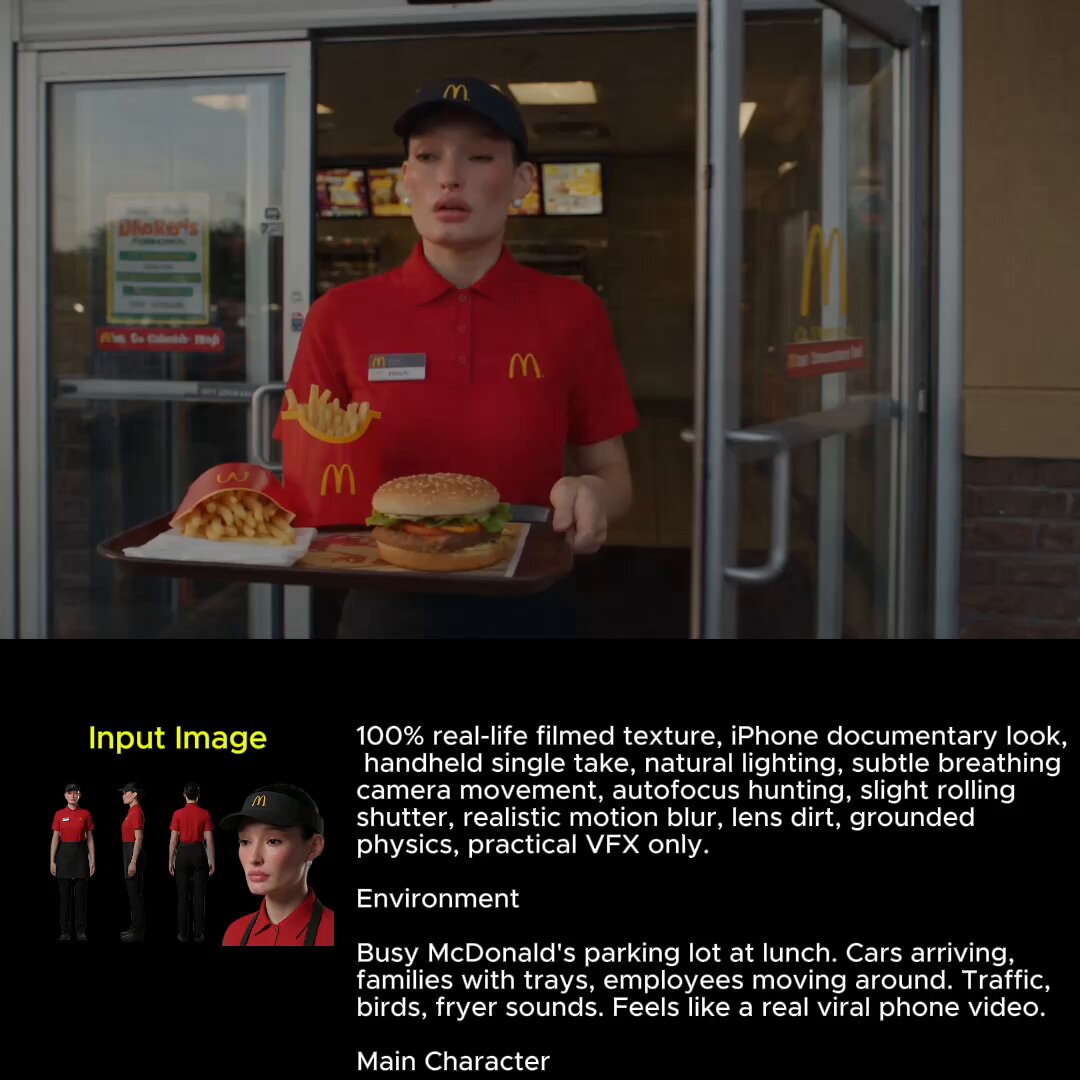
Text-to-video and image-to-video models handle b-roll, abstract backdrops, product-in-context shots, and simple narrative scenes. For talking-head content, avatar and lip-sync tools cover spokesperson variants and multi-language delivery.
Two practical rules save weeks of frustration. First, generate more short clips than you need, at the highest resolution your budget allows. Second, name and tag every file with its prompt, style, and usage rights status as you download it. A shot library without metadata becomes unusable at roughly the two-hundred-clip mark.
4. Assembly and Editing
AI editors handle rough-cut assembly from transcript, silence and filler removal, auto-reframing between vertical, square, and widescreen, scene detection, and caption styling. That is genuine labor removed from the timeline.
A human editor then does the part that decides whether the video feels intentional: pacing, music selection, sound design, and the small cuts that create rhythm. This is the stage where most teams should spend their saved hours, not on generating more raw footage.
5. Voice, Captions, and Accessibility
Neural voiceover is now good enough for scratch tracks and increasingly for final narration. Use it for internal review, for versions you will never publish, and for languages where you cannot justify a booth session on a test.
Always ship captions. A large share of feed viewing happens with sound off, and captions measurably improve completion rates on most platforms. Review captions manually for product names, numbers, and technical terms, which is precisely where speech models fail most often.
6. Localization and Variant Production
The efficient approach is not translating a finished video. It is rebuilding it from the script and shot list. Swap on-screen text, re-record narration, adjust idioms, change the call to action, and reconsider which proof point leads in each market.
Localization quality depends far more on the script stage than on the voice model. A translated script that keeps English sentence rhythm will sound wrong no matter how natural the synthetic voice is.
7. Distribution, Variants, and the Feedback Loop
Build a variant matrix before you publish: three hooks, two lengths, two opening frames. That produces twelve assets from one production cycle, which is enough to learn something without drowning your audience.
Then close the loop. Record which hook, length, and opening won, and feed that back into the next brief. Teams that document their winners improve steadily; teams that do not keep regenerating the same average video with new prompts.
A 30-Day Rollout Plan
Week 1: Choose one funnel stage, typically mid-funnel explainer content, and one platform. Write the brief and voice sheet. Produce two scripts.
Week 2: Generate assets, assemble two finished videos, and publish both. Do not wait for a perfect version.
Week 3: Build captions and one localized or adapted variant. Review performance data.
Week 4: Produce four variants based on the winning hook. Document the workflow so it becomes repeatable rather than heroic.
Choosing a Tool Stack for Your Team
Tool choice matters less than workflow discipline, but mismatches still waste money. Match the stack to your volume.
Solo Creator or Small Brand
Prioritize one script assistant, one video generation model, one AI-assisted editor, and one captioning tool. Resist adding a fifth subscription until the fourth is fully used. Your constraint is attention, not features.
In-House Marketing Team
Add collaboration and review layers: shared asset libraries, comment-and-approve workflows, and a brand kit that locks fonts, colors, and logo treatments. Consistent inputs produce consistent output; inconsistent inputs produce drift you will spend hours correcting.
Agency or High-Volume Studio
API access becomes the deciding factor, because templated production and automated variant generation only scale through programmatic workflows. Look for batch rendering, deterministic style presets, and export presets per platform.
Evaluation Criteria Before You Commit
- Output rights. Confirm commercial usage and modification rights in writing.
- Shot-to-shot consistency. Test whether the same character or product stays stable across ten clips.
- Resolution and aspect ratios. Verify true output resolution, not just upscaled exports.
- Editability. Can you export layered elements or clean plates, or are you locked into flattened video?
- Cost per finished minute. Not per generation. Most generations are discarded.
- Team access. Seats, permissions, and review history matter more than you expect at scale.
Personalization at Scale Without Crossing Lines
Personalization works when it reflects something the viewer already knows about themselves: their industry, their region, their plan tier, their stated goal. It fails when it implies surveillance.
The reliable middle ground is segment-level personalization. Create one base video and swap the variables that are safe and meaningful: the example used, the on-screen terminology, the currency or measurement unit, the testimonial, and the call to action. A logistics company seeing warehouse examples instead of retail examples feels tailored without feeling watched.
Keep a documented list of which variables may be personalized and which may not. Anything involving sensitive categories, inferred health or financial status, or precise location should stay out of the personalization matrix entirely, both for trust and for regulatory reasons.
Finally, test whether personalization actually helps. In some categories, a strong single message outperforms segmented variants because it builds sharper memory structures. Personalization is a hypothesis, not a default.
Interactive, Adaptive, and Live-Data Video Formats
Static video is now table stakes. Three adjacent formats are worth experimenting with.
Interactive branching. Viewers choose a path, and the narrative responds. Best used for product tours, onboarding, and training, where the viewer has a genuine question to answer. It rarely works for brand awareness because choice adds friction before interest exists.
Adaptive creative. The video changes based on externally supplied data such as weather, inventory, sports results, or time of day. This is powerful for retail and travel, and it requires strict guardrails: define exactly which data sources are allowed to alter which scenes, and build a fallback version that renders when data is unavailable.
Sequential storytelling. Instead of one longer video, publish a series where each installment assumes the viewer saw the previous one. Completion and return-viewing metrics usually beat a single long asset, and production cost per piece drops.
All three formats benefit from AI because they multiply production volume. They also multiply the damage from a weak brief, so pilot them on one product line before rolling out broadly.
Optimizing Video for Search, Feeds, and Silent Viewing
Discovery is now a metadata problem as much as a creative one. Three layers matter.
Spoken content. Tools transcribe your audio, which means the words you say are indexable. Say the topic plainly in the first fifteen seconds instead of opening with an abstract mood piece.
Text on screen. On-screen text is read by viewers with sound off and increasingly interpreted by platform systems. Keep critical phrases on screen long enough to register.
Descriptions and filenames. Write specific descriptions rather than keyword-stuffed ones, and name files descriptively before upload. Small hygiene steps compound across hundreds of assets.
For voice and visual search, the principle is the same: describe what is visibly happening. A video where someone demonstrates a task is more retrievable than one that merely mentions the topic, because the visual content and the transcript agree with each other.
Governance, Disclosure, and Brand Safety
As generated content becomes indistinguishable from captured footage in some contexts, governance stops being optional.
Maintain a simple disclosure policy. Synthetic presenters and materially altered footage should be labeled where audiences could reasonably be misled. Documentary, testimonial, and news-adjacent formats deserve the strictest treatment.
Keep a rights record for every generated asset: model used, prompt, date, and license terms. When a campaign runs for eighteen months across six markets, that record is the only thing that answers a legal question quickly.
Assign one owner for brand consistency. A single reviewer with authority to reject output prevents the slow slide toward a library of videos that each look slightly different from the brand.
Common Mistakes and How to Avoid Them
Generating before briefing. The most expensive mistake, because it produces attractive footage that cannot be used.
Judging tools by demo reels. Demo reels show curated best-of output. Test with your own brand assets and your own worst-case scene, such as hands, text, or a specific product.
Publishing without captions. You lose silent viewers and accessibility, and you lose searchable text.
Over-automating the edit. Automated assembly is a starting point. Videos that skip human pacing decisions feel assembly-line produced even when every frame is beautiful.
Ignoring the audio mix. Bad levels destroy perceived quality faster than imperfect visuals.
Scaling before validating. Doubling output before you know which hook works multiplies waste, not results.
No variant documentation. Without a record of what you tested, every cycle restarts from intuition.
Measuring What Matters
Volume metrics are seductive and mostly misleading. Track these instead.
Hook retention. The percentage still watching at three seconds and at ten seconds. This is the clearest signal of whether your opening works.
Completion rate by length. Compare fairly: a fifteen-second video and a three-minute video have different baselines.
Cost per finished minute. Include generation attempts, editing hours, and review cycles. This number tells you whether AI is genuinely improving efficiency.
Assisted conversion. Use post-purchase or post-signup surveys and platform attribution together. Neither is perfect, and the disagreement between them is informative.
Production velocity. How many testable variants you shipped this month. Velocity is the leading indicator that your workflow is healthy.
Review these monthly, not daily. Video performance is noisy in short windows and patterns only emerge across a few dozen assets.
Frequently Asked Questions
How much of video production can AI realistically handle?
Roughly the first 70 percent: research synthesis, scripting drafts, asset generation, rough-cut assembly, captioning, and localization. The final 30 percent, which is taste, pacing, brand judgment, and strategy, remains human work and determines whether the output is good.
Do audiences mind AI-generated video?
They mind low-quality, generic, or misleading video. Audiences respond to usefulness and clarity. Disclosure matters most when a synthetic presenter could be mistaken for a real person making a real claim.
How do I keep generated clips visually consistent?
Lock a style reference image, reuse the same descriptive prompt structure, keep a fixed palette and lighting vocabulary, and avoid mixing many models within one video. Consistency comes from constrained inputs.
Is AI video actually cheaper?
Per finished minute, usually yes, once you account for discarded generations. Per successful campaign, it depends on whether you use the saved time for testing. Teams that produce more variants typically get better returns than teams that simply produce the same video faster.
What is the fastest way to get started?
Pick one product, one platform, and one funnel stage. Produce two videos this week using a single script assistant, one generation tool, and one editor. Measure hook retention. Expand only after you have a winner.
How do I avoid output that looks like everyone else's?
Constrain the model with your own references, write briefs with a specific point of view, and add real footage or real people wherever credibility matters. Genericity is a symptom of vague inputs, not an inherent property of the tools.

Alexander
More Blogs
Read MoreVidu Q4 Alternatives: 4K AI Video Models Compared (2026)
Vidu Q4 alternatives compared: Kling 4.0, Seedance 2.5, Wan 3.0, and Runway Gen-4 — 4K support, input modes, durations, audio, and what each costs in credits on Domer.
Top 4K AI Image Generators in 2026: 5 Models Compared on Real Costs
The top 4K AI image generators on Domer compared: Flux 3 Klein, Nano Banana 2.1, GPT Image 2.5, GPT Image 2, and Nano Banana Pro — 4K credit costs, reference limits, and speed.
Nano Banana 2.1 vs GPT Image 2.5: Which Image Model Should You Use? (2026)
Nano Banana 2.1 vs GPT Image 2.5 Flare compared: credit costs per resolution, aspect ratios, reference images, text rendering, and which tasks fit each model.