

Why AI video stalls at the story layer
Generative video tools are extremely good at producing a single striking clip. They are still surprisingly bad at producing a sequence that holds attention for ninety seconds. The gap is not model quality; it is production structure. Generate clips one at a time with no plan and you get a pile of attractive fragments that refuse to cut together: the same character has three jawlines, the sun sets twice inside one scene, and the emotional beat that should land at 0:40 arrives at 1:12 with no setup.
Animation and live action both solve this with structure that sits before the camera: script, beat sheet, shot list, continuity notes, edit plan. AI video needs the same structure executed faster. That is what an agent director layer provides.
Two working styles dominate AI video production. Clip-first creators start with a prompt, generate until something looks good, then build a narrative around the result. Sequence-first creators decide the story, plan shots, approve keyframes, and only then spend video generations. Clip-first is faster for a ten-second post. Sequence-first is the only reliable path to a short film, a product narrative, or an episodic series.
The practical rule: every hour spent planning before the first video generation saves several hours of regeneration later. Planning is not overhead; it is the compression step that makes the rest affordable.
What an AI agent director does
An agent director is a planning and orchestration layer between your script and your render jobs. It reads the story, turns it into structured production data, then drives image, video, voice, and music models with that data while tracking what has already been produced. Think of it as a first assistant director, a continuity supervisor, and a render wrangler in one place.
Script breakdown
The agent parses the script into scenes, beats, characters, locations, props, and dialogue. A human script supervisor does this with a highlighter; the agent does it as editable structured fields. The output must be inspectable, because if you cannot correct the breakdown you cannot trust anything downstream.
Shot planning and coverage
From each beat, the agent proposes a shot list: establishing wide, medium for dialogue, close-ups for turns, inserts for props, transition plates. Good planning includes coverage ratios, not just a list. For a 90-second final cut, plan for roughly three to four minutes of generated material so the edit has choices.
Continuity tracking
The agent maintains a continuity ledger: wardrobe, hair, props, time of day, weather, screen direction, and which character reference is current. Every shot request reads from that ledger, which is what stops a character changing jackets mid-conversation.
Render orchestration and retries
Video generation is probabilistic and slow. An agent queues jobs, retries failures, picks the best take from several, and records which seed and prompt produced an approved shot so the result can be reproduced later.
Review and revision loops
Notes should become parameters. Slower push in, warmer light, hold the close-up two seconds longer. If a note means rebuilding the shot by hand, the system is not doing its job.
A minimal shot card looks like this:
shot_id: sc03_sh02
beat: she decides to answer the radio
shot_type: medium close-up
duration_sec: 4
character: keeper
wardrobe: wool_coat_grey
location: lighthouse_radio_room
time_of_day: night
lighting: single_warm_lamp
motion: slow_push_in
reference: refs/keeper_three_quarter_02.png
Every field exists to prevent a specific class of continuity error.
Building the story layer before you touch a model
Logline
One sentence: who wants what, what stands in the way, what the turn is. A logline is not marketing copy; it is a test of whether a story exists. If yours needs three sentences, you have a mood, not a plot.
Example: A lighthouse keeper who has stopped speaking to anyone must decide whether to answer a radio call that claims to be his own voice from thirty years in the future. That sentence already implies a location, a prop, a conflict, and a final image, so every downstream decision can be checked against it.
Beat sheet
A 90-second short usually needs seven to ten beats with time budgets assigned before anything is generated.
| Beat | Function | Budget |
|---|---|---|
| Setup | Establish world and routine | 0:00-0:12 |
| Disturbance | The radio crackles | 0:12-0:22 |
| Refusal | He ignores it | 0:22-0:34 |
| Escalation | The voice knows details | 0:34-0:48 |
| Turn | He answers | 0:48-1:00 |
| Consequence | The reply is wrong | 1:00-1:14 |
| Resolution | Final image, no dialogue | 1:14-1:30 |
Time budgets force decisions. They tell you the escalation beat deserves four shots and the refusal beat deserves two.
Scene cards
Convert beats into scene cards: location, time of day, characters present, emotional turn, key props, continuity notes. This is the document the agent reads, and it is also the document a human editor needs at assembly time.
From beats to a shot list
Coverage is the vocabulary of editing. Without it you have one angle and no rhythm.
| Shot type | Purpose | Typical length |
|---|---|---|
| Establishing wide | Place the audience | 3-5 s |
| Master shot | Full scene geography | 6-10 s |
| Medium | Dialogue and action | 3-5 s |
| Medium close-up | Emotion, subtext | 2-4 s |
| Close-up | Turn, decision | 1.5-3 s |
| Insert | Prop, detail, clue | 1-2 s |
| Over-the-shoulder | Power dynamics | 2-3 s |
| Transition plate | Passage of time | 1-3 s |
| Final image | Lasting impression | 4-8 s |
Two rules matter more than the table. First, cut on motion: generate shots that end with movement, because an edit point reads better when something is already in transit. Second, vary shot length deliberately; a run of identical four-second shots feels like a slideshow no matter how beautiful each frame is.
An agent director helps here by proposing coverage per beat rather than per prompt. You approve the plan, then it generates. That single shift -- approve the plan, not the clip -- is what turns a folder of outputs into a film.
Character and location consistency
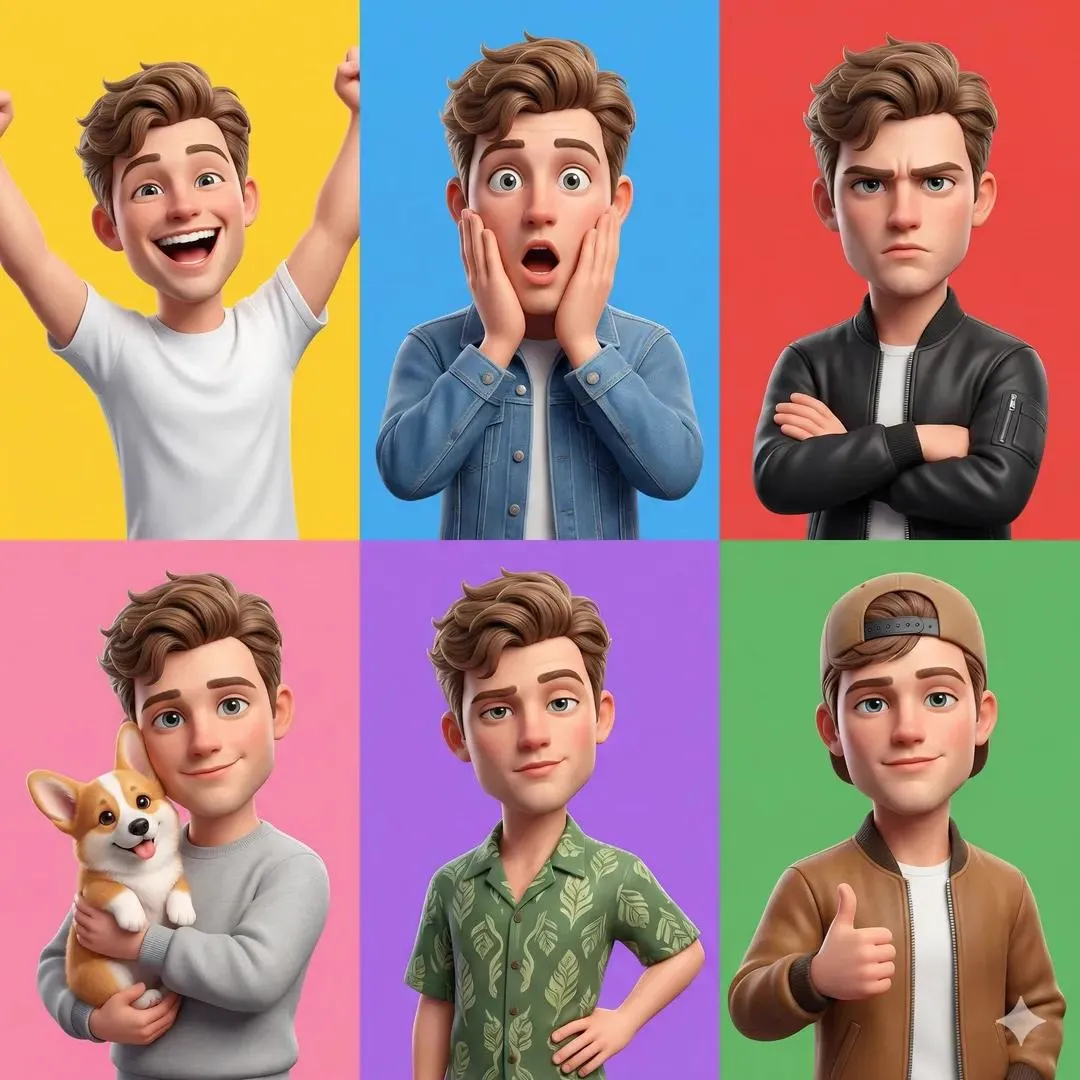
Consistency is mostly a reference management problem, not a model problem. Fix the references and most drift disappears.
Reference sheets
Build one sheet per character with five to eight images: neutral front, three-quarter left, three-quarter right, profile, full body, plus two expression variants. Lock wardrobe, hairstyle, and accessories, and use plain backgrounds with identical lighting. If the reference sheet is inconsistent, every downstream shot inherits the inconsistency.
Prompt scaffolding
Keep a fixed block describing the character and the look, and vary only the action clause. The locked block might read: man in his sixties, weathered face, grey wool coat, salt-and-pepper beard, 40mm lens, warm lamp light, shallow depth of field. The variable clause: reaches for the radio dial. Models respond better to this two-part structure than to one free-form sentence because the stable portion carries identity.
Seeds, keyframes, and reference features
Lock seeds where the model supports it. Generate a still keyframe per shot, approve it, then use image-to-video instead of text-to-video. Many video models accept a first frame and sometimes a last frame; using both controls where a shot lands. Style adapters and character references add stability at the cost of flexibility, so use them when identity matters more than improvisation.
Fixing drift
When a shot drifts, regenerate the keyframe, not the video. Continuity failures are almost always visible in the still image, and a still costs a fraction of a video take. Keep a canon folder of approved stills and never generate a shot without a reference from it.
Audio that carries the cut
Audiences forgive imperfect video far more readily than bad audio. Build the audio bed early, because it changes your shot lengths.
Voice: use one voice identity per character across the whole piece. Generate dialogue line by line so individual lines can be retimed, and request two or three reads. If a line sounds robotic, shorten the sentence and add a comma-sized pause; speech models handle short declarative lines far better than long nested clauses.
Music: pick one theme and make variations instead of a new track per scene. A motif that returns in the final beat does more narrative work than three unrelated cues.
Ambience: room tone, wind, rain, and hum glue shots together and hide cuts. Keep ambience low under dialogue and let it rise in the gaps between lines.
Sound design: whooshes and impacts give transitions a reason to exist, but a whoosh on every cut becomes noise. Use them at scene boundaries, not between every pair of shots.
Sync: place music markers before you cut. If the drop lands at 0:41, the decision shot should end at 0:41.
An end-to-end workflow
- Write the logline, then the beat sheet with time budgets.
- Lock runtime and aspect ratio. Vertical for short-form, widescreen for narrative, square only when the destination demands it.
- Convert beats into scene cards with continuity fields.
- Build and approve character and location reference sheets.
- Generate one still keyframe per shot and approve all of them before generating any video.
- Assemble an animatic: keyframes on a timeline with temporary voice and music. Fix story problems here.
- Generate video from approved keyframes, using the shortest duration that covers the action.
- Build the audio bed: dialogue, music, ambience, effects.
- Assemble the cut, trimming handles and cutting on motion.
- Finish: unify contrast, grain, and loudness, then export per destination.
The animatic step is the one people skip and the one that saves the most time. A story problem that costs ten minutes in an animatic costs hours after video generation, because by then you are paying for movement, faces, and lighting that no longer serve the scene.
Common mistakes and how to fix them
| Mistake | Symptom | Fix |
|---|---|---|
| Prompt-first production | Clips that will not cut together | Write the beat sheet first |
| Weak reference sheets | Character face changes between shots | Rebuild references on plain backgrounds |
| Over-long shots | Pacing feels sluggish | Target 2-4 seconds for most cuts |
| Constant camera movement | Everything feels weightless | Reserve moves for emotional turns |
| Music doing all the work | Scenes collapse without the track | Add ambience and performance beats |
| No animatic pass | Expensive late rewrites | Approve stills on a timeline first |
| Regenerating video for continuity | Slow, inconsistent results | Regenerate the keyframe instead |
| Mixed aspect ratios | Bars and reframing errors | Lock ratio before generating shots |
| Audio finished last | Rushed mix, uneven levels | Build the audio bed before the edit |
Choosing models and tools: decision criteria
Do not choose a model from a demo reel. Choose by the control the shot in front of you requires.
| Criterion | What to check | Why it matters |
|---|---|---|
| Image control | Reference images, style adapters, seeds | Character stability |
| Video control | First and last frame support, motion strength | Predictable shot endings |
| Duration per generation | Seconds per job, extendability | Fewer seams in long shots |
| Motion realism | Hands, fabric, water, crowds | Fewer unusable takes |
| Audio support | Native sound, lip sync, voice cloning | Shorter tool chain |
| Batch and API access | Automatable jobs | Enables agent orchestration |
| Resolution and ratio | Native output sizes | Avoids upscaling artifacts |
| Style range | Photoreal, animation, stylized | Format flexibility |
A practical stack usually mixes tools: a still image model for keyframes, one or two video models with different motion profiles, a dedicated voice tool, a music generator, and a conventional editor for assembly and finishing. The agent layer routes each shot to the model most likely to nail it, then keeps the results consistent in the edit.
FAQ
How long should a first AI-generated short be?
Sixty to 120 seconds. Longer pieces multiply continuity requirements faster than they multiply storytelling value, and a tight 90 seconds teaches more than a loose five minutes.
Do I need a script if I generate from prompts?
Yes, even a single page. A script is a decision record. Without it you make story decisions while writing prompts, which is the most expensive place to make them.
How many reference images per character?
Five to eight. More and you spend your time maintaining references instead of shooting; fewer and the model has no stable identity to lock onto.
Can I fix a face in post?
Sometimes, but it is slow and rarely matches motion. Regenerating the keyframe and re-rendering the shot is almost always faster.
What matters more, model quality or planning?
Planning, for anything longer than three shots. A great model with no shot list produces attractive fragments; a mid-tier model with a solid plan produces a watchable film.
How do I keep pacing from feeling slow?
Vary shot duration, cut on motion, and keep dialogue scenes tight. If a shot has no new information after two seconds, it should probably be two seconds long.
Vertical or widescreen?
Match the destination. Vertical for short-form feeds, widescreen for narrative and presentations. Cropping later loses composition and wastes generations.
How many takes per shot?
Generate three and approve one. Fewer gives you no choice; more invites indecision and burns time better spent on the next shot.
Do I need an editor if I have an agent director?
Yes. An agent director plans, generates, and tracks continuity; it does not replace the judgment of assembling a cut. Treat it as a production partner, and keep a human hand on pacing, performance, and the final mix.
Planning beats prompting, and structure beats novelty. Start with a 90-second short, plan it properly, and the difference in your output will be obvious before you finish the first edit.
