


Why Direction Beats Generation in AI Video Production
Generative video has crossed a threshold. Models can hold a face steady through a slow push in, render fabric that folds like fabric, and accept camera instructions that would have sounded absurd three years ago. And yet the number of AI-assisted videos that feel finished — that hold a viewer from first frame to last — remains stubbornly small. The limiting factor is almost never the renderer. It is direction.
Direction, in this context, means the work that happens before and around generation: deciding what the story is, breaking it into beats that change something, translating those beats into discrete shots with durations and camera instructions, writing prompts that behave like production notes rather than poetry, protecting continuity across sessions, and running review loops that converge instead of spinning.
A script assistant — whether it is a dedicated screenwriting tool, a general-purpose language model, or a feature built into an editing suite — is only useful when it is plugged into a workflow that already knows what it needs. Ask an assistant to "write me a video about loneliness" and you will get pleasant prose that has nothing to do with your cast, your locations, or your runtime. Ask it to stress-test a beat sheet, generate coverage options for a scene, or rewrite a line of dialogue to fit four seconds, and it becomes genuinely valuable.
This guide is a neutral, tool-agnostic look at that workflow. It assumes you may use different engines for different shots, that you may switch tools mid-project, and that your creative intent should live in documents you control rather than in a chat history you will eventually lose.
What an AI Script Assistant Is Actually Good At
It helps to be precise about capabilities, because overestimating them is how projects stall.
Strong at structure. Assistants are excellent at taking a messy premise and returning a three-act outline, a beat sheet with turns, or a list of scene cards. They are fast at noticing that scene four has no obstacle, that your protagonist never makes a choice, or that two scenes perform the same narrative job.
Strong at volume with variation. Need twelve ways a character could refuse a gift? Eight camera angles for a kitchen argument? Assistants generate options cheaply, which is exactly what early development needs.
Strong at translation. Converting a prose paragraph into a shot list, or a shot description into a structured prompt, is a formatting task, and assistants handle formatting well.
Weak at taste. Assistants will happily produce a scene that is competent and forgettable. They optimize toward the average of what they have seen, which is the opposite of what a memorable video does.
Weak at continuity over time. Unless you feed them the state of your project — wardrobe notes, established locations, prior shot IDs — they will drift. A character who wore a grey coat in scene two will be wearing something else in scene nine.
Weak at restraint. Ask for a shot and you will often get three camera moves, two actions, and a mood adjective that contradicts the lighting. Restraint is your job.
The practical conclusion: use an assistant for scaffolding and iteration, and keep the final decisions — what the story means, what the camera does, what gets cut — firmly human.
Building the Story Layer Before You Open a Generator
The story layer is model-independent. If it does not work as plain text, no amount of motion will save it.
Loglines that already imply images
A weak logline describes a theme: "a story about how memory shapes identity." A useful logline describes a person, a want, an obstacle, and a visual world: "a night-shift archivist discovers her city is deleting its own memories and has one evening to carry a single photograph past the checkpoint."
The second version is already a production document. It implies night exteriors, sodium light, a coat, a checkpoint, a hand holding paper. Every downstream image decision gets easier because the logline contains visual evidence. Ask your assistant to generate ten loglines from the same premise, then pick the one you can see.
The change test for every scene
Break the script into beats, then into scene cards. Each card records the scene goal, the obstacle, the turn, the location, and who is present. A card with no turn gets cut. That is the change test: if no value shifts for anyone — safety, trust, knowledge, hope — the audience has no reason to keep watching.
Assistants are useful here as a second pair of eyes. Paste a beat sheet and ask which scenes could be removed without changing the ending. The answer is often uncomfortable and usually correct.
Visual anchors and runtime discipline
Add one field to every scene card: the visual anchor, meaning the single frame you would use to represent that scene in a thumbnail grid. If you cannot name it, the scene is probably still too abstract to shoot.
Then be honest about runtime. Generated shots are short, so a three-minute script is a large project. Sixty to ninety seconds is a realistic first target — long enough to contain a turn, short enough to finish, review, and iterate.
From Script to Shot List: Making Instructions a Machine Can Obey
This is the step most creators skip, and it is the step that determines whether your footage edits together.
A shot list schema that survives handoff
Use stable columns. Stable columns make review, versioning, and collaboration possible.
- Shot ID — for example S03-02, where the first number is the scene and the second is the shot.
- Duration target in seconds.
- Shot size — wide, medium, close, insert.
- Camera — static, push in, pull out, pan, handheld, orbit.
- Subject action — one clear verb per shot.
- Dialogue or narration, with exact text.
- Prompt reference — a pointer to a prompt library entry rather than a wall of text jammed into the cell.
- Audio note — ambience, music cue, sound effect.
- Status — planned, prompted, selected, rejected, final.
Two rules keep the list honest. One action per shot; if you wrote two verbs, you have two shots. One camera instruction per shot; combining a push in with a pan and a tilt is how you get a melted result nobody asked for.
Coverage patterns that protect the edit
You cannot cut what you did not shoot. A pattern that works for almost every scene: one establishing wide, one medium that carries the action, one close-up that carries the emotion, one insert that carries texture or information. Four shots per scene minimum. A six-scene short therefore needs roughly twenty-four planned shots before you generate a single candidate.
Plan transitions deliberately. Generated footage is weakest at complex movement, so cut on motion, shape, or sound rather than relying on a generated whip pan. A doorway fill, a hand crossing the lens, or a color wipe built in the edit is far more reliable than asking a model to perform gymnastics with the camera.
Do the runtime math out loud
Usable clips typically run three to six seconds. Editing trims, so budget a select ratio between three to one and six to one — a ninety-second finished video may require five to nine minutes of raw generated footage. That number tells you how many prompts you are actually writing, and it is nearly always more than people expect. Knowing it early prevents the mid-project panic that arrives when the edit is half finished and the folder is nearly empty.
Prompt Architecture: Writing Instructions a Video Model Can Follow
Treat prompts as production notes, not spells. A consistent structure produces consistent results, and consistency is what makes a project finishable.
The six-slot formula
Fill six slots in the same order every time:
- Subject, including identity markers that must not change.
- Action, one verb, present tense.
- Environment, with one or two concrete details.
- Camera, framing and movement.
- Light and color, describing direction, quality, and palette.
- Format and style, covering lens character, grain, and aspect ratio.
Example: a woman in a grey wool coat with a red scarf, walking slowly toward a rain-slicked bus stop, empty city street at dusk, medium shot, slow push in, soft overhead sodium light with cool blue shadows, 35mm look, fine grain.
Every slot is present, and none of them are poetic. Vague adjectives such as "cinematic" or "stunning" carry almost no information compared with light direction and lens character. If you want an assistant to help, give it this template and your shot list, and ask it to fill the slots — then edit the result for specificity.
Build a prompt library, not a prompt graveyard
Store prompts in a document or spreadsheet keyed to shot IDs. For each entry, record the prompt, the settings, the model version, and a one-line note about what happened. Over a project, those notes become the most valuable document you own, because they tell you which vocabulary your tools actually respond to.
When a generation fails, change one variable at a time. Adjusting three prompt variables at once teaches you nothing about which one mattered.
Guardrails and negative constraints
Where a tool supports exclusions, use them for problems you have already seen: extra limbs, warped lettering, morphing background crowds, day-for-night flips, style drift toward illustration. Where exclusions are unsupported, enforce constraints in the shot design instead. Do not build a shot that requires reading a sign if text rendering is unreliable — show the character reacting to the sign instead.
A worked prompt iteration
Say a shot of a courier running through a market keeps producing mush. Version one asks for running, dodging, and looking back. Version two keeps only running. Version three adds a specific lens and light direction. Version four introduces a reference image for the courier's face and wardrobe. By version four the shot is usually usable, and you now know that the problem was action density plus missing references, not the engine.
Continuity Systems for Characters, Wardrobes, and Places
Continuity failures are the most common reason an AI video feels amateurish. Most of them are preventable with two documents.
Reference packs
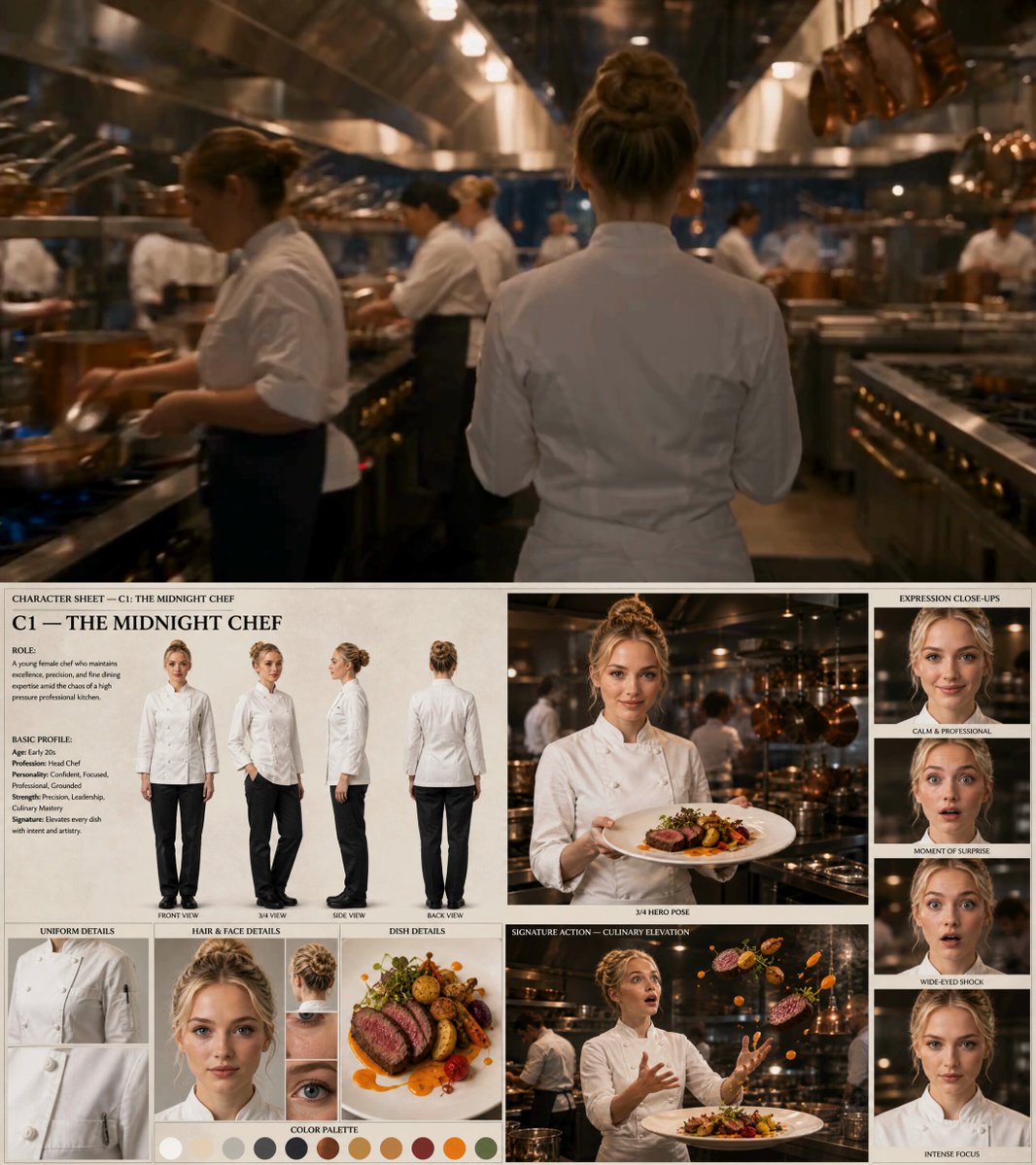
For every recurring character, assemble a small set: neutral front view, three-quarter view, profile, and one full-body frame in the hero wardrobe. Keep the lighting flat and even so the model learns the face rather than the mood. Alongside the images, write a feature note — hair color and length, build, distinguishing marks, and the exact wardrobe for each scene. When a shot fails, the note tells you whether the prompt or the reference was wrong.
The style bible
Pin your visual identity in writing so it survives multiple sessions and multiple tools. Record a palette with a handful of anchor colors, a preferred lens family, a grain or texture preference, and a contrast curve described in words. If you apply a grade preset in post, name it here, because matching generated footage to a fixed grade is far easier than matching it to a memory.
Location plates
Build a mini pack per location: one wide plate, one reverse angle, and notes on time of day, weather, and key props. Continuity errors in AI video are more often location errors than face errors. A door that opens the wrong way or a street that changes direction reads as a mistake faster than slightly different eyebrows.
Continuity checkpoints
Before generating a scene, re-read the previous scene's shots. Ask three questions: does the light direction match, does the wardrobe match, does the geography match? Two minutes of checking saves an hour of regeneration.
Sound, Timing, and the Audio-First Decision
Audio is not a finishing step. It is a scheduling input.
Dialogue first when lip sync matters
If characters speak on camera, record or generate the voice track before generating the shot. Measure the exact length of each line, then set the shot duration to the audio rather than trimming audio to fit footage. This single change removes most lip sync pain, because the performance has a fixed length the model can be asked to match. A script assistant can help by rewriting lines to hit a target duration — "make this line land in three seconds" is a request it handles well.
Where lip sync is not required, invert the approach: lock the visuals and lay narration over them. Talking-head precision is expensive; narration is forgiving.
Music as a structural map
Choose a temporary track early and mark cue points against your beat sheet: where the theme enters, where it drops out for a line of dialogue, where it resolves. A drop-out is the cheapest way to make a generated sequence feel intentional, because silence creates emphasis no camera move can match.
Ambience as glue
Give ambience its own column. Room tone, rain, traffic, and machine hum bond mismatched shots together and hide the small continuity gaps generative footage inevitably produces. Two shots from different engines will never match perfectly, but under consistent room tone the audience stops looking.
Choosing Your Stack Without Locking Yourself In
Evaluate tools against your shot list, not against demo reels. Demos show peak quality on a curated shot; your project needs predictable quality across forty attempts.
Useful criteria:
- Usable clip length. Can it hold a shot long enough for your longest planned take?
- Camera control. Does it accept movement instructions, or does it improvise?
- Reference support. Can you supply character and location images?
- Aspect ratios you actually deliver in. Vertical matters if the destination is short-form.
- Resolution and upscaling path. Can a selected shot survive a grade and a crop?
- Audio handling. Generated, imported, or ignored — know which before you plan dialogue.
- Predictability. This is the criterion people underweight. A slightly less spectacular model that behaves consistently will finish a project faster than a spectacular one that requires twenty attempts per shot.
Then test the whole pipeline end to end on one scene: generate, edit, grade, mix, export. The friction you discover in that hour shapes better decisions than any feature comparison table.
Common Mistakes and How to Fix Them
- Prompting before planning. Symptom: clips that look good individually and will not cut together. Fix: write the shot list first, even a rough one.
- Switching engines mid-sequence. Symptom: a visible texture or motion change between adjacent shots. Fix: finish a scene on one tool, or lock a style bible and re-test a single shot before committing.
- Two actions in one shot. Symptom: warped limbs, unclear motion, an action that resolves halfway. Fix: split into two shots.
- No reference pack. Symptom: a character ages, changes hair, or changes build. Fix: build references before the first prompt.
- Audio left to the end. Symptom: every shot is slightly too short or too long. Fix: generate dialogue and choose music before final shot lengths are locked.
- Reviewing without gates. Symptom: notes that reopen finished decisions. Fix: three explicit locks — story, shot, cut — and a written rubric.
- Judging takes by feel across dozens of clips. Symptom: endless scrolling and decision fatigue. Fix: score each candidate one to five on subject fidelity, motion quality, composition, and continuity with neighbours. Average, keep the top two, stop watching the rest.
FAQ
How long should a first AI video project be?
Sixty to ninety seconds. Long enough to include a turn, short enough to finish and iterate.
Do I need a script if I am generating from prompts?
Yes. A prompt is a production decision, and production decisions without a story produce attractive noise.
How many candidates should I generate per shot?
Plan for three to six and expect to keep one. Anything beyond ten usually means the prompt or the reference is wrong, not that you need better luck.
Can I mix generated shots with real footage?
Often this is the strongest approach. Real plates for establishing shots and inserts reduce generation volume and give the edit a stable visual floor.
What breaks continuity fastest?
Changing wardrobe or lighting language between prompts. Lock a style bible and a per-scene wardrobe note, then vary only what the shot demands.
How should I handle text and logos?
Avoid depending on generated text. Composite real graphics in the edit, or frame the shot so text is implied rather than read.
When is it time to stop regenerating a shot?
When it passes your rubric and cuts cleanly with its neighbours. Further iteration on a passing shot usually costs time without improving the finished piece.
Is a shot list overkill for a solo creator?
A solo creator benefits most, because there is no one else holding the plan in their head.
How do I keep a long project consistent across weeks?
Keep four living documents: the shot list, the prompt library, the character and location reference packs, and the style bible. If a decision is not written down, assume it will drift.
Where does an AI script assistant fit best?
Early in development for structure and options, and mid-production for constrained rewrites such as trimming a line to a fixed duration. Keep final creative judgement and continuity tracking outside the chat window.
Final Checklist Before You Render
- Logline written with a visible subject, a want, and an obstacle.
- Beat sheet locked, with every scene passing the change test.
- Shot list complete with IDs, durations, shot sizes, one action per shot, and one camera instruction per shot.
- Coverage pattern planned per scene, including at least one insert.
- Prompt library keyed to shot IDs, with result notes and reference links.
- Character reference packs and location plates assembled.
- Style bible written with palette, lens character, grain, and grade notes.
- Dialogue recorded and measured before shot lengths are finalised.
- Review gates, take rubric, and a predictable file naming convention agreed.
- One pilot scene produced end to end before full production begins.
Pre-production is not the slow part of AI video. It is the part that makes the fast part useful. The creators who finish are not the ones with the best model access — they are the ones who decided what the video was before they asked a machine to imagine it.
