
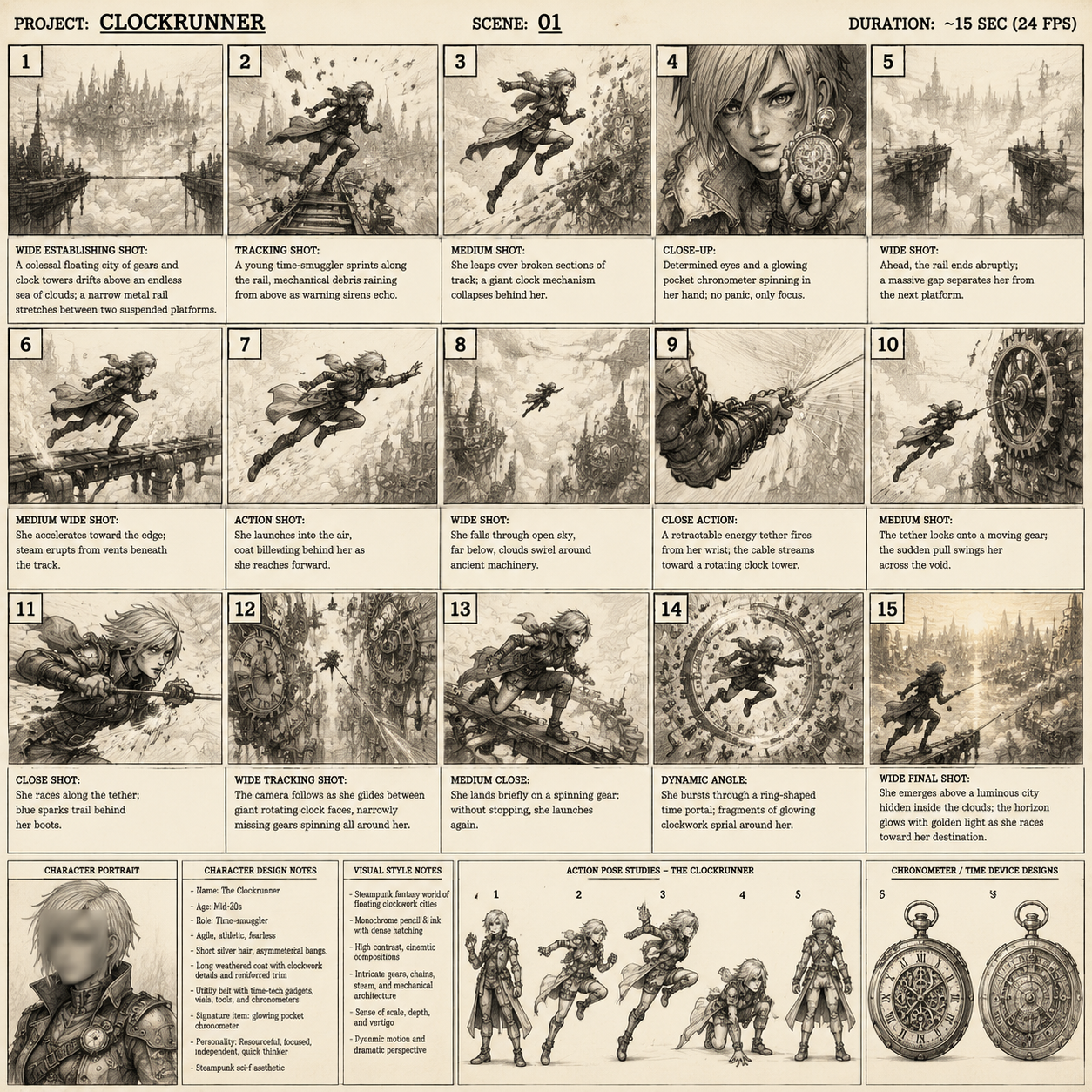

Why Script-to-Shot Design Is the Real Bottleneck
Rendering a clip now takes seconds to minutes. Deciding what that clip should contain still takes hours. That asymmetry is the defining problem of modern video production: generation has become cheap, but translation has not.
The translation layer is the space between a written scene and an executable shot. A script says: Maya hesitates at the door, then steps through. One sentence. As a shot, that sentence needs a framing choice, a lens, a lighting state, a movement, a duration, a performance beat, and a sound design decision. Multiply that by forty scenes and you have a pre-production problem that no amount of raw generation speed solves on its own.
This is where AI script analysis and automated shot design earn their place. Not as a replacement for a director, but as a way to compress the mechanical parts of the breakdown — scene segmentation, entity extraction, shot parameter drafting, continuity tracking — so that human attention goes to the choices that actually matter.
This guide walks through a complete, tool-agnostic workflow: parsing a script into structured beats, converting beats into a shot list, generating consistent keyframes, prompting shots reliably, and running quality control before assembly. It assumes you already know how to write. The goal is to make the writing executable.
How AI Script Parsing Works (and Where It Fails)
Most script-analysis systems follow a similar conceptual pipeline. Understanding it helps you write scripts that cooperate with the tools instead of fighting them.
Scene segmentation and beat detection
The parser identifies scene headings, location changes, time-of-day markers, and character entrances. It then chunks each scene into beats — usually defined as a shift in intention, location, or speaker. A beat is the smallest unit that can carry its own shot.
Good systems also tag emotional valence per beat: tension rising, tension releasing, exposition, revelation. Those tags are what drive suggestions like "push in" versus "hold wide."
Entity extraction
Characters, props, locations, and wardrobe details get pulled into a structured list. This is the seed of your continuity bible. Every recurring element should have a stable name here — Maya, not Maya in one scene and the woman in the next. Inconsistent naming is the single most common reason automated breakdowns produce incoherent shot lists.
What the parser gets wrong
Four failure modes show up repeatedly:
- Subtext. A line of dialogue that means the opposite of what it says will be tagged literally. You must override the emotional tag manually.
- Simultaneity. Action lines often describe two things happening at once. Parsers linearize them, producing shots that feel sequential when they should feel layered.
- Reaction shots. Dialogue-heavy scenes get broken down speaker-first. The interesting shot is usually the listener.
- Ambiguous pronouns. "He hands it to her" works for a human reader holding the scene in memory. For a parser it can attach to the wrong character.
The fix is a deliberate rewriting pass before parsing. More on that next.
A Step-by-Step Workflow: From Script to Shot List
This is the core loop. It works whether you are generating a 30-second social spot or a ten-minute narrative short.
Step 1: Normalize the script
Before any analysis, run a cleanup pass:
- Replace every pronoun with a proper name.
- Name every prop that recurs, even minor ones.
- Split compound action lines into single actions.
- Add explicit time-of-day and location tags if they are implied.
- Mark which lines are dialogue, voiceover, or on-screen text.
This takes twenty minutes and saves hours of cleanup downstream. A script that reads slightly redundant to a human reads unambiguously to a parser.
Step 2: Lock the look before you generate anything
Write a short style contract and keep it outside the script. It should specify:
- Aspect ratio and resolution
- Color palette and contrast character
- Lighting logic per location
- Lens language (wide, normal, long, mixed)
- Grain, texture, and grade direction
- Movement philosophy — locked-off, handheld, or choreographed
Every prompt and every keyframe generation inherits from this document. Without it, your first five shots will look like five different films.
Step 3: Generate shots in beat-sized batches
Process one scene at a time, and within a scene, one beat at a time. Batch by beat rather than by shot so that the emotional progression stays visible while you work.
For each beat, decide three things before prompting:
- Information: what must the audience learn here?
- Emotion: what should they feel?
- Transition: how does this beat hand off to the next one?
The shot type follows from those three answers. If the beat is informational, favor clarity and stability. If emotional, favor proximity and movement. If transitional, favor negative space and motion.
Step 4: Review and repair
Review at three levels:
- Technical — artifacts, warping, morphing hands, flickering backgrounds.
- Narrative — does the beat still read without sound?
- Continuity — wardrobe, hair, props, screen direction, time of day.
Log every repair as a note attached to the shot ID. Patterns will appear fast: if six shots fail on the same hand gesture, change the gesture rather than regenerating six times.
Choosing the Right Pipeline: Decision Criteria
The tool landscape splits into a few practical categories. Rather than chasing brand names, evaluate candidates against your actual production profile.
| Criterion | What to ask |
|---|---|
| Shot complexity | Does it handle multi-subject blocking, or only single-subject action? |
| Duration control | Can you specify clip length precisely, or are you at the mercy of a default? |
| Consistency | Does it accept reference images, character IDs, or seed locking? |
| Camera control | Can you direct movement, or only describe it and hope? |
| Iteration speed | How long is a regenerate cycle at your target resolution? |
| Style fidelity | Does it drift toward a house look regardless of your prompt? |
| Audio | Native dialogue and ambience, or do you plan to dub? |
| Output rights | Are commercial terms clear and suitable for your distribution? |
The single most consequential split is text-to-video versus image-to-video. Text-to-video is fast for exploration and weak for continuity. Image-to-video — where you first generate or shoot a keyframe and then animate it — is slower per shot but dramatically more controllable, because composition and lighting are decided before motion enters the picture.
My recommendation for narrative work: image-to-video for anything involving a character's face, text-to-video for establishing shots, textures, and insert material. Establishing shots do not need identity continuity. Faces do.
Keyframes and Character Consistency
Consistency is the hardest technical problem in AI video, and it is solved in pre-production, not in post.
The three-reference rule
For any recurring character, keep three reference images on hand at all times:
- A neutral front at medium distance
- A three-quarter angle with the current wardrobe
- A full-body shot establishing height and silhouette
Every generation of that character references all three. This is tedious for the first scene and nearly automatic afterward, because the references themselves become stable.
Locking the keyframe before the motion
Generate the still frame first. Approve it. Then animate it. If the still is wrong, no prompt will fix the clip. This single discipline eliminates the majority of wasted generation cycles in a typical project.
Handling wardrobe and location drift
Drift happens gradually. Scene one looks right, scene four looks close, scene seven looks like a cousin. To stop it:
- Regenerate the reference set at the start of every new location.
- Never mix references generated under different lighting conditions.
- Keep one "hero" frame per location and check new shots against it side by side.
Prompt Patterns for Reliable Shots
Prompts fail for structural reasons, not poetic ones. Use a fixed skeleton so you always know which variable broke.
The shot prompt skeleton
[Subject + wardrobe] + [action, one verb] + [environment] + [camera framing and movement] + [lens character] + [lighting] + [style and grade] + [motion intensity] + [duration]
Example:
Maya in a grey wool coat, stepping through a heavy door, dim apartment hallway, medium shot pushing slowly forward, 40mm, soft window light from the left with deep falloff, muted teal and amber grade, low motion, five seconds.
One verb. One camera instruction. One lighting statement. The temptation is to add more, and more is exactly what breaks it.
Dialogue scenes
Do not generate speaking faces and expect lip-sync to save you. Instead:
- Shoot the listener during dialogue.
- Use over-the-shoulder framing to hide mouth detail.
- Reserve one clean frontal shot for the line that matters most, and plan to dub it.
- Consider generating the dialogue audio separately and cutting picture to the audio, which gives you precise timing control.
Negative prompts worth keeping
Keep a short standing list — extra limbs, warped hands, text artifacts, lens flare, fast zoom, morphing background — and append it to every generation rather than retyping variations.
Common Mistakes and Fixes
Overloading prompts. More than two modifiers per category causes the model to average them into mush. Cut, do not add.
Changing style words mid-scene. "Cinematic" then "documentary" then "dreamy" across three shots in one scene produces three films. Freeze the style vocabulary per scene.
Ignoring eyelines. Characters looking in contradictory directions across cuts reads as an error even to viewers who cannot name it. Sketch a simple floor plan and mark camera positions.
No continuity bible. A one-page document listing characters, wardrobe, props, and locations prevents most drift. Write it on day one.
Too many shots per beat. Beginners over-cut. Fewer, longer shots are easier to generate consistently and usually play better.
Forgetting audio entirely. Plan dialogue, ambience, and music per scene at the shot-list stage. Audio decisions change shot durations.
Skipping the still frame. Animating an unapproved keyframe is the most common cause of wasted iteration time.
Chasing perfection on throwaway shots. Inserts and transitions do not need hero treatment. Spend the effort where the audience is looking.
Worked Example: A 90-Second Short
Take a simple premise: a woman returns to an empty apartment and finds a letter she did not expect.
Script pass. Six beats: arrival, discovery, reading, reaction, decision, departure. Three locations: hallway, living room, doorway. One recurring prop: the letter. One wardrobe state.
Look contract. 2.39:1, cool interiors with warm practical lamps, 35mm-equivalent lens language, minimal movement, restrained grade, low grain.
Shot list. Beat one gets a wide hallway and a medium push. Beat two gets a top-down of the letter on the table. Beat three gets over-the-shoulder inserts of text, no readable words needed. Beat four is the only close-up in the film — reserve it. Beat five is a static wide with negative space. Beat six mirrors beat one's framing to close the loop.
Generation. Nine shots total. Eight are image-to-video with locked keyframes. The close-up is generated four times and one is selected. Total revision rounds: two.
Assembly. Cut to a single music cue with a hard drop at beat four. Interior ambience only in beats one and six to bracket the silence.
Nine shots for 90 seconds is roughly right. Beginners often draft twenty-five and use eleven.
Pre-Assembly Quality Checklist
Run this before you open your editor:
- Every shot has a unique ID and a one-line description.
- Aspect ratio and resolution are identical across all clips.
- No shot contains an unresolved artifact at normal viewing size.
- Screen direction is consistent across every cut.
- Wardrobe, hair, and props match the continuity bible.
- Every clip has at least two seconds of usable, stable head and tail.
- Audio assets exist for every scene that needs them.
- The film reads without sound at the storyboard stage.
If the last item fails, the problem is the script or the shot list, not the generation. Go back one step.
FAQ
Do I still need to write a full script?
Yes. AI is excellent at translating a clear script and poor at inventing clarity. The script is the specification. Skip it and you are generating randomly and hoping.
How long should an AI-generated shot be?
Three to six seconds for most narrative work. Longer clips accumulate drift and artifacts, and shorter ones force cuts that feel nervous.
What is the fastest way to improve consistency?
Lock keyframes before animating, and maintain three stable references per character. Nothing else moves the needle as much.
Should I generate dialogue inside the video model?
Only for close-ups where you can verify the result. For everything else, generate the audio separately and cut picture to it. You get better performance control and easier revisions.
How many shots should I plan per minute of finished video?
Six to twelve for narrative, twelve to twenty for promotional. Fewer than six feels slow; more than twenty feels like a montage.
What do I do when a shot keeps failing?
Change the shot, not the seed. Simplifying the action, shortening the duration, or moving the camera usually resolves what a dozen regenerations cannot.
Is storyboarding still worth the time?
It is the highest-leverage hour in the entire pipeline. A storyboard is cheap to revise and a generated clip is not.
The pattern across all of this is simple: the more decisions you make before generation, the fewer you make after. Script clarity, a written look contract, locked keyframes, and a disciplined shot list turn an unpredictable process into a repeatable craft — one where the AI handles the mechanical translation and you handle the storytelling.
