


How AI Video Generation Actually Fits Into a Production Workflow
The most persistent myth about generative video is that one well-worded sentence produces a finished scene. In practice, the technology behaves less like a director and more like an extremely fast, extremely literal camera crew. It renders whatever you describe with impressive fidelity to surfaces, lighting, and motion — and it renders your mistakes just as faithfully. Understanding that division of labour is the difference between a workflow that scales and a folder full of beautiful five-second clips nobody can assemble into a story.
A useful mental model is this: generative models are a shot factory, not a story engine. They are outstanding at producing coverage — alternative angles, atmospheres, textures, and motion beats that would previously require a location shoot, a 3D artist, or a stock library crawl. They are poor at deciding which shot belongs where, how long a beat should breathe, or whether an audience will understand a cut. Those remain editorial decisions, and they are exactly where a creator adds irreplaceable value.
That split has practical consequences. It means your job shifts from operating equipment to specifying intent, then curating output. It also means the bottleneck in AI-assisted production is rarely generation speed. It is almost always consistency — keeping a character, a colour palette, or a camera logic stable from shot to shot — and selection, the discipline of throwing away 80 percent of what the model returns.
This guide walks through the full pipeline: how it is structured, how to write prompts that hold up once motion is involved, how to protect continuity across a sequence, how to handle animation-specific problems, and how to assemble everything so the result feels intentional rather than generated.
The Four Layers of an AI-Assisted Pipeline
Almost every successful AI video project, from a fifteen-second social ad to a short narrative film, passes through the same four layers. Skipping or blurring them is the most common cause of projects that stall halfway.
Layer one: development
Development is where you decide what the video is about before any model is invoked. Deliverables here are unglamorous and enormously valuable: a one-line premise, a beat sheet, a shot list with approximate durations, and a visual reference board. The shot list is the critical artefact, because it converts a vague creative ambition into a sequence of independently generatable units.
A good shot list entry specifies subject, action, framing, movement, duration, and emotional tone. If you cannot describe a shot in those terms, you cannot prompt it either — you will simply be guessing and hoping.
Layer two: generation
Generation covers text-to-video, image-to-video, video-to-video, and hybrid approaches. Each has a distinct strength profile:
- Text-to-video is best for establishing shots, abstract sequences, landscapes, and any moment where exact subject identity does not matter.
- Image-to-video is best when identity or composition matters. You control the frame; the model supplies motion.
- Video-to-video is best for restyling existing footage — rotoscoping effects, painterly treatments, format conversions, and matching an existing shoot's look.
- Hybrid approaches combine generated plates with practical footage, 3D renders, or illustrated keyframes, and usually produce the most professional results.
Layer three: assembly
Assembly is editing. It is where rhythm emerges and where most AI-heavy projects either succeed or collapse. Generated clips have a tendency toward uniform pacing — everything moves at the same confident mid-tempo — so deliberate cutting, speed ramps, and held frames are what break the monotony.
Layer four: finishing
Finishing covers sound design, voice, music, colour continuity, titles, captions, and export. Audiences forgive visual imperfection far more readily than they forgive bad audio. Budget real time here, not the ten minutes people usually allocate.
Writing Prompts That Survive Motion
Still-image prompting rewards adjectives. Motion prompting rewards structure. When a model has to invent movement across dozens of frames, every ambiguity compounds, which is why the same prompt that produces a gorgeous keyframe can produce a drifting, morphing mess as a clip.
The shot-description formula
A reliable structure for video prompts is: subject + action + environment + camera + light + style + duration constraint. For example: "A lone cyclist pedalling uphill on a rain-slick coastal road, medium tracking shot from a car window, overcast diffused light, muted teal and grey grade, documentary realism, six seconds."
Each element does specific work. The camera clause stops the model from defaulting to a slow push-in, which it will otherwise do constantly. The light clause prevents the harsh noon-day look that appears whenever lighting is unspecified. The duration clause forces you to think about whether the action can actually resolve in the time available.
Constraints matter more than flourishes
Describe what should not happen. Words like static frame, no cuts, single continuous motion, and steady camera act as guardrails. If your clip keeps splitting into unintended montage, an explicit single-shot instruction usually fixes it. If limbs keep warping, specifying a wider framing or a partially obscured subject removes the model's opportunity to fail at anatomy.
Iterate on one variable at a time
When a clip is close but not right, resist rewriting the whole prompt. Change one element — camera, light, or action — and regenerate. Systematic variation teaches you what each model responds to, and it produces a set of usable alternates rather than a single lucky result.
Keeping Continuity Across Shots
The single biggest quality gap between amateur and professional AI video is continuity. Two clips that look great alone can feel jarring together if the light direction flips or a character's jacket changes colour.
Anchor everything to a reference frame
The most reliable technique is to generate or select a hero frame for each scene, then drive every subsequent shot from that frame using image-to-video. This locks palette, wardrobe, lens character, and grade far more effectively than repeating descriptive text.
Lock your vocabulary
If your first prompt says "muted teal and grey grade," do not later write "cool blue tones." Consistency of language produces consistency of output. Keep a project glossary of exact phrases for your look, your main character, and your locations, and paste them into every prompt.
Manage identity explicitly
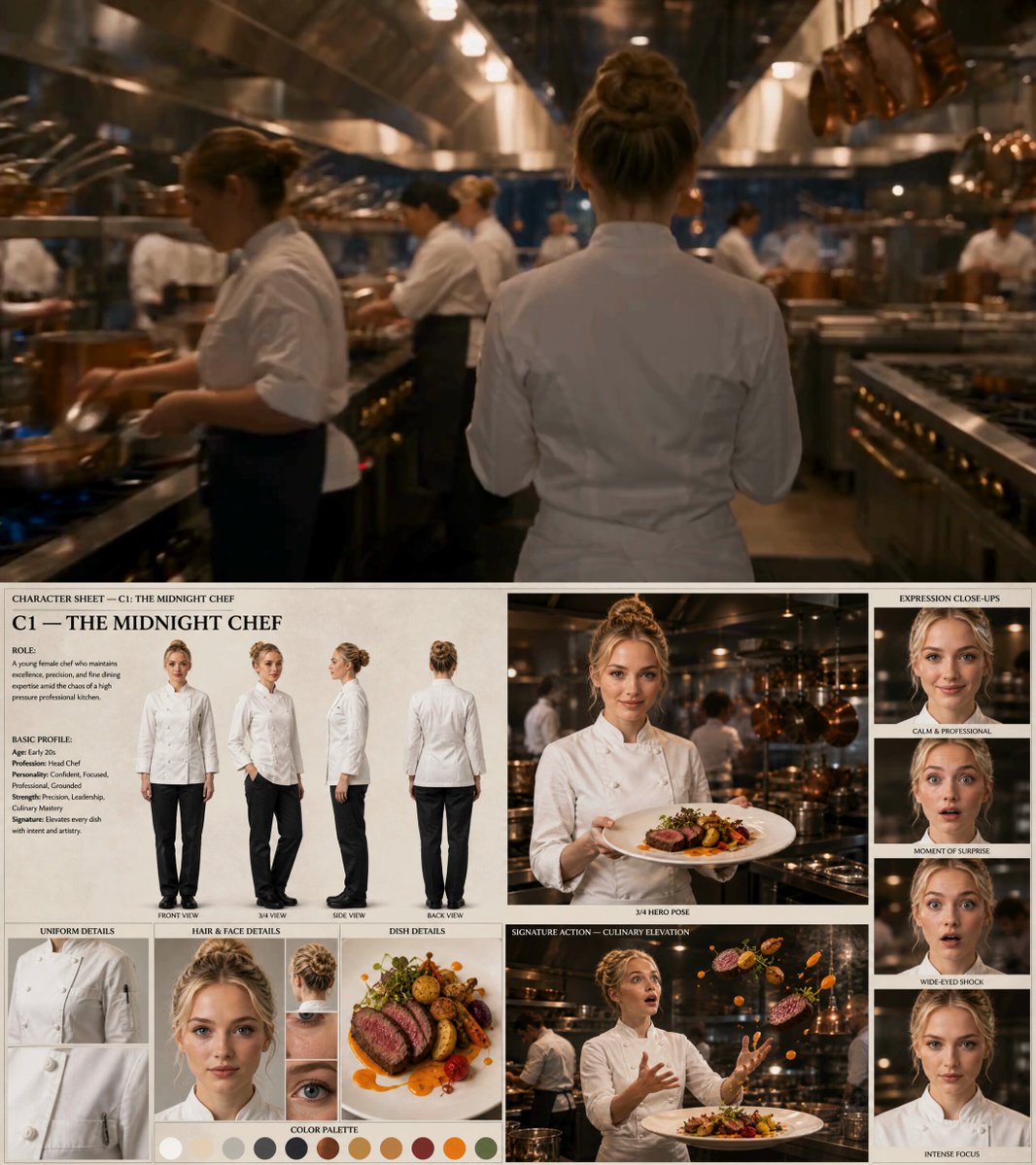
For recurring characters, build a small reference sheet: front view, profile, three-quarter view, and a couple of expression variants. Feed those references into every shot. Where the model still drifts, accept that the fix may be editorial — keeping a character in medium or wide shots, or partially turned away, is a legitimate and often more cinematic solution.
Control what the audience can verify
Audiences notice continuity errors in proportion to how closely they are looking. Fast cuts, motion, foreground occlusion, and short shot durations all disguise small inconsistencies. Long static close-ups expose them. Design your shot list with that trade-off in mind rather than fighting it after the fact.
Animation Techniques: Characters, Objects, and Camera Movement
Animation is where generative tools shine brightest, because the source material is already synthetic and the audience has no real-world reference to compare against.
Character animation
The dominant workflow is pose-driven: create or source a keyframe illustration, then use it as the first frame for an image-to-video pass with a motion prompt describing the performance. Weight, follow-through, and secondary motion — hair, cloth, tails — are the details that make a result feel animated rather than merely moved.
For dialogue, generate the voice track first and animate to it. Animating first and dubbing later forces the performance to fight the audio, and lip sync tools will visibly strain to reconcile them.
Rigid objects and physics
Rotating props, vehicles, and machinery are the hardest category, because audiences have strong intuitions about weight. Two tricks help. First, shorten the clip: three seconds of convincing motion beats eight seconds of drifting. Second, give the object a clear pivot and a visible ground plane so the model has spatial anchors to reason from.
A camera-move vocabulary worth memorising
Generative models respond well to a small set of established terms:
- Push in / pull out — emphasis and reveal.
- Truck left or right — lateral parallax, good for showing scale.
- Orbit — hero shots of objects and characters.
- Crane up / down — geography and scale.
- Handheld — immediacy and documentary energy.
- Locked-off tripod — clarity, formality, and comedy timing.
Mix these deliberately across a sequence. A scene that uses a push-in for every shot feels hypnotic in a bad way.
Smoothing and interpolation
If a generated clip has a low or irregular frame cadence, interpolation tools can raise it to a deliverable frame rate. Use them carefully: aggressive interpolation creates the infamous soap-opera look and can invent detail that contradicts your art direction. A mild pass is usually enough.
Sound, Voice, and Rhythm
Sound is where AI video most often looks cheap. A visually convincing sequence with flat audio reads as a demo, not a film.
Build the sound bed first
Before finalising visuals, lay a scratch music track and a rough voiceover. Cut the visuals to that timing rather than fitting audio to picture. Music gives you structural beats for free: downbeats become cut points, and a build gives you permission to hold a shot longer.
Voiceover and narration
Modern text-to-speech handles long-form narration confidently when you give it punctuation to work with. Short sentences, deliberate commas, and paragraph breaks produce natural breathing. Avoid abbreviations, symbols, and all-caps emphasis, which are read literally or ignored inconsistently.
Foley and ambience
Simple layers matter enormously: room tone under dialogue, wind under exteriors, cloth movement under action. Even a single well-placed whoosh on a transition does more for perceived production value than doubling your render resolution.
Mixing priorities
Dialogue intelligibility first, then music, then effects. Side-chain the music under the voice rather than simply lowering the whole track. Aim for consistent loudness across the piece; uneven levels are more noticeable than slightly soft overall volume.
Assembly and Post-Production: Where Craft Takes Over
Generation produces raw material. Editing produces meaning.
Shot selection discipline
Assume you will use roughly one in five generated clips. Watch each one without sound first, judging only composition and motion quality, then with sound. Mark in and out points immediately — the frame where motion is cleanest, the moment a morph begins. Never keep a clip just because it was expensive in time to make.
Cutting for rhythm
Vary shot lengths. A sequence of uniform four-second clips feels mechanical. Try alternating a one-second insert with a six-second wide. Use J-cuts and L-cuts so audio leads or trails picture; it is the cheapest way to make AI-generated material feel professionally assembled.
Colour continuity
Apply one grade to the whole piece. Shot-matching tools, scopes, and a consistent set of curves will unify clips generated on different prompts or even different models. If one shot refuses to match, desaturating it slightly and reducing contrast often blends it into the sequence.
Titles, captions, and deliverables
Burn in nothing you might need to change. Export a master with separate caption files, plus platform-specific versions at the correct aspect ratio and duration limits. Vertical, square, and widescreen cuts are not resizes — reframe them, because a centre crop often destroys the composition you generated.
Choosing Tools: Decision Criteria That Actually Matter
Feature lists are long and nearly identical. What separates tools in daily use is narrower.
- Controllability over cleverness. Does the tool let you specify camera motion and input frames explicitly, or does it hide that behind a single text box?
- Maximum clip length. Longer single clips reduce assembly work but often reduce quality. Know your real needs: social spots rarely need more than eight seconds per generation.
- Consistency features. Reference-image support, reusable character definitions, seed control, and style locking matter more than raw resolution.
- Output format and fidelity. Check frame rates, container formats, alpha channel support, and whether exports are clean enough for further grading.
- Rights and licensing. Understand what you may use commercially and what you may claim as your own. This is the criterion people skip and later regret.
- Latency and iteration speed. A fast, approximate model you can run twenty times usually beats a slow, perfect one you can run twice.
- Integration. API access, batch generation, and scripting support decide whether the tool fits a solo workflow or a team pipeline.
A sensible approach is to pick two tools: one for expressive, low-control experimentation, and one for controlled, reference-driven production work. Trying to make a single tool do both usually means compromising on both.
Common Mistakes and How to Avoid Them
Writing the script after generating footage. You will generate beautiful clips that do not belong to any story. Script first, always.
Prompting adjectives instead of actions. "Cinematic, stunning, masterpiece" adds nothing to motion. Describe what physically happens.
Ignoring the first frame. In image-to-video, the starting frame determines 80 percent of the outcome. Spend your time there instead of on prompt length.
Generating at maximum duration. Long generations accumulate drift. Cut them into shorter beats you can assemble flexibly.
Skipping a scratch audio track. Editing silence produces pacing that falls apart once music arrives.
Chasing one perfect clip. Ten variations at 90 percent quality give you options; one heroic attempt gives you a fragile sequence.
Forgetting the audience's screen. Detail that reads beautifully on a monitor can vanish on a phone. Test every export on a small screen at arm's length.
Neglecting continuity planning. Decide palette, wardrobe, and lens character before generating anything. Changing your mind mid-project means regenerating everything.
FAQ: Practical Questions From Real Projects
How long does a one-minute AI video take? Expect the generation itself to be a small fraction of the work. Development, iteration, and finishing dominate. A realistic first pass on a polished minute is a multi-day effort for one person, most of it spent on selection and sound.
Can AI video replace a live shoot? For product inserts, abstract sequences, establishing shots, and animation, often yes. For performance-driven human scenes where subtle acting carries meaning, it is not there yet. The strongest results are hybrids: shoot what humans do well, generate what is expensive or impossible.
Why does my character's face change between shots? Because each generation is an independent sample. Reference frames, consistent descriptive vocabulary, and framing that hides fine facial detail are the practical fixes.
Should I animate first or record audio first? Audio first. Timing, lip sync, and performance energy all follow from a locked voice track.
What resolution should I generate? Generate at the highest practical resolution and downscale for delivery rather than the reverse. Downscaling hides artefacts; upscaling amplifies them.
How do I keep a project coherent across weeks? Keep a written style guide with your exact prompt fragments, reference frames, colour targets, and lens choices. Projects fall apart when the vocabulary drifts, not when the model fails.
Is it worth learning traditional animation or editing? Yes, and it is the fastest way to improve AI output. The people getting the best results from generative tools are usually people who already understand timing, staging, and cutting. The tool supplies frames; craft supplies meaning.
Seen that way, AI video is less a replacement for filmmaking than a compression of its most expensive stages. The creative decisions — what to show, when to cut, what to leave out — remain entirely yours, and they remain the reason an audience watches to the end.
