

Why Targeted Video Campaigns Look Different Now
Digital marketing has shifted less because of new channels than because of who — or what — does the analysis. A few years ago, a team would plan a campaign, produce three videos, publish them, and wait weeks for aggregate numbers to settle. The feedback loop was long enough that "learning" mostly meant a post-mortem nobody had time to read. Today the analysis layer runs continuously. Watch-time curves, comment sentiment, search intent, save rates, and creative performance feed back into the next asset within days rather than quarters.
The practical consequence is that targeting is no longer a checkbox inside an ad platform. It is a pipeline. Audience research shapes the brief. The brief shapes the script. The script shapes the shot list. The shot list determines what gets generated, filmed, or repurposed. AI touches every one of those stages, but not in the same way. Some stages reward automation heavily — clustering thousands of comments into themes, drafting variant scripts, generating establishing shots and b-roll. Others still depend on human judgment: deciding which single insight deserves a whole campaign, defining what the brand should sound like, and recognizing when a metric is flattering you without being useful.
This guide walks through that pipeline in order. It covers how to use analytics to isolate a real audience, how to convert findings into a video brief, how to choose among generative approaches, how to run production without losing creative control, and how to measure results without drowning in vanity numbers. It is written for in-house marketers, small creative teams, and founders who need campaigns that reach specific people rather than campaigns that merely exist.
Start With Audience Intelligence, Not Creative
The most common failure in video marketing is writing a script before knowing who will watch it. Generative tools make that failure cheaper and therefore more frequent: it now takes minutes to produce a polished, generic video that nobody needs. The fix is to reverse the order. Spend the first phase collecting and interpreting signals, and only then decide what to make.
Signals worth collecting
You do not need a data warehouse to do this well. Start with sources you already own:
- Watch-time curves from existing videos, especially the drop-off point. The second where viewers leave is often the second where your promise stopped matching their expectation.
- Comment and review text, which contains the exact vocabulary your audience uses for its problems.
- Search queries that brought people to your site, including the long-tail phrases that reveal intent level.
- Support tickets and sales call notes, the most honest record of objections you will ever have.
- On-site behavior: which product pages get revisited, which pricing sections get scrolled past, which demos get replayed.
- Competitor creative patterns, useful mainly as a map of what your audience has already seen and therefore finds predictable.
A useful exercise is to build a simple table: signal source, observed pattern, and what it implies about awareness level. A visitor who searches a comparison phrase is further along than one who searches a category term. That difference should change whether your video explains the problem or proves the solution.
Sentiment and intent at a granular level
Basic sentiment analysis — positive, negative, neutral — is nearly useless for creative decisions. What matters is granularity: which specific feature or promise generates enthusiasm, which generates confusion, and which generates objections that need to be addressed on screen within the first ten seconds.
AI-assisted text analysis helps here because it can process thousands of comments and reviews in a consistent way, grouping them into themes you can count. Treat the output as a hypothesis generator, not a verdict. If the clustering says price objections dominate, check whether those comments cluster around one specific tier or around the entire offer. The theme is the starting point; the segmentation is the insight.
Intent classification matters just as much for search and remarketing audiences. Separate people who are problem-aware from people who are solution-aware and from people who are vendor-comparing. Each group needs a different opening frame: problem framing for the first, capability framing for the second, differentiation framing for the third. One video cannot do all three without becoming incoherent.
Building micro-personas that survive reality
Traditional personas are often fiction with a stock photo attached — invented in a workshop, never updated, and biased toward whoever spoke loudest in the room. Data-derived personas are better because they start from observed behavior and can be revised when behavior changes.
A practical structure is to define three to five micro-personas, each with four attributes:
- Trigger — the event that starts their search.
- Constraint — budget, time, technical skill, or internal approval.
- Objection — the reason they hesitate.
- Proof — the evidence that would move them forward.
Keep each persona narrow enough that a single 30-second video could plausibly speak to it. Broad personas produce broad videos, and broad videos are the most expensive way to be forgettable. A persona like "marketing manager who needs to justify spend to a skeptical finance lead" gives you a script. A persona like "small business owner aged 30 to 55" gives you nothing.
From Insight to Brief: Turning Findings Into a Creative Direction
Once the audience is defined, write a brief that a director — human or automated — could execute without asking clarifying questions. The brief should fit on one page and contain six elements:
- Primary persona and awareness level. One persona per video. If you need two, make two videos.
- The single promise. One sentence. If it needs a comma splice and a caveat, it is two promises.
- The proof. A demonstration, a number, a before-and-after, or a customer statement.
- The format constraint. Vertical short, horizontal explainer, silent-first social cut, or long-form demo.
- The hook line. The first spoken or written sentence, which does most of the work.
- The action. What the viewer should do next, and how obvious that is on screen.
A common temptation is to let analytics write the creative. It cannot. Data tells you where attention breaks; it does not tell you what is interesting. The best briefs use data to set boundaries — length, tone, proof type, opening frame — and then leave the actual idea to a human. When a team skips the brief and jumps straight into generation, they usually end up with several attractive clips that do not add up to an argument.
One useful test: read the brief aloud and ask whether each element could be proven wrong. If a claim in the brief is unfalsifiable, it is decoration. Replace it with something a viewer could verify.
Choosing the Right Generation Approach for Each Job
Generative video is not one tool. It is a family of approaches with different strengths, and picking the right one per shot is most of the craft.
Text-to-video
Best for concept exploration, mood pieces, abstract transitions, and any shot where you need an idea rather than a specific object. Weaknesses are consistency of characters and products, and precise motion. Use it early, when you are still deciding what the video should feel like, then move to more controlled methods for anything that must match reality.
Image-to-video and multi-modal inputs
When brand accuracy matters, start from a real asset — a product photo, a package render, a location still, a storyboard frame — and animate from there. Multi-modal workflows that accept an image plus a text instruction plus a reference style give you far more control than text alone. This is the approach to use for product shots, logo-adjacent imagery, and anything a legal or brand team will review.
Avatar and voice-led formats
Talking-head video remains the cheapest way to deliver a complex explanation, and synthetic presenters have become good enough for internal training, localized versions of existing content, and test variants where the message matters more than the face. Be deliberate about disclosure and about audience expectations; viewers forgive synthetic presenters in instructional and B2B contexts far more readily than in emotional, testimonial-style content.
When editing automation beats generation
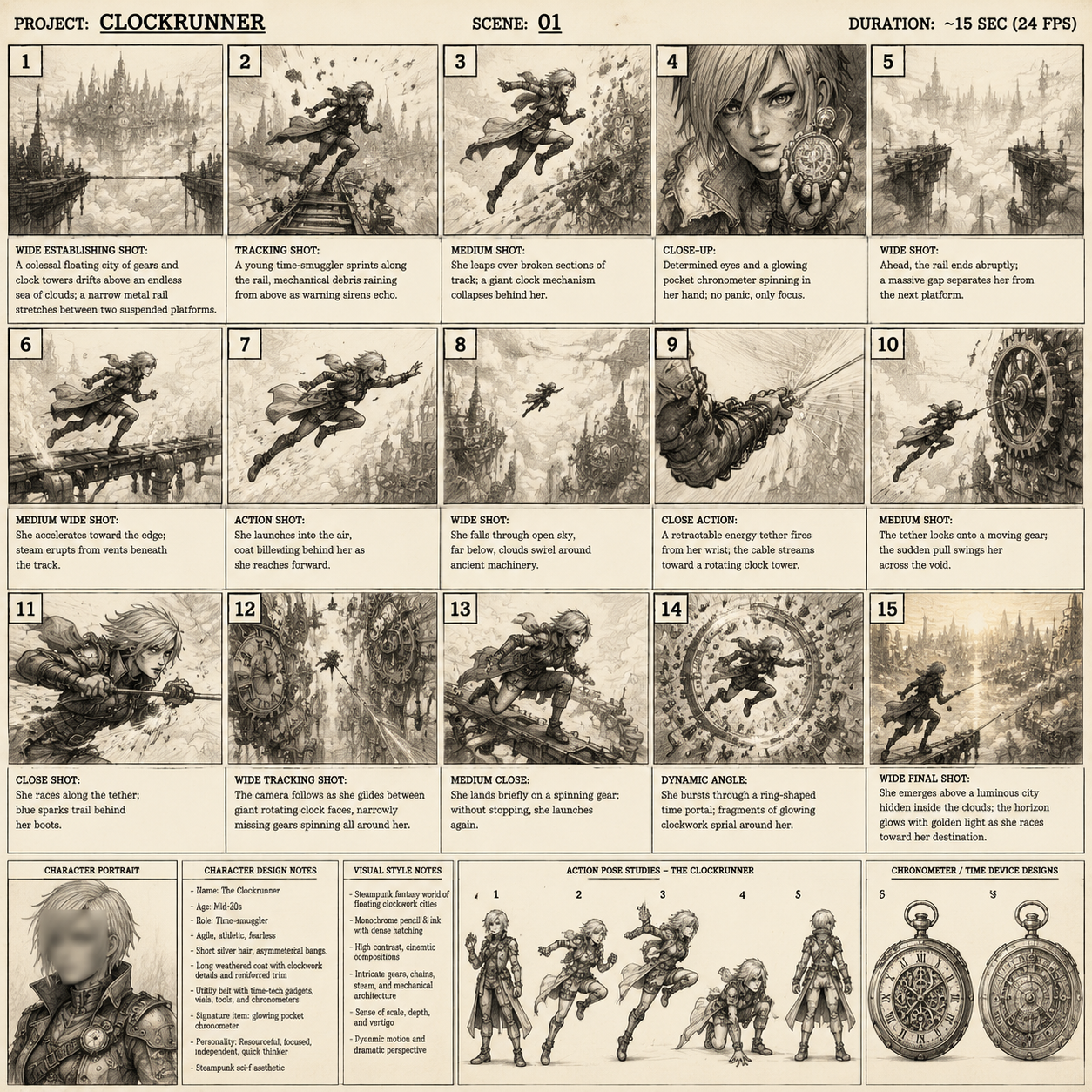
Not every problem needs a new video. If you already have strong footage, automated editing — transcript-based cutting, silence removal, auto-captioning, reframing to vertical, clip selection for short-form — produces better results faster and cheaper than generating anything. A good rule: generate what you cannot film, edit what you already have, and only then consider reshooting.
Directing the Tools: Prompts, Shot Lists, and Continuity
Generation quality depends more on direction than on model choice. A well-specified shot beats a better model with a vague instruction.
Write a shot list before you generate. Each entry should specify subject, action, camera movement, lens feel, lighting, setting, and mood. For example: "hands opening a matte black box on a wooden desk, slow push-in, shallow depth of field, warm side light, quiet and premium." That single line is far more useful than "product unboxing video."
Three habits prevent most continuity problems:
- Lock a reference set. Save approved images for each character, product, and location, and reuse them across shots.
- Keep motion simple. One camera move per shot. Complex choreography across multiple subjects is where generated footage most often falls apart.
- Separate style from content. Style instructions — color palette, film grain, lighting direction — should repeat identically across every prompt. Content instructions change per shot.
Also plan for failure. Generate more variations than you need, review in batches, and keep a reject pile. Editing is where coherence is created; a folder of ten imperfect clips often cuts into a better 20 seconds than one perfect-looking clip that has no relationship to the rest.
A Production Workflow From Script to Final Cut
A repeatable workflow matters more than any single tool. This one is designed to keep humans at the decision points and machines at the volume points.
1. Insight review (human). Two hours with the signal table and persona definitions. Output: one prioritized insight.
2. Brief (human). One page. Output: an approved promise, proof, and format.
3. Script and hook variants (machine-assisted). Draft five to ten hooks and two script structures. Humans select and rewrite.
4. Shot list (human with machine suggestions). Assign each line a method: generate, shoot, reuse archive, or edit from existing footage.
5. Asset generation (machine). Batch by scene. Tag outputs with the shot number so editors can find them.
6. Assembly (human). Cut for rhythm first, then for information. Most first cuts are too long by 30 percent.
7. Localization and accessibility (machine with human review). Subtitles, translated voice tracks, audio description where required. Review all translated scripts for meaning rather than literal accuracy.
8. Variant production (machine). Produce alternate hooks, endings, and length cuts from the same master timeline so testing measures creative, not production inconsistency.
9. Distribution packaging (human). Aspect ratios, thumbnails, first-frame text, captions, and platform-native pacing.
10. Measurement handoff (machine). Ensure every variant has a distinct identifier before launch, otherwise testing is guesswork.
Document this once and reuse it. Teams that skip documentation end up re-deciding the same questions every campaign, which is where most of the time actually goes.
Creative Testing at Scale Without Losing the Brand
Generative tools make it trivial to produce fifty variants and ruinous to produce fifty inconsistent ones. Structure testing around a small number of variables and hold everything else constant.
High-value variables to test:
- Hook type: question versus claim versus demonstration.
- Proof form: metric, customer voice, side-by-side comparison.
- Pacing: first cut at three seconds versus six seconds before the payoff.
- Format: silent-first with captions versus voice-led.
- Length: 15 versus 30 versus 45 seconds, measured by completion rate and downstream action, not by views.
Low-value variables to avoid: color grading preferences, minor music swaps, and anything you cannot articulate as a hypothesis. Every test should begin with a prediction. If you cannot say what you expect to happen and why, you are not testing, you are shuffling.
Define a stopping rule before launch. Small samples produce noisy winners, and acting on noise wastes more budget than a slower decision. Aim for enough exposure per variant to distinguish a real difference from coincidence, and be willing to call a test inconclusive rather than crown a false winner.
Measurement: Metrics That Decide the Next Move
Most video dashboards are built to impress, not to decide. Build yours around three layers.
Attention layer. Hook retention at three seconds, average watch time, completion rate. These diagnose the creative.
Response layer. Click-through, save rate, share rate, comment quality, and reply volume. These diagnose relevance.
Outcome layer. Qualified visits, trials, pipeline, or revenue, depending on your business model. These diagnose whether the campaign was worth making.
Attribution remains imperfect, especially for brand-led video. Use direction over precision: compare cohorts over time, hold audience definition constant across variants, and use incrementality checks — geo splits, holdout groups, or staged rollouts — when budget allows. When metrics conflict, trust the outcome layer and treat attention metrics as diagnostics rather than goals. A video with a spectacular completion rate and no downstream action is usually entertaining rather than persuasive.
One more discipline: write down the decision each metric could trigger. If a number cannot change what you do next, remove it from the report.
Mistakes That Quietly Kill AI-Driven Video Campaigns
- Producing before segmenting. If the audience is not defined, variants compete against each other in the same auction.
- Optimizing for novelty. Synthetic visuals are only interesting the first time. Substance retains attention.
- Letting tool limits define the concept. Decide what the video must communicate, then choose tools.
- Ignoring brand consistency across generated assets. Fix a palette, a typographic system, and a sound signature up front.
- Skipping captions and sound-off design. A large share of views happen muted.
- Treating localization as translation. Idioms, humor, and pacing do not survive literal conversion.
- No review step. Every published asset should pass a human check for claims, rights, and tone.
- Over-automating judgment. Automate volume; keep decisions human.
Tooling Criteria and Frequently Asked Questions
Choose tools by capability category rather than brand loyalty. You will generally need something for insight clustering, something for conceptual generation, something for controlled image-to-video work, something for synthetic voice or presenters, and something for editing automation. Evaluate each on output consistency, control granularity, export flexibility, licensing clarity for commercial use, and how easily outputs move into your editing software.
How do I know if my audience segmentation is good enough?
If you can describe the trigger, constraint, objection, and required proof for each segment in one sentence, it is good enough to write a brief from. If segments overlap heavily or you need a paragraph each, simplify.
How many videos should one campaign include?
Start with one master asset and two to four variants that differ in hook or proof. Testing more variables than that in a single cycle makes results unreadable.
Can AI replace a creative director?
No, but it removes the excuse for slow iteration. Direction is still about choosing one idea and defending it against attractive alternatives — a judgment task that benefits from taste, context, and accountability.
What is the fastest legitimate improvement to a weak campaign?
Rewrite the first three seconds and add captions. Hook and sound-off legibility account for a disproportionate share of performance differences and take hours rather than weeks to change.
How should small teams sequence investment?
Insight analysis first, editing automation second, generation third, synthetic presenters last. This order maximizes payoff per hour spent and keeps the creative grounded in audience evidence.
A thirty-day starter plan
Week one: assemble signals, build the persona table, and pick one prioritized insight. Week two: write the brief, script three hook variants, and lock a shot list. Week three: generate or shoot assets, assemble the master cut, and produce variants with distinct identifiers. Week four: launch with a defined stopping rule, then review attention, response, and outcome metrics separately before deciding the next brief.
Targeted video campaigns are not won by the most advanced model. They are won by teams that know exactly who they are speaking to, make one clear promise, and iterate faster than the feedback loop they once relied on.
