


Why Video Is Now the Default Business Channel
Video has become the fastest way for a business to explain what it does. Buyers watch a short product walkthrough before they read a landing page, candidates watch a culture clip before they apply, and partners watch a two-minute overview before they book a call. Feeds autoplay, most viewers start with sound off, and the first two seconds decide whether anything else gets seen at all.
That shift changes the production question. It is no longer "should we make video?" but "how do we make enough video, at a consistent quality, without a shoot day for every idea?" The bottleneck moved from cameras to capacity: scripting, storyboarding, revisions, voiceover, captions, and versions for every platform. One campaign can now require a dozen aspect ratios, three languages, and five different opening hooks, all inside a single week.
AI video tools answer part of that demand. They collapse the cost of iteration, let a single editor produce what used to need a small crew, and make localization realistic for mid-sized companies rather than only for enterprises. What they do not do is decide what the video should say, who it should persuade, or whether the offer is worth watching. Those remain human decisions, and they are where most video programs succeed or fail.
What AI Changes in the Pipeline — and What It Doesn't
Generative video models have removed three specific frictions. First, concept visualization: you can turn a script into an animatic in an afternoon instead of waiting for a shoot. Second, volume: the same core message can be re-rendered in vertical, square, and widescreen with different pacing, without re-editing from scratch. Third, refresh speed: when a hook underperforms, you can regenerate the opening and retest within hours.
The list of things AI does not fix is longer, and worth internalizing before you buy anything. It does not fix weak positioning, an unclear offer, a boring product demo, or a brand with no visual identity. It does not replace an editor's sense of rhythm, and it does not remove the need for a review process. A generated clip that looks impressive but says nothing will perform exactly like an expensive clip that says nothing.
A useful mental model: treat AI as a production accelerator attached to a human strategy layer. Strategy sets the message, the audience, and the success metric. Production turns that into shots and cuts. If the first layer is vague, the second layer only produces vagueness faster.
The End-to-End Workflow: From Brief to Published Cut
Start With the Job, Not the Tool
Every video should have one job: book a demo, explain a feature, reduce support tickets, recruit engineers, announce a release. Write that job at the top of the brief, then write the single action you want from the viewer, then write the one sentence they should remember. If you cannot fill those three lines, no model will rescue the video.
Write for the Ear, Not the Page
Scripts that read well on paper often drag when spoken. Keep sentences short, avoid stacked clauses, and read the draft aloud with a timer. For a 30-second short, aim for roughly 70 to 85 spoken words. For a two-minute explainer, plan for four or five discrete beats, each with its own visual idea, rather than one long monologue over generic footage.
Choose a Generation Mode Deliberately
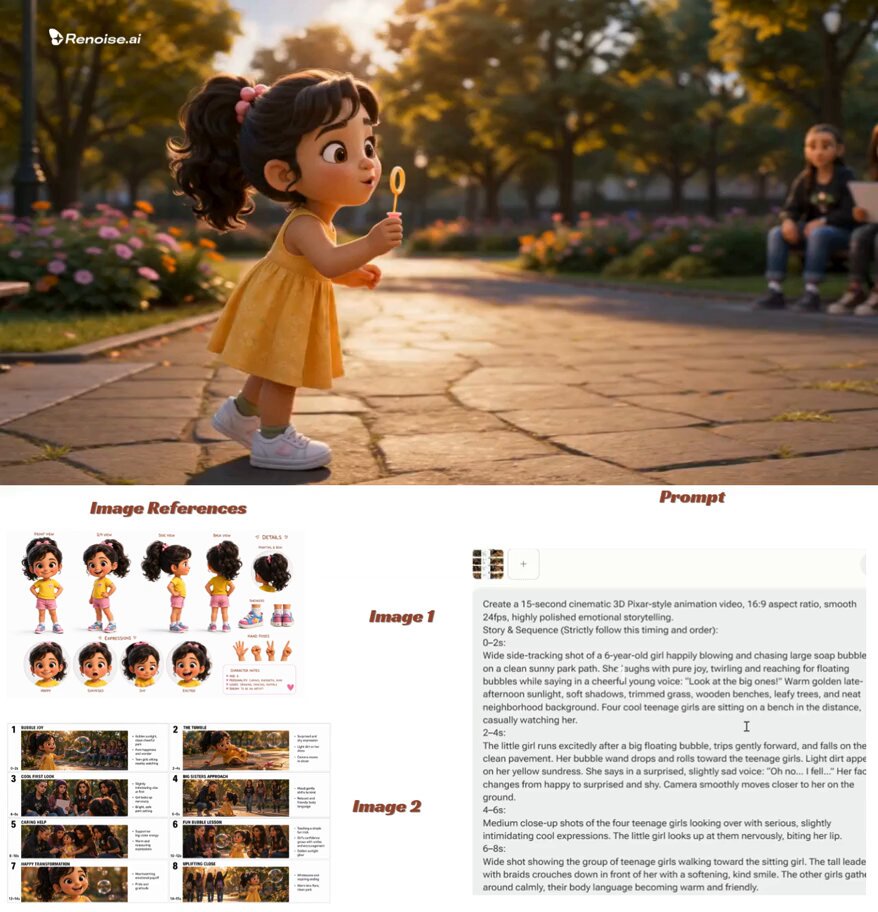
Text-to-video works best for abstract or atmospheric shots: light moving across a surface, a city at dusk, a stylized background. Image-to-video is better when brand accuracy matters, because you control the first frame and the model animates from it. Edit and extend modes are for fixing small problems: replacing a background, extending a shot by a second, changing a sign or a screen. Matching the mode to the task saves more time than any prompt trick.
Assemble Voice, Music, and Captions
Synthesized voice has become good enough for many internal and support videos, and good enough for ads when the script is conversational. For brand films and founder-led content, recorded human voice still carries more warmth. Whatever you choose, mix the audio before you judge the cut: inconsistent loudness makes good visuals feel amateur. Then add captions. A large share of viewers watch with sound off, and captions are also your accessibility baseline.
Cut for Retention, Not for Beauty
Retention is built in the first three seconds and defended every five. Open on motion or on a claim, not on a logo. Cut the first shot you loved if it delays the point. Remove any pause longer than half a second. A rough rule: if you can delete two seconds without losing meaning, delete them.
Publish Platform-Native Variants
One export does not fit every channel. Vertical for short-form feeds and paid social, widescreen for websites, sales decks, and long-form platforms, square for feed placements that crop aggressively. Change more than the aspect ratio: reorder the hook, adjust caption size, and trim the ending to match how each platform is consumed.
Choosing Tools by Task, Not by Hype
Most teams do not need one perfect tool. They need a small stack where each part handles a specific job and the handoffs are clean.
| Task | What to look for | Why it matters |
|---|---|---|
| Ideation and scripting | Fast drafting, version history | Volume of ideas beats polish at this stage |
| Storyboard frames | Image generation with style control | Locks look and framing before spending on motion |
| Motion clips | Consistent character and scene rendering | Inconsistency is the main cause of reshoots |
| Presenter or avatar | Natural lip-sync, editable script | Useful for training and localized versions |
| Voiceover | Voice range, pacing control, clean output | Audio quality drives perceived production value |
| Captions and translation | Accurate timing, multi-language export | Unlocks reach without a second edit |
| Assembly and finishing | Timeline editing, audio mixing, brand kit | Where the video actually becomes watchable |
Decision criteria worth weighing before committing: output length limits, resolution and frame rate, how much control you get over camera and subject, consistency across shots, commercial usage terms, export formats, and how long a render takes during a deadline. Speed and consistency usually matter more than maximum fidelity, because a slightly softer shot delivered on time beats a perfect shot delivered late.
Format Decisions That Quietly Change Performance
Aspect ratio is not a cosmetic choice. Vertical video changes how much context a viewer sees, which makes close-ups and single-subject framing far more effective. It also rewards text and captions as primary design elements rather than subtitles added afterward. Horizontal formats allow wider scenes, side-by-side comparisons, and product interfaces that need room to breathe, which makes them the better fit for demos and long-form education.
Beyond shape, decide on duration bands and build templates for each: 15 seconds for a hook test, 30 to 45 seconds for a single benefit, 60 to 90 seconds for a problem-solution story, and two to four minutes for tutorials and onboarding. Teams that define these bands stop arguing about length and start optimizing within a known constraint.
Building a Repeatable Content Engine
The difference between a company that publishes occasionally and one that publishes consistently is process, not talent. Four habits do most of the work.
First, batch production. Script five videos in one session, generate all footage in another, edit in a third. Context switching is what kills throughput.
Second, templates. Build a title card, an end card, a caption style, a lower-third, and a music bed selection that are reused across every video. Templates keep a brand recognizable and cut editing time dramatically.
Third, an asset library with naming conventions. Store raw generations, selected takes, voice files, and final exports with a consistent naming pattern that includes the campaign, the variant, and the aspect ratio.
Fourth, a repurposing matrix. One long-form video should yield a short hook, a quote clip, a carousel of stills, a captioned audio snippet, and a thumbnail set. Plan those outputs at the start so they are exported during editing, not recovered weeks later.
Quality Control: Failure Modes and Fixes
Generated video fails in patterns, and most failures have predictable remedies.
- Warping in hands, faces, or text. Shorten the shot, reduce motion, or switch to image-to-video starting from a clean frame.
- Text that renders as gibberish. Never let a model invent on-screen text. Generate the background, then add typography in the editor.
- Character inconsistency between shots. Lock a reference image and reuse it, or hide inconsistencies with cutaways, inserts, and tighter framing.
- Lip-sync drift. Shorten spoken segments, slow the delivery slightly, and check the sync at the halfway point of the clip rather than only at the start.
- Uncanny presenter performance. Reduce camera time, add cutaways, or use a real presenter for high-trust moments such as pricing and support.
- Pacing that feels long. Compare average view duration against video length. If people leave early, the problem is usually the first five seconds, not the middle.
- Caption errors in product names. Maintain a custom dictionary so brand terms, model names, and acronyms are spelled correctly.
- Audio inconsistency. Normalize loudness across every clip before final export; viewers forgive soft images faster than uneven sound.
Add one more safeguard: a two-person review before publishing, one checking messaging accuracy and one checking technical quality. A single reviewer tends to miss the category they are not looking for.
Measuring What Matters
Views are a weak signal because they mix accidental autoplay with genuine interest. Track a short list instead.
- Hook rate: how many viewers make it past the first three seconds.
- Average view duration as a share of total length, not in absolute seconds.
- Watch-through rate for videos under 60 seconds.
- Click-through rate on the intended action, measured per placement rather than blended.
- Conversion rate on the destination, so you can tell whether the video or the page is underperforming.
- Cost per qualified action when paid distribution is involved.
Review by variant, not by campaign. If five hooks were tested, compare them to each other. Log the winner and its structure — the opening line, the visual, the pacing — so the next round starts from evidence instead of instinct. A simple spreadsheet with one row per variant and a weekly review meeting is enough structure for most teams.
Governance: Rights, Disclosure, and Brand Safety
AI production raises questions that legal and marketing teams should answer before publishing, not after.
- Confirm commercial usage rights for every model and asset you rely on, including music beds and stock imagery.
- Keep written permission for any real person's likeness, especially when using avatars or voice clones.
- Follow applicable disclosure rules for synthetic media in your market and on each platform.
- Store source files and prompts so you can reproduce or justify a published asset later.
- Review generated footage for unintended logos, trademarks, or recognizable locations.
- Treat customer footage and internal data as sensitive; avoid uploading material your agreements do not permit.
- Keep captions and audio descriptions in the workflow so accessibility requirements are met by default.
Governance does not have to be bureaucratic. A one-page internal policy covering likeness, disclosure, licensing, and review is enough for most organizations, and it prevents the expensive version of these conversations.
FAQ and a Practical Starting Plan
How long does an AI-assisted video take?
A 30-second short with a prepared script can move from draft to export in two to four hours, including generation, voice, captions, and one revision round. Longer explainers take one to three days depending on how much custom footage is needed.
Will AI video hurt brand trust?
It depends on what it is used for. Atmospheric footage, backgrounds, and localized versions rarely raise concerns. Presenting a synthetic person as a real employee, or faking a product demonstration, damages trust quickly. Use real people and real screen recordings where authenticity is the selling point.
Should we replace our editor or agency?
Rarely. The strongest setups keep human editing and creative direction, then use generation to multiply concepts and versions. The agency, if you use one, moves up the stack to strategy and campaign design.
What is the minimum viable setup?
One capable laptop or a cloud rendering option, one scriptwriter, one editing tool, one image generator, one video generator, one voice option, and a caption tool. Add specialized models only when a specific task keeps failing.
How many videos should we publish?
Start with two per week for a quarter. That is enough to learn which hooks and formats work, and little enough to maintain quality while the process is still forming.
A first week you can actually run
Paste the last three customer conversations into a document and highlight the phrases they repeat. Those phrases are your scripts. Write five 30-second versions around the strongest one, each with a different opening line. Generate only the shots you cannot film. Edit, caption, and export vertical and widescreen variants. Publish two, measure the first three seconds, and keep the winner as a template for the next batch.
That loop, repeated, is what turns video from a project into a channel.
