
Video stopped being a campaign asset a while ago. It is now a continuous operating rhythm: a brand posts, a creator posts, a comment thread turns into a follow-up clip, and the algorithm decides within hours whether any of it deserves more distribution. Generative video tools did not create that pressure, but they changed the economics of answering it. Producing twenty variations of a hook used to require twenty shoot days or a very expensive editor. Now it requires a clear brief, a repeatable pipeline, and a decision about which parts of production should be automated and which parts should stay stubbornly human.
This guide walks through the full workflow — how to structure an always-on production system, where generative models genuinely help, how to keep a brand visually consistent across dozens of clips, how to work with creators when AI sits in the middle of the process, and how to measure the result without drowning in vanity numbers. It is written for marketers, creative leads, and small production teams who need a system they can actually run next week.
Why video production shifted from campaigns to always-on systems
The old model was linear: brief in January, shoot in February, launch in March, report in April. The new model is circular. A single strong clip generates comments, comments generate questions, questions generate the next ten clips, and the cycle repeats weekly. The bottleneck is no longer distribution — every platform wants more video — it is the supply of usable footage and the speed at which a team can turn an idea into something publishable.
Three forces pushed this change. First, short-form feeds reward volume and iteration, so a brand that publishes four clips a month competes against a brand publishing four a day. Second, production costs for a polished talking-head video have not dropped nearly as fast as distribution expectations have risen. Third, generative video tools became good enough for supporting shots — b-roll, product context, stylized transitions, animated explainers — which means a small team can now fill the visual gaps that used to require a stock library or a second crew day.
The practical consequence is that teams should stop thinking in terms of "one hero video" and start thinking in terms of a content system with inputs (ideas, footage, creator clips) and outputs (platform-specific cuts). Everything below is about designing that system deliberately rather than improvising it every Monday.
The end-to-end workflow: from idea to published cut
A reliable pipeline has five stages, and each one should have a named owner and a defined output. If you cannot describe what leaves stage three, you do not have a pipeline — you have a group chat.
Stage 1: Idea intake and scoring
Ideas arrive from customer support tickets, comment sections, sales calls, creator pitches, and internal brainstorms. Instead of debating them in meetings, score each idea against three questions: does it answer a real question someone asked, can it be shown visually in under fifteen seconds, and does it map to a product or brand message we already own? Ideas that pass all three go into a ranked backlog. Aim for a backlog of twenty to thirty scored ideas so production never stalls waiting for inspiration.
Stage 2: Script and shot brief
A shot brief is not a script. It is a list of what the camera needs to see: a hook line, three to five visual beats, one payoff frame, and the call to action. Keep it to a single page. For AI-assisted shots, add a line describing camera angle, lighting direction, and motion, because those three variables cause most regeneration loops. Vague prompts produce vague footage, and vague footage produces endless rounds of review.
Stage 3: Capture — human, generative, or hybrid
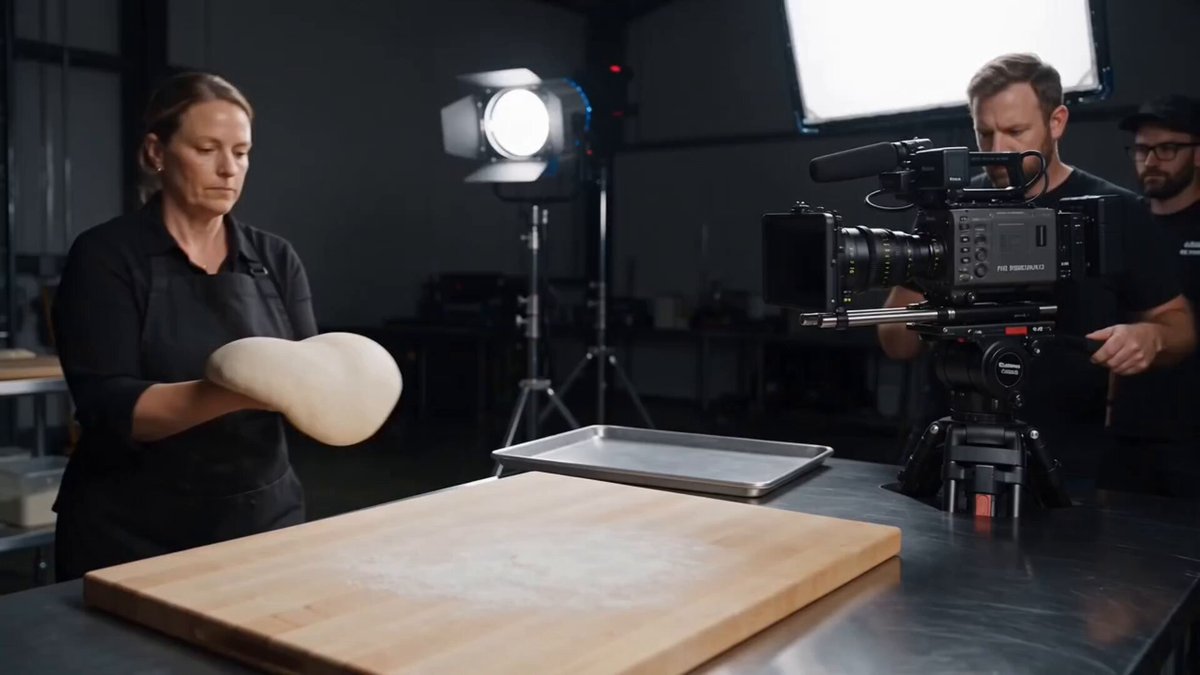
Decide per shot, not per project. A talking head with a real person should stay real; it builds trust and it is cheap to shoot on a phone. A conceptual shot — a product dissolving into light, a map animating, a texture sweep behind text — is a strong candidate for generative video because reshooting it manually would cost more than the shot is worth. Hybrid is the most common outcome: real footage for the human moments, generated footage for the connective tissue.
Stage 4: Assembly and versioning
Edit the master cut first, then create platform versions from it rather than editing each platform from scratch. The same fifteen seconds usually needs a vertical crop, a hook that lands in the first 1.2 seconds, burned-in captions, and a different opening frame for feeds that autoplay muted. Build these as a template so the versioning step takes minutes, not hours.
Stage 5: Publish, read, recycle
Publishing is not the end of the workflow; it is the start of the feedback loop. Tag every clip with its hook type, format, and creator so that after four weeks you can see which combination performed. Winning clips get re-cut with new hooks; losing clips get their visuals reused in a different context. Nothing is wasted, because footage is an asset and hooks are variables.
Where generative video models genuinely help — and where they do not
It is tempting to treat generative video as a replacement for production. It is better understood as a specialist contractor with a narrow but extremely useful skill set: it produces plausible motion for shots that are expensive, dangerous, or impossible to film.
Strong use cases include abstract brand visuals, animated data or process explanations, background plates for captioned text, stylized transitions between scenes, product-in-context shots where the real product can be composited later, and rapid concept tests before committing to a real shoot. A storyboard that used to require a designer for two days can now be drafted in an afternoon.
Weak use cases are equally important to name. Faces and hands still fail under scrutiny, especially in motion. Long dialogue scenes drift in identity and lip sync. Precise brand assets — logos, packaging text, product labels — should never be generated; composite them in post instead. And anything requiring a specific real person's likeness should be approached as a legal question before it becomes a creative one.
The practical rule: use generative models for the parts of the frame no one will pause to inspect, and use real footage for the parts people will.
Keeping character and brand consistency across dozens of clips
Consistency is the single hardest problem in AI-assisted video production, and it is the one that determines whether the output looks like a brand or like a random collection of stock clips. There are four levers worth controlling.
Character continuity
If a recurring character appears across clips — a mascot, an illustrated host, an animated presenter — lock down a reference set: three to five approved images from different angles, a fixed wardrobe description, and a written note about hair, build, and age. Reuse that reference set in every generation request. When a generation drifts, compare it against the reference set rather than against the previous clip, because errors compound when you chain outputs.
Visual style lock
Write a one-paragraph style definition that describes palette, contrast, lens feel, and grain. Something like: "warm neutral palette, soft window light from the left, shallow depth of field, slight film grain, no harsh color saturation." Attach it to every brief. Teams that skip this step end up with a feed that looks like five different brands sharing one account.
Recurring elements
Templates are consistency machines. Define a fixed lower-third, caption style, transition, and end card. When every clip shares the same three visual anchors, individual shots can vary widely without the overall feed feeling chaotic.
Review gates
Place a consistency check before editing, not after. One reviewer compares new footage against the reference set and approves or rejects in a single pass. This is faster and less political than debating aesthetics in a group review.
Working with creators when AI is part of the production
Creator partnerships change when generative tools enter the picture, and the change is mostly about clarity. Creators want to know three things: what they are responsible for, what the brand will add afterward, and how their likeness and footage will be used.
Put it in writing. A short production addendum covering the following removes most friction: which shots the creator films and which are generated; whether generated shots may include a likeness of the creator or anyone else; how long the brand can reuse the footage and on which channels; whether the creator gets approval over AI-modified versions of their own appearance; and what happens if a clip is edited after approval.
On the creative side, the most productive division of labor is to let creators own the human moments — reactions, demonstrations, opinions, humor — and let the brand own the connective tissue. Creators are usually better at the first three seconds than any brand team, and brands are usually better at keeping visual consistency across a series. Combining those strengths produces better work than either side producing everything alone.
Also consider a small always-on roster rather than one large exclusive deal. Five creators delivering two clips each per month gives you ten pieces of authentic footage, a broader audience overlap, and much lower risk if one relationship sours.
The repurposing engine: one shoot, a month of content
The highest-leverage habit in video marketing is treating every production as raw material rather than as a finished artifact. A single half-day shoot should yield far more than one video.
Start by capturing what editors call coverage: wide, medium, and close versions of the same action; clean plates with no people for text overlays; a few seconds of silence before and after each line for clean edits; and at least three takes of the hook with slightly different energy. Coverage costs almost nothing on the day and saves enormous time later.
Then run a deliberate extraction pass. From one shoot, you can typically produce: the hero cut, a vertical short, a captioned silent version, a quote card series, a behind-the-scenes clip, a comment-response video, a carousel of still frames, and two or three generated b-roll inserts that fill gaps in older footage. That is roughly ten assets from one session.
Keep an asset library organized by person, product, and setting rather than by project. When a new idea arrives, you search the library first and schedule new filming only if the library cannot cover it. Over a few months, this habit turns production from a recurring cost into a growing inventory.
Measurement: what actually matters when production speeds up
When output volume increases, average performance per clip usually falls. That is normal and does not mean the strategy is failing. Judge the system, not the individual post.
Track four numbers weekly. First, hook retention: the percentage of viewers still watching at three seconds. This tells you whether your openings work, independent of budget. Second, completion rate on clips under twenty seconds, which is the cleanest signal of whether the body of the clip earns its length. Third, saves and shares per thousand views, which correlate with durable reach far better than likes. Fourth, assisted conversion: how many people who watched a clip later visited a landing page or started a signup, measured in aggregate rather than attributed to a single clip.
Be careful with attribution claims. Short-form video rarely converts on the first view, and last-click models will consistently undervalue it. A simple weekly cohort comparison — conversion rate among viewers versus non-viewers — is more honest than per-clip dashboards.
Finally, track production throughput as a metric in its own right: ideas scored, clips published, hours per published clip. If hours per clip stop falling after the first month, your pipeline has an unidentified bottleneck, usually in review or versioning.
Common mistakes and how to avoid them
Starting with tools instead of a brief. Teams that open a generative model before writing a shot list produce beautiful footage that does not fit anything. Write the brief first, always.
Automating the human parts. Generated talking heads undercut the trust that makes creator content work. Keep real people on camera and automate the connective shots.
Chasing per-clip perfection. In an always-on system, a good clip published today beats a perfect clip published next month. Set a quality bar and defend it, but do not let it become an excuse for delay.
Ignoring consistency until the feed looks broken. Consistency is a weekly habit, not a quarterly cleanup. Review new assets against the reference set every time.
Letting prompts live in someone's head. Store approved prompts, style definitions, and reference images in a shared document. Institutional memory beats individual talent when a team scales.
Treating generated footage as free. Regeneration loops, review time, and editing complexity all cost money. Budget for iteration, not just for the first render.
Skipping the legal conversation. Likeness, music, and disclosure obligations do not disappear because a shot was generated. Clarify them before publishing, not after a complaint.
A decision checklist for building your stack
When choosing tools, resist feature lists and score against your actual workflow.
- Does it fit the pipeline stage where you are slowest? For most teams that is versioning, not generation.
- Can it hold a character or style reference across separate sessions? If not, it belongs in one-off concept work only.
- How long does an average iteration take end to end, including review and export?
- Does it produce files in formats your editor already handles, so nothing needs converting?
- What are the licensing terms for commercial use, and do they cover the channels you publish on?
- Can a non-specialist on your team run it after thirty minutes of training?
- Is there a clear failure mode when the model drifts, or does it silently degrade quality?
A stack of two or three tools used deeply will outperform a dozen tools used occasionally. Pick one generator for stylized shots, one for fast iteration and testing, keep a real camera for people, and build the rest of the workflow around editing templates.
FAQ
Do I need a production team to run this workflow?
No, but you need clear ownership. A two-person team — one creative lead who owns briefs and consistency, one editor who owns assembly and versioning — can publish ten to fifteen clips a week once templates exist.
How much of a video can realistically be generated?
For conceptual and abstract content, most of it. For anything involving faces, spoken dialogue, or precise brand assets, treat generation as a supporting layer and plan for real footage.
How do I keep a consistent look across different tools?
Define the style once in words, attach it to every brief, and enforce it in a fixed template for captions, transitions, and end cards. The template does more work for consistency than any single model setting.
What should I do when a creator's audience reacts badly to AI-assisted edits?
Be transparent in the caption about how the video was made, avoid generating the creator's likeness without written approval, and give creators a veto over AI-modified versions of their own footage. Most negative reactions come from surprise, not from the technology itself.
How often should I refresh hooks on the same footage?
Test two or three new openings on any clip that performed close to your median. Hooks are cheap to change and often double retention on footage you already own.
Is short-form the only format worth producing?
No. Long-form builds searchable depth and trust, and short-form drives discovery. Produce long-form as the source of truth and cut it into short-form rather than producing them as separate projects.
What is the fastest way to start?
Score ten existing customer questions, film one half-day session answering three of them, cut six vertical clips from that footage, and add generated b-roll to the two clips that need visual support. Then measure hook retention for two weeks and iterate from there.
The teams that win at video marketing are not the ones with the largest budgets or the newest models. They are the ones with a repeatable pipeline, a tight visual identity, a roster of real people on camera, and a habit of publishing, reading the numbers, and reusing everything they have already made.
