
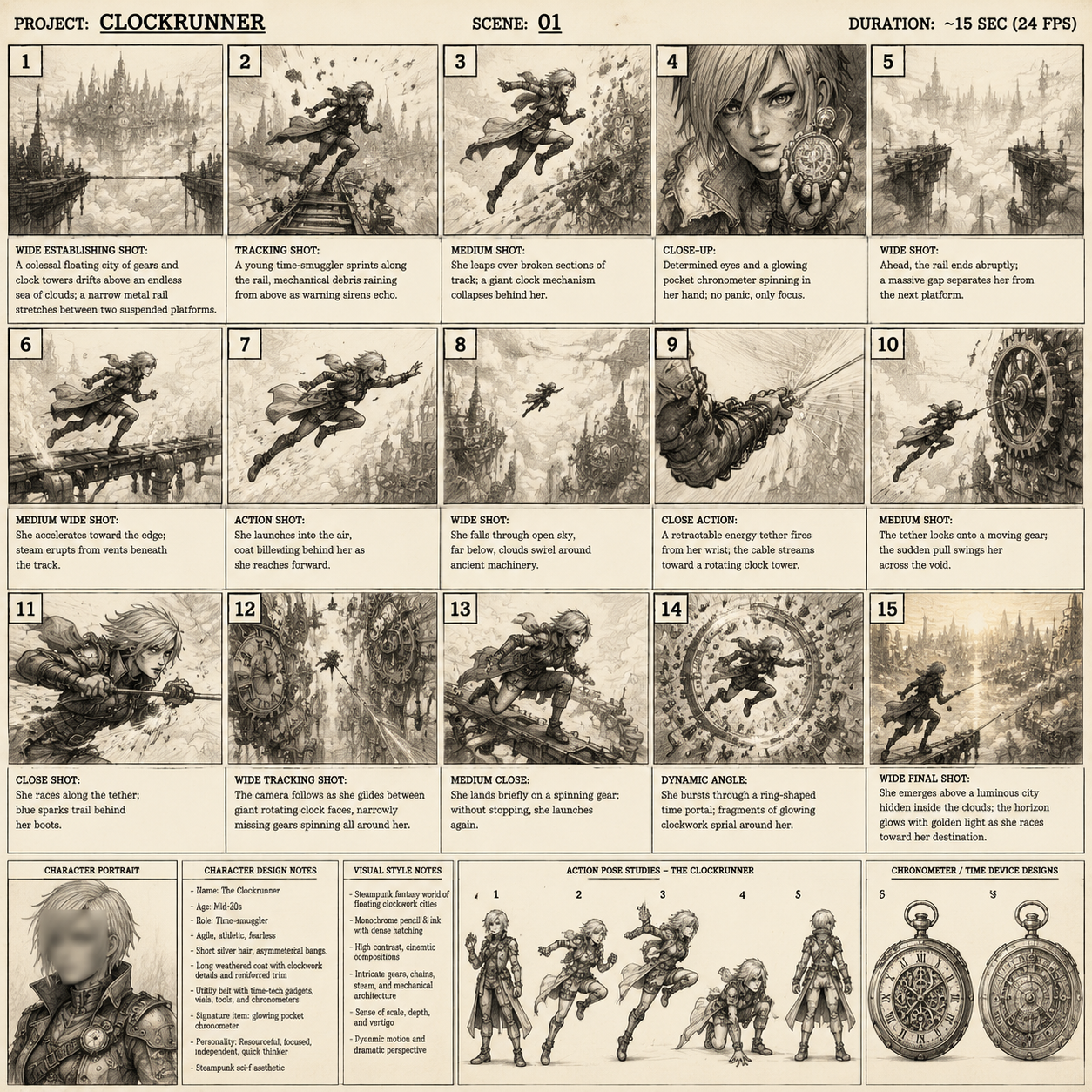
Why Prompt Quality Sets the Ceiling on AI Video
Two people can open the same model, choose the same aspect ratio, set the same duration, and get results that look like they came from different decades. One clip has drifting faces, rubbery motion, and a camera that seems confused about where it is. The other looks like a fragment of a real film: intentional framing, motivated light, movement that serves the story.
The difference is almost never the model. It is the instruction.
Modern video engines are trained on enormous amounts of footage, and they respond to how you describe a scene. Vague prompts force the model to guess, and models guess toward the average — the most generic possible interpretation of "a woman walking in a city." Specific prompts pull the output toward a particular film, a particular lens, a particular emotional register.
Think of prompting as directing rather than searching. A director does not tell a cinematographer "make it cool." They say: low angle, 40mm, hard key from the left, she stops mid-step, hold on her face for two seconds before she turns. Prompts work the same way. You are not describing a picture; you are describing a moment that happens.
This guide is a workflow for exactly that: how to structure prompts, how to control camera and continuity, how to adapt phrasing to different engines, and how to diagnose the failures that appear in almost every first draft.
The Anatomy of a Storytelling Prompt
Every strong prompt answers a small set of questions in a predictable order. Order matters: most engines weight early tokens more heavily, and clarity consistently beats volume.
Subject and Action
Start with who or what, then what they are doing in the present tense. "A tired lighthouse keeper" is a subject. "A tired lighthouse keeper pours coffee with shaking hands" is a subject with an action. Action gives the model something to animate rather than something to hold still.
Environment and Time of Day
Place the action in space and light: "in a cramped stone kitchen at 5 a.m., blue pre-dawn light through a single window." Time of day is a lighting instruction in disguise, and stating it removes the model's freedom to invent a sunny noon.
Lens, Framing, and Camera Movement
Describe the camera as a physical object in the scene: "medium close-up, 50mm, slow dolly in." If you want stillness, write "locked-off tripod shot" — otherwise many engines add drift, because movement looks more dynamic in training data.
Lighting and Color
Name the source and the quality: "single practical lamp, warm 2700K, deep shadows on the opposite wall." Avoid stacking contradictory mood words such as "bright moody daylight."
Style and Texture
Choose a filmic reference rather than a branded one: "documentary realism, fine grain, muted teal and rust palette." Look-based references are safer and more portable across engines than references to a specific title.
Motion and Pacing Cues
Add how the moment unfolds: "she hesitates, then nods once; the camera holds still." Temporal language tells the engine where the beat is and how long to linger.
The compact spine is: subject + action + environment + camera + light + style/pacing. Everything else is refinement.
Writing a Prompt Stack From Logline to Shot
A single prompt cannot carry a story. Real work comes from breaking a scene into beats and giving each beat exactly one prompt.
Step 1: Write the Logline
One sentence with a character, a want, and an obstacle. "A retired diver returns to the wreck that took her crew, to recover one last thing." Vague ideas stay vague in video; the logline is where you discover whether you actually have a scene.
Step 2: Build a Beat Sheet
Four to eight beats. Each beat is one visual idea. For the diver: descent line, hesitation at the hull, a hand on a rusted railing, a light sweeping a corridor, the object, the ascent. If a beat cannot be photographed, rewrite it until it can.
Step 3: Shot List With Camera Verbs
Assign one camera behavior per shot. Shot 1: wide, slow crane down into water. Shot 2: close on mask, static. Shot 3: over-the-shoulder, handheld drift. Shot 4: lateral track through the corridor. One verb each, no exceptions.
Step 4: Prompt Each Shot
Write each prompt in the six-block order. Keep vocabulary consistent across shots — the same words for the same character, the same palette names, the same lens family.
Step 5: Iterate on Variables, Not Vibes
Change one variable at a time. If the shot fails, decide whether it was the action, the light, or the camera that broke it. Rewriting everything at once teaches you nothing and burns an afternoon.
A useful habit: keep a plain text file or spreadsheet with columns for shot number, prompt, model, seed, and rating. After twenty shots you have a personal knowledge base of what your engines respond to — far more useful than any generic tip list.
Camera Language That Video Models Actually Understand
Camera vocabulary is the fastest lever you have, and also the most common source of confusion. Models respond best to a limited, physical vocabulary.
Movement Terms That Work
- Static or locked-off: no movement. Best for dialogue and detail.
- Slow push in: builds tension, emphasizes interiority.
- Dolly out: reveals context or isolation.
- Truck left or right: lateral movement parallel to the subject.
- Crane up or down: vertical reveal, useful for scale.
- Orbit or arc: circles a subject for emphasis.
- Handheld: instability, intimacy, documentary feel.
- Whip pan: fast transition, risky — often smears into mush.
Framing Terms
Wide establishing shot, medium shot, medium close-up, close-up, extreme close-up, over-the-shoulder, low angle, high angle, Dutch angle, top-down. Pick one framing and one movement. Stacking three movements in a single prompt produces an unreadable blur more often than not.
Lens and Format Cues
"24mm wide," "50mm normal," "85mm portrait compression," "anamorphic flare," "shallow depth of field," "deep focus." Aspect ratio belongs in settings rather than the prompt, though it is worth testing whether your engine respects "vertical framing" language.
Speed and Texture
"Slow motion," "real-time," "time-lapse," "subtle motion blur." Be careful with slow-motion prompts on short clips — the model may simply produce a slow, floaty result with no additional detail resolved.
One strong rule: if a human camera operator could not perform the move without a rig change, the prompt is asking for too much in one shot.
Keeping Characters and Style Consistent Across Shots
Continuity is where AI video workflows live or die. Faces drift, jackets change color, lighting jumps between cuts. Consistency is a system, not a lucky seed.
Lock a Character Block
Write a fixed description and paste it verbatim into every prompt where that character appears. "Maya, late 30s, cropped black hair, faded green canvas jacket, small scar above left eyebrow." Never paraphrase it. The moment you write "short dark hair" in shot four, the engine treats it as a new person.
Use Reference Images
Most engines accept one or more reference frames. Feed the same still into every shot of the same character. Keep the reference clean, front-lit, and neutral in expression.
Fix the Palette Globally
Define three to five colors and reuse the exact names: "oxidized copper, bone white, storm grey." Palette consistency reads as authorship even when faces wobble slightly.
Control the Light Continuity
If your scene is one location, describe the same key direction in every shot. An unplanned change of light direction between two adjacent shots is the most noticeable continuity break in AI video, and audiences register it instantly even if they cannot name it.
Reuse Seeds Where Supported
When a seed produces a good result, hold it and change only the prompt details. Seeds are not a magic lock, but they reduce variance meaningfully and make A/B comparisons honest.
Build a Shot Bible
Keep one document with the character block, palette, lens family, and movement rules. Share it, reuse it, version it. This is what makes a series look like a series rather than a folder of unrelated clips.
Adapting Prompts to Different Engines
No two engines read prompts the same way. The same words that produce something remarkable in one produce a slideshow in another.
Natural-Language Engines
Some models follow paragraph prompts well: full sentences, temporal order, causal language ("she reaches for the door; it opens before she touches it"). With these, write like a novelist describing a shot.
Tag-List Engines
Others behave like image models with motion: short comma-separated tokens, strongest keywords first. With these, trim adjectives and put the most important noun at the front.
A Reliable Hybrid
One descriptive sentence followed by a compact tag block: the sentence carries the story, the tags carry the technical specification. This structure survives model swaps with minimal rewriting.
Build a Personal Test Suite
Pick three hard prompts: a face in motion, a complex hand action, and a wide landscape with a moving element. Run them on any new model before committing a project to it. Twenty minutes of testing beats any feature list.
Motion, Duration, and Resolution Settings
Higher motion strength increases drift; longer duration increases the chance of late-clip collapse; higher resolution slows iteration. For exploration, generate short, inexpensive drafts and only finish the shots that earn it. This is a workflow decision rather than a prompt trick, and it saves more time than anything else in this guide.
A Practical Workflow: A Thirty-Second Cinematic Scene
Here is the full loop, start to finish, using a two-character interior scene.
- Brief. One paragraph: who, where, what changes by the end.
- Logline. "A father teaches his daughter to repair a clock he cannot fix himself."
- Beats. Six beats: workshop wide, hands on gears, the daughter's question, the father's pause, the clock ticking, a shared look.
- Shot list. Six shots, one camera behavior each, six to eight seconds of intended screen time.
- Prompt drafting. Six-block prompts, a shared character block, a shared palette.
- Draft generation. Low resolution, two variations per shot, the cheapest settings that still show motion.
- Selection. Rate each take on face stability, motion plausibility, and framing match.
- Refinement. Re-prompt only the failures, changing a single variable each pass.
- Finishing. Regenerate the winners at final resolution with consistent settings.
- Assembly. Cut for rhythm, then add room tone, foley, and a music bed.
Two practical notes. First, generate a clean plate for each location if your engine supports image-to-video; it stabilizes backgrounds dramatically. Second, cut on motion. Editing on movement hides small continuity errors that a static cut would expose immediately.
A useful refinement: rate every take before you look at the next one. Ratings made in the moment are far more honest than ratings reconstructed after thirty clips have blurred together.
Common Failure Modes and Fixes
Melting or Morphing Faces
Cause: too much motion, a face too small in frame, or an inconsistent character description. Fix: closer framing, slower movement, a locked character block, and a reference image.
Flicker and Texture Crawl
Cause: high motion settings combined with complex textures. Fix: reduce motion strength, simplify background detail, and add "consistent lighting, stable texture" to the prompt.
Unwanted Text and Logos
Cause: models reproduce signage and watermarks from training data. Fix: specify "no text, no signage, no watermarks" and avoid prompts that mention screens, posters, or book covers in the scene.
Wrong Camera Move
Cause: contradictory instructions such as "static handheld push in." Fix: one movement per shot, stated with a single verb.
Character Age or Wardrobe Drift
Cause: paraphrased descriptions. Fix: a verbatim character block plus wardrobe details repeated in every prompt.
Everything Looks the Same
Cause: defaulting to the model's average style. Fix: name a specific palette, lens, and light source instead of relying on the word "cinematic."
Motion Without Story
Cause: prompts that describe a scene but not an event. Fix: add a change — something must happen, even something small: a glance, a step, a door closing.
Audio and Lip-Sync Mismatch
Cause: generating dialogue in a short clip without matching phoneme timing. Fix: generate dialogue separately, or keep mouths out of frame during speech and cover the line with a reaction shot.
Reusable Templates and a Pre-Flight Checklist
A template removes decision fatigue without removing authorship.
Base template: [subject with locked description] + [action in present tense] + [environment and time of day] + [framing, lens, single camera move] + [light source, quality, color] + [style, texture, pacing].
Reaction shot: close-up, [character block], eyes shifting, breath visible, single practical light from camera left, shallow depth of field, static, documentary realism, subtle grain.
Establishing shot: extreme wide, [location] at [time of day], slow crane down, natural light, muted palette, 24mm, fine grain, no people.
Object shot: macro, [object] on [surface], controlled studio light, soft falloff, slow orbit, deep blacks, crisp texture, no text.
Pre-flight checklist before you generate:
- One subject, one action, one camera move.
- Time of day stated explicitly.
- Light source named.
- Character block pasted verbatim.
- Palette names match previous shots.
- No contradictory mood words.
- Duration matched to the beat, not to the maximum allowed.
- Aspect ratio set in settings, not in the prompt.
Run that list every time and your first-draft hit rate climbs quickly. Most people plateau not because their prompts are too short, but because they never built a repeatable process around them.
FAQ
How long should a prompt be?
Long enough to remove ambiguity, short enough to stay readable. For most engines, 40 to 90 words works well. Past that, models start dropping details.
Do I need a different prompt for every model?
The story content can stay identical; the phrasing, ordering, and length should adapt to each engine.
How do I stop characters from changing between shots?
Paste a fixed character description verbatim, use reference images, and keep palette and light direction constant across the sequence.
Is it better to write one long prompt or many short ones?
Many short ones. One prompt equals one shot. Trying to cover a whole scene in a single generation produces a summary rather than a film.
How many generations should I expect per usable shot?
With a well-structured prompt, typically a handful. With a vague one, dozens. Iteration count is the clearest signal that your prompt needs work.
Can I repair a shot instead of regenerating it?
Sometimes. Localized editing helps with small object errors. For problems in the core action, regenerate — repair tools rarely fix bad movement convincingly.
Where should I spend the most time?
On the beat sheet and shot list. Most disappointing AI video comes from unclear directorial intent, not from weak models.
What is the single biggest upgrade for a beginner?
Slow everything down. Fewer subjects, less movement, tighter framing, one camera verb. Restraint reads as craft in AI video far more often than ambition does.
