
Modern AI video generation has quietly crossed a threshold that is easy to miss if you only watch viral clips. The interesting change is not that a model can produce a beautiful five-second shot. It is that a small team can now produce a coherent thirty-shot sequence, revise it after client feedback, and deliver on a schedule. That shift from novelty to production discipline is what separates a demo reel from an actual workflow.
This guide treats AI video as a craft. It covers the two ecosystems that now dominate the field, how they differ when you are on a deadline, how to keep characters and style stable across shots, and how to assemble a pipeline that survives contact with a real brief.
Why AI video crossed the line from demo to production
Three things changed at roughly the same time, and together they removed the ceiling that used to cap AI video at short, unpredictable clips.
Semantic coherence improved. Earlier models generated motion that looked plausible frame by frame but fell apart logically. A character would walk toward a door and the door would merge into a wall. Current frontier systems model physical interaction and spatial continuity well enough that multi-second shots hold together without manual repair.
Control surfaces multiplied. Text prompting alone is a blunt instrument. Today you can condition generation on a reference image, a first frame and a last frame, a depth pass, a motion path, or a set of subject photos. That is the difference between hoping for the right shot and specifying it.
Open-weight models became genuinely usable. A year ago, running a video model locally meant accepting a large quality gap. That gap has narrowed enough that open-weight options are now a reasonable primary choice for many projects, particularly when privacy, volume, or customization matter more than peak fidelity.
The practical consequence is that model choice is no longer a single decision made once. It is a series of decisions made per shot, per project, and sometimes per iteration.
The two ecosystems, and what each is actually good at
It helps to stop thinking in terms of "best model" and start thinking in terms of two ecosystems with different strengths.
Hosted frontier models
These are the polished, API-accessible systems from major labs and well-funded studios: the Sora family, Runway's Gen line, Luma's Dream Machine, Pika, and several regional leaders such as Kling and MiniMax Hailuo. You do not manage infrastructure. You send a request, you get a clip.
Their strengths are consistent:
- Peak realism and physical plausibility. Complex human motion, water, fabric, and crowd scenes degrade more gracefully.
- Strong prompt adherence. Ambiguous, layered prompts land closer to intent.
- Fast iteration loops. You can test ten variations in the time it takes to configure a local environment.
- Built-in tooling. Native support for reference images, camera moves, extend-and-continue, and upscaling reduces glue work.
Their weaknesses are equally consistent: variable cost at volume, limited or no fine-tuning, data-handling questions, and rate limits that can stall a deadline.
Open-weight and self-hosted models
The open-weight side has matured fast. Families such as Wan, HunyuanVideo, Mochi, LTX-Video, and the video branches built on Flux-style image backbones now cover a wide range of quality tiers. You download weights, run them on your own hardware or rented compute, and modify whatever you want.
Their strengths:
- Predictable economics at scale. Once the hardware is in place, marginal cost per generation approaches the cost of electricity and time.
- Full control. You can fine-tune on a specific actor, product, or visual style, and you can pin a model version so results do not shift under you.
- Data sovereignty. Nothing leaves your environment, which matters for unreleased products, medical content, and anything under NDA.
- Composability. You can wire the model into a node graph alongside depth estimation, masking, and upscaling steps.
Their weaknesses: setup complexity, VRAM ceilings, inconsistent documentation, and output that often needs more post-processing to reach the same polish.
A quick way to decide
Ask three questions before you pick a model for a shot:
- Does this shot need to be indistinguishable from camera footage? If yes, start hosted.
- Will I generate more than a few hundred clips in a month? If yes, price out self-hosting seriously.
- Is the input material confidential? If yes, self-host or use an enterprise agreement with clear data terms.
Reference-driven control: the real skill of AI video
The biggest shift in day-to-day practice is that prompting is now the least important part of the job. The people producing the most consistent work are the ones who assemble reference sets.
Text prompts still matter, but as scaffolding
A prompt does three jobs: it names the subject, it describes the action, and it sets the visual register. Keep those jobs separate in your head. Vague prompts fail because they blur them. "A woman walking in a city at night, cinematic" gives the model almost no constraints. A better structure is explicit: subject, wardrobe, action, camera behavior, lighting, and a stylistic anchor.
Write prompts in that order and keep a template. It makes variation testing far easier, because you can change one variable at a time.
Multi-image referencing and subject consistency
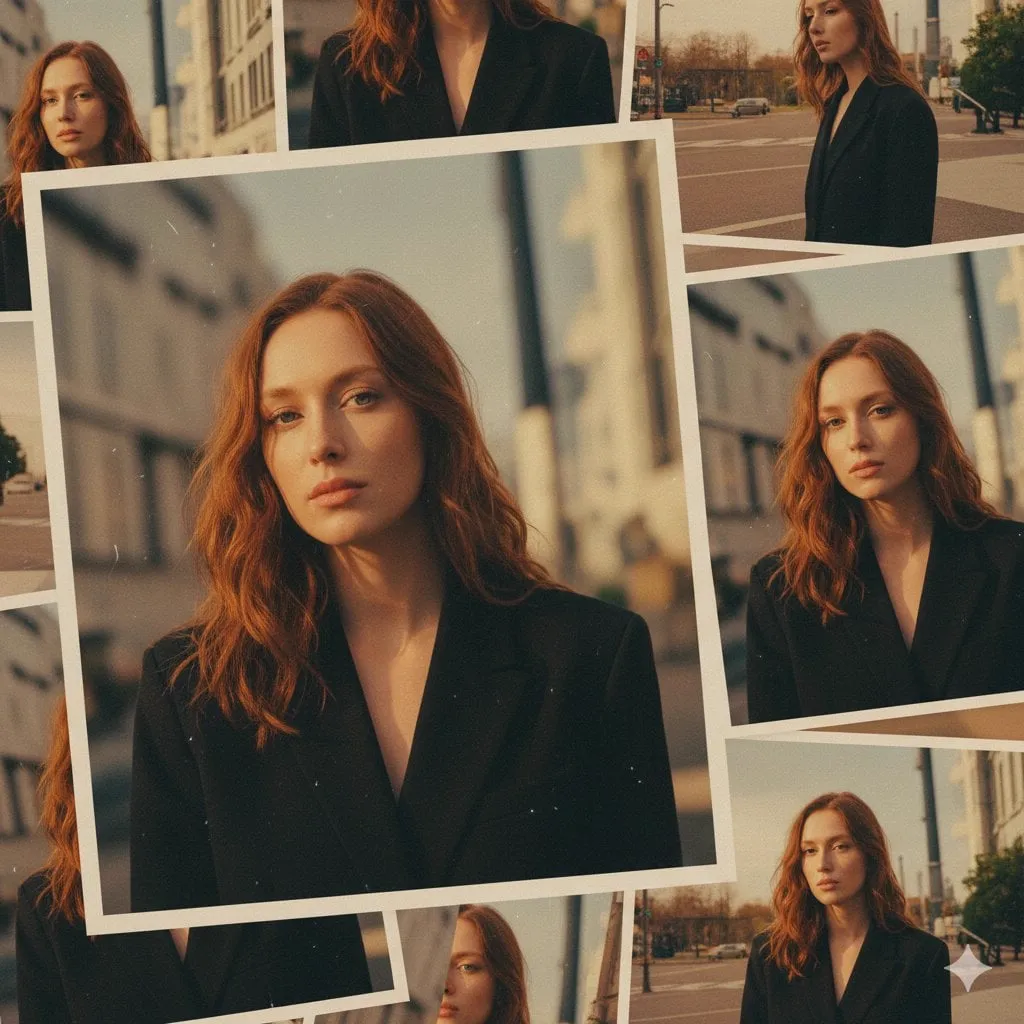
Subject consistency is where most projects live or die. The technique that has become standard is multi-image conditioning: you supply several photographs of the same person or product from different angles, and the model extracts an identity representation it reuses across generations.
To make this work reliably:
- Use 4–8 references, not 1. One photo gives the model a snapshot; a set gives it a shape.
- Vary angle, distance, and expression. Neutral and extreme expressions both help.
- Keep lighting consistent between references where possible. Mixed color temperature confuses identity extraction.
- Avoid occlusions. Hands over faces, heavy shadows, and hats break identity features.
For products, the same logic applies with one addition: include a clean turntable or at least a straight-on, a three-quarter, and a side view. Product geometry is unforgiving of gaps.
First-frame, last-frame, and motion control
Keyframe conditioning is the single most underused capability. Instead of describing where a shot ends, you supply the final frame. The model interpolates the motion between them. This turns shot design into something closer to animation blocking, and it solves the common problem of clips that drift away from the composition you wanted.
Combine keyframes with these controls where available:
- Camera path specification for dolly, crane, orbit, and handheld feel.
- Motion masks to restrict movement to a region, such as a flag waving while the rest of the frame stays locked.
- Depth or pose passes when you need precise human motion that matches a plate.
Style consistency across a sequence
Style drifts subtly between clips, especially when you switch models mid-project. Two habits prevent this. First, build a small "style bible" of three to five approved frames that every new shot is compared against. Second, run a consistent color and grain pass across all shots in post, which visually re-unifies generations that came from different sources.
A repeatable shot-by-shot workflow
The following sequence works for short films, product spots, and social campaigns alike. It assumes a project of 15 to 40 shots.
Step 1: Break the script into shots, not scenes
An AI video shot should be short — typically two to six seconds — with one dominant action and one camera intention. If a shot needs two actions, split it. This constraint is not a limitation of the tools; it is good practice that keeps regeneration cheap and feedback surgical.
Step 2: Build the reference pack
For each recurring subject, gather your image set. For each location, generate or photograph a key plate. For each shot, decide whether it will be text-driven, keyframe-driven, or reference-driven. Write this down in a table. The table becomes your production tracker and your handoff document.
Step 3: Generate wide before you generate tight
Start with a full pass at a cheap setting across every shot. Your goal is to validate timing, composition, and continuity, not fidelity. Review the pass as an animatic with temp music. Fixing structural problems here costs minutes; fixing them after final renders costs days.
Step 4: Lock performance before polish
Once the animatic reads correctly, refine only the shots that carry emotional weight. Regenerating a background shot for the ninth time is the most common way to burn a week. Rank shots by narrative importance and spend your iteration budget in that order.
Step 5: Assemble, then upscale
Cut in an editor, not in the generation tool. Timing decisions belong in a timeline where you can trim, slip, and reorder. Once the cut is locked, upscale to delivery resolution. Upscaling after editing means you only pay the compute cost once per final shot rather than on every discarded version.
Step 6: Repair, grade, and sound
The final ten percent is unglamorous and decisive. Use inpainting to fix warped hands or drifting logos. Apply a unified grade with matched grain and a subtle lens treatment. Add sound design and a music bed — audio does more for perceived realism than another generation pass ever will. Audiences forgive slight visual softness in a shot with convincing sound and notice broken visuals in a silent one.
A quality-control checklist you can reuse
Run every shot through the same gate before it enters the cut.
- Identity: Does the subject match the reference pack across angle changes?
- Continuity: Are wardrobe, props, and lighting consistent with adjacent shots?
- Physics: Do feet land, do liquids behave, do reflections move correctly?
- Hands and text: Any warped fingers or garbled lettering?
- Motion: Is there strobing, morphing, or an unexplained speed change mid-clip?
- Framing: Does the composition survive the crop for each delivery aspect ratio?
- Duration: Is it exactly as long as the edit needs, with handles for trimming?
A shot that fails two or more of these is almost always cheaper to regenerate than to repair.
Common mistakes that cost the most time
Chasing a single perfect generation. Models are stochastic. If a prompt produces a good shot once in twelve attempts, that is a viable shot, not a lucky one. Save the prompt and the seed.
Mixing models within a single scene. Different models have different color science, motion cadence, and texture. Mixing them inside one scene creates visible seams. Mix between scenes if you must.
Ignoring aspect ratio early. Generate or plan crops for every delivery format. A vertical cut is not a crop of a horizontal shot; it is a different composition.
Skipping the animatic. Every hour saved by skipping the preview pass is repaid threefold in late-stage rework.
Treating post as optional. Generation gets you a plate. Grading, sound, and repair turn it into a shot.
Forgetting version pinning. Hosted models update. If a project is mid-flight, freeze your tooling and prompt templates, or expect subtle regressions when a provider ships an update.
How to evaluate new models without wasting weeks
New video models appear constantly, and it is tempting to rebuild your pipeline around each one. Use a short, fixed benchmark instead. Pick five shots that stress different capabilities: a dialogue close-up, a fast action beat, a product rotation, a wide establishing shot, and a shot requiring text in frame. Run all five on the new model with the same prompts and references you used before. Compare against your current baseline on identity retention, motion realism, prompt adherence, artifact rate, latency, and cost per acceptable take.
"Cost per acceptable take" is the metric most people forget and the one that matters most. A model that is twice as expensive per generation but produces a usable shot in three attempts instead of ten is cheaper in practice.
Choosing your stack: hosted, self-hosted, or hybrid
Most serious teams end up hybrid, and that is usually the right answer.
- Develop and pitch on hosted models. Speed matters most when the brief is still moving.
- Produce high-volume or confidential work on self-hosted models. Predictable cost and privacy win on long runs.
- Keep one open-weight model fine-tuned on your recurring subject or brand style. It becomes your consistency anchor for everything else.
- Standardize your interface. Prompts, reference packs, and naming conventions should be portable so you can move a shot between environments without rethinking it.
Build for portability from day one. Teams that hard-code themselves into a single provider's quirks pay heavily when a model is deprecated or repriced.
FAQ
Do I need a powerful GPU to work with AI video?
Not to start. Hosted models run in a browser or through an API. A local GPU becomes worthwhile when volume, privacy, or fine-tuning enter the picture. For self-hosting, VRAM is the binding constraint; expect to make tradeoffs between resolution, clip length, and batch size.
How long should an AI-generated clip be?
Two to six seconds is the sweet spot for most work. Shorter clips are easier to control, cheaper to regenerate, and cut together more naturally. Longer continuous takes are possible but usually cost more in retries than they save in editing.
Why does my character's face change between shots?
Almost always because the reference set is too small or too uniform. Add more angles, vary expressions, and keep lighting consistent between references. If the problem persists, generate a still image of the character first in a known pose, then use that still as the first frame.
Is open-weight quality good enough for client work?
For many categories, yes — particularly product, abstract, and stylized content. For photoreal human performance at the highest level, hosted frontier models still lead. The gap is narrow enough that the decision usually comes down to privacy and cost rather than quality alone.
How do I stop motion from looking unnatural?
Slow it down. Request less movement per clip, use keyframe conditioning to define start and end, and keep the camera intention simple. Post-production speed ramps also hide cadence issues effectively.
What is the most overlooked part of an AI video pipeline?
Sound design. Viewers judge realism largely through audio. A well-mixed ambience and a motivated music cue will make a technically average generation read as professional.
Where this is heading
The direction of travel is clear. Control is becoming more explicit and more spatial: depth, pose, and camera data are turning generation into a directing tool rather than a slot machine. Open-weight models keep closing the fidelity gap, which pushes hosted providers toward workflow features instead of raw quality as their differentiator. And consistency tooling — identity retention, style locking, scene memory — is becoming the battleground, because that is what actually unblocks long-form work.
For anyone building a practice right now, the practical advice is unglamorous. Learn to plan in shots, invest in reference packs, validate cheaply before you polish expensively, and keep your pipeline portable. The models will keep changing. The discipline of a good workflow will not.
