

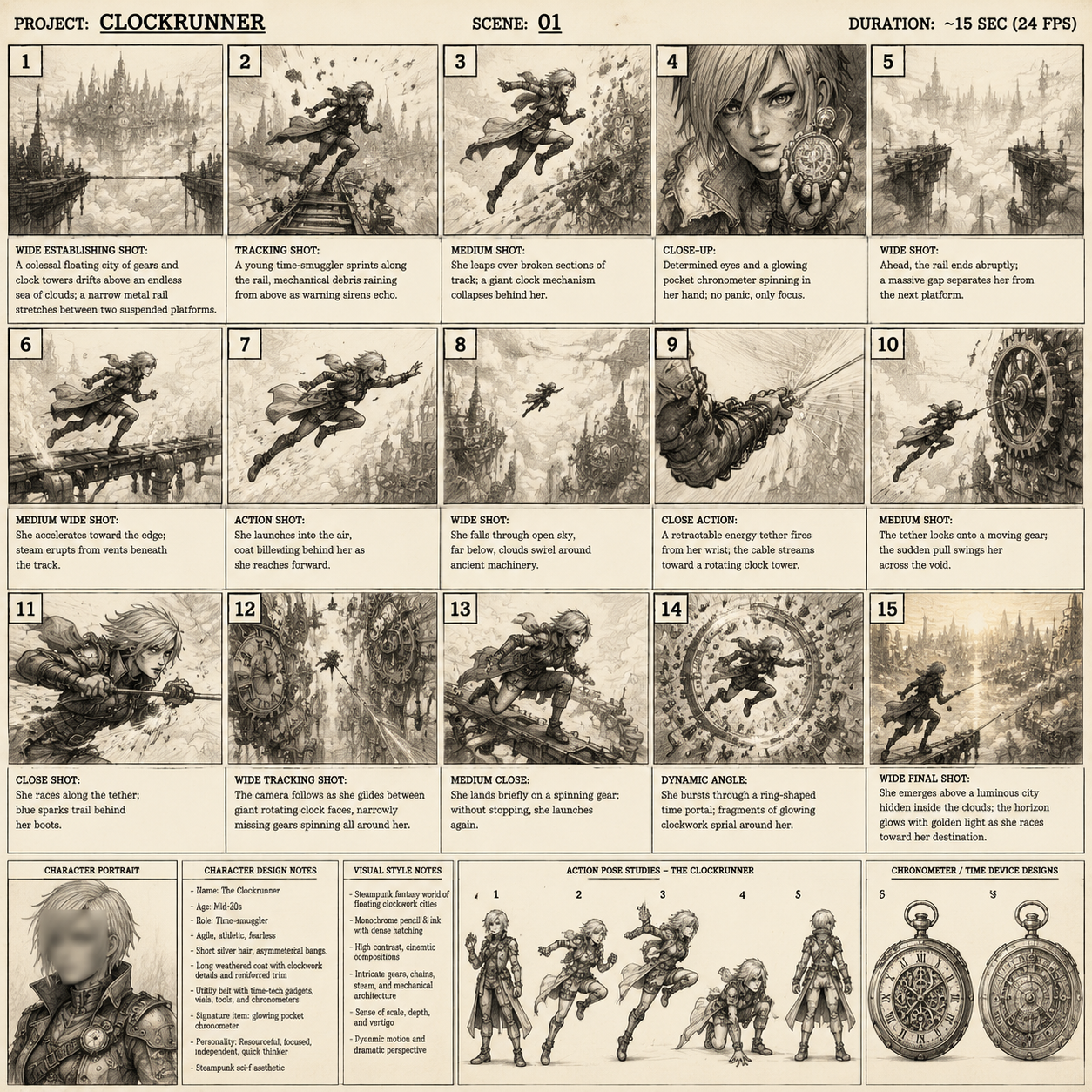
Start With the Output, Not the Model
Most AI video projects fall apart for reasons that have nothing to do with which generator you chose. They fall apart because nobody decided up front what the finished clip had to do: how long it runs, who appears in it, whether the camera moves, whether a face speaks on screen, and how the shots will be cut together. Picking a model before answering those questions is the fastest way to spend a weekend producing beautiful clips that cannot be edited into a coherent piece.
A workflow is just the repeatable sequence that takes you from a blank page to an exported file. Useful workflows share three properties. They are inspectable, so you can look at any stage and understand why the result looks the way it does. They are resumable, so a failed shot can be regenerated without rebuilding the whole project. And they are bounded, so before you start you have a rough idea of how many generations, how much render time, and how many revision passes the work will need.
Everything below describes that kind of pipeline: a small number of layers, each with a clear job, plus decision criteria for when to move forward instead of regenerating the same shot for the tenth time.
The Four Layers of a Reliable AI Video Pipeline
Nearly every project that ships on schedule is organised into four stacked layers. Skipping a layer does not save time; it moves the cost into the editing room, where it is more expensive to pay.
Reference and asset preparation
Before generating motion, build a reference bible: one folder per project containing character sheets, style frames, location plates, and colour references. For each recurring character, produce a neutral front view, a three-quarter view, a profile, and a full-body frame under the same lighting. For each location, produce one clean wide plate. Lock your aspect ratio, frame rate, and target duration now — changing them later invalidates every clip you have already generated.
Habits that pay off immediately: name files by shot and version, keep a single hero frame per character that you always return to, and generate references at the highest resolution available so downstream upscaling has real detail to work with.
Generation and shot coverage
Break the script into shots, then generate coverage rather than one perfect clip: a wide, a medium, and a close for each beat. Three to five seed variations per shot is usually enough to find a winner; more than that and you are shopping rather than working. Keep a shot log with the prompt, seed, model, duration, and a one-line note about what was wrong with each take. That log is what turns a lucky accident into a repeatable process.
Two small rules prevent most editing pain. First, generate every shot about a second longer than you need, so there are handles for crossfades, speed ramps, and stabilisation. Second, overlap adjacent shots in content — end the wide as the character begins to move toward camera, and start the close with that movement already underway.
Consistency control
This is the layer where projects either hold together or visibly fall apart. Consistency operates on four axes: identity (the same face and body), style (the same look across shots), lighting (the same direction and colour temperature), and motion (the same physical behaviour). Identity is usually handled with reference images, identity adapters, or a trained model. Style is handled with a locked prompt prefix and style references. Lighting is handled by reusing location plates. Motion is handled by describing camera behaviour explicitly and preferring slower, simpler moves.
Treat consistency as a product of inputs, not of luck. If two shots of the same character look different, the difference is almost always traceable to a changed reference, a changed prompt prefix, or a changed seed family.
Finishing and delivery
Finishing is where AI footage starts behaving like normal footage: editing, upscaling, frame interpolation to your delivery frame rate, stabilisation, sound design, voice recording, lip sync, colour grading, captions, and export. Reserve at least a third of project time for this layer. Deliver a mezzanine file — high bitrate, light compression — rather than a heavily compressed social upload, and keep the project file so a revision does not become a rebuild.
Overscan matters here too. Generate a slightly wider frame than the final composition needs, then crop in when stabilising; a three to five percent margin absorbs almost all motion-induced crop jitter.
Keeping a Character Consistent Across Shots
Character drift is the most common complaint in AI video, and it is mostly a reference-management problem rather than a model problem.
Start with a canonical reference set and never let a generated frame replace it. The moment you begin feeding outputs back in as references, errors compound: skin tone shifts, jawlines soften, wardrobe changes silently. Reset from the canonical set every three or four shots.
Reference-conditioned generation — supplying an image alongside the text prompt — beats text-only prompting for any recurring subject. Text cannot reliably describe bone structure, and every regeneration reinterprets it. When you need an exact look, generate a stylised still first, approve it, then use image-to-video to animate that specific frame.
Shot-to-shot continuity has a cheap trick: use the final frame of shot A as the first frame of shot B when the camera does not cut. This works well for continuous action and poorly across hard cuts, where you want a deliberate visual break. For identity-critical moments, choose closer framing. Faces at distance, in profile, or in fast motion degrade quickly, so save the wides for moments where identity matters less.
Finally, log the small stuff: which hand holds the product, which side the part is on, whether a jacket is zipped. These continuity errors are the ones viewers notice and the ones that cost the most to fix late.
When Fine-Tuning a Custom Model Is Worth It
Training a model is not a status symbol; it is a maintenance commitment. It pays off when the same visual identity has to survive dozens of generations over a long period.
Signals that you actually need a trained model
- A character appears in twenty or more shots across multiple episodes.
- Your look is proprietary and resists description in words.
- Specific objects must render exactly, such as packaging, logos, or on-screen text.
- You regenerate the same style every week and re-solve the same prompt problems each time.
- Off-the-shelf results plateau at roughly eighty percent, and manual fixing now costs more than preparing a dataset would.
Cheaper steps to try first
Before training anything, tighten the fundamentals: a canonical reference set, a locked style prefix, a small library of approved seeds, style reference images, and lightweight adapters trained on a handful of images. Image-to-video from an approved still solves a surprising number of identity problems with no training at all. Only move to a full fine-tune when you can name, in one sentence, the thing the base model keeps getting wrong.
Preparing a dataset that teaches something
A useful dataset is small, consistent, and varied in the right places. Twenty to sixty images is often enough for a character or a product look. Keep lighting and camera style consistent while varying pose, framing, and background. Write captions that separate identity from variable attributes, so the model learns what is constant. Hold back a validation set, avoid near-duplicates (they cause overfitting), and check that backgrounds are not baked into the subject. Then test with three prompts you have never used before — not the ones you trained on.
Matching the Generator to the Shot
Different shot types have different technical demands, and a single tool rarely wins everywhere. Use the table below as a routing guide rather than a ranking.
| Shot type | Primary requirement | Practical approach |
|---|---|---|
| Talking head | Lip sync, identity stability | Avatar or performance-driven tools, then a lip sync pass in finishing |
| Product macro | Texture, controlled camera | Image-to-video from a hero still, slow dolly or orbit |
| Action beat | Motion plausibility | Short generations, faster cutting, motion blur in post |
| Establishing shot | Scale, atmosphere | Text-to-video, longer durations, minimal subject motion |
| Stylised sequence | Look consistency | Video restyling or a trained style adapter |
Evaluate any tool on five criteria before committing: how much camera control it exposes, how long a clip it produces in one pass, whether it accepts image references, what licence its output carries for commercial use, and how costly a failed attempt is in time. That last criterion matters most in practice. A tool that produces slightly weaker average results but returns in thirty seconds will beat a superior tool that takes ten minutes per attempt on any project with a real deadline.
Prompting and Shot Planning for Iteration
Write prompts as structured descriptions rather than sentences. A dependable order is: subject, action, environment, camera movement, lens and lighting, style, duration. Keeping the order stable lets you change one variable at a time and see what actually caused a difference.
Maintain a shot list as a spreadsheet with one row per shot and columns for prompt, reference image, seed, model, duration, and status. When a shot works, freeze its row and stop touching it. Most wasted hours come from regenerating a shot that was already approved because someone decided to "improve" the prompt.
Seeds are a tool, not a superstition. Reusing a seed family across a scene helps hold lighting and palette steady. Changing seeds is the right move when you want genuinely different interpretations of the same idea. Record which seed produced which approved take; you will need it when someone asks for one more variation a month later.
Motion, Physics, and Audio: The Details Viewers Notice
Motion is what separates convincing AI video from obvious AI video. Prefer fewer simultaneous actions: one subject, one movement, one camera behaviour per shot. Slow camera moves read as intentional; fast ones read as errors. A four-second generation cut with real editorial rhythm feels longer than four seconds, so do not chase long single takes unless the shot genuinely requires one.
Physics remains the weak point. Liquids, cloth, crowds, reflections, and hands interacting with objects still break down. Design around them: cut before the pour completes, keep hands out of frame during complex actions, and use wider shots for crowd scenes where individual anatomy cannot be inspected. Frame interpolation smooths motion but amplifies warping, so apply it after a clip is approved, not before.
Audio sells realism more than resolution does. Layered ambience, subtle foley, and clean dialogue make a 1080p sequence feel more professional than a silent 4K one. Record or generate the voice track first, conform the visuals to its rhythm, and treat lip sync as a finishing pass rather than a generation-time promise.
Mistakes That Quietly Cost a Whole Day
- Generating before the script is locked. Every shot made against an unstable script is likely to be discarded.
- One perfect take mentality. Coverage exists because you cannot predict which take will cut well.
- Feeding outputs back in as references. Errors compound; always return to the canonical set.
- Changing aspect ratio mid-project. It invalidates every clip and every composition decision.
- Ignoring handles. Clips generated to the exact required length leave no room for transitions.
- No shot log. Without records, a good result cannot be reproduced.
- Skipping the audio plan. Silence hides good visuals and exposes bad ones.
- No approval gate. Decide who signs off on a shot, and when, or revision loops never close.
A Full Example: 45-Second Product Spot From Brief to Export
A realistic schedule for a single-location spot with one presenter and three product shots:
- Script and shot list. Twelve shots, eight product and four presenter. Lock aspect ratio, frame rate, and total duration.
- References. Produce or photograph a hero product frame, two presenter reference frames, and one location plate. Approve them before any video exists.
- Product shots. Use image-to-video from the hero frame, camera dead slow, three seeds each, keep handles, and log everything.
- Presenter shots. Generate against the canonical reference with closer framing for identity, and record the voice track in parallel so visuals can be timed to it.
- Assembly. Rough cut, replace weak shots, then stabilise and interpolate to the delivery frame rate.
- Finishing. Lip sync pass, sound design, colour grade, captions, export a mezzanine master plus platform-specific versions.
The lesson in that schedule is that generation occupies roughly two of five working days. The rest is preparation and finishing, which is exactly where newcomers under-plan.
FAQ
How many shots should I generate per minute of finished video?
Budget eight to fifteen shots per minute for anything with pace, more for action, fewer for atmosphere pieces. Each shot needs three to five attempts, so plan accordingly.
Do I need a trained model for a one-off project?
Almost never. For a single video, a strong reference set plus image-to-video will outperform a rushed training run.
How do I stop characters from drifting?
Reset from canonical references every few shots, use image conditioning, prefer closer framing for identity-critical moments, and never feed generated frames back in as references.
Can I mix several generators in one project?
Yes, and most experienced teams do. Keep the look consistent by matching prompt prefix, reference images, palette, and camera behaviour across tools, and always finish in a single editor.
Why does my footage look "AI" even when it is sharp?
Usually because of motion, not detail. Too much simultaneous action, unnaturally smooth movement, missing camera inertia, and absent ambience are the giveaways. Simplify the motion and add sound design.
When should I stop iterating on a shot?
Set a budget before you start: five attempts or twenty minutes, whichever comes first. If neither yields something usable, the problem is usually in the script or the reference, not the generator.
What is the single highest-leverage habit?
Keeping a shot log. It turns a project from a series of lucky accidents into a process you can repeat, hand over, and improve.
