

Why short-form creators are moving to AI-assisted pipelines
Publishing three to five short videos a week is a demanding baseline. Doing it with a phone, natural light, and a friend who can hold a camera stops being realistic the moment you travel, get sick, or run out of ideas that fit your own face. That is the real reason AI video generation spread so quickly through short-form communities: not because anyone wanted to replace filming, but because the production bottleneck moved. The hard part is no longer "what do I say" — it is "how do I get a usable shot today."
AI generators solve a specific slice of that problem. They are excellent at producing b-roll, atmospheric establishing shots, abstract transitions, product mockups, and stylized sequences that would otherwise require a full shoot day. They are weaker at sustained dialogue, precise brand assets, and anything where a viewer's trust depends on seeing a real person's face. Creators who get results treat AI as a second unit — a fast, inexpensive crew that fills the gaps around the parts they still film themselves.
The payoff compounds. When b-roll can be generated in minutes, you can publish daily, test more hooks, and keep a consistent visual identity across a series. Recommendation systems reward consistency more than they reward perfection, and AI makes consistency affordable.
What "free" actually buys you in AI video generation
Free tiers are not charity. They are product demos with carefully placed limits, and understanding those limits is the difference between a workflow that scales and one that collapses on a busy week. Before you build a series around any tool, stress-test each of these constraints:
- Watermarks. Some free exports carry a logo. Check whether it is removable and where it lands on a vertical frame.
- Resolution and aspect ratio. Many tools render vertical video at 720p only. That is workable for mobile feeds but painful if you later want to reuse the clip on a larger screen.
- Clip length. Most free tiers cap individual generations at three to six seconds. You will be stitching, so plan your shot list around short beats rather than long takes.
- Queue priority. Free renders often process behind paying users. A clip that takes eight seconds at off-peak hours can take several minutes at peak.
- Daily and monthly limits. Track how many generations you realistically need per video. A 30-second video with six distinct shots means six to ten generations once retries are counted.
- Commercial usage rights. This is the constraint people skip. If you monetize content or work with brands, confirm that generated output can be used commercially and that the license does not change retroactively.
- Model availability. Free access is usually restricted to a single, older model. That caps your quality ceiling no matter how good your prompt is.
- Data handling. Know what happens to your prompts and any uploaded reference images, especially if you work with client material.
A practical rule: never build a series around a free tier you have not tested for a full week. Free access terms change quickly, and a tool that feels generous today can tighten its limits without warning. Keep two options in rotation so a policy change never stops your publishing schedule.
The anatomy of a short video that AI can genuinely produce
Before choosing a tool, decompose the video into layers. Every short-form video, whether filmed or generated, is a stack:
- The hook (first two seconds). Usually a visual surprise, a bold claim on screen, or motion that stops a scroll.
- The narration. A voiceover, a talking head, or pure on-screen text. This is where your idea lives.
- The visual layer. Broken into individual shots, each with its own purpose: establish, demonstrate, transition, or emphasize.
- Sound design. Music, ambience, whooshes, and hard cuts on the beat.
- Captions. Burned-in text that makes the video watchable on mute.
- The payoff or loop. The reason someone watches to the end or replays it.
Now decide which layers AI owns in your workflow. A reliable split for most creators looks like this: AI handles the visual layer and often the captions; the creator handles the hook, the script, and the final sound mix. Narration depends on your niche — synthetic voices work well for educational and list-style content, while personal brands almost always need a real voice for trust.
This decomposition matters because it prevents the most common beginner mistake: asking a generator to produce a finished video. Generators produce shots. Assembling shots into a video that holds attention is an editing and writing job, and no model does it for you yet.
How to choose a generator: a decision framework
There is no single best tool, only the best fit for your content type. Score candidates across four dimensions and you will stop chasing hype cycles.
Fidelity versus motion coherence
Fidelity is how clean a single frame looks. Motion coherence is whether the subject moves believably across frames — hands, hair, fabric, liquid, crowds. Most tools are stronger at one than the other. Cinematic landscape shots tolerate lower motion coherence because viewers expect slow, atmospheric movement. Dance, sports, and action content demand high coherence and expose weak models instantly.
Control features that actually matter
- Image-to-video. Upload a still and animate it. This is the single most useful feature for brand consistency.
- Camera controls. Prompt-level control over pans, dollies, and zooms reduces wasted generations.
- Motion strength or guidance. A slider that stops the model from over-animating a calm shot.
- Aspect ratio presets. Native vertical output beats cropping a widescreen render.
- Style references. Keeping a consistent look across a series is far easier with a reference image than with adjectives alone.
Ecosystem fit
Ask where the clip goes next. If your editor accepts standard MP4 at 1080p, almost anything works. If you rely on a mobile editing app, prioritize tools with clean mobile export or direct-to-editor handoff. If you publish in multiple languages, check whether the tool integrates with captioning and dubbing.
Cost of iteration
The best tool is not the one with the highest ceiling — it is the one that lets you retry cheaply. A model that produces great output on the third attempt but limits you to two attempts per day is worse for daily publishing than a slightly weaker model with generous retries.
The table below is a useful mental model when comparing options:
| Need | Priority | Typical solution |
|---|---|---|
| Daily publishing on a tight budget | Volume and retries | Free tiers plus fast editing |
| Client or brand work | Rights and consistency | Paid tier with commercial license |
| Cinematic storytelling | Motion coherence | Higher-end generation model |
| Fast meme-style content | Speed over polish | Lightweight tools, heavy editing |
Step-by-step: a repeatable AI video workflow
This is the loop that keeps output steady without sacrificing quality.
Step 1 — Mine the hook before anything else
Start with the hook, not the visuals. Scan comments on popular videos in your niche, look at search suggestions, and write down the exact phrasing people use when they ask a question. The hook is a sentence, and every shot you generate afterward exists to support it. Creators who skip this step end up with beautiful footage attached to a video nobody finishes.
Step 2 — Write a shot list, not a script
Convert the hook and the key points into four to eight shots. Each shot gets one line: what the viewer sees, how long it lasts, and what it proves. Two seconds for the hook, three to four seconds for supporting shots, and a final shot that resolves or loops. This list becomes your generation queue and your editing map.
Step 3 — Write prompts as if briefing a camera operator
A useful prompt has five parts: subject, action, environment, camera behavior, and look. For example: "Close-up of a ceramic coffee cup on a wooden table, steam rising slowly, morning light through a window, slow push-in, shallow depth of field, warm tones." Vague prompts produce vague motion, and vague motion is what makes AI footage feel uncanny.
Step 4 — Generate in batches and select ruthlessly
Generate three to five variations per shot and pick one. Do not fall in love with a clip that has a broken hand or a flickering background — those artifacts survive compression and viewers notice them instantly. Keep a folder of unused but usable clips; they become b-roll for future videos and cut your next production time in half.
Step 5 — Assemble around the audio
Build the edit on top of the music or voiceover rather than adding sound last. Cut shots on beat, keep any single shot under four seconds, and use audio transitions to hide visual seams between generated clips. This single habit makes AI footage feel intentional rather than assembled.
Step 6 — Caption, export, and log results
Burn in captions, keep them inside the safe area, and export vertical. Then record the outcome: hook used, retention pattern, comments. After twenty videos you will have data instead of guesses about what your audience actually watches.
Prompt patterns that consistently produce usable clips
Most failed generations are prompt problems, not model problems. These patterns reduce retries:
- One action per clip. "A woman walks toward the camera" works; "a woman walks, turns, opens a door, and smiles" does not.
- Describe the camera, not just the subject. Telling the model to "orbit slowly around" or "hold a static wide" gives it a plan for motion between frames.
- Anchor lighting and time of day. "Golden hour," "overcast diffuse light," and "single practical lamp in a dark room" steer the mood far more reliably than "cinematic."
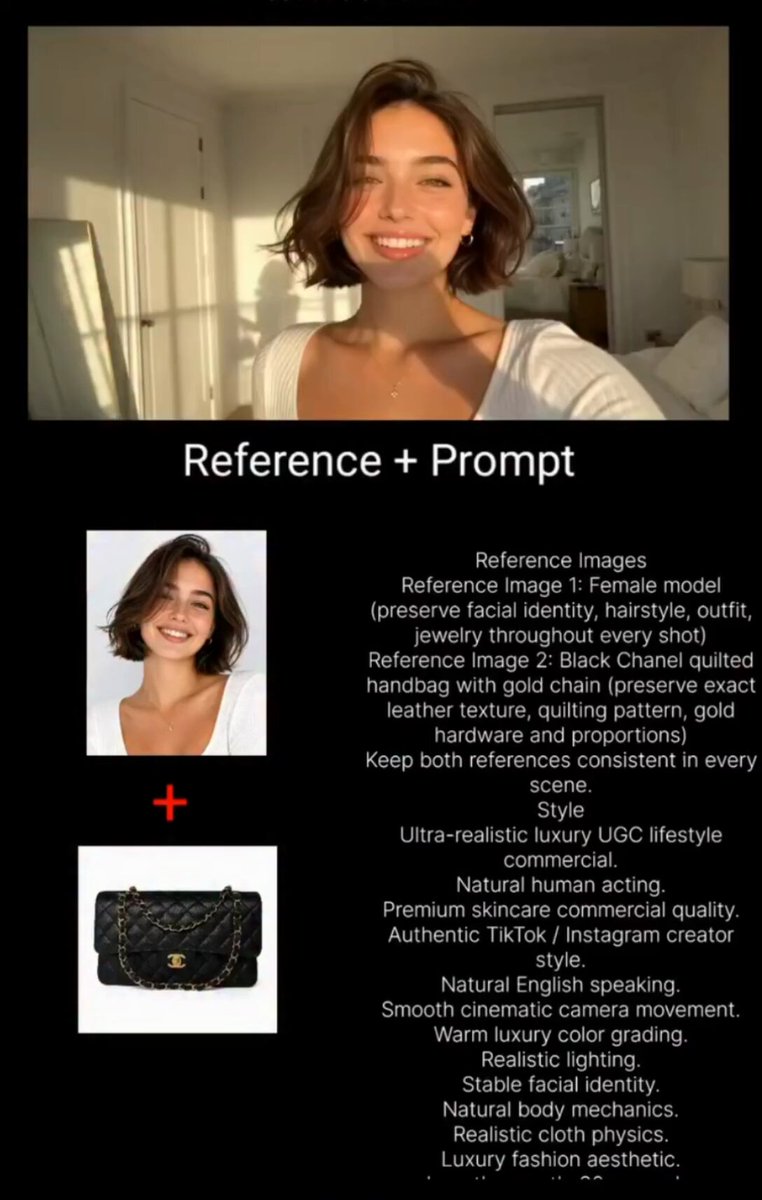
- Reference an image when consistency matters. For a product or character, image-to-video with a still reference beats any amount of descriptive text.
- Avoid text inside the frame. Models still mangle lettering. Add text in the editor where you control the font and placement.
- State the aspect ratio and shot size. "Vertical 9:16, medium shot" saves a regeneration round.
- Iterate one variable at a time. If you change subject, lighting, and camera at once, you learn nothing about what worked.
Editing rules that make generated footage feel human
Generated clips have tells: overly smooth motion, slightly plastic skin, and a habit of drifting. Editing fixes most of them.
- Cut faster than feels natural. Short-form pacing hides imperfection. Two to three seconds per shot is usually right.
- Add imperfection. Slight grain, a subtle camera shake preset, or a light vignette makes AI footage sit better next to filmed content.
- Use diegetic sound. A cup clink, footsteps, or a door creak under a generated shot creates believability that visuals alone cannot.
- Avoid lingering close-ups of faces. Use medium shots, backs of heads, hands, and silhouettes. Reserve real faces for filmed segments.
- Match color across all shots. A single LUT or adjustment layer applied to the whole timeline is the fastest way to make disparate generations look like one video.
- Hide cuts with motion. Cut when something moves — a hand passing the frame, a whip pan, a flash — and the transition disappears.
Mistakes to avoid and a pre-publish checklist
The most common failures are strategic rather than technical. Avoid these: publishing before the hook is clear; using free output with a visible watermark on a brand account; building a whole series on one tool with no backup; generating a hundred clips before writing a single line of script; and ignoring sound design because "the visuals are the point."
Before you publish, run this checklist:
- Does the first two seconds work with the sound off?
- Is every shot under four seconds?
- Are captions inside the safe area and free of typos?
- Is the audio level consistent between voice and music?
- Do any clips show warped hands, faces, or text?
- Is the export vertical, 1080p or better, and without an unwanted watermark?
- Does the ending deliver the payoff the hook promised?
- Do you have rights to everything in the frame?
Scaling output without burning out
Scaling is about templates, not effort. Build three repeatable formats — for example a list format, a transformation format, and a myth-busting format — and reuse the same shot structure across episodes. Batch generation once or twice a week, then edit in blocks. Recycle unused clips into future videos instead of deleting them. Repurpose one long video into four shorts by extracting the strongest thirty-second segments. Series formats also train viewers to expect your next upload, which compounds retention in a way one-off viral attempts never do.
Finally, keep a small library of tools rather than a single dependency: one generator for cinematic shots, one for fast edits, one for voice, and one editor. When a limit changes or a model degrades, your pipeline keeps running.
FAQ
Can free AI video tools really produce TikTok-ready content?
Yes, for b-roll, atmosphere, transitions, and text-driven formats. They are weakest at faces, hands, and text inside the frame, so plan shots that avoid those.
How many generations does a 30-second video need?
Plan on six to ten, assuming an average of two attempts per shot. Batching reduces the number.
Should I use an AI voice or my own?
Use your own voice if your content depends on trust, personality, or expertise. Synthetic narration works well for listicles, explainers, and faceless channels.
How do I keep a consistent look across videos?
Use a reference image, a fixed set of lighting adjectives, the same aspect ratio, and one shared color grade in your editor.
Why does my AI footage look uncanny?
Usually one of three reasons: too much motion in a single clip, a lingering close-up of a face, or a shot that lasts too long. Shorten the clip, widen the shot, and add sound.
Is AI footage penalized by the algorithm?
Not for being AI. Reach is driven by retention and rewatches. Weak hooks and poor pacing hurt far more than the origin of the pixels.
What is the fastest way to find my next hook?
Read the comments of videos already performing in your niche. The questions people repeat are the hooks you should answer next.
