
Why prompt chaining beats one enormous prompt
Most first attempts at AI-assisted screenwriting look the same: a single long prompt that asks for a genre, a premise, a cast, and a complete script. The output is usually competent, grammatically clean, and completely forgettable. The model never got the chance to commit to a point of view, so it reaches for the average of everything it has seen.
Chaining changes the shape of the work. Instead of one request, you build a sequence of requests where each output becomes part of the context for the next. The concept feeds the character work. The characters feed the beat sheet. The beat sheet feeds scene cards. The scene cards feed dialogue passes. Each stage is small enough to inspect, argue with, and fix before its errors get buried under three more layers of generation.
That traceability is the real benefit. When a scene feels flat, you can trace it back: was the beat vague, was the motivation missing, or was the dialogue instruction simply too polite? With a single-prompt draft you can only rewrite the whole thing and hope.
This guide walks through a full chaining workflow for short films — roughly three to fifteen minutes of screen time — with an eye on the moment the script has to become shots.
Step one: define the container before generating anything
A short film is defined as much by its limits as by its idea. Before you prompt for a premise, write down the constraints:
- Target runtime (three minutes, seven minutes, twelve minutes)
- Number of speaking roles
- Locations you can actually build, find, or generate
- Whether you are shooting live action, generating shots with AI video tools, or mixing both
- Tone references — two films or shows that describe the emotional register
- Audience and platform (festival short, vertical social cut, internal pitch)
Feed those constraints into the model as fixed parameters and tell it they cannot be violated. This single step prevents the most common failure of AI-assisted writing: a beautiful, unfilmable script with nine locations, a car chase, and a child lead.
A practical opening prompt looks like this:
You are helping me develop a short film. Fixed parameters: runtime 6 minutes, maximum 3 speaking roles, 2 locations, no stunt work, no child actors. Tone: quiet sci-fi with dry humor. Deliverable for this step only: three premise options, each with a logline, the dramatic question, and the reason the story must be short rather than feature length.
Notice what is missing: no dialogue, no scenes, no script. The first link in the chain establishes the container. Everything after it inherits the limits.
Building the narrative spine
Concept, theme, and the dramatic question
Pick one premise and interrogate it. Ask the model to state the theme in a single sentence that does not use the words "love," "hope," or "humanity" — a constraint that forces specificity. Then ask for the dramatic question, the thing the audience is waiting to have answered.
A useful chaining move here is to request three competing thematic readings of the same premise. If the model can generate genuinely different meanings from your idea, the idea has depth. If all three collapse into the same message, the premise is thin and you should return to the premise list.
Character bibles that survive revision
Character drift is the silent killer of long AI-assisted drafts. By scene nine, the pragmatic engineer has become a wisecracking optimist.
Fix it with a compact character bible that travels in every subsequent prompt. For each character, capture:
- Name, age range, and one physical detail that matters to the plot
- Want (external goal) and need (internal change)
- Speech pattern: sentence length, vocabulary, verbal tics, what they refuse to say
- A secret the audience learns and a secret they never learn
- Relationship delta: how they treat each other at the start versus the end
Keep each bible under 120 words. Long character descriptions bloat the context window and dilute attention. Three short bibles you paste into every prompt beat one sprawling document the model skims.
Generating the beat sheet
Ask for a beat sheet in a fixed number of beats — eight for a short film works well — with one line each: what happens, what changes, and which character drives it. Then do the pruning pass: delete any beat that does not change the situation.
A beat sheet is also where you check your runtime math. As a rough rule, one page of properly formatted script is about one minute of screen time, and a beat usually runs one to one and a half pages in a short. Eight beats, six minutes: the arithmetic is tight, which is exactly the pressure a short film needs.
From beats to scenes: contextual stacking
Drafting scene cards
Now expand each beat into a scene card before writing a word of screenplay. A scene card contains:
- Slugline (interior or exterior, location, time of day)
- The one thing that must be true by the end of the scene
- Entry point and exit point — what the audience arrives in the middle of
- Obstacle: who or what resists the protagonist
- Visual anchor: the single image you would use to sell the scene in a trailer
Scene cards double as your shot-planning document later, which is why they are worth the extra fifteen minutes. When you hand a scene card to a video generation model, you already have the shot's intent, its setting, and its visual anchor.
Dialogue passes and subtext
Dialogue is where chained workflows pay off most. Do not ask for the scene and its dialogue simultaneously. Run them as separate passes:
- Beat pass — write the scene in prose, present tense, no dialogue.
- Conflict pass — rewrite it so both characters pursue incompatible goals.
- Dialogue pass — convert to script format with a hard rule: nobody says what they mean in the first half of the scene.
- Compression pass — cut 20% of the words, starting with the first and last line of every exchange.
- Voice pass — check each line against the character bible and rewrite anything that could be spoken by anyone else.
Run the read-aloud test after the compression pass. Read the dialogue out loud, in character, at speaking pace. Lines that look sharp on the page often die in the mouth. If a line takes longer to say than the emotion behind it deserves, cut it.
Continuity: the invisible scaffold
Once you have more than a handful of scenes, continuity becomes a system rather than a habit. Keep a running continuity sheet outside the chat and paste the relevant slice into each prompt:
- Timeline: what hour or day each scene occurs, including travel time
- Props: who holds what, and where it ends up
- Costume and state: injuries, wet hair, dirt, tears in clothing
- Knowledge state: what each character knows at the start of each scene
- Repeated lines and motifs: callbacks you plant early and pay off later
The knowledge-state column catches the most embarrassing errors. AI-assisted drafts love handing characters information they have no way of possessing, and the mistake is easy to miss when you read scenes in isolation.
Style tokens for a consistent look
If your script will become AI-generated footage, define a style token string early and reuse it verbatim in every visual prompt. Something like:
muted teal and amber palette, 35mm grain, soft window light, shallow depth of field, slow handheld camera, no lens flares
Style tokens work because they are boring. Rewriting the look of each shot in fresh language produces a patchwork of incompatible images. Copy the same string, then vary only the subject, action, and framing.
Translating the script into shot-ready prompts
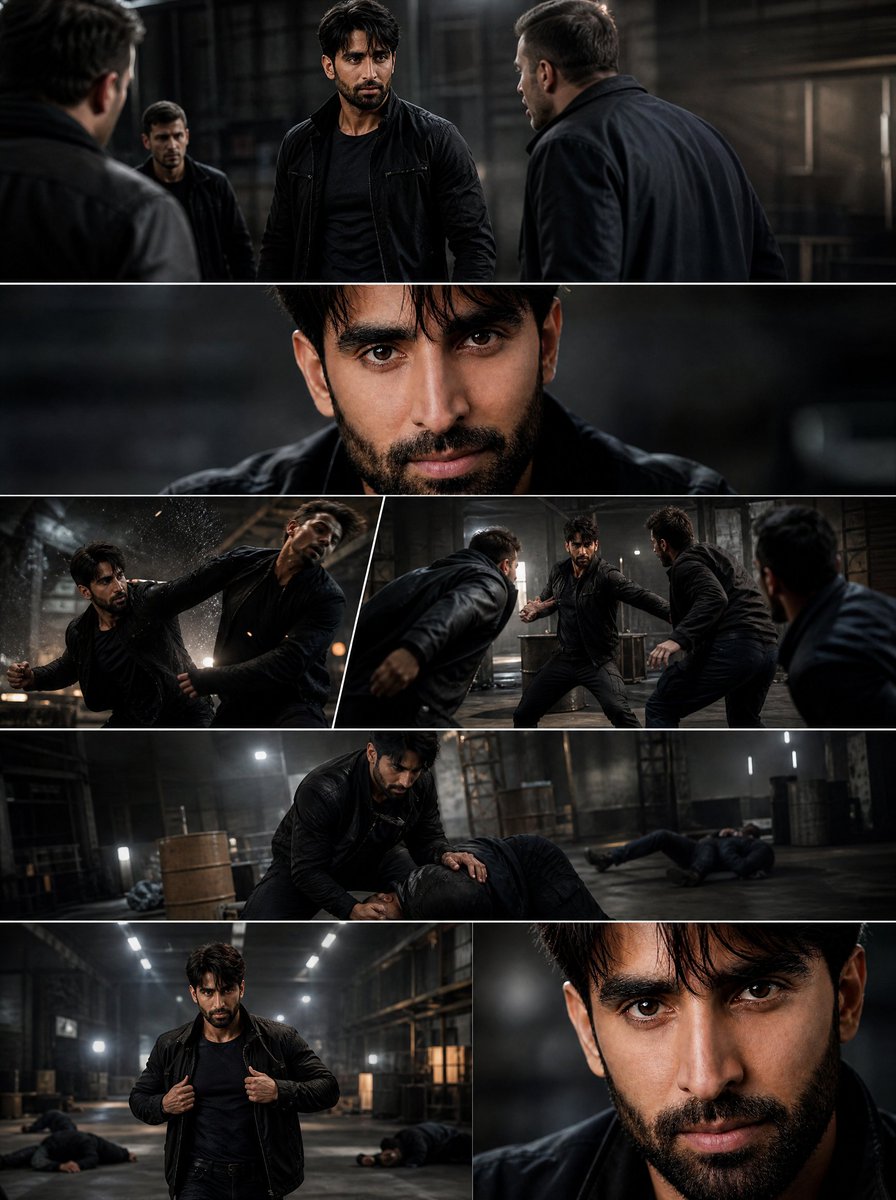
The gap between a finished script and a coherent video is usually a shot list. Convert each scene card into shots using a simple coverage pattern:
- Establishing or re-establishing shot (three to four seconds)
- Master shot of the scene's main action
- Two over-the-shoulder or profile shots for dialogue
- Insert shots for props, hands, screens, or text
- One closing image that lands the scene's emotional turn
Then annotate each shot with the details a video model or a camera operator needs: shot size, camera movement, subject action, lighting, duration, and audio intent. For a six-minute short, a realistic count lands between 60 and 110 shots — more than most first-time filmmakers expect.
For AI-generated footage, keep individual generations short. Four to eight seconds per clip is where most text-to-video tools stay coherent, and longer clips tend to drift in faces, hands, and background detail. Build the film from cuts rather than trying to generate long takes.
Choosing the right tools for each stage
Different jobs need different tools, and mixing them deliberately keeps the chain honest.
| Stage | What to use | Why |
|---|---|---|
| Premise, structure, dialogue | A conversational LLM | Fast iteration, easy revision |
| Storyboards | Image generation | Cheap way to test framing and palette |
| Footage | Text-to-video and image-to-video models | Turns a shot list into clips |
| Voice | Text-to-speech or recorded actors | Consistency and emotional range |
| Assembly | A standard editing suite | Real editing control |
| Captions and rough cuts | Automatic editing tools | Speed for social versions |
A workable stack for a small team: ChatGPT or Claude for writing passes, Midjourney or a comparable image model for boards, Runway, Kling, Luma, Veo, or Pika for shots, ElevenLabs or real actors for voice, and DaVinci Resolve or Premiere for the edit. None of these is mandatory. The workflow matters more than the logo.
A worked example: the six-minute short "Static"
To make this concrete, here is how the chain looks end to end.
Container: six minutes, two locations (a radio observatory control room and a rooftop), two speaking roles, no stunts. Tone: quiet sci-fi with dry humor. Thematic question: what do you owe a message you cannot answer?
Character bibles: Mara, 40s, night-shift technician. Wants to prove the signal is real. Needs to accept that being believed is not the same as being right. Speaks in short declaratives and deflects with technical detail. Devon, 30s, visiting auditor. Wants the paperwork signed. Needs to be needed. Speaks in questions he already knows the answer to.
Beat sheet (eight beats): anomaly detected; Devon arrives to shut the site down; Mara hides the signal; they argue over protocol; the signal repeats in pattern; Devon recognizes the pattern from a personal loss; they choose to answer; the answer is not what they expected; they leave the room changed.
Scene cards: four scenes, each with one obligation. Scene two, for example, must end with Devon suspicious and Mara committed to the lie. Visual anchor: a coffee cup vibrating on a console.
Dialogue pass rule: neither character names the real subject until the final scene.
Style tokens: sodium orange and monitor blue, 16mm grain, fluorescent flicker, static camera with slow push-ins, no lens flares.
Shot list: 84 shots, averaging five seconds, with eleven silent shots reserved for the two montages.
Revision: three table reads with real voices, which cut 14 lines and one entire scene that existed only to explain the plot.
The result is not a masterpiece. It is a finished, coherent film made in a fraction of the usual development time — and, more importantly, one you can revise without starting over.
Mistakes that quietly ruin chained drafts
Letting the model write the whole thing before you read it. Read every link. Errors compound.
Asking for dialogue too early. Prose first, dialogue second, always.
Skipping the continuity sheet. The moment you have six scenes, you need it.
Re-describing the visual style in every prompt. Define style tokens once and reuse them.
Accepting the first beat sheet. Ask for three, then combine the strongest beats from each.
Ignoring runtime math. Ten beats in a six-minute film means a rushed, shallow story.
Letting the AI resolve the theme. The model will happily hand you a tidy moral. Decide the ambiguity yourself.
Treating the script as final before the shot list. Some lines are unshootable or unnecessary on screen, and the shot list exposes them.
FAQ
Do I need a paid model to do this? No. Chaining is a method, not a subscription tier. Shorter context windows just mean keeping your character bibles tighter.
How many prompts does a six-minute short take? Realistically 25 to 50 meaningful exchanges across concept, beats, scene cards, dialogue, continuity, and shot list — spread over several sessions.
Should I let the AI write in screenplay format from the start? No. Prose drafts survive revisions better, and formatting early locks in structure you may still need to change.
How do I stop characters sounding the same? Run a voice pass with the bible in context, plus a read-aloud test with a different person reading each role.
Can I use this workflow for a feature? Yes, but treat each act as its own chained project, and expect the continuity sheet to grow into a full story bible.
What about tools that generate video from a whole script? They are useful for animatics and pitch visuals, but scene-level control usually beats whole-script generation when performance and rhythm matter.
A checklist to run before you shoot or generate
- Fixed container documented and respected
- One premise, one dramatic question, one theme sentence without abstraction
- Character bibles under 120 words each, reused in every prompt
- Beat sheet pruned to beats that change something
- Scene cards with obligation, obstacle, and visual anchor for every scene
- Dialogue compressed, read aloud, and voice-checked
- Continuity sheet covering timeline, props, costume, and knowledge
- Style token string locked and reused verbatim
- Shot list with sizes, movement, and durations
- A realistic generation or shooting plan that matches your runtime
Chaining is not a trick for getting better text out of a model. It is a way of keeping authorship in your hands while the machine handles volume. The model proposes; you decide; the next prompt inherits your decision. That loop, repeated a few dozen times, is the whole method — and it is the difference between a script that reads like everyone's average and a short film that sounds like you.
