

Why short-form now rewards cinematic craft
Generating a moving image is no longer the hard part. Anyone with a browser, a sentence, and ten minutes can produce a clip that moves, breathes, and looks vaguely like film. What has become genuinely scarce is taste: the ability to make twenty of those clips add up to something a viewer finishes, remembers, and shares.
That shift changes what a creator's job actually is. The bottleneck moved from rendering to directing. A short-form piece that reads as "cinematic" is not the product of one lucky generation — it is the product of decisions made before, during, and after generation: which shot size tells this beat best, where the light comes from, how long to hold before cutting, what the audio does when the picture stops moving.
This guide lays out a neutral, tool-agnostic workflow for producing cinematic short-form video with AI assistance. It covers the vocabulary of film language you need to prompt effectively, a four-stage production loop, continuity tactics that survive a multi-shot sequence, practical tool-selection criteria, and a pre-publish quality-control pass. Nothing here depends on a specific vendor. Use whatever generator, editor, and voice tool you already trust.
What "cinematic" actually means in a vertical frame
Before you can prompt for a look, you have to be able to name it. "Cinematic" is a lazy adjective that hides four separate technical systems. Separate them and your prompts get dramatically more useful.
Shot size and lens language
Film language is built on a small vocabulary of shot sizes: wide, medium, close-up, and the extremes of each. The single most common amateur tell in AI short-form is cutting from a medium shot to another medium shot of the same subject at the same angle. It reads as a glitch rather than a cut.
The fix is a simple rule: never cut between two shots of the same size. If your first beat is a medium, your second should be a wide or a close-up. This creates rhythm without any extra effects.
Lens choice matters too, and modern generators respond to it. A 24mm lens exaggerates depth and makes spaces feel cavernous; a 50mm is neutral and human; an 85mm compresses backgrounds and flatters faces. In a 9:16 frame, that compression is especially valuable because the crop is already aggressive. Reserve your long-lens close-ups for emotional beats and use wide lenses when you need the environment to carry meaning.
Vertical framing also has its own geometry. Eye-lines sit higher than in 16:9, headroom collapses quickly, and the upper third is usually where platform UI and captions live. Plan negative space deliberately rather than discovering it in the edit.
Light, color, contrast
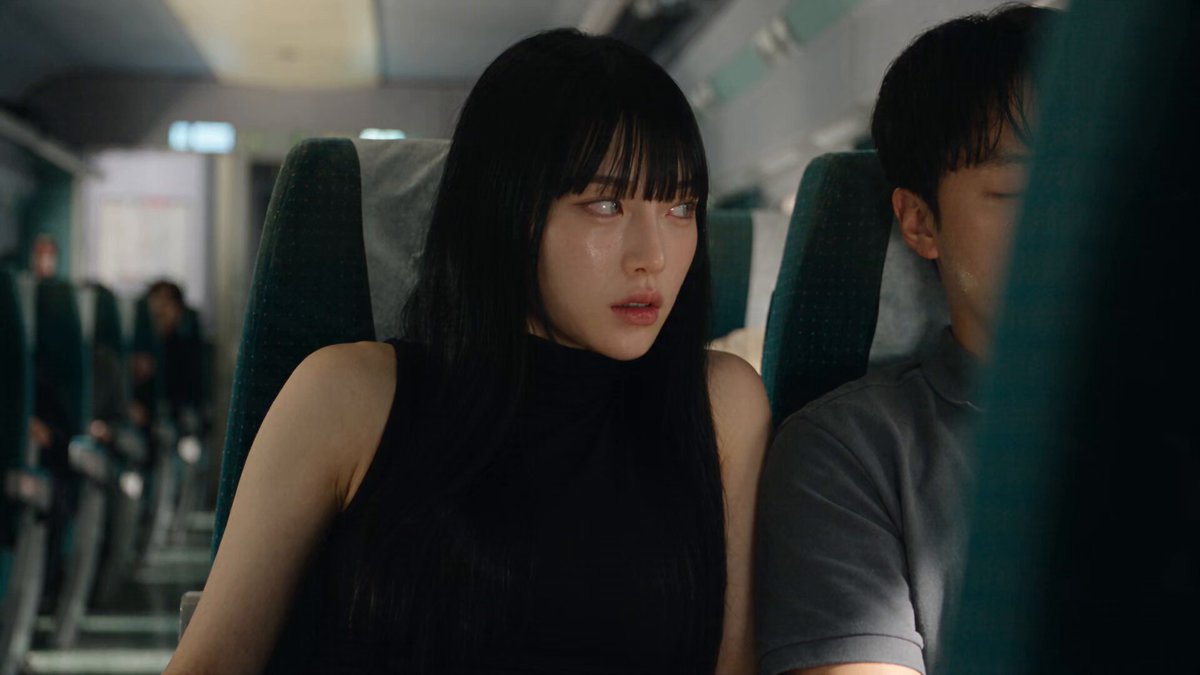
The second tell is flatness. Amateur AI footage is often evenly lit, evenly exposed, and evenly colored — the visual equivalent of a shrug.
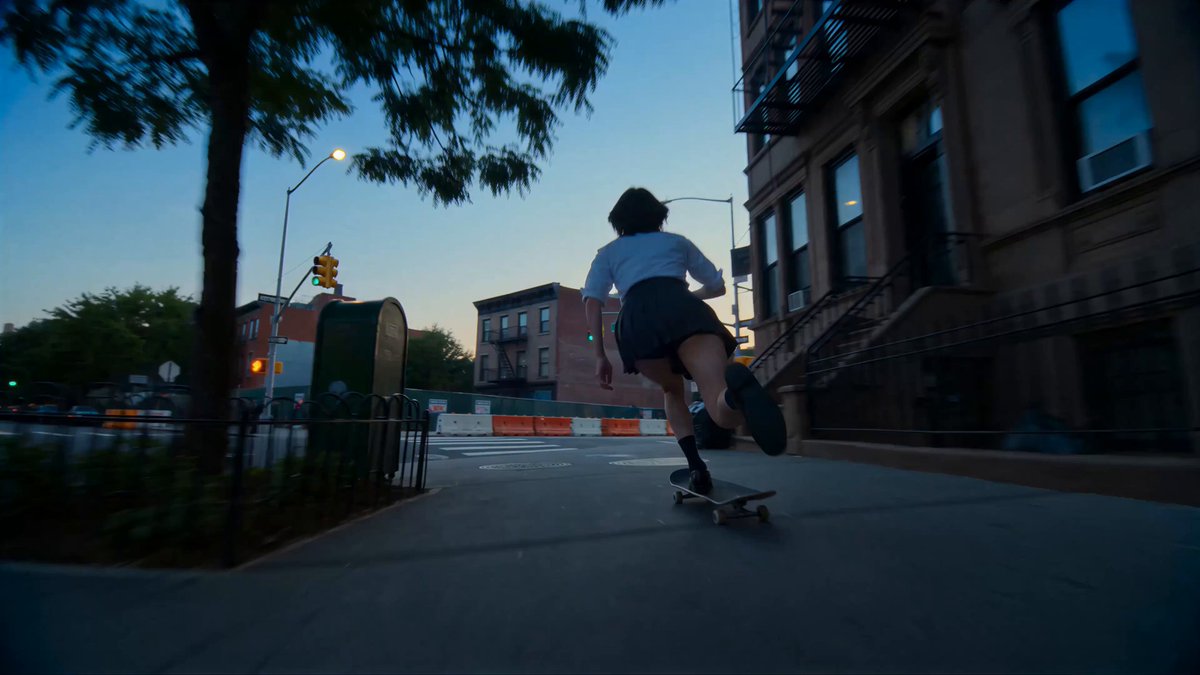
Cinematic images almost always have a motivated light source: a window, a lamp, a screen, a streetlight. Name that source in your prompt. Then introduce a second, opposite element: warmth against coolness, a hard rim against a soft fill, a bright practical against a dark wall. Contrast is what makes a frame feel photographed rather than computed.
Color temperature is your fastest mood lever. A single warm source in a cool room reads as intimacy or loneliness depending on the subject. A single cool source in a warm room reads as unease. Pick a direction and commit — mixed, unmotivated color is what makes footage look synthetic.
Finally, texture. A touch of grain, slight halation around highlights, and a gentle contrast curve (lifted blacks only at the very bottom, rolled-off highlights) do more to sell a filmic look than any single effect pushed hard.
Motion and tempo
Camera movement should have a reason. A push-in means realization or approach. A pull-out means isolation or revelation. A lateral track means observation. A handheld drift means intimacy and imperfection. If you cannot say which of those you want in one sentence, cut the move.
Tempo in short-form is compressed. Where a feature might hold a shot for eight seconds, a vertical short holds for one and a half to three. That means one idea per shot. If a shot is trying to show a location, a character change, and a plot twist, it will show none of them clearly.
Cut on motion when you can. Motion masks the cut, hides small continuity errors, and keeps perceived energy high even when the pacing is slow.
Sound
Sound is the cheapest way to make a short feel expensive and the most frequently skipped. The core elements are room tone (a continuous low bed that prevents silence from feeling like a technical fault), movement accents (footsteps, cloth, a chair scrape), transitional whooshes or impacts, and a musical bed that stays out of the voice's frequency range.
One powerful technique: pull the music out for half a beat before a reveal. The sudden absence of sound does more work than any added effect.
A repeatable AI video workflow, stage by stage
The creators who ship consistently are not more talented; they run the same loop every time so decisions get cheaper. Here is a four-stage loop that scales from a single short to a weekly series.
Stage 1 — Concept and beat sheet
Start with one sentence: who wants what, and what stops them. Then break it into three beats — hook, development, payoff — and assign each a duration budget. A 30-second short usually breaks down as 2–3 seconds of hook, 15–20 seconds of development, and 5–8 seconds of payoff.
Write the hook as an image, not a caption. If the first frame does not create a question, no amount of text overlay will rescue it.
Stage 2 — Storyboard and shot list
Build a table before you generate anything. Columns that work well:
- Shot number
- Shot size (wide / medium / close)
- Lens (24mm, 50mm, 85mm)
- Camera move (static, push, pull, track, handheld, crane)
- Subject and action
- Location and light source
- Duration
- Audio cue
- Generation notes (model, style reference, seed)
Filling this in takes twenty minutes and saves hours. It also forces you to notice when you have written three consecutive medium shots, or when two beats are trying to occupy the same shot.
Stage 3 — Generation and iteration
Generate in batches of three to six variants per shot, not one. Selecting between options is faster and more reliable than trying to describe the perfect take in advance.
Lock a seed once a look is working. Change one variable at a time when it is not. If a shot fails after three serious attempts, the problem is usually conceptual — the prompt is asking for two incompatible things (a slow push-in and a whip pan), or the beat genuinely needs to be split into two shots.
Name your files with the shot number and take letter from the start. s03_closeup_take_b.mp4 will save you in the edit; output_final_2.mp4 will not.
Judge every take on a phone screen at actual size. A shot that looks impressive on a 27-inch monitor can be unreadable at 400 pixels wide.
Stage 4 — Assembly, sound, and finishing
Edit chronologically, cut on motion, and resist the urge to insert a transition until you have watched the sequence once without any. Most cuts need no transition at all; a hard cut is the most cinematic tool available.
Then layer sound: room tone bed, movement accents, one or two transitions, music. Mix so dialogue or voiceover sits clearly above everything else. Finally, grade. Do this last, as a single pass across the whole timeline — shot-by-shot grading is what creates a patchwork look.
Prompting for camera language
A prompt that reliably produces cinematic footage has a consistent shape:
subject + action + environment + light source + shot size/lens + camera move + texture reference + pacing
For example:
A woman in a wool coat stands at a rain-slicked bus stop, exhaling slowly. Empty street behind her, sodium streetlights and a single lit window. Medium close-up on an 85mm lens, static with a slight handheld drift. Subtle grain, deep shadows, warm highlights against cool blue ambient. Slow, quiet pacing.
Three more patterns worth keeping:
- The reveal: Wide establishing shot, 24mm, slow push-in toward a doorway, single hard light source inside, high contrast, no camera shake.
- The interior beat: Close-up on hands, 50mm, static, soft window light from the left, shallow depth of field, muted palette.
- The energy shot: Medium tracking shot alongside a runner, 35mm, lateral movement matched to subject speed, practical lights streaking in the background, slight motion blur.
What to avoid: contradictory moves ("static push-in"), competing light sources ("bright sunlight and neon and candlelight"), and unmotivated superlatives ("epic, stunning, masterpiece") that carry no directorial information. Say what the camera does and where the light comes from, and the mood follows.
Continuity and consistency across shots
Nothing breaks the illusion faster than a character whose face, wardrobe, or hair changes between cuts. Consistency is a documentation problem more than a generation problem.
Build a character sheet: one paragraph that describes the person in fixed language — age, build, hair, wardrobe, one distinguishing detail. Copy that paragraph verbatim into every prompt where the character appears. Do not paraphrase it, and do not add adjectives impulsively. The moment you write "her dark green coat" in one shot and "her emerald jacket" in the next, you have introduced drift.
Do the same for locations. A location bible of two or three sentences — architecture, dominant color, light source, time of day — keeps a series visually coherent across episodes.
Use reference images or image-to-video conditioning whenever the tool supports it. A single reference frame is worth a paragraph of description.
Keep lens and grade choices per scene fixed. If scene one is 85mm with a warm grade, scene two should not drift to 24mm with a cool one unless the story explicitly changes location or time.
Tool selection: criteria that actually matter
Tool sprawl is the most common reason creators stall. Pick two or three tools and go deep. Evaluate candidates on these criteria:
Output resolution and aspect-ratio support. Native vertical output beats cropping a widescreen render, which loses composition and resolution.
Motion realism versus stylistic rendering. Some engines excel at photoreal human motion, others at stylized or animated looks. Match the engine to the project, not to the hype.
Reference and image-to-video support. This is the single biggest lever for continuity. Prioritize it.
Control granularity. Can you specify lens, camera move, and duration, or are you limited to a single free-text field?
Iteration speed and cost per attempt. A slightly weaker engine that renders in twenty seconds will produce better work than a superior one that takes ten minutes, because you will actually iterate.
Audio and voice capability. Either integrated or via a dedicated voice tool. Check pronunciation control, pacing, and licensing terms for commercial use.
Export and interoperability. ProRes, H.264, alpha channels, and clean import into your editor of choice.
Batch and queue management. If you are producing a series, the ability to queue multiple shots overnight matters more than any single-shot quality difference.
For editing, a capable free option like DaVinci Resolve or CapCut handles short-form work well; Premiere Pro remains a common choice for teams already in that ecosystem. For voices, dedicated synthesis tools generally outperform video generators' built-in audio.
Quality-control checklist before you publish
Run this pass on every short, in order:
- Watch once with sound off. Does the story read visually?
- Watch once with picture off. Does the audio stand alone?
- Check the first 1.5 seconds. Is there a question, a face, or a motion?
- Look for same-size cuts. Fix any you find.
- Confirm character and wardrobe consistency shot to shot.
- Verify the grade is uniform across the whole timeline.
- Check caption safe zones against the target platform's UI.
- Confirm loudness is consistent with the platform's normal range.
- Watch the last two seconds. Does the payoff land, or does it trail off?
- Confirm every asset is licensed for commercial use.
Common mistakes that flatten the cinematic look
Overcutting. Fast cuts feel energetic only when the viewer can register each shot. Below roughly half a second, cuts become noise.
Overuse of transitions. Whip pans, glitches, and zooms are seasoning, not structure.
Music louder than the voice. The most common technical fault in short-form. Duck the bed under dialogue.
No silence. A short with continuous music has no dynamics. Cut the music somewhere.
Prompt sprawl. Forty-word prompts with six adjectives produce mush. Ten to twenty specific words beat forty vague ones.
Generating before storyboarding. The fastest route to a folder of unusable clips.
Grading shot by shot. Produces a patchwork. Grade the finished sequence in one pass.
Ignoring the thumbnail frame. The first frame is your cover image on most platforms. Choose it, do not inherit it.
Delivering for multiple platforms
One master cut, several exports. Cut a clean 16:9 master if you can, then reframe for vertical — but always check that the reframe has not decapitated anyone or pushed a key subject under the caption area.
Prepare two or three hook variants that differ in the first two seconds. Small hook changes routinely produce large differences in retention, and testing them costs almost nothing once the body is done.
Caption style should be legible at a glance: high contrast, no more than two lines, positioned above the platform's UI zone. Burn in captions for platforms where autoplay is silent by default.
Keep a written delivery spec for each platform — aspect ratio, resolution, safe zones, loudness target, file naming — so you stop re-deciding the same things every week.
FAQ
How many shots should a 30-second short have?
Between eight and fifteen is a comfortable range. Fewer than eight tends to feel slow; more than twenty rarely gives any single shot room to register.
Do I need a different tool for every type of shot?
No. Two or three well-understood tools beat eight half-learned ones. Depth of familiarity, especially around seeds and reference inputs, produces more consistency than access to more engines.
Why does my footage look "AI" even when the composition is good?
Usually flat lighting and unmotivated color. Add a named light source and a clear warm/cool direction, then add grain and a gentle contrast curve in the grade.
How do I keep a character consistent across a series?
Write one fixed descriptive paragraph per character, paste it verbatim into every prompt, use reference images wherever supported, and never rephrase the anchor details.
Is a storyboard really necessary for a 20-second video?
Especially for a 20-second video. Short pieces have no room for an unclear shot, and a shot list is where you catch that before generation.
What is the fastest way to improve my output?
Fix your sound and your first 1.5 seconds. Those two changes improve perceived quality more than any generation upgrade.
Where to go from here
Pick one short you have already made and rebuild it through the four-stage loop: beat sheet, shot list, batched generation, single-pass assembly and sound. Compare the two versions. Most creators find the second attempt shorter, cheaper to produce, and noticeably better — not because the tooling changed, but because the directing did.
Once that loop feels automatic, the natural next step is turning it into a series: standardize your character sheets, lock a grade and lens palette, and keep a reusable delivery spec. Consistency across episodes is what converts a single good short into an audience that comes back.
