

What Cinematic Storytelling Means in the AI Era
Cinema has always been a visual language. A well-composed shot tells you who the character is, what they want, and how they feel — often without a single line of dialogue. For decades, mastering that language required years on set, expensive equipment, and a crew that understood light, lens, and blocking. Generative AI has not eliminated that craft. It has moved it.
Today, the director's most important tool is the prompt, and the most important skill is knowing how to translate story intent into visual instructions. The models do the rendering; you do the directing. The creators who win are the ones who treat AI generation not as a shortcut past filmmaking, but as a new way of practicing it.
This article walks through the principles of cinematic storytelling with AI: how to think about composition, lighting, continuity, and emotion when your camera is a text box, and how to adapt those principles to real audiences and real budgets.
The Core Principle: Show, Do Not Tell
The first rule of cinematic storytelling applies in AI exactly as it applies on set: the visuals must carry the meaning. If your scene can only be understood through dialogue, it is not cinema yet — it is a radio play with pictures.
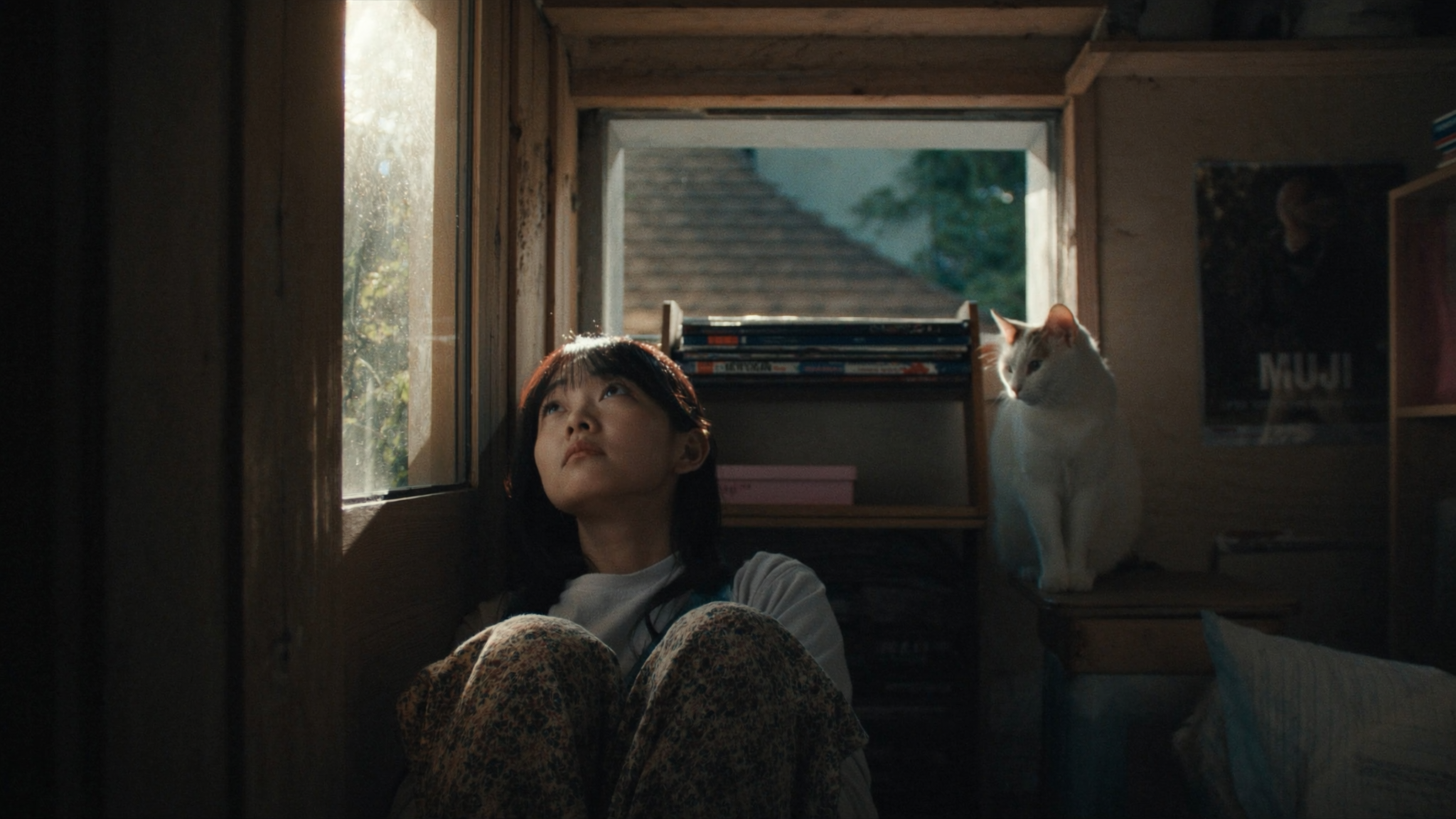
When you write a prompt for a story beat, ask what the audience should feel from the image alone. A character standing small in a vast empty room says loneliness without the word. A low-angle shot of a figure against a bright doorway says power and escape simultaneously. Warm, golden light on a reunion says safety; cold blue light on the same reunion says distance.
Translate that instinct into prompt language by describing what the camera sees, not what the story means. Instead of "a sad scene," write "a woman sitting alone at a kitchen table at 3 a.m., a single overhead light, her reflection faint in the window." The emotion emerges from the concrete details. This is the discipline of show-don't-tell applied to generation, and it is the fastest way to improve the quality of your output.
Thinking in Shots: Composition and Framing
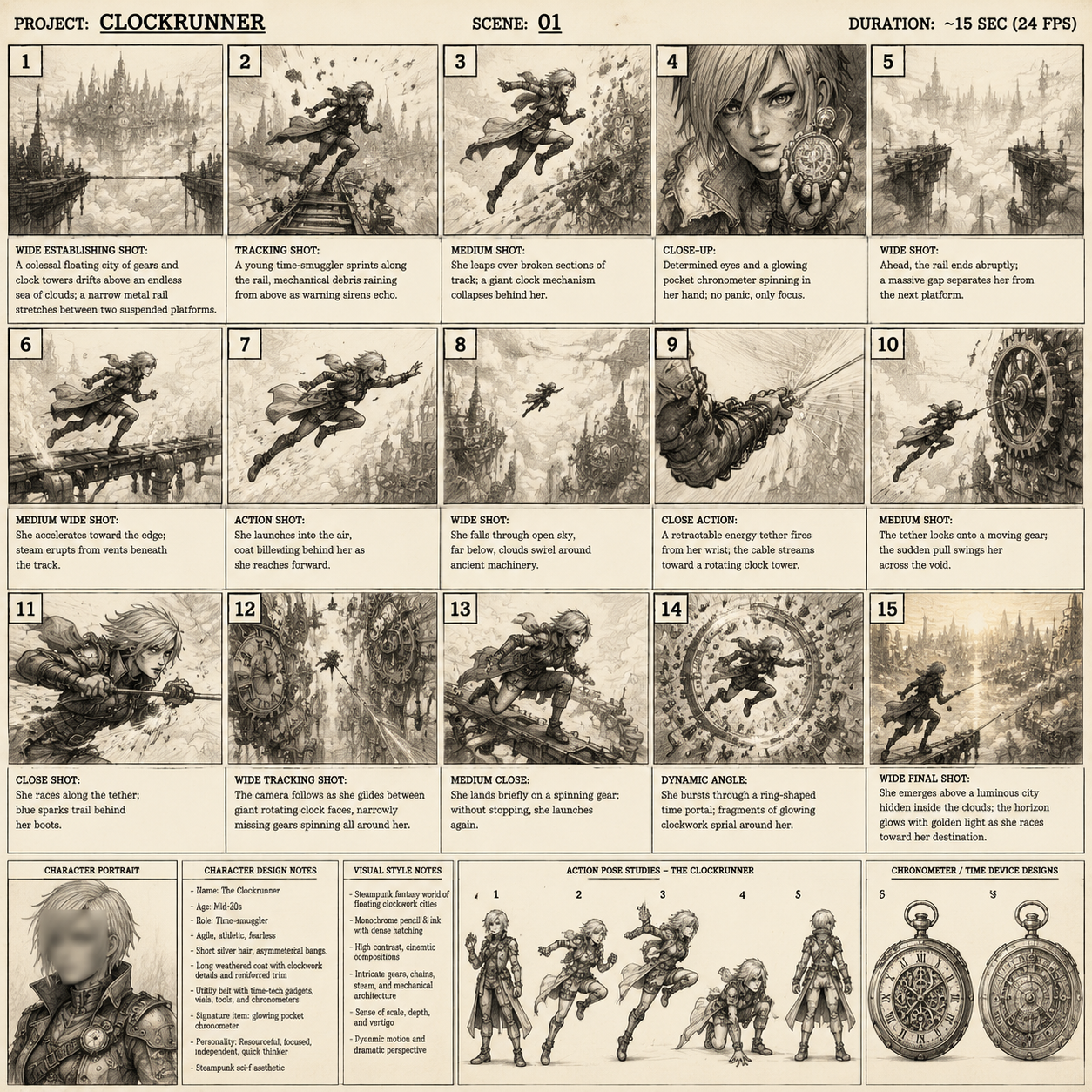
A cinematic prompt is a shot list. Before generating anything, break your story into shots and decide the camera language for each one.
Establishing shots set the world. Wide, static, and slow, they give the audience spatial context. In AI generation, describe the environment, the scale, the atmosphere, and the time of day. The wider the shot, the more the scene's mood lives in environmental details — weather, architecture, light.
Medium shots carry action and dialogue. They frame characters from the waist up and give room for gesture and movement. Here, describe body language and interaction: who is facing whom, who is dominant, where the eye lines go.
Close-ups carry emotion. The face fills the frame, and every detail matters. Describe the expression precisely and the lighting on the face specifically. In AI generation, close-ups are where identity consistency becomes critical — the same character must look identical in every close-up, or the emotional impact collapses.
Camera movement deserves its own prompt language. A slow push-in builds tension. A handheld shake adds documentary immediacy. A crane shot rising away signals loss or scale. These are not decorations; they are punctuation for the scene. Write them into the prompt the way you would write them into a shot list.
Light Is the Mood
Lighting is where AI-generated video most often looks flat, and where cinematic storytelling is most often won or lost. A well-lit prompt separates a generated clip that looks like a video from one that looks like a film.
The most reliable cinematic lighting patterns transfer directly to prompts. Rembrandt lighting — a triangle of light on the shadowed cheek — reads as classical and dramatic. Backlighting separates the subject from the background and creates depth. Practical lights — lamps, neon, screens visible in the frame — add realism and motivate the light source. Golden hour gives warmth and nostalgia; blue hour gives melancholy and tension.
When writing prompts, specify the light source, its direction, and its quality. "Soft window light from the left" and "harsh overhead fluorescent" produce completely different scenes. If you want a specific mood, name it through light rather than through the word "moody." "A room lit only by a television" is a far more direct instruction than "a tense evening scene."
Consistency of light matters across a sequence too. If scene one is lit by afternoon sun and scene two by moonlight, the audience will feel the jump even if they cannot name it. Plan the lighting language for the whole story before you generate a single shot.
Visual Consistency: The Non-Negotiable
Nothing breaks cinematic immersion faster than a character who changes appearance between shots. The audience forgives a lot — imperfect physics, stylized rendering — but they do not forgive a protagonist who becomes a different person.
The solution is reference-based generation. Build a set of reference images for each main character and each recurring location, and feed those references into every generation involving them. The reference set should cover multiple angles and lighting conditions, and the character's defining features must be identical across all of them.
Treat locations the same way. If your story returns to the same café, the same street, the same room, maintain a reference set for each. Recurring locations anchor the story in a consistent world, and the audience registers that consistency even subconsciously.
Do not rely on text alone to hold identity. A prompt can describe a character's face in detail, but the model will still reconstruct it probabilistically on every render. References lock it down. The more episodes or scenes your story has, the more important this becomes.
Directing Emotion and Dramatic Tone
A cinematic sequence is a controlled emotional arc, and you can direct that arc through model choice and prompt design.
Different generation models have different temperaments. Some excel at photorealistic drama with subtle facial performance; others deliver stylized, expressive imagery; others prioritize physics and motion. Match the model to the emotional register of the scene. A gritty crime sequence wants realism; a dream sequence wants stylization; an action set piece wants physical dynamism. Do not force every scene through the same model just because it is convenient.
Within a scene, the emotional tone is set by a combination of framing, light, color, and motion. Desaturate the colors for tension, warm them for nostalgia, push contrast for drama. Slow the motion for weight, speed it for urgency. These choices are the director's vocabulary, and in AI generation they all belong in the prompt.
The most underused tool is negative direction: telling the model what you do not want. If the scene should feel calm, state "no motion blur, static camera, even lighting." Explicit constraints reduce the model's tendency to inject default drama, which is often the reason generated scenes feel generic.
Adapting Storytelling to a Local Audience
Cinematic language is universal, but audiences are local. A story that works in one market can feel foreign in another — not because of language, but because of cultural references, visual expectations, and narrative conventions.
If your audience is in a specific region, adapt the visual details that signal authenticity. Architecture, clothing, interior design, street scenes, food, and social dynamics all carry cultural weight. A prompt that describes "a modern office" will render a generic international office; one that describes the specific architectural style, furnishing, and social codes of your market will resonate with local viewers.
Character design matters here too. Audiences connect more readily with characters who resemble the people they see around them. When generating protagonists, be deliberate about ethnicity, style, and mannerisms — and be consistent about them across the whole story through reference images.
This does not mean abandoning universal storytelling. The strongest work combines culturally specific authenticity with emotionally universal arcs. The specificity is what makes it feel real; the universality is what makes it travel.
The Budget Question: Creative Control vs. Commercial Reality
Artistic ambition meets its limit at the budget. Generative AI has already collapsed the cost of production, but it has not made it zero, and quality still correlates with iteration.
The practical approach is tiered investment. Spend your iteration budget on the scenes that carry the story — the emotional peaks, the establishing moments, the shots that will be seen the most. Generate rough versions quickly to test composition and tone, then invest in high-fidelity renders only for the winners. The scenes that merely connect the plot do not need the same treatment.
Time is a budget too. A story with twenty scenes will take far longer to bring to a consistent standard than a five-scene story of the same length. If you are producing for a deadline, cut scope before you cut quality. A shorter film that is visually coherent beats a longer one that falls apart halfway through.
Return on investment in AI storytelling is a matter of iteration discipline. The creators who produce strong work consistently are not the ones with unlimited budgets. They are the ones who know which scenes deserve the expensive passes and which do not.
A Workflow for AI Storytelling
A reliable production workflow keeps the creative process under control. Here is a sequence that works for short films, branded content, and series alike.
Develop the script first. Write the story as a beat sheet, then expand the beats that matter into full scenes. Decide the emotional arc and the ending before you generate anything.
Turn the script into a shot list. Break each scene into shots, and assign each shot its camera language, lighting, and emotional function. This is your generation blueprint.
Build the asset kit. Create reference sets for every main character and recurring location. Verify the references against each other — contradictions here will poison the whole production.
Generate in passes. First pass: rough versions of every shot to check composition and tone. Second pass: refine the shots that survive, tightening prompts and fixing continuity. Third pass: high-fidelity renders of the final selects.
Edit for rhythm. Assemble the renders, cut to the story's rhythm, and add sound design and music. Audio is half the cinematic experience; do not neglect it just because the visuals came from AI.
Review against the emotional arc. Watch the cut and check each scene against its intended function. Does the opening hook? Does the middle escalate? Does the ending land? Fix what fails the test.
FAQ
Do I need to know filmmaking to make good AI video?
It helps enormously. The skills that make a good director — composition, lighting, pacing, storytelling — transfer directly to prompt design. If you are new to both, learn the basics of cinematography first; the prompts will follow.
How do I keep characters consistent across a long story?
Use reference images for every character and location, and generate all scenes involving them from those references. Add verified frames from your own renders back into the reference set as the production progresses.
Why does my AI video look flat?
Almost always lighting. Add specific light sources, directions, and qualities to your prompts. Flat lighting is the most common reason generated video feels amateur.
Should I use the same model for the whole video?
Not necessarily. Different models serve different scenes. The constraint is consistency: if you mix models, keep the same references and visual language so the audience does not feel the seams.
How long should an AI-generated film be?
As long as it needs to be to tell the story — and as short as it can be while staying coherent. In practice, a tight five-minute film with consistent craft outperforms a sprawling twenty-minute one that falls apart visually.
The Director's Seat Is Still Occupied
Generative AI changed who can make films, not what filmmaking requires. The camera is cheaper, the crew is smaller, and the render times are faster, but the questions a director must answer are the same: What does the audience see? What do they feel? What do they understand? The tools now render your answers, but you are still the one who must have them.
Learn composition, master lighting, protect consistency, and direct emotion scene by scene. Do that, and the only limit on your stories is your imagination — not your budget, not your crew, and not the machine.
