
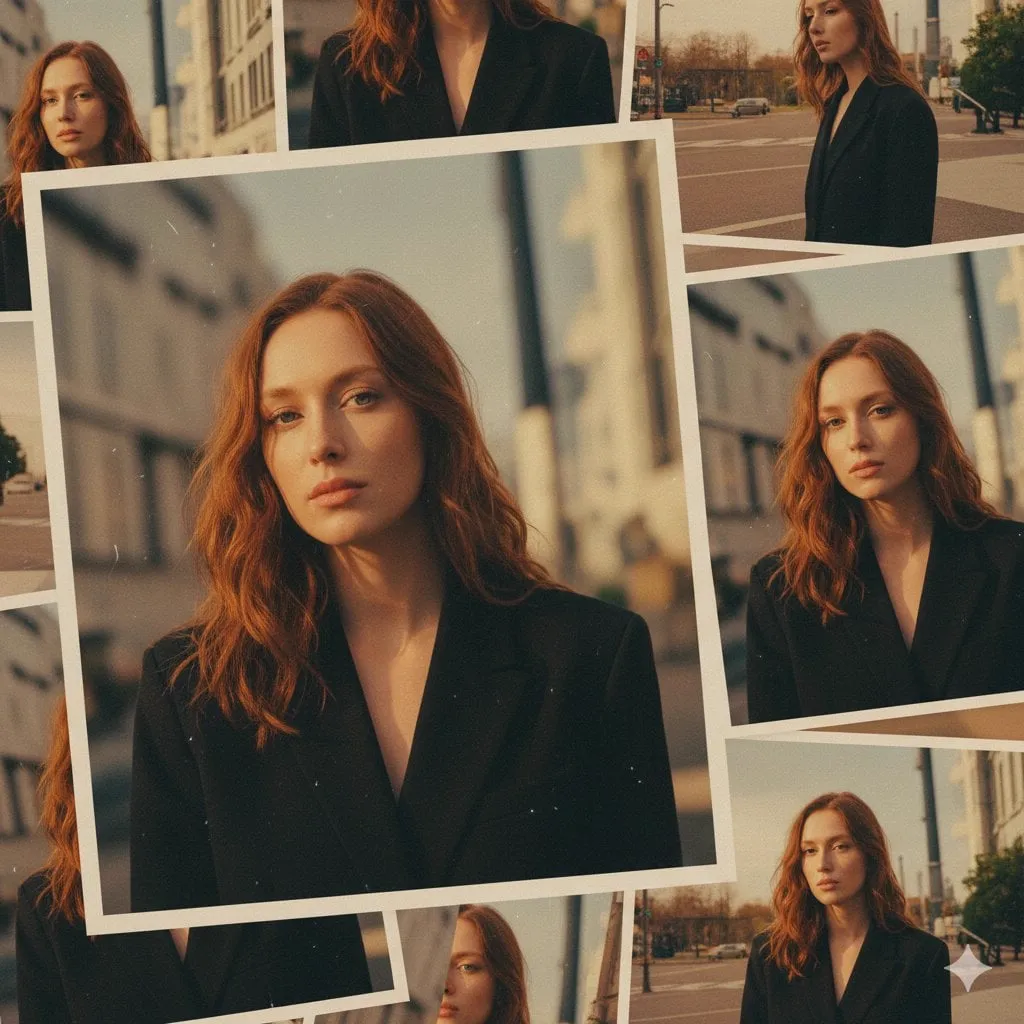

The shot that breaks the film
Every filmmaker knows the moment. The dailies come back, and one shot is wrong: the protagonist's face is subtly different, the light on the hero prop has shifted, the wardrobe has changed color between two scenes that are supposed to be continuous. In traditional production, fixing it means a reshoot, a day of logistics, cast and crew rebooked, and a hole in the schedule that the editor will feel for weeks.
Cinematography is the art of controlling light, lens and motion across many shots that must feel like one continuous world. The hardest part of that job has always been consistency: making sure the same character, the same object, the same light behaves identically from shot to shot, even when those shots are filmed days apart. Generative AI did not remove that problem; it initially made it worse, because a model asked to produce the same character twice will happily produce two different characters.
The solution that is reshaping the craft is multi-image fusion: using a set of reference images to define a character, object or style so tightly that every subsequent generation stays true to it. This is not a niche trick. It is the technical foundation for a new kind of cinematography where the virtual camera can be pointed anywhere, and the world it captures remains stable.
What multi-image fusion actually does
At its core, multi-image fusion is a way of teaching a generative model who or what something is. You provide several images: a character in different poses, a product from different angles, a location under different light. The model analyzes the set, separates what is stable from what varies, and builds a compressed visual identity. From that point on, you can generate new scenes, new angles and new actions while the identity holds.
The analogy is casting. A director does not describe an actor to the camera department on every shoot day; the actor simply is that person, and the crew works around the fixed identity. Multi-image fusion gives generated characters the same status: once fused, they carry their identity into every frame, the way a contracted actor carries theirs across a production.
Three properties make fusion the right tool for cinematography:
- Identity persistence: the character looks like themselves in every shot.
- Style persistence: the visual language, color and texture stay consistent across the piece.
- Context flexibility: within that stable identity, the character can move, emote and react, because fusion constrains identity, not performance.
Why shot consistency is the heart of the craft
Cinema works because the audience believes the world is continuous. When a character walks from a kitchen into a hallway, the viewer must believe both spaces exist in the same home, lit by the same sun, at the same hour. Achieving that belief required enormous discipline: continuity supervisors, script supervisors, meticulous set and lighting notes, and reshoots when something slipped.
AI-generated cinematography inherits the same demand and adds a new failure mode. A generator has no memory of the previous shot. Without a reference system, every new prompt starts from zero, and the probability of the same character looking identical twice is near zero. The result is the "AI look": beautiful images that cannot hold a story together.
Multi-image fusion attacks exactly this weakness. It gives the generator a persistent memory of identity, expressed as reference images, and it gives the filmmaker a continuity system for the virtual world. For the first time, the technical problem that most limited AI storytelling, character and world consistency, has a practical engineering answer.
The cinematographer's new workflow
Adopting fusion-based consistency does not mean abandoning cinematographic thinking; it means encoding it.
Design the character like a casting director
Before generating a single scene, build the character reference set: front, three-quarter, profile, back; neutral and emotional expressions; primary and alternate costumes. This is the equivalent of the actor's contract: the rules of the character's appearance, fixed before production.
Design the world like an art director
Locations need the same treatment. A reference set for a city street, a room or a landscape locks the architectural style, the color palette and the lighting logic, so that every shot set in that location reads as the same place. World references are what prevent the audience from feeling that each shot is a different universe.
Lock the light
Lighting is the cinematographer's signature. If the reference set captures a character in warm afternoon light, fuse a light-aware identity and keep the lighting vocabulary consistent in every prompt. When a scene needs a different time of day, generate a new light-condition reference rather than describing it in text and hoping.
Shoot coverage deliberately
Traditional directors shoot coverage: wide, medium, close-up, insert. With fusion, you do the same, but the "camera" is a prompt. For each beat of the scene, generate the coverage using the same fused identity and the same world references. The result is an editable sequence, not a set of beautiful but disconnected images.
Review against the reference, not the mood
The filmmaker's eye needs a checklist: does the face hold, does the costume hold, does the light hold? Compare every shot to the fused reference set before accepting it. This is the digital version of the script supervisor's pass, and it catches drift before it reaches the edit.
Applications across the industry
Advertising and brand storytelling
Brands live and die by visual consistency. A mascot, a product line or a signature look must be recognizable across campaigns, platforms and seasons. Fusion lets a brand define its visual identity once and generate campaign after campaign within it, which collapses the cost of producing consistent branded video.
Long-form storytelling and series
Episodic content is where consistency matters most, because audiences return week after week with a memory of the characters. Series produced with fused identities can maintain character fidelity across dozens of scenes and episodes, making serialized AI storytelling commercially plausible for the first time.
Virtual production and game cinematics
Virtual production pipelines that blend live action with generated plates need the generated elements to match the captured ones. Fusion references built from the actual live-action footage let the AI generate matching continuation shots, which keeps the virtual world visually welded to the real one.
Independent film
For independent filmmakers, fusion removes the most expensive constraint of production: the inability to return to a location or actor. A scene that needs a new angle can be generated from the fused identity without reassembling the crew. This is the democratizing promise of AI cinematography: the discipline of consistency, at a fraction of the cost.
Technical foundations worth understanding
The practical work happens above the level of model internals, but a working understanding of the stack helps you make better decisions.
Reference injection
The model receives reference images as conditioning input, alongside the text prompt. The fusion layer decides how much each reference contributes to the generation. This is why reference quality matters so much: the model trusts what you feed it.
Fine-tuning versus fusion
Fusion works on the fly with your reference set. Fine-tuning trains a dedicated model on your character or style, which yields even tighter consistency at the cost of setup time and resources. For flagship projects with many scenes, fine-tuned models are the gold standard; fusion is the fast, flexible default.
Style and identity separation
The best fusion systems separate identity (who the character is) from style (how the world looks). That separation lets you change the world without breaking the character, or restyle an entire project while keeping the cast intact. Choosing tools with explicit identity/style control gives you the most creative latitude.
Data and storage management
Reference sets are assets. Keep them organized per character, per location and per project, with version history. A project that spans months will regenerate scenes, and the ability to reproduce the exact identity settings from a previous session is what keeps the whole piece coherent.
Building your own consistent project
If you want to put this into practice, here is a sequence that works.
- Write the story and break it into scenes.
- Design the character and world references before generating anything.
- Fuse the references and test one simple scene until identity holds.
- Generate coverage for each scene using the locked references and consistent prompt vocabulary.
- Review every shot against the reference checklist.
- Edit, grade and finish the assembled sequence.
- Document the reference sets and settings so the project can be resumed later.
The discipline is the same as traditional production: prepare before you shoot, check continuity while you shoot, and never let a single beautiful frame break the world.
The economics of consistent virtual production
The business case for fusion-based cinematography is as strong as the creative one. Traditional production pays for consistency twice: once during shooting, with the crew and discipline required to keep a world coherent across days of filming, and again during post, when the editor and VFX team work around the gaps. Reshoots are among the most expensive events in film production, and they exist almost entirely to restore continuity.
AI production with fusion changes the cost structure. The expensive step, keeping identity stable across shots, moves from logistics into software. A character or location reference set is built once and reused without marginal cost. A missing angle is generated rather than reshot. The consequence is that iteration stops being a budget risk and becomes a creative tool: a director can test versions of a scene without burning a shoot day.
There are real costs on the other side: the compute for high-quality generation, the time spent building and validating reference sets, and the human review required to keep quality high. But those costs are predictable and scale with usage, unlike the lumpy, unpredictable costs of physical production. For studios and independents alike, that predictability is worth real money, and it is the reason the craft is moving in this direction faster than many expected.
Common mistakes in fusion-based production
The technique is powerful, but it fails predictably when teams mishandle the basics. Learn these from the mistakes of others.
- Changing references mid-project: Updating a character's reference set after scenes are generated introduces drift between old and new shots. Lock the set at the start and treat changes as a deliberate re-casting decision.
- Mixing incompatible styles: If the references and the scene prompts disagree about the art style, the fused identity wobbles. Define the style once and reuse the same vocabulary everywhere.
- Over-constraining performance: Pushing identity weight too high produces a character that never varies in expression or energy. Consistency should bind identity, not acting.
- Skipping the review pass: Automated pipelines make it tempting to trust the output. Drift still sneaks in, and a five-minute per-shot review is cheaper than rebuilding a broken sequence.
- Ignoring the human role: The technology does not replace the director's eye. It removes the logistics of consistency, and the creative decisions still belong to the filmmaker.
Frequently asked questions
Is multi-image fusion the same as character training?
Not exactly. Fusion applies reference sets on the fly to keep identity consistent; training builds a dedicated model for the character. Fusion is faster and more flexible; training is tighter and better for high-volume flagship work.
Can I maintain consistency across different AI models?
Switching models mid-project usually breaks consistency, because each model interprets references differently. If you must mix models, build a reference set for each model and test compatibility before production.
Does fusion work for non-human subjects?
Yes. Products, locations, vehicles and creatures respond to the same logic. Build reference sets for anything whose identity must persist across shots.
How many images do I need for a solid reference set?
Four to eight well-chosen images covering angles, expressions and states are enough for most characters and objects. Quality and coverage matter more than quantity.
Is this technology limited to short clips?
Consistency is length-agnostic in principle. Long-form production is hard for reasons beyond consistency, mainly cost and coherence of large generated volumes, but the identity problem is solved by the same reference discipline at any length.
Conclusion
Cinematography has always been the craft of making many images feel like one world. Generative AI threatened to break that craft by producing images without memory, beautiful shots that could not hold a story. Multi-image fusion answers with a memory system: define identity once, in reference images, and every subsequent generation inherits it. The result is a new kind of cinematography where the director keeps the artistic decisions, character, light, coverage, emotion, and the technology handles the continuity that used to consume reshoots and budgets. For advertisers, studios, game developers and independents alike, that is not a small improvement. It is the difference between generating clips and making films.
