

There is one problem that every creator runs into the moment they try to tell a real story with AI video: the character will not stay the same. Ask for the hero in a second scene, and you get a stranger who merely resembles them. Hair changes, eye color drifts, the costume quietly mutates. For anyone building a series, an animated short, or even a multi-scene branded spot, this instability is the difference between a portfolio piece and a finished production. The solution, increasingly, is a technique called multi-image fusion: feeding the model several defined reference images so it locks onto a single identity and carries it across every scene. This article explains how it works and how to use it to create characters your audience will recognize in every shot.
Why Character Consistency Is the Hardest Problem
Think about what a viewer experiences watching an AI-generated story that loses its lead character. The first scene invests them in someone, and the second scene quietly replaces them. Even if they cannot articulate it, the audience feels that something is wrong. Recognition is the quietly crucial ingredient that lets people follow a narrative. When a character stays recognizable, audiences stop inspecting the footage and start caring about what happens next.
The difficulty is technical, not personal. Generative models are designed to synthesize variation; giving you something new each time is precisely what they are good at. A video model asked to produce "the same person" has no inherent memory of who that person is from the previous render. Unless you anchor it, the model treats every prompt as a fresh, unconstrained creative problem, which is why the face you approved in shot one rarely survives into shot two. Consistency has to be engineered into the process.
Recognition is also an economic matter. Across a large and growing body of AI-generated video, a memorable, consistent character is what makes a creator's work stand out. Think of the mascots, hosts, and recurring figures that anchors successful series. Viewers come back for the character. If you cannot keep that character stable across episodes, you cannot build a following around them. Consistency, in other words, is not a technical nicety; it is the foundation of audience-building in this medium.
How Multi-Image Fusion Works
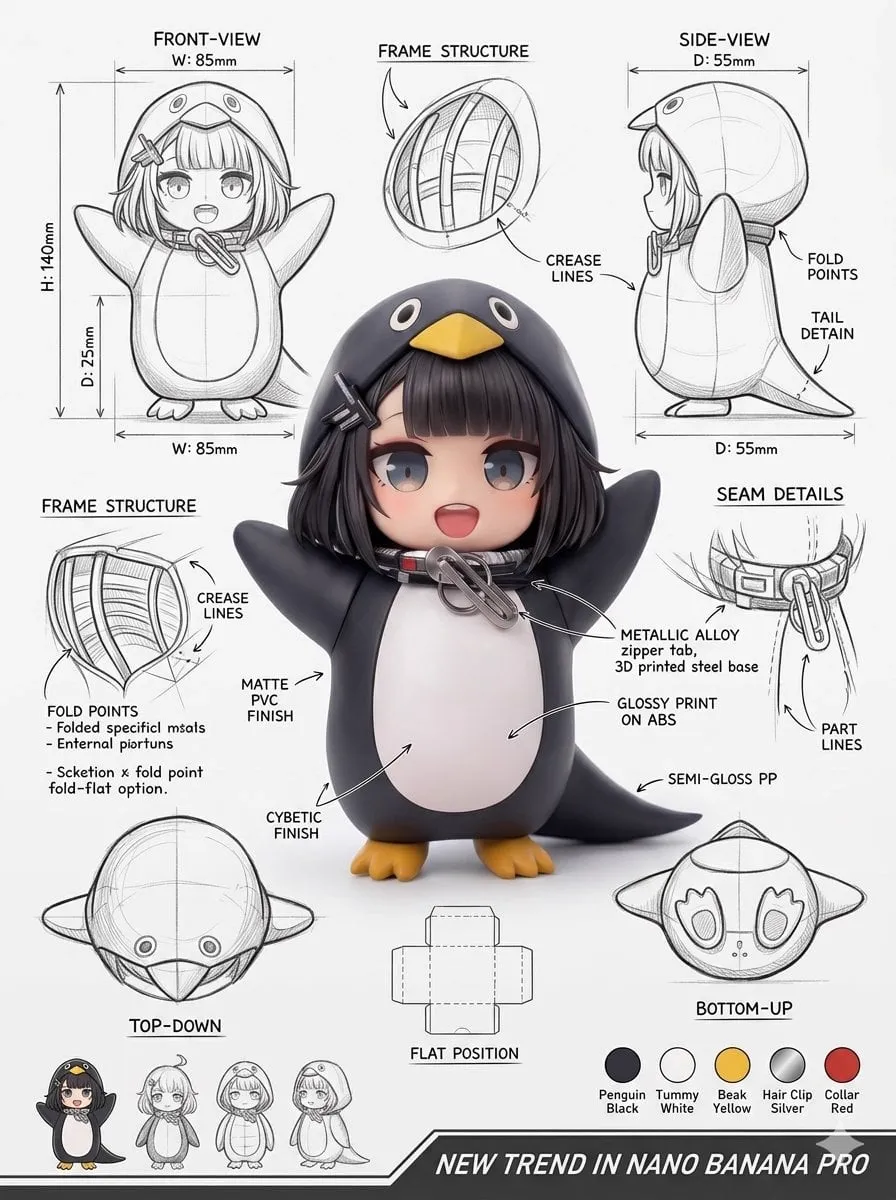
The core idea is simple: rather than asking the model to invent or remember a character, hand it a set of established images that define the character's identity. Multi-image fusion goes a step beyond single-image reference prompting by using several views at once. A front view establishes the face, a profile view establishes the facial structure, and a three-quarter view fills in how the features sit in space. Together they give the model a three-dimensional understanding of the character that a single angle cannot provide.
This structural information is what lets the model rotate the character into new camera positions without redrawing the identity. When you have handed over the full geometry of the face from multiple angles, the model has enough context to place the character in a wide shot, a close-up, or a tracking shot while keeping the same person. The images act as a fixed reference point that the generation builds around rather than improvises on.
Multi-frame fusion matters most in two situations. The first is multi-scene storytelling, where the same character must move through different settings and situations. The second is maintaining consistency across specialist models, where you want a character designed in one style or model to survive being animated through another. In both cases, the reference images are the contract that keeps the identity intact.
Building a Strong Reference Set
The quality of your consistency is capped by the quality of your references. Here is how to build a reference set that actually works.
Start With a Clean Identity Anchor
Your primary image should be a clear, well-lit, front-facing view of the character with no distracting props or busy background. The model needs to read the features unambiguously. High resolution matters; a blurry, low-detail anchor forces the model to invent details, and invention leads to drift. Save this as your master.
Add Complementary Angles
Follow the front view with a profile and a three-quarter view of the same character. Together these three angles describe the face's structure in three dimensions. The richer the geometry you provide, the more confidently the model can place the character in arbitrary camera positions. This is the difference between accuracy and mere resemblance.
Include Expression and Wardrobe Variants
Your character will not stay in one expression or one outfit for a whole story. Provide additional reference images that show different emotional states and costumes, while keeping the underlying face consistent. These variants let you move the character through scenes without breaking the physical identity, because the model always has a version of the character that matches the required situation.
Keep Everything Consistent in Its Details
All your reference images must show the same person. If the front view and profile view describe different facial structures, you have given the model contradictory instructions, and the result will be an unstable compromise. Spend the time to ensure the reference set is internally coherent before you rely on it.
The Multi-Scene Workflow
Once the reference set is in place, the process of generating a consistent multi-scene sequence becomes systematic.
Lock the Identity Before You Shoot
Run a series of test generations using your reference set and confirm the character holds across simple scenes before attempting anything dramatic. If the identity is not stable in easy tests, it will not survive hard ones. Fix the references now, while the cost is low.
Plan Each Scene Against the Same Reference
Write out the full shot list for the story, then generate each scene using the shared reference set plus that scene's specific description of action, setting, and lighting. Every scene points back to the same identity anchor, which is what keeps the lead character recognizable even as the camera and context change.
Restate Style and Lighting in Every Prompt
Consistency is not only about the face. A character who looks the same but appears in wildly different lighting conditions can still feel like a different person. Decide on a lighting mood and visual style for the piece and restate them in every prompt. This keeps the whole production on a single visual track rather than letting each scene invent its own world.
Audit Renders Side by Side
Do not review each scene in isolation. Place every new render next to the character master and check for drift. Look closely at the things that quietly change: eye color, hair parting, scars, costume details, prop placement. The side-by-side comparison catches small differences that accumulate into a character who is suddenly unrecognizable a few scenes later.
Carrying Characters Across Models and Styles
A more advanced but increasingly common use of multi-image fusion is moving a character between different generation models or visual styles without losing the identity. Real productions rarely live in a single tool. You might design the character's look in one model, generate stills in another, and animate scenes in a third. The reference set becomes the bridge that lets the character survive those transitions.
The trick is that the reference images define identity, while the generation model defines the rendering style. By keeping the same reference images and changing only the generation model or the style qualifiers in your prompts, you can restyle the character—from photoreal to illustrated, from one palette to another—while keeping the underlying person recognizable. This is powerful for brand work, where the same mascot may need to appear in a photoreal ad and an animated explainer.
It is important to calibrate expectations, however. Different models honor reference images to different degrees. Some apply them faithfully; others treat them as loose inspiration. Before committing a production to a workflow that spans models, test each model with your reference set to see how strongly it holds the identity. The weakest model in the pipeline will cap the consistency you can actually achieve.
Practical Applications: From Stills to Entire Series
Putting it all together, multi-image fusion opens up production styles that were impractical before.
Long-Form Narratives
With a stable character, you can generate multi-scene stories where the audience stays oriented. Each scene can be produced independently and still cut together into a coherent sequence, because the identity anchor keeps the lead character recognizable across the whole run. This is the difference between isolated clips and an actual narrative.
Recurring Digital Characters
Creators building recurring digital characters or mascots can now rely on a consistent identity episode after episode. Once the reference set is built, every new episode starts from a known face rather than a reconstruction. That reliability is what makes a character worth investing in as a brand asset.
Parallel and Alternate Takes
Reference-driven consistency also makes it practical to produce alternate takes. Because every render starts from the same identity anchors, you can generate several interpretations of a scene—different actions, moods, or camera choices—and know each one still shows the same character. This frees you to explore creatively without risking the identity. In conventional production, alternate takes are expensive; here they become a routine part of assembling the best possible cut.
Collaborative and Iterative Storytelling
Finally, a stable character, carried reliably across episodes, opens the door to iterative storytelling. You can write a scene, render it, review how the character reads on screen, and then adjust the references or the scene description and regenerate. Because the identity persists, each iteration builds on the last rather than starting over. This feedback loop—render, review, refine—is the engine of the most ambitious long-form AI projects, and it is only possible when the character does not dissolve between attempts.
Multi-Angle Product and Presenter Content
The same technique applies to demonstrating objects, products, or an on-screen presenter from multiple angles. Locking the subject's identity with reference images lets you produce an establishing shot, a close-up, and a detail shot that all clearly show the same thing, which is essential for convincing product content and instructional video.
Pitfalls to Avoid
Multi-image fusion is powerful, but it rewards care. The classic failures almost all come from weak reference discipline.
Inconsistent Reference Sets
If your reference images disagree about the character, the output will oscillate as the model tries to reconcile contradictory information. Build a coherent set and verify it holds before scaling up.
Overloading With Busy Sources
A reference image full of clutter forces the model to decide what is identity and what is noise. Keep the master images clean and centered on the character so the model knows exactly what to preserve.
Expecting Memory
Even with fusion, do not assume the model will remember across sessions or episodes. Refeed the reference set every time. The tool is stateless; your discipline is what carries the identity forward.
Skipping the Audit
Consistency erodes silently. Without regular side-by-side comparison against the master, drift accumulates until the character is unrecognizable, by which point rework is expensive. Make the audit ritual.
Frequently Asked Questions
How many reference images do I really need?
A front, profile, and three-quarter view make a strong core. Add expression and wardrobe variants as your story demands. Three complementary angles beat a single image in almost every case.
Do I have to use the same tool for design and animation?
No. Multi-image fusion is exactly what makes it reasonable to design a character in one tool and animate it in another. Test each tool with your reference set and build the pipeline around the ones that honor it.
Why does my character still drift when I use references?
Look for a weak link: an internally inconsistent reference set, a busy anchor image, or a model that ignores reference inputs. Fix those before regenerating, and always regenerate against the shared master.
Can multi-image fusion style a character differently between projects?
Yes. Keep the identity-fixing references and vary only the style qualifiers or the generation model. The identity stays put while the rendering style changes.
Is this only useful for characters?
No. The same reference technique works for any subject whose identity you need to preserve: products, creatures, locations, mascots. Any recurring visual subject benefits from a multi-reference anchor.
