

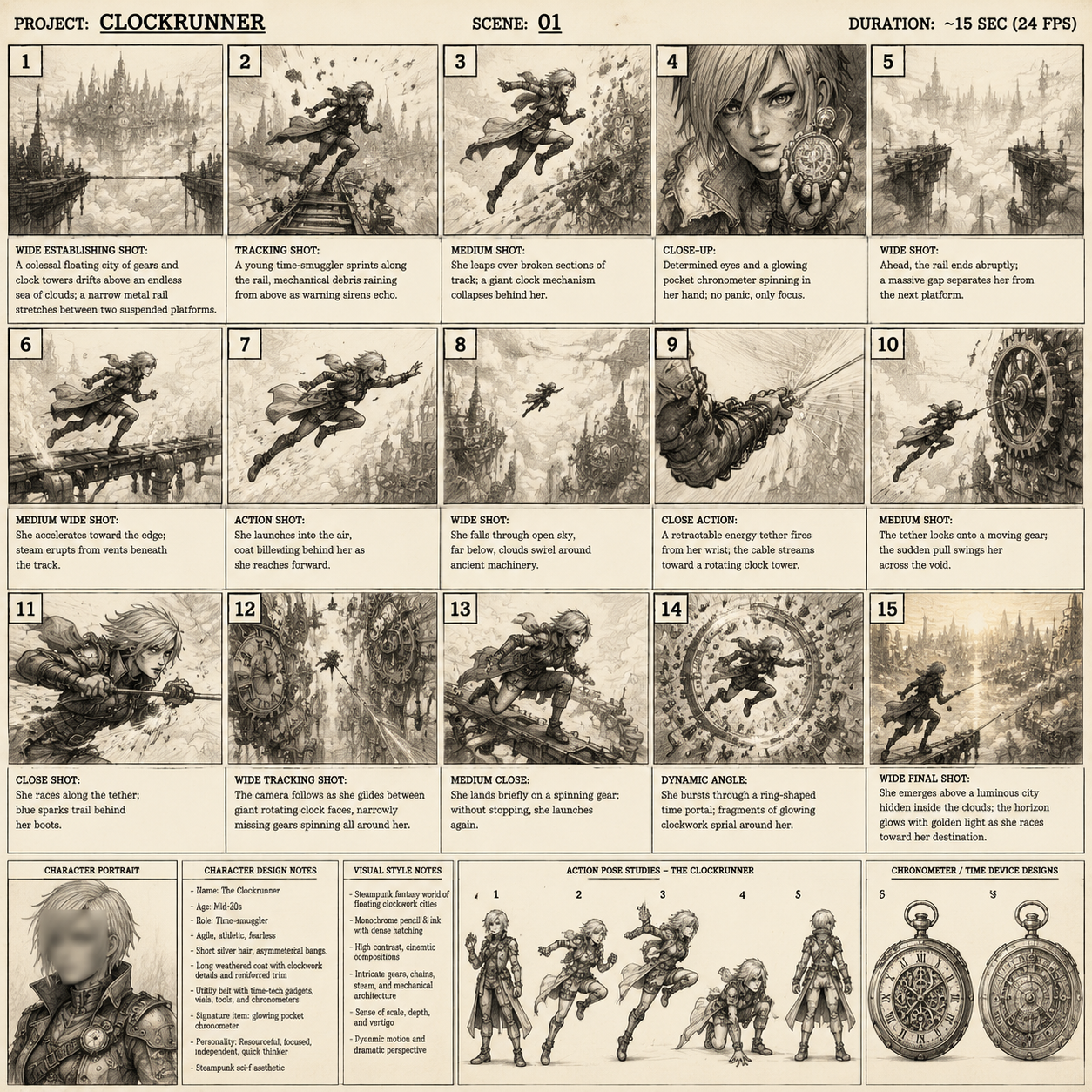
Nothing breaks a viewer’s immersion faster than a hero whose face changes between cuts. Character drift—that subtle morphing of facial structure, wardrobe, or proportions across scenes—has become the defining challenge in AI filmmaking. Modern text-to-video and image-to-video models produce gorgeous frames in isolation, but a story is made of sequences. Audiences need to believe they’re watching the same person from the opening shot to the final frame.
Multi-image fusion is the technique that makes this possible. Instead of leaving identity to chance or prompt wording, the generation pipeline builds a persistent identity profile from several carefully selected reference images. That profile is then applied to every frame, no matter how much the camera moves or the lighting changes.
The New Requirement: Character Consistency
Generative video models are stochastic by design. Type the same prompt twice and you’ll get two different performances, two different faces, two different worlds. That unpredictability is useful for exploration, but disastrous for continuity. When a character appears in five scenes, the audience expects one continuous person.
Viewer tolerance for inconsistency drops sharply as runtime grows. A single artifact can be forgiven; a changing nose, vanishing scar, or shifting costume destroys immersion. The pressure to solve this has pushed the industry beyond clever prompting toward structural techniques like multi-image fusion.
The core idea is simple: use multiple reference images to build a single identity anchor. The model must respect that anchor at every denoising step. It’s the closest thing the medium currently has to a character sheet that the camera can’t forget.
Building a Character Blueprint
The reference set is the foundation. At a minimum, capture three high-resolution views: front, profile, and three-quarter. If the character has a distinctive scar, piece of jewelry, or unusual eye color, make sure it appears in at least two of those views. The goal is to communicate what is permanent about the character and what can change.
Clothes can change. Hairstyles can change. Bone structure, facial markings, and posture should not.
Keep backgrounds neutral in most reference shots. When a model sees a cluttered environment, it may start treating the environment as part of the identity. That’s one reason a clean character sheet produces better results than a random still from a scene.
If the story will include a flashback, dream sequence, or stylized segment, include one reference image in that style as well. This teaches the fusion engine to separate underlying identity from surface style. It also lets you switch aesthetics mid-film without losing the face.
A strong AI image generator is invaluable for this step. Use it to create character sheets with neutral expressions, consistent framing, and controlled lighting before you ever open the video model.
The Fusion Process: Locking Identity into the Latent Space
Once the reference set is ready, the platform processes the images into an identity embedding. This is where multi-image fusion earns its keep. The embedding mathematically encodes the character’s visual DNA.
During video generation, those latent codes are injected directly into the sampler loop. The selected model, regardless of its specialty, is pulled toward that known profile on every frame. The prompt still matters, but it no longer carries the entire burden of remembering who the character is.
This makes the system robust to slight prompt variations, rapid camera motion, and even model switching. You don’t have to pray that the next take looks similar; the identity layer is a hard constraint.
Testing remains essential. Generate two or three test clips and inspect the face frame by frame. If the nose shifts or eye spacing feels wrong in a side view, return to the reference set, adjust the relevant image, and rebuild the embedding. This iterative loop is how professional studios reach the consistency threshold audiences expect.
Choosing the Right Model for Every Shot
Once identity is locked, you gain a surprising freedom: the ability to choose the best model for each individual shot. Different engines have different strengths. One may excel at photorealistic close-ups, another at action, another at hand-drawn textures.
With a locked identity embedding, you can use a high-fidelity model for an emotional close-up, then switch to a faster or more stylized model for a wide establishing shot. The audience never notices the seam. The character remains constant because the fusion layer carries the identity between engines.
This workflow also opens the door to more efficient productions. Expensive, high-fidelity models are reserved for shots where the character’s face is front and center. Simpler scenes can be routed to lighter engines without sacrificing visual continuity.
An automated director layer can help manage these decisions. It reads the requirements of each scene—facial detail, motion complexity, style, depth—and routes the shot to the most appropriate model while keeping the identity embedding attached.
Domer’s AI video generator provides a practical starting point for testing this kind of pipeline. Generate a character clip, swap styles, and see how much identity holds across the transition. That single experiment will teach you more about consistency than any model comparison chart.
Advanced Storytelling: Camera Moves, Style Shifts, and Props
When you no longer have to worry about the character falling apart, storytelling opens up.
Complex camera moves become viable. Long tracking shots, whip pans, and rapid zooms no longer threaten the geometry of the face. Because the identity embedding also influences volume and mass, the character keeps believable proportions through fast choreography.
Depth of field is another payoff. If a character moves from the background to the foreground in a two-shot sequence, the model can respect focus cues across both frames. The result is a shot that feels directed rather than stitched together.
Style shifts become a narrative tool. You can move from photorealistic footage to a painterly flashback without breaking the audience’s sense of identity. The character remains the fixed point, so the stylistic change reads as intentional storytelling.
The same principle extends to props and environments. A heroine’s locket, a villain’s distinctive weapon, or a recurring room can be embedded alongside the character. If the story returns to a location several acts later, the set dressing stays recognizable, even under different lighting or from a different camera angle.
The latest generation of image and motion models is making this even easier. When those models are built with disciplined reference sets and fused identity, the results begin to look genuinely cinematic.
Building a Production-Ready Workflow
Character consistency is not a single magical feature. It is a repeatable process.
Start with a character sheet. Curate at least three strong references. Build an identity embedding. Generate tests across multiple scenes and camera angles. Inspect every frame for drift. Refine the references. Rebuild the embedding. Repeat until the character is stable in your most challenging shots.
Document the character’s permanent features, palette, and emotional range. Share that style guide with collaborators and future generation sessions. The more consistent the plan, the more consistent the output.
Conclusion
Multi-image fusion has transformed character consistency from an impossible problem into a manageable workflow. The best AI storytellers don’t rely on lucky prompts or a single reference image. They build identity anchors, test them under pressure, and use them to hold the story together across every scene.
The tools are already here. The discipline is what separates a tech demo from a narrative. If you want to tell stories that keep audiences engaged, make consistent characters the first thing you solve.
