
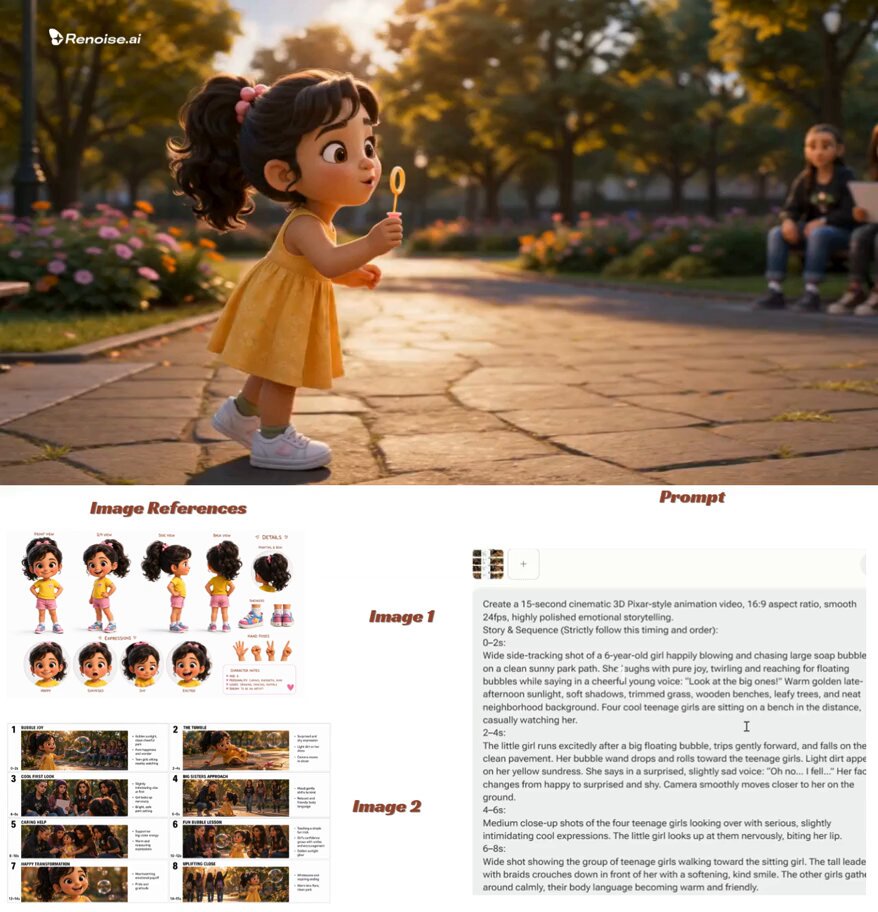


Design systems solved a very specific problem: they turned visual decisions into reusable, versioned, testable parts. Color, spacing, typography, motion curves, elevation — all encoded once, then consumed by every product surface. Video resisted that treatment for years. It lived in its own folder, owned by its own team, described in its own vocabulary, and shipped on its own schedule.
AI video generation changes the economics of that separation. When a usable shot can be produced in seconds from a text prompt, the bottleneck stops being production capacity and becomes consistency. Anyone can generate a clip. Very few teams can generate the right clip, at the right aspect ratio, with the right pacing, in a style that matches the rest of the brand, and then repeat that result next quarter. That is a design system problem wearing a machine learning costume.
This guide walks through how to bring AI video generation inside an open source design system: the architecture, the asset conventions, the model-selection criteria, the review gates, and the mistakes that quietly break these pipelines.
Why AI Video Needs a Design System, Not Just a Prompt Library
A prompt library feels like the obvious first step. Save your best prompts in a shared doc, tag them by project, move on. It works for a few weeks and then collapses for predictable reasons. Prompts are written in natural language, which means they drift. Two people writing "cinematic lighting, soft, moody" will produce wildly different frames, and neither of them can tell you which token in the brand guide they were honoring.
A design system fixes this by making the constraint explicit. Instead of a prompt that says "make it feel premium," you have motion.easing.entrance.standard, palette.surface.inverse, and camera.lens.portrait.85mm. Those are reviewable values. They can be linted, diffed, deprecated, and migrated. When the brand refreshes, you change one token and every downstream video render inherits it.
The second reason is scale. Marketing teams rarely need one video. They need forty variants: six aspect ratios, three languages, five audience segments. Hand-tuning prompts across that matrix is unmanageable. Structured systems generate variants from a template, and templates are cheap to maintain.
The third reason is trust. Stakeholders approve a system, not a hundred individual clips. When the system has a change log and a review process, approval conversations get dramatically shorter.
Core Architecture: Tokens, Components, and Render Jobs
The architecture that works in practice has three layers: a token layer, a component layer, and a render layer. They are loosely coupled and communicate through structured data, not through a shared UI.
Design tokens as the single source of truth
Your token source should already exist for web and product surfaces. Extend it rather than starting a parallel file. Add a video namespace and populate it with the values video actually needs: aspect ratios, safe-area insets for captions, minimum shot durations, transition timings, color pairs with sufficient contrast for video compression, and motion curves expressed as cubic-beziers instead of adjectives.
Keep tokens in a machine-readable format such as JSON or YAML, and produce platform-specific outputs through a build tool like Style Dictionary. The video pipeline is just another target — it consumes tokens.video.json the same way your CSS build consumes tokens.web.json.
Shot components and the scene contract
Borrow the component mental model. A shot component is a reusable unit of meaning: a product hero shot, an animated chart reveal, a testimonial cut-in, a logo resolve. Each one exposes a small set of props — subject, palette, duration, lens, motion preset, caption slot — and hides everything else.
Define a scene contract that every shot component must satisfy before it can enter the library. A workable contract asks for: a stable identifier, a required prop schema with types and defaults, allowed model categories, forbidden content, output resolutions, and an example render. If a shot cannot fill out the contract, it is not ready to be a component. It is an experiment, and experiments live in a scratch directory.
A scene contract does something subtle but important: it makes the prompt an implementation detail. Prompts can be rewritten, model versions can change, and the contract stays stable. Downstream compositions do not break when you swap engines.
Rendering as a build step
Treat render as a build. That means a render manifest — a declarative file listing the shots, their props, their model category, and the output paths. A renderer reads the manifest, resolves tokens, composes prompts, dispatches jobs, and writes artifacts to a predictable location.
This is the single biggest architectural shift. Once render is a build step, you get everything CI gives you: reproducibility, caching, parallel execution, and a clear place to insert validation.
Repository and Asset Structure for Video
Messy asset storage is the most common reason these pipelines stall after the first demo. Plan for volume before you need it.
Folder structure and naming
Separate source from output. Sources are small, human-edited, and versioned in Git: token files, manifests, prompt templates, shot component definitions. Outputs are large, generated, and stored elsewhere — object storage, a media server, or a release directory that is ignored by version control.
Adopt a deterministic naming convention early: {project}/{sequence}/{shotId}@{version}.{ext}. Deterministic names mean you can find a render from a ticket number, and you can diff two versions of the same shot without guessing which file is newer.
Media asset management
Every generated clip should carry metadata: the manifest revision, the token version, the model category, the generation parameters, and the operator. Without this, three months later nobody can reproduce a shot that a stakeholder loved.
Write the metadata into the file name when possible and into a sidecar JSON or embedded container metadata when not. If your team already runs an asset manager, feed it from the manifest rather than uploading by hand.
Matching Render Jobs to the Right Model
Not every shot deserves the same engine. Choosing deliberately is the difference between a pipeline that costs less than the work it replaces and one that quietly drains a budget.
Choosing a quality tier
Sort your shot library into tiers. Tier one is hero content that appears on landing pages and paid placements — allocate the strongest available model and allow several candidate takes per shot. Tier two is supporting footage: b-roll, background loops, ambient motion. Tier three is internal or placeholder content used during editing before final renders land.
Most teams over-spend on tier two and tier three because there is no explicit policy. Writing the tier into the scene contract makes the decision mechanical.
Style-specific and regional models
Different engines have different strengths. Some handle photoreal human motion better; others excel at illustration, anime, or graphic motion. Some are tuned for specific regional aesthetics, which matters when you localize a campaign rather than just translate it.
Rather than betting on one provider, define model categories in your manifest and map categories to concrete engines in a configuration file. Swapping the mapping should not require touching a single shot definition.
Planning compute budgets
Track usage at the level of render, sequence, and project. Set soft limits that warn before hard limits that block. A useful habit is to record the estimated and actual cost of each render alongside the artifact; within a month you will know exactly which shot components are expensive and which are basically free.
From Design Tokens to Video Prompts
The bridge between design tokens and generated video is a template. Done well, the template is boring, readable, and testable.
Prompt templates as code
Store prompts as templates with named slots, not as finished strings. A template might read: {{shot.subject}}, {{camera.lens}}, {{lighting.setup}}, {{palette.dominant}}, {{motion.camera}}, {{style.reference}}.
At render time, the resolver fills each slot from tokens and props. Two benefits follow. First, you can validate that every slot resolves — a missing token becomes a build error rather than a strange-looking clip. Second, you can render the resolved prompt next to the output for review, which makes disagreements concrete.
A reusable shot grammar
Define a fixed order for information in every prompt: subject, action, environment, camera, lighting, palette, style, technical constraints. Order matters because most engines weight earlier tokens more heavily, and consistency makes outputs comparable across shots.
Add a negative constraint block per component rather than globally. Global negatives accumulate over time and start suppressing things you actually want.
A Practical Workflow: From Component to Finished Cut
Here is the loop that works for a small team shipping a real sequence.
1. Define the scene contract
Write the shot identifier, props, allowed model categories, resolution, duration range, and caption safe area. Commit it. Right now, before generating anything.
2. Generate a styleframe
Produce a single still image that establishes framing, palette, and lighting. Stills are fast and cheap to iterate on, and they settle most disagreements before you spend compute on motion. Approve the styleframe as the visual reference for the shot.
3. Render candidate takes
Dispatch three to five takes through the manifest, varying only the seed or a single specified prop so the comparison is meaningful. Vary more than one variable and you learn nothing.
4. Assemble and conform
Bring approved clips into your editor or a code-based compositor. Conform means enforcing the tokens here too: correct durations, correct easing, captions rendered with system typography, transitions from the motion token set. This is where most projects leak inconsistency, so automate it if you can.
5. Version and publish
Write the manifest revision, token version, and approved takes into the release record. Publish to the asset store with deterministic names. Anything not in the release record does not exist.
6. Feed learnings back
If a shot needed five rounds to get right, that is a signal. Either the contract was underspecified, the prompt template was missing a slot, or the model category was wrong. Fix it at the system level, not in that one project.
Review, Approval, and Quality Gates
Automated checks catch the cheap problems: missing tokens, wrong resolution, duration outside the allowed range, captions clipped by the safe area, palette drift beyond a threshold. Run these in the build.
Human review should be reserved for judgment calls: does the shot read correctly at thumbnail size, does the pacing work in sequence, does the subject feel on-brand. Give reviewers the resolved prompt and the token values next to the clip. Feedback becomes actionable when it points at a value instead of a feeling.
Set an explicit cap on review rounds — three is a common, workable limit. When a shot exceeds the cap, it goes back to the contract, not back to the render queue. Uncapped iteration is how AI video pipelines turn into expensive hobbies.
Mistakes That Break AI Video Pipelines
Prompting before modeling. Teams start generating immediately and only later try to reverse-engineer a system from the outputs. Build the token namespace and one scene contract first; it takes an afternoon.
Treating every shot as bespoke. If more than a third of your shots have no reusable component, your component boundaries are wrong. Look for the shared structure rather than adding another one-off.
Ignoring aspect ratio early. Vertical, square, and widescreen versions of a shot are not crops — they are different compositions. Build the ratio into the contract from the start.
No reproducibility metadata. If you cannot regenerate a clip from the repository, you do not own it.
Skipping the styleframe. Jumping straight to motion multiplies iteration cost and makes feedback vague.
Letting model choice leak into the design. When a shot definition names a specific engine, you have coupled your design layer to a vendor. Keep the mapping in configuration.
Approving in isolation. A clip that looks great alone can fail badly in sequence. Review in timeline context at least once per sequence.
Governance, Licensing, and Open Source Hygiene
Open source design systems come with obligations, and video adds a few more questions. Audit the licenses of every token source, icon set, font, and template you pull in. Font licensing in particular gets overlooked when text is baked into pixels rather than rendered at runtime — confirm that your font license covers rasterized and video output.
Document provenance for generated assets: which model category produced them, under what terms, and whether they are cleared for commercial use. Some engines restrict certain content categories, and that needs to live in the scene contract as a forbidden-content field so the build fails early rather than after a legal review.
Finally, decide what your team publishes. If you maintain an open source design system, a well-documented video token namespace and a handful of example scene contracts are genuinely useful to the community. Publish the structure, not the campaign assets.
FAQ: Design Systems and AI Video Generation
Do we need a design system before we generate any video? No. Start with a token namespace and one scene contract, then generate. The system can grow alongside the work as long as new decisions get encoded rather than improvised.
How many shot components should we build first? Five to eight covers most early needs: logo resolve, product hero, text reveal, chart or data reveal, transition, lower third, and a generic b-roll slot. Resist building twenty before you have shipped anything.
Should prompts live in the repository? Yes, as templates with slots rather than finished strings. Templates are diffable, reviewable, and reusable across projects.
How do we handle localization? Treat language as a prop on the shot component, not as a separate component. Localizing text inside a generated clip is unreliable, so render text layers separately and composite them, using the same typography tokens as the rest of your system.
What about model deprecations? Assume they will happen. Because the engine choice lives in a configuration mapping, a deprecation means re-rendering the affected shots and comparing outputs against approved references — not rewriting your library.
How do we measure whether this is working? Three numbers: time from brief to approved sequence, the share of shots built from existing components, and render cost per finished minute. All three should trend the right way within a quarter.
Can this work for a team of one? Yes, and the benefits are proportionally larger. A solo creator with a token file and five scene contracts avoids the slow drift into an unmaintainable pile of prompts that nobody can reproduce.
Start small. Pick one campaign, define one token namespace, write one scene contract, render one sequence. Then encode what you learned — because the whole point of a design system is that the second sequence costs less than the first.
