

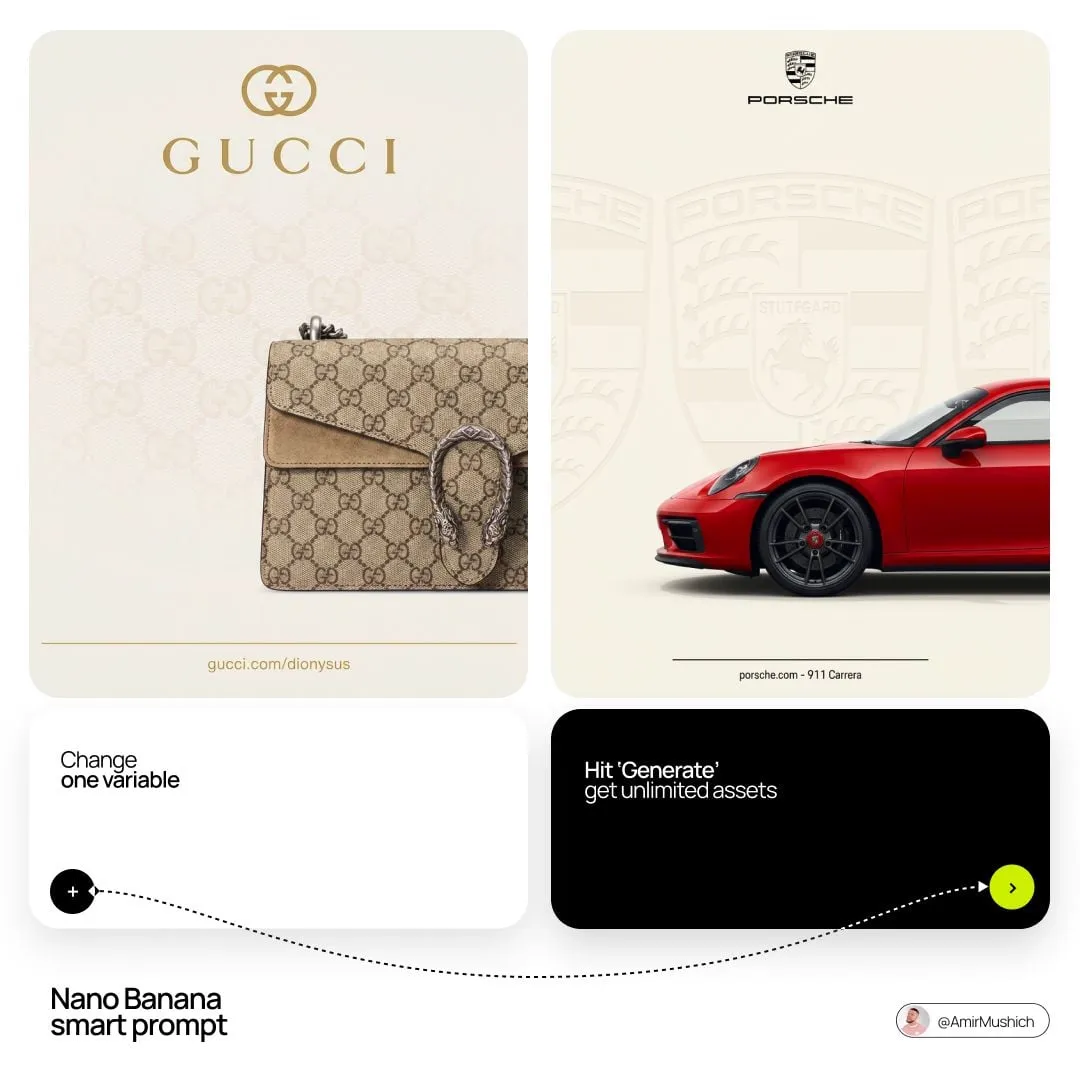
Advertising has never been a forgiving industry. Every brand is competing for the same finite pool of attention, and the gap between a campaign that gets noticed and one that gets skipped often comes down to the quality of the creative itself. For years, producing high-quality ad creative meant high budgets, long timelines, and a specialized team of copywriters, designers, and editors. That model still works, but it no longer scales. As customers expect more personalized and more visually compelling ads, the traditional production pipeline has become a bottleneck. Generative AI changes the economics of that pipeline, letting marketers and small teams produce more creative variants, test faster, and keep quality high without multiplying headcount.
This is not about automating away human creativity. It is about removing the repetitive and expensive parts of production so that people can spend their energy on the decisions that actually matter: the message, the audience, and the emotion. Below we walk through a practical way to raise the quality of your advertising with generative AI, from visual style and character consistency to automated production and smart personalization.
What Changed About Ad Production
Generative AI has quietly flipped the cost structure of producing advertising. Historically, the expensive part was variability. Each new version of a campaign, each regional adaptation, each format change, meant redoing work. Designers redrew, editors recut, and budgets ballooned. With generative models, the marginal cost of producing a new visual variant is close to zero compared to manual work. The creative vision is still yours, but the execution is dramatically faster.
That shift matters for quality in a specific way. Quality in advertising is often the product of iteration. The best ads are rarely the first idea; they are the second, third, or twenty-fifth refinement built on what testing reveals. When iteration is cheap, you can afford to explore more directions, throw away weak concepts early, and polish the ones that show promise. That loop, rather than any single perfect render, is what raises the ceiling of a campaign.
Using Generative AI to Build Distinctive Visual Styles
The first lever for improving creative quality is a distinctive and coherent visual style. Audiences remember campaigns that look like nothing else in their feed, and a strong visual identity signals polish and confidence. Generative image and video models let you define a style and apply it consistently across assets rather than hoping a designer can reproduce a look by hand every time.
To get there, you describe the style precisely and anchor it with reference material. Colors, lighting, lens feel, subject treatment, grain, and mood can all be encoded. When you produce a series of ads, you hold that style stable so the campaign reads as one coherent piece of work instead of a collection of disconnected posts. This coherence is a form of quality that audiences feel even when they cannot name it.
Consistent Characters That Carry the Campaign
Many memorable campaigns are built around a character, an imagined spokesperson or a recurring mascot that audiences recognize across every touchpoint. Historically, getting that character to look the same in every shot required casting, photography, and careful art direction. Generative AI changes this by letting you define a character once and reference it for every render.
The technique is straightforward. You supply reference images of your character's face, wardrobe, and signature props, and the model preserves that identity across scenes and actions. Because the character never appears inconsistent, the campaign stays immersive and professional. This is especially valuable when you need to produce many variants, such as the same character starring in separate ads for different products or markets.
When you establish a character this way, you also gain speed. You can quickly pose them in new situations to explore campaign angles without a full production cycle. That exploration phase is where strong creative gets discovered, and making it cheap directly raises the average quality of what you ultimately publish.
Rapid Prototyping and Testing Multiple Variants
Another reason ad quality suffers in traditional workflows is that teams cannot afford to test many options. Each concept is expensive, so marketers default to a single polished idea and hope it works. Generative AI breaks that assumption by making concept production nearly free. Within a short window you can render a dozen visual directions, a handful of voice-over options, and several messaging variations, all cheaply.
The value compounds when you tie this to testing. Instead of gambling on one big bet, you run multiple lighter variants against a small audience, use the data to pick the strongest direction, and then invest in polishing the winner. This is a fundamentally higher-quality strategy because decisions are driven by audience response rather than internal guesswork. It also means your final spend is concentrated where you already have evidence the creative works.
Automating the Advertising Production Workflow
Quality also comes from consistency in execution, which is where automation earns its keep. When production is manual, small inconsistencies creep in between versions: a subtitle off by a pixel, a voice-over that does not quite match a scene, a logo placed slightly differently in every cut. Automating the pipeline removes those human-scale variations.
The pattern is to treat ad production as a repeatable workflow rather than a series of freehand sessions. A campaign brief becomes an input, and the system resolves it into a set of production steps: selecting the right model for each asset, applying the established visual style, generating the footage, adding voice and music, and exporting the required formats. Because the steps are consistent, the output is consistent, and quality is easier to protect at volume.
Data-driven decisions can plug directly into this automation. If a variant with a certain emotional tone or call to action performs better, you can feed that signal back into the pipeline and have the system emphasize the winning pattern in the next batch. Automation, in this sense, is not a way to remove human judgment; it is a way to apply human judgment at scale.
Delivering Personalization Without Losing Polish
Audiences increasingly expect ads to feel relevant to them. But personalized creative historically meant premium production costs, because every variation was a separate piece of work. Generative AI makes personalization affordable by producing tailored versions of the same campaign for different audiences, languages, or product interests while keeping the core visual identity intact.
The key is to distinguish the parts that change from the parts that stay fixed. The brand style, the character, and the overall look remain stable, while the message, on-screen text, voice, and imagery adapt to the audience. This gives you the relevance of personalization with the polish of a campaign that still looks on-brand. The audience sees something made for them, and the brand still looks coherent.
Careful governance keeps personalization from turning into chaos. Track which variant went to which segment, keep a record of the parameters used, and route any legal review properly. When every version is a structured variant rather than an orphaned file, you retain the ability to update, audit, and reproduce.
Owning Your Creative Control and Investment
For many brands, the long-term question is not just production speed but ownership. When you rely on a library of models and can train a custom style or character around your own brand, the creative asset becomes reusable and trainable. This flips the relationship from renting individual renders to building an internal creative capability.
This is also where a community and ecosystem matter. When creators can share styles, models, and techniques, the pace of better creative accelerates, and brands can learn from what works across a wider set of examples. The practical takeaway is to invest early in the reusable pieces, the character library, the style guide, and the training data, because those compound in value over time.
A Practical Checklist for Raising Ad Quality
Build a precise style guide and apply it consistently across every asset. Define and reference a consistent character for campaign-long recognition. Generate multiple creative variants and let audience tests pick the direction. Automate production so every version maintains the same polish. Personalize messages for different segments while holding the visual identity steady. Keep governance on every personalized render for audit and compliance. And invest in reusable, trainable creative assets.
A Worked Example: Scripting a Small Campaign in Hours
To make this concrete, imagine a small brand launching a new product. In a traditional model, producing ad creative for the launch means a shoot, a designer, an editor, and weeks of lead time. With a generative workflow, the same campaign can move in a single afternoon. The team writes a short brief describing the product, the audience, and the message. They define a visual style and a spokesperson character. Then they generate a mix of assets: a hero video, a few social cuts, a localized variant for one or two markets, and a static image for display ads.
Running this does not require engineers on the creative side. Someone with a clear brief, a style guide, and basic command of the tools drives the loop. The bottleneck becomes the pace of review and feedback instead of the pace of production. That is the practical win: quality still depends on the creative direction, but the team no longer needs to wait weeks to see whether an idea works, so they can kill weak concepts early and invest the saved budget in the winners.
The same loop repeats for every campaign. As the reference library, character set, and style guide fill in, each successive project starts further along. The production muscle becomes an asset that appreciates instead of a recurring cost.
Protecting Quality When Volume Rises
More output often threatens quality, but in a generative workflow the risk is managed by structure rather than by slowing down. The two things that preserve quality at scale are a strong creative brief and a consistent review gate. The brief encodes the intent, and the review gate makes sure nothing ships that does not meet the standard, no matter how fast the pipeline produces.
Design the review to focus on the decisions that change the outcome: Is this on-brand? Does this move the audience? Is the message clear? Rather than nitpicking individual pixels, reviewers steer the direction. This keeps the loop fast while protecting the standard. As volume grows, the review becomes the discipline that keeps quantity from degrading into noise.
Balancing Automation With Human Judgment
There is a myth that automation removes the need for human judgment. In practice it does the opposite: it concentrates the value of judgment because it removes the busywork that used to eat the day. The same creative who once spent hours exporting, resizing, and re-exporting can now spend that time deciding which direction to pursue and which copy to lead with.
The healthy division of labor is clear. Machines handle generation, variation, and the mechanical parts of production. People set the strategy, judge the output against the audience, and make the calls that no model can make for them. The teams that succeed are the ones that use automation to reclaim time for thinking, not the ones that use it to replace thinking.
Frequently Asked Questions
Do I still need designers and editors if I use generative AI?
Yes, and their role becomes more valuable. They shift from repetitive execution to art direction, defining the visual style, judging output quality, and deciding what is on-brand. The AI removes drudgery, not judgment.
How do I keep ads from looking generic when everyone uses AI?
The style, character, voice, and messaging are still yours. Differentiate on the creative decisions, not on the rendering engine. A distinctive brand identity and consistent character will make campaigns recognizable even when the underlying tools are similar.
Can I use generative AI for a small-budget campaign?
Absolutely. One of the biggest benefits is that it collapses production costs, which is exactly what small teams and small budgets need. The main requirement is a clear creative direction and some time to learn the tools.
Final Thoughts
Generative AI will not hand you a great campaign on its own, but it removes the friction that keeps great campaigns from being made. When production is fast, variants are cheap, characters stay consistent, and personalization is affordable, the quality bar is set by your creative judgment rather than your budget. The teams that raise their advertising quality with AI will be the ones that use the speed to test more, listen harder, and put the winning ideas back into the next round of production.
