


Short-form video stopped being a side experiment for creators a long time ago. It is now the main surface where audiences discover new faces, follow ongoing storylines, and decide within seconds whether someone deserves a follow. The creators who grow fastest are rarely the ones with the biggest budgets. They are the ones who built a repeatable pipeline: a system for finding ideas, shaping them into hooks, producing them quickly, and reading the results without burning out.
This guide walks through that pipeline end to end — hook design, format selection, AI-assisted production, cross-platform adaptation, analytics, and the quiet mistakes that suppress reach. Nothing here depends on a single platform or a single tool. The goal is a workflow you can adapt as formats shift.
Why Consistency Beats the Viral Lottery
Most creators treat reach as a lottery. They publish something, it underperforms, and they conclude the algorithm hates them. In practice, short-form distribution rewards a small number of predictable signals: watch time relative to video length, rewatches, shares, saves, and comments that generate replies. None of those are random. They are downstream of structure.
A creator who posts three structured videos a week for eight weeks will almost always outperform someone who posts one ambitious video a month. The reason is not volume for its own sake. It is that each post becomes a data point. You learn which hook phrasing stops the scroll, which pacing keeps people past the midpoint, and which topics generate saves instead of passive views.
Consistency also compounds socially. Audiences follow accounts that feel alive. When someone lands on your profile after seeing one clip, the grid of recent posts is the real pitch. A profile with twelve coherent videos in a recognizable visual style converts far better than one with three polished pieces and a long gap.
There is a useful mental model here: treat every video as a test with two jobs. Job one is to entertain the person already watching. Job two is to teach you something you can reuse. If a clip fails but tells you that your cold-open framing is weak, it still paid for itself.
Building the Creator Pipeline: Idea to First Cut
Speed does not come from rushing. It comes from removing decisions. A pipeline that separates thinking from producing is faster than one where you improvise every step at once.
Idea intake and the swipe file
Keep a single capture location — a notes app, a board, a spreadsheet — where every idea lands in one line. Do not evaluate at capture time. Twice a week, sort the list into three buckets: strong hook ideas, strong story ideas, and pure reference clips you admire.
For each candidate, write the promise in a single sentence: what will the viewer know, feel, or see by the end? If you cannot write that sentence, the idea is not ready.
Scripting for the ear, not the eye
Short-form scripts should read like speech. Write them in short lines and read them aloud. Any sentence you stumble over gets cut or simplified. A practical pattern that works across niches:
- Line one: the tension or the contradiction.
- Lines two to four: the specific detail that makes the tension real.
- Middle: the turn — what changed, what you learned, what the viewer should notice.
- End: a payoff plus one reason to keep watching the next post.
Keep scripts lean. A 30-second video rarely needs more than 70 to 90 spoken words, and leaving breathing room gives the edit space to work.
Shot planning and visual continuity
Before shooting or generating anything, list the shots you need. A simple three-column list is enough: shot description, framing, and where the transition happens. This is where most creators lose time, because a missing close-up means a reshoot or an awkward workaround.
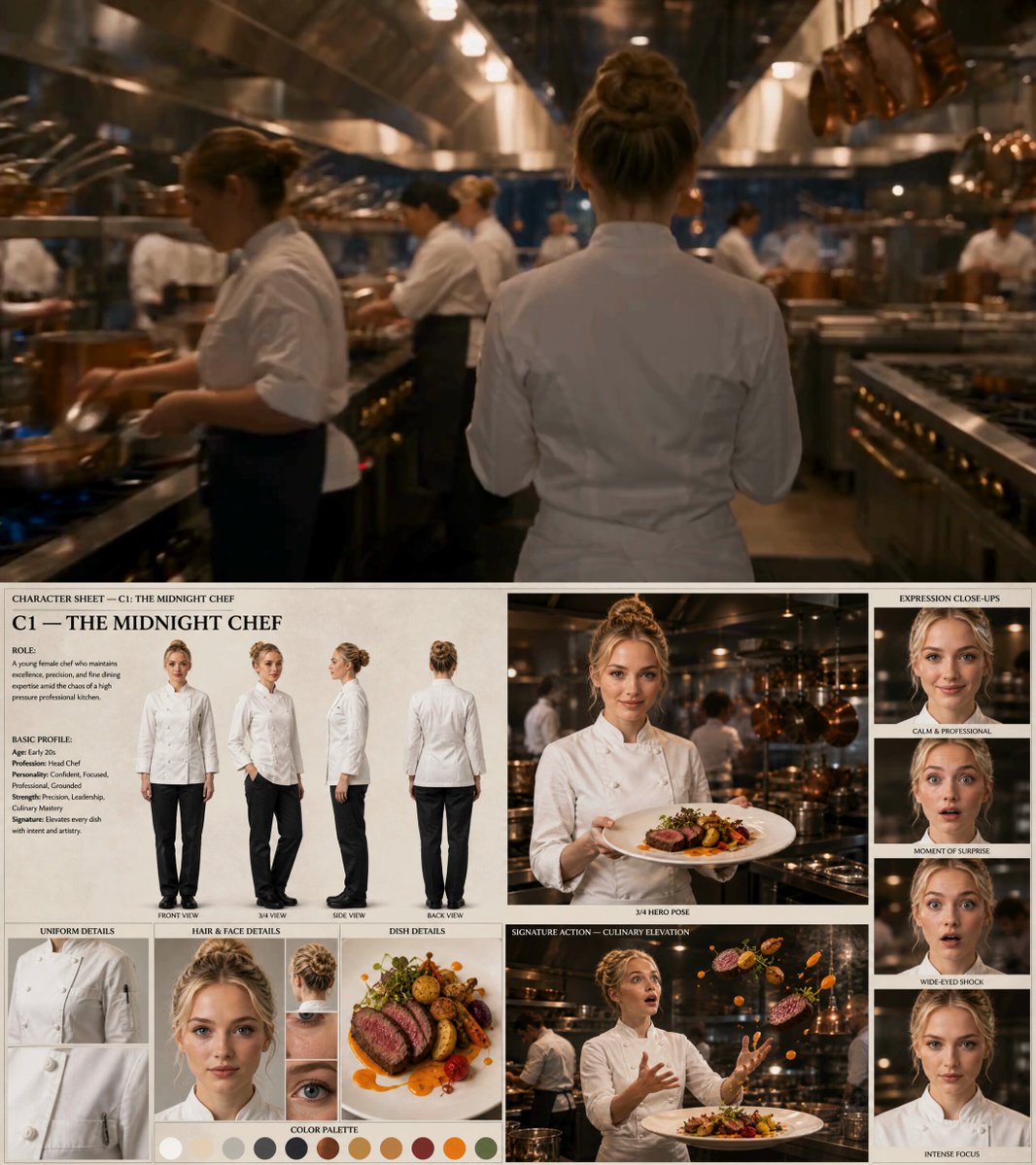
Visual continuity matters more than people expect in short-form. If a character wears a red jacket in one clip, keep it red in the next clip of the same sequence, even if the two clips were made days apart. Continuity builds the feeling of a real world, which is what makes a series bingeable.
Assembling the first cut
Edit for rhythm first, polish second. Cut the timeline to the beat of the spoken lines, then remove anything that does not move the story. A useful rule: if a shot does not change information, emotion, or location, it is dead weight.
Add captions early. Most viewers watch with sound off at least part of the time, and burned-in captions keep the hook legible even when audio is muted. Then add music last, so you are matching the track to the cut rather than cutting to the track.
Hook Architecture: Winning the First Three Seconds
Every platform measures the same thing at the start of a video: how quickly people leave. Your opening frame, first spoken line, and first caption all compete against an infinite feed. Treat them as one unit.
Three hook families that keep working
The unresolved question. Open with something the viewer cannot answer yet. "I deleted every app on my phone for a week" works because the brain wants the outcome. The key is to ask a question the video actually answers.
The contrarian claim. State a position that conflicts with common advice, then earn it. "Posting more made my reach worse" only works if you show the data and the correction.
The mid-action opening. Start in the middle of something already happening — a mistake, a reveal, a reaction. Cut the setup entirely and let context arrive later.
| Hook family | Best for | Common failure |
|---|---|---|
| Unresolved question | Explainers, storytime | Question never gets answered |
| Contrarian claim | Commentary, reviews | Claim is bait with no evidence |
| Mid-action opening | Lifestyle, behind the scenes | Confusion instead of curiosity |
Testing hooks without reshooting
You do not need to reshoot to test an opening. Create two versions of the same video with different first three seconds — a different spoken line, a different first frame, or a different on-screen text overlay. Publish them a few days apart, ideally to similar audiences, and compare the average view duration rather than raw views.
Raw views fluctuate with time of day and distribution luck. Retention in the first five seconds is far more stable, and it tells you whether the hook did its job.
Choosing the Right Format Container
Creators often blame execution when the real problem is that the idea was poured into the wrong container. Four containers cover most short-form needs:
- The single-idea explainer. One claim, three supporting beats, one takeaway. Best when your audience is searching for answers.
- The process clip. Show the work from raw material to result with minimal narration. Best for craft, cooking, design, fitness, and repair niches.
- The reaction or commentary loop. Your take layered over existing footage or a screenshot. Best for news-adjacent topics where speed matters.
- The serialized story. Recurring characters, places, or problems across episodes. Best for building a returning audience rather than a one-time spike.
A quick decision rule: if the idea needs explanation, use the explainer. If the idea needs proof, use the process clip. If the idea needs urgency, use commentary. If the idea needs loyalty, serialize it.
Cross-Platform Adaptation Without Reshoots
Repurposing badly is worse than not repurposing at all. A vertical clip that is stretched, cropped into awkward framing, or padded with dead air looks careless on any platform.
Start with a master edit that keeps the action inside a safe central area. This single habit makes reformatting almost trivial, because nothing important lives at the edges. Export the master at high resolution, then create platform variants from it:
- Vertical for feed-first platforms, captions placed above the lower interface zone so nothing is covered by buttons.
- Square or 4:5 for profiles and carousels where vertical crops too aggressively.
- Horizontal for long-form hosting and embedded players, where you can also include a slightly longer cold open.
The second half of adaptation is language, not aspect ratio. Rewrite the caption for each platform rather than pasting the same block of text. Hashtags, link behavior, and acceptable tone differ enough that a copied caption reads as spam. Also adjust the on-screen text: a joke that lands in one community can read as noise in another.
Finally, stagger publication. Publishing the same clip everywhere at the same minute splits early engagement and makes it harder to read which version performed. Give each variant its own window and its own tracking note.
Where AI Fits in the Production Workflow
AI tools are most valuable when they absorb repetitive work and least valuable when they replace judgment. The practical split looks like this.
Pre-production
Use language models to expand one-line ideas into shot lists, generate alternate hook phrasings, and summarize competitor videos into structural outlines. This is genuine time savings because you are generating options, not final copy. Always rewrite the output in your own voice before it reaches a script.
Production and b-roll
Generative video models are strong at inserts: abstract backgrounds, stylized transitions, environment shots, and concept illustrations that would otherwise require a shoot. They are weaker at sustained human performance, precise hand interactions, and anything requiring continuity of a specific person across many shots.
Two habits make generated footage usable:
- Fix the look first. Define palette, lighting direction, lens feel, and motion speed once, then reuse that description across every prompt in the same sequence.
- Generate in batches. Produce several variations of the same shot and keep the best one. Regenerating a single clip repeatedly tends to drift in style.
Post-production
AI-assisted editing helps with three tedious tasks: transcription and captioning, silence and filler-word removal, and rough subject tracking for reframing. Each of these saves real minutes per video and rarely harms quality when reviewed.
Guardrails
Set rules for yourself before the tools tempt you. For example: no synthetic voice for personal storytelling, no generated footage in any clip that claims to be documentary, and always disclose when a visual was synthesized. Audiences forgive experimentation; they do not forgive being misled, and the reputational cost of a single misleading clip outweighs the convenience of skipping a shoot.
Publishing Cadence, Testing, and Reading Analytics
A cadence you can sustain for three months beats an ambitious schedule you abandon in three weeks. For most solo creators, three to five short videos per week is a realistic ceiling if you batch production into two sessions.
Track a small set of numbers, and track them the same way every time:
- Three-second retention. Did the hook stop the scroll?
- Average view duration as a percentage. Did the structure hold attention?
- Shares and saves. Did the video feel useful or worth passing on?
- Profile visits and follows. Did the video make people want more?
- Comments that are questions. These are direct requests for the next video.
Review weekly, not daily. A single underperforming post is noise; a pattern across five posts is signal. When something works, do not move on immediately — make two more videos in the same structure with different topics. Repeatability is the whole point of a trend: it is a format you can own rather than a moment you happened to catch.
Mistakes That Quietly Suppress Reach
Most reach problems are not penalties. They are small structural issues that compound.
Burying the payoff. If the most interesting moment happens at second twenty, the video should probably start there.
Over-explaining the setup. Context is cheap to add later and expensive at the start. Front-load tension, not background.
Inconsistent visual identity. Changing fonts, caption colors, and framing every week makes your work hard to recognize in a crowded feed.
Chasing every trend. Jumping on formats outside your niche confuses your audience about what you are for. Pick trends that can be translated into your subject.
Ignoring the last frame. The final two seconds determine whether a viewer loops or leaves. End on a question, a visual punchline, or a clean transition into the next episode.
Publishing without a next step. Every video should point somewhere — a series, a profile, a playlist. Otherwise you are collecting views instead of an audience.
FAQ
How many videos do I need before I can judge what works?
Ten to fifteen posts in a consistent format. Fewer than that and you are reading noise, especially if you changed your style between uploads.
Should I use AI to generate entire videos?
For narrative inserts, environments, and stylistic sequences, yes. For anything that depends on your personality, presence, or credibility, use real footage and let AI handle captions, cuts, and cleanup instead.
What is the ideal video length for short-form?
As long as the idea sustains. A tight 22-second clip with a complete payoff beats a padded 60-second one. Watch duration as a percentage is the more useful measure than seconds.
How do I keep a series visually consistent when I shoot on different days?
Lock three things: wardrobe or color palette, lighting direction, and camera distance. Write them down and check the list before every shoot. If you use generated footage, reuse the same look description across prompts.
Do captions actually improve performance?
Yes, for two reasons: a large share of viewers start muted, and captions reinforce the hook in the first seconds. Keep them short, high-contrast, and positioned away from interface elements.
When should I stop making a format?
When three consecutive videos in that structure underperform your personal baseline on retention and shares. Then change one variable at a time rather than rebuilding everything.
Putting It Together: A Weekly Operating Rhythm
A workable week looks like this. One session for idea sorting and scripting, one for shooting or generating footage, one for editing and captioning, and one short block for analytics and next-week planning. That is roughly six focused hours for three to five videos, which is manageable alongside other work.
Batch where you can. Shoot two or three videos in the same session with the same lighting and wardrobe, then edit them together. Batch editing keeps your caption style and pacing consistent, and it removes the temptation to over-polish one video while neglecting the rest.
Finally, keep a running log of what worked. Not a dashboard, just a plain list: date, hook type, format, retention, and one sentence about why you think it performed. After two months that list becomes more useful than any trend report, because it is calibrated to your audience, your niche, and your voice. Trends change, but a system for reading your own results does not.
Start with the pipeline, not the tools. Pick one hook family, one format container, and one publishing cadence, and hold them steady for a month. The creators who look like overnight successes are usually the ones who spent that month learning what their audience actually does after the first three seconds.
