


Why Reels Playback Stalls More Often Than It Used To
A stalling Reel is rarely one single bug. It is usually the visible end of a chain: how the file was encoded, how the platform re-encoded it during upload, how the viewer's device decodes it, and how much bandwidth happens to be available at that moment. When any link in that chain is weak, the spinner appears and the viewer swipes away. The frustrating part is that the same file can play perfectly on one phone and freeze on another, which makes the problem feel random when it is actually deterministic.
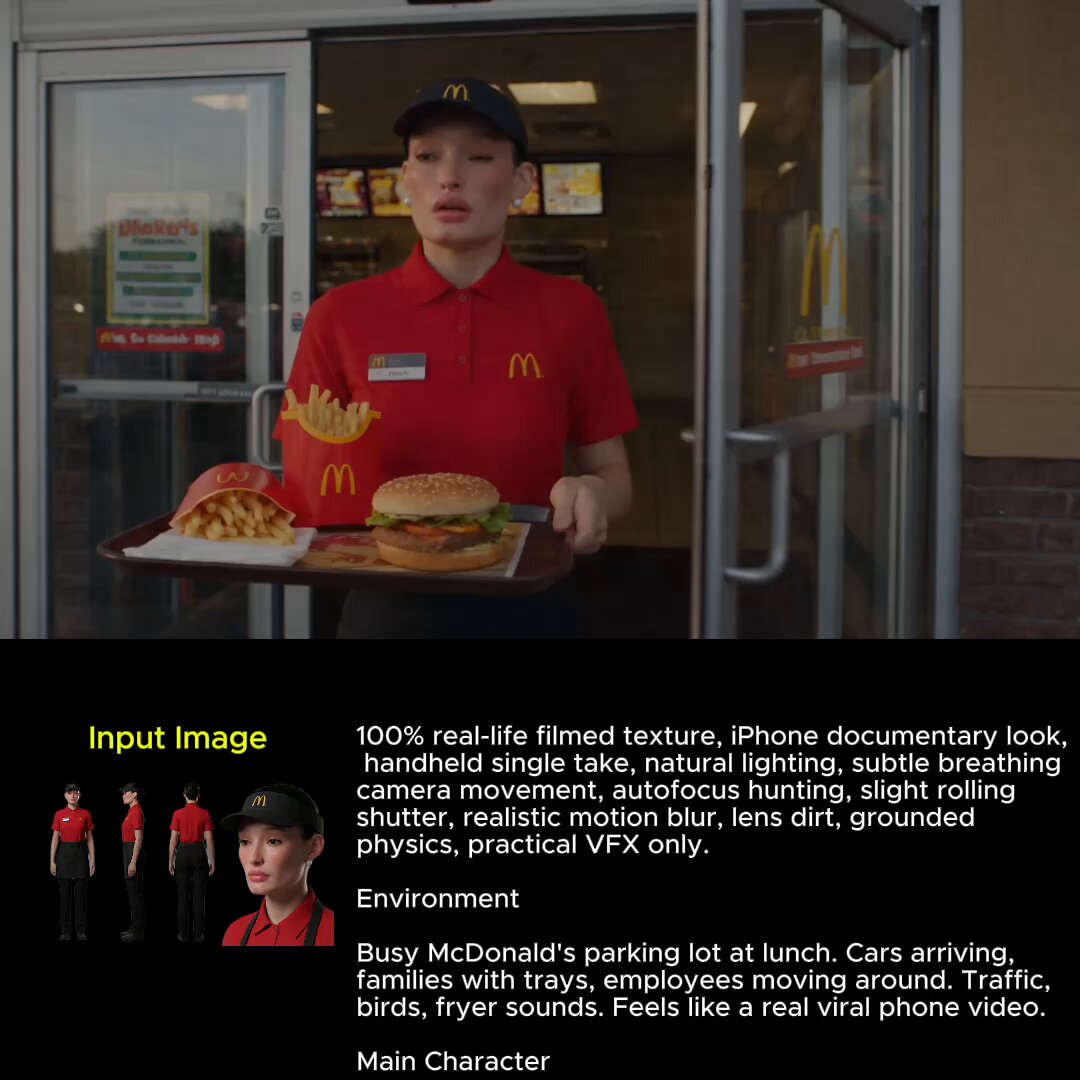
Understanding that chain matters more than ever because the footage creators produce today is heavier than typical phone video. AI-generated clips, detail-heavy visual effects, multi-layer composites, and timelines assembled from several different generators all tend to arrive with inconsistent encoding parameters. Platform ingest pipelines expect consistency. When they do not get it, they either re-encode aggressively — which softens detail and can introduce playback artifacts — or they produce a file that decodes unevenly on mid-range hardware.
The practical goal is simple: deliver a file the platform barely needs to touch, so that what viewers receive is close to what you uploaded and close to what their device can decode in real time. Everything below is about closing that gap.
Diagnosing the Freeze: Is It the File or the Viewer?
Before changing settings, split the diagnosis into two questions. Does the freeze follow the file, or does it follow the viewer? The answer determines whether you should re-encode or simply upload again.
Symptoms that point to the file
- The stall happens at the same timestamp every single time you watch it.
- It freezes on Wi-Fi and on cellular data alike.
- Multiple viewers report the same stall point in comments or DMs.
- Audio keeps playing while the image is stuck, or the two slowly drift apart.
- The platform preview looks fine, but the published version stutters.
- The freeze happens on a brand-new phone as well as an old one.
Any two of these together almost always means the encoded file itself is the problem — usually a bitrate spike, a variable frame rate timeline, or a keyframe gap that is too long for smooth seeking.
Symptoms that point to the network or the device
The opposite pattern looks like this: the Reel freezes at a random point each time, or only in specific places such as crowded venues, basements, transit, or older handsets. You may notice the image dropping to a softer resolution right before the stall, which is the adaptive streaming algorithm reacting to a bandwidth dip. If the Reel resumes after a short buffer, the file is probably fine and the delivery path is the weak link.
The upload itself is a third failure mode
There is a category in between that creators often miss: damage that happens during upload. An interrupted transfer, an unstable connection, or a file with malformed metadata can produce a partial or inconsistently encoded asset on the server. That is why the same export can fail once and succeed the next day without a single setting changing. When in doubt, re-upload from a stable connection before you rewrite your entire export pipeline.
The Encoding Specs That Keep Reels Playing Smoothly
Platform documentation changes slowly and quietly, but the fundamentals are stable. Aim for the middle of the recommended range rather than the maximum, because the maximum is what triggers aggressive server-side re-encoding.
Container and codec
Stick with MP4 as the container and H.264 (AVC) as the video codec in High Profile. Pixel format must be yuv420p, which is a 4:2:0 chroma layout — many editing tools and AI video exporters default to 4:2:2 or even 4:4:4 for quality reasons, and those files are frequently rejected or re-encoded on ingest. Audio should be AAC-LC at 48 kHz, stereo.
HEVC and ProRes are excellent for archival and for intermediate work, but they are unreliable as delivery formats for social platforms. Export a clean H.264 master for upload and keep your high-quality version for your own archive.
Resolution and frame rate
1080 × 1920 is the sweet spot for vertical Reels. Uploading 4K vertical does not usually produce a visibly sharper result after platform processing, and it dramatically increases both upload time and the chance of a re-encode. If you shoot or generate in 4K, downscale to 1080 × 1920 with a good resampling filter rather than letting the platform do it.
For frame rate, 30 fps is the safest choice for most content. 24 fps gives a cinematic feel but can look slightly jerky on fast handheld motion. 60 fps is fine for gaming and high-motion sports, but it doubles the amount of data per second, so keep the bitrate under control if you use it. Critically, export at a constant frame rate. Variable frame rate footage — common in screen recordings and some AI generators — is one of the most frequent hidden causes of audio drift and mid-clip stutter.
Bitrate, keyframes, and audio
For 1080 × 1920 at 30 fps, a target bitrate of 8–12 Mbps with a maximum around 12–15 Mbps is reliable. Going far above that does not improve perceived quality on a phone screen; it just slows the upload and invites re-compression.
Keyframe interval matters more than most creators realize. Place a keyframe every one to two seconds (roughly every 30–60 frames at 30 fps) so that scrubbing, looping, and mid-clip recovery are cheap. Long keyframe gaps make a Reel look fine on replay from the start and broken when someone taps into the middle.
Audio should be 128–192 kbps AAC, stereo, and normalized to roughly −14 LUFS integrated loudness with peaks below −1 dBTP. Loud, clipped audio does not cause video stutter, but it does cause platform-side limiting that can shift sync slightly on some devices.
A Pre-Upload Checklist That Prevents Most Freezes
Run this before every upload. It takes three minutes and eliminates the majority of recurring stall reports.
- Confirm the container and codec. MP4, H.264 High Profile, yuv420p, AAC audio.
- Confirm the frame rate is constant. No mixed 24/30/60 fps segments and no variable frame rate metadata.
- Check the aspect ratio. 9:16 with no letterboxing baked into the file. If you must deliver 4:5 or 1:1, crop rather than pad.
- Check the first frame. Some encoders produce a black or corrupted opening frame that makes the Reel appear frozen for a beat.
- Normalize audio and verify there is no clipping.
- Move the moov atom to the front with a fast-start flag so playback can begin before the file finishes downloading.
- Play the exported file locally in a plain video player, not in your editor. Editors hide problems.
- Upload over a stable connection and keep the app in the foreground until processing finishes.
Optimizing AI-Generated Footage for Reels
AI-generated clips bring specific challenges because the output parameters vary from tool to tool and even from generation to generation within the same tool.
Flicker, grain, and inter-shot inconsistency
Generated footage often carries subtle per-frame grain or texture variation. Grain is expensive to encode: it looks like high-frequency detail, so the encoder spends bitrate trying to preserve noise that the viewer will never consciously notice. A light temporal denoise before export — strong enough to calm the grain, gentle enough to keep skin texture — typically cuts file size noticeably and reduces stutter. If you are cutting several AI clips together, also normalize color, contrast, and black levels so the encoder is not forced to handle abrupt luminance jumps at every cut.
Detail-heavy effects and particle work
Flowing hair, confetti, smoke, sparks, water, and dense particle simulations are the worst case for H.264. They generate motion in nearly every block of the frame, which means very little can be predicted from the previous frame and the bitrate requirement spikes. Two practical responses: shorten the shot, or hold the camera move steadier so that the background is predictable and only the effect region is expensive. If a specific clip always freezes, try bumping the bitrate for that segment or splitting the sequence into two shorter Reels.
Converting long-form output into vertical cuts
When you cut a long horizontal piece into vertical shorts, avoid exporting the full timeline at vertical resolution and slicing it afterward — that wastes processing and often leaves keyframes in the wrong places. Instead, cut the short segments first, then export each one natively at 1080 × 1920 with fresh keyframes. Add burn-in captions rather than relying entirely on platform auto-captions, and re-frame the subject rather than shrinking a horizontal frame into the middle of a vertical canvas. Bars at the top and bottom reduce effective resolution and make the whole file look less sharp than it is.
Encoding Workflows: Editors, FFmpeg, and HandBrake
If you work in a standard editor, build a dedicated export preset: 1080 × 1920, H.264 High, constant 30 fps, 10 Mbps target, AAC 160 kbps, fast-start enabled. Save it as "Reels Delivery" and never improvise settings again.
If you prefer command-line control, a reliable baseline looks like this:
ffmpeg -i input.mov -vf "scale=1080:1920:flags=lanczos,fps=30" \
  -c:v libx264 -profile:v high -level 4.1 -pix_fmt yuv420p \
  -b:v 10M -maxrate 12M -bufsize 20M -g 60 -keyint_min 30 -sc_threshold 0 \
  -c:a aac -b:a 160k -ar 48000 -ac 2 -movflags +faststart output.mp4
The -g 60 and keyint_min 30 arguments create a keyframe roughly every one to two seconds. -sc_threshold 0 prevents scene-change keyframes from being inserted unpredictably, which keeps the file size and decode load more even. -movflags +faststart is the flag that makes streaming start immediately.
HandBrake is a good middle ground for creators who do not want to touch a terminal. Use the H.264 encoder, set the frame rate to constant 30, set quality to a constant-quality value around 20–22, and enable the web-optimized option. Verify afterward that the output is actually constant frame rate — some source files force variable output unless you explicitly override it.
Common Mistakes That Reintroduce Stutter
- Exporting at maximum quality settings. Higher bitrate is not the same as better delivery. It usually just triggers heavier server re-encoding.
- Leaving variable frame rate untouched. Screen recordings and some generated clips carry VFR metadata; always force constant frame rate on export.
- Mixing frame rates in one timeline. A 24 fps clip inside a 30 fps sequence produces duplicated frames that look like micro-stutter.
- Ignoring the audio track. An oversized PCM or FLAC audio stream can make an otherwise modest file unnecessarily large.
- Re-uploading the original instead of the export. Uploading the project render rather than the delivery file is a very common cause of repeat failures.
- Uploading from the middle of a large batch. Parallel uploads compete for bandwidth and increase the chance of a damaged transfer.
- Trusting the in-editor preview. The preview decodes with different settings and hides real-world problems.
Testing Before You Publish — and After
Watch the exported file three ways before uploading: at full size on a desktop player, in the platform's own upload preview, and on an older phone if you have one. The older device is the honest test — it will reveal decode load that a modern flagship hides.
After publishing, check the Reel on both Wi-Fi and cellular, and tap into the middle of the clip rather than watching from the start, since mid-clip entry is where keyframe gaps show up. If the published version stutters while the local file does not, the problem is almost always a bitrate spike or a keyframe spacing issue, not the platform.
Keep a small library of known-good exports. When something breaks, compare the failing file against a working one using a media info tool: check codec, profile, pixel format, frame rate mode, bitrate, keyframe interval, and audio codec. Nine times out of ten, a single field differs and explains everything.
FAQ
Why does my Reel freeze only for some viewers?
Because playback is a negotiation between the file and the viewer's network and hardware. A file with tight bitrate headroom succeeds everywhere; one that sits at the edge of acceptable encoding plays fine on fast connections and flagships and stalls on older devices or congested networks.
Does uploading in 4K give me better quality after processing?
Rarely. After platform processing and phone-screen display, the difference between a well-encoded 1080 × 1920 upload and a 4K upload is small, while the re-encode risk, upload time, and file size penalty are real.
Why does the audio keep playing while the picture freezes?
The audio track is much lighter and decodes easily, while the video decoder is struggling with a bitrate spike or an unpredictable frame. It is a strong signal that the video encoding, not the connection, is the bottleneck.
Can I fix an already-published Reel without re-uploading?
Only by editing the caption or cover. Playback problems require a re-upload of a corrected file, which is why testing locally first saves so much time.
Should I use HEVC to save space?
For your own archive, yes. For delivery to social platforms, use H.264. Compatibility is still the deciding factor, and unsupported files are re-encoded more aggressively.
How long should a Reel be if it keeps stalling?
Length itself is not the issue — total data volume and spike density are. A dense 15-second effects shot can be harder to deliver than a calm 60-second talking-head clip. If a specific shot always fails, shorten that shot or reduce its motion complexity.
The Takeaway: Consistency Beats Raw Quality
Reels stutter is almost never a mystery. It is the predictable result of a file that sits outside the parameters the delivery pipeline handles gracefully. Constant frame rate, H.264 in yuv420p, 1080 × 1920, a moderate bitrate with headroom, tight keyframe spacing, and a clean audio track will resolve the majority of freezes before they ever reach a viewer.
Build the settings into a saved preset, run the pre-upload checklist, and test on an older device. That routine turns a recurring technical headache into a two-minute step — and keeps the audience you earned watching to the end instead of swiping past a spinner.
