
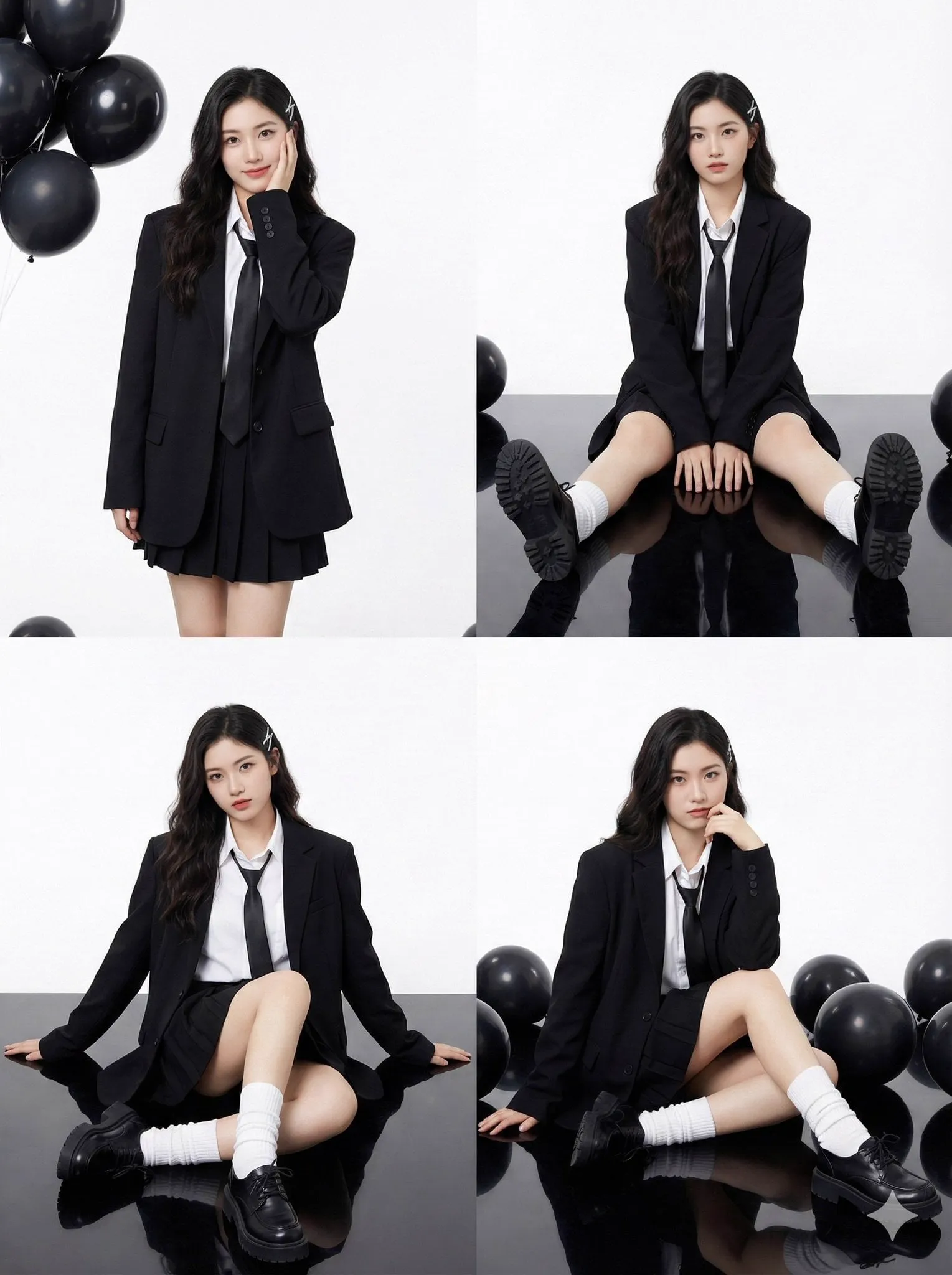

Why Photorealistic Synthesis and Detection Belong in the Same Pipeline
Most teams treat image generation and object detection as two separate disciplines. One group writes prompts and iterates on keyframes; another group labels bounding boxes and trains detectors. In practice, the most reliable photorealistic output comes from treating them as a single feedback loop. Detection is not just an analysis step that happens after generation — it is a control mechanism that tells you whether the image you produced actually contains the thing you intended, in the position you intended, at the scale you intended.
That distinction matters more than it sounds. A diffusion model can produce a stunning frame of a cyclist on a rain-slicked street that fails every downstream requirement: the bike is fused with the guardrail, the rider's hands are anatomically wrong, and the subject occupies twelve percent of the frame instead of the sixty percent your shot list demanded. Without a detector, you only find out after the shot has been animated, composited, and reviewed. With a detector, you catch it in seconds and regenerate.
The workflow described below is model-agnostic. It applies whether you are working with latent diffusion image models, modern transformer-based text-to-image systems, or text-to-video generators. The names change; the logic of planning, generating, verifying, and repairing does not.
How the Core Technologies Actually Work
Before optimizing a pipeline, it helps to understand what each stage is genuinely good at — and where it quietly breaks.
Diffusion Models and the Move to Latent Space
Diffusion models learn to reverse a noise process. Training gradually adds noise to real images until they become pure static; the network then learns the reverse mapping, so at inference time it can start from random noise and denoise step by step into something coherent. Early implementations operated directly on pixels and were painfully slow. The shift to latent diffusion — compressing images into a smaller latent representation, running the denoising process there, then decoding back to pixels — made high-resolution photorealistic generation practical on ordinary hardware.
The practical consequences are worth internalizing. Because denoising is iterative, every sampler and step count changes the result. Because the model was trained on captioned data, prompt phrasing steers it strongly. And because the process is stochastic, the same prompt with a different random seed produces a different image. Reproducibility therefore requires recording the prompt, the model version, the sampler, the step count, the guidance scale, and the seed. If your team is not logging those five values, you are not running a pipeline — you are gambling.
Text-to-Video and Temporal Consistency
Video generation adds a dimension that has no equivalent in still image work: consistency across time. A model must keep a character's face, clothing, lighting, and surroundings stable while the camera moves and the subject acts. This is usually solved by extending the model's attention across frames so that tokens can reference earlier timesteps, combined with motion priors learned from video data.
Failures are predictable. Faces drift over a few seconds. Hands morph. Background architecture rearranges itself between cuts. Fabric textures shimmer. Rather than fighting these individually, treat temporal consistency as a constraint you engineer around: shorter shots, explicit motion descriptions, and reference frames that anchor identity.
Object Detection as a Control Layer
Modern detectors fall into a few families. Anchor-based and anchor-free single-stage detectors are fast and reliable for well-represented classes. Segmentation models that produce pixel masks rather than boxes are far more useful for compositing because they give you a clean matte. Open-vocabulary detectors that accept text queries let you search for concepts the training set never explicitly labeled.
For a photorealistic pipeline, the most valuable properties are mask quality, open-vocabulary flexibility, and speed. A detector that runs in 300 milliseconds per frame lets you check every frame of a five-second shot at 24 frames per second in under a minute. That is fast enough to sit inside your iteration loop rather than after it.
A Practical End-to-End Workflow
The following six-stage workflow scales from a single social clip to a multi-shot narrative sequence.
Stage 1: Shot Planning and Specification
Write down, per shot, what must be present and where. This sounds bureaucratic, but it converts subjective review into testable criteria. A useful specification includes the subject class, an approximate bounding box region expressed as a fraction of frame width and height, the required lighting direction, and the camera movement. Anything not specified becomes a variable you will later argue about in review.
Stage 2: Keyframe Generation With Structural Control
Generate the first and last frames of each shot before generating motion. Structural conditioning — depth maps, edge maps, pose skeletons, or segmentation masks — lets you dictate composition while the model handles texture and lighting. A depth map derived from a rough 3D blockout is often enough to lock camera perspective without constraining creative detail.
Generate more candidates than you need. Ten to twenty keyframes per shot, then filter. Filtering is cheaper than regenerating later.
Stage 3: Automated Verification of Keyframes
Run detection on every candidate. Score each one on three axes: presence (is the subject there), placement (does the mask overlap your specified region), and integrity (are there fused limbs, duplicated objects, or impossible geometry). Reject anything below threshold. What remains is a shortlist of frames that are both attractive and structurally compliant.
This step is where most teams gain the largest quality improvement for the least effort, because it removes the frames that would have failed later at much higher cost.
Stage 4: Motion Generation and Temporal Repair
Animate from your approved keyframes. Describe motion in terms of subject action and camera behavior separately — models handle these differently, and conflating them produces mush. Keep shots short: three to six seconds per generation is a reliable range, because error accumulates with duration.
After generating, re-run detection across the frame sequence to measure identity drift and mask stability. If a subject's mask area changes by more than roughly fifteen percent between adjacent frames without narrative justification, something is wrong.
Stage 5: Masking, Compositing, and Replacement
Segmentation masks enable targeted fixes without regenerating the whole shot. Common uses include replacing a background, inserting a product into a scene, relighting a subject, or removing an unwanted object. Because masks are per-frame, they also support rotoscoping-free effects: color grading a subject independently, adding depth-of-field that respects subject boundaries, or applying motion blur only to the background.
Stage 6: Finishing and Quality Control
Final review should combine automated checks with human judgment. Automated checks catch geometry, placement, and drift. Humans catch story, emotion, and taste. Keep both, and keep the automated report attached to the shot so that fixes are traceable.
Choosing the Right Tool for Each Stage
Not every project needs every capability. The table below maps common requirements to the kind of tool that handles them well.
| Requirement | Typical Solution | Watch Out For |
|---|---|---|
| Stylized still keyframes | Latent diffusion models with LoRA fine-tuning | Overfitting to a narrow look |
| Photoreal portraits | High-resolution transformer or diffusion models | Skin texture that reads as plastic |
| Text-to-video motion | Modern video generators with image conditioning | Face and hand drift after three seconds |
| Precise composition | ControlNet-style structural conditioning | Over-constraining kills natural variation |
| Fast class detection | Single-stage detectors | Weak performance on small or occluded objects |
| Pixel-accurate masks | Promptable segmentation models | Edge bleed on hair and transparent surfaces |
| Novel concepts | Open-vocabulary detectors | Inconsistent confidence thresholds |
A workable default stack is: one strong still-image model for keyframes, one video model for motion, one promptable segmentation model for masks, and one fast detector for verification. Add specialized models only when a specific failure repeats.
Decision Criteria: When Not to Generate
Photorealistic synthesis is powerful but not always correct. Choose conventional photography or 3D rendering when any of the following apply.
Legal or regulatory accuracy matters. Product packaging, medical devices, and safety equipment must match reality exactly. Generated imagery risks subtle inaccuracies that create compliance problems.
You need identical repeatability. If two shots must be pixel-identical across versions, deterministic rendering or photography wins.
The subject must be a real person. Consent, likeness rights, and disclosure obligations make generated depictions of identifiable individuals a legal minefield.
Cost of iteration is low and cost of error is high. If a photographer can capture the shot in an hour, do that.
Conversely, generation wins when you need variants at volume, when the scene is impossible or expensive to shoot, when you are prototyping before committing to production, or when the concept is inherently synthetic.
Common Failure Modes and How to Fix Them
Fused or duplicated limbs. Usually caused by prompts that describe complex poses without structural guidance. Fix with pose conditioning or by simplifying the pose and adding detail in a later pass.
Temporal identity drift. Symptoms include changing eye color, shifting hairline, or clothing that alters between frames. Fix by conditioning on a reference image throughout, shortening the shot, and avoiding camera moves that hide and reveal the face repeatedly.
Detector false positives on background texture. A confident detection on a patterned wall or a reflection usually means your confidence threshold is too low for that class. Raise the threshold per class rather than globally.
Mask edge chatter. When a segmentation mask flickers between frames, downstream compositing looks like static. Apply temporal smoothing to masks, or generate alpha from a matte model rather than a raw detector output.
Over-smoothing from aggressive denoising. Too many steps or too high a guidance scale can strip texture. Dial guidance down and let the model retain grain.
Prompt drift across a sequence. Long sequences forget earlier context. Re-inject the full subject description in every generation rather than relying on memory.
Detection-Specific Tuning That Actually Matters
Most detection problems in generative pipelines come from treating detector configuration as an afterthought. Three settings deserve deliberate attention.
Confidence thresholds per class. A single global threshold will always be wrong for something. People and vehicles are easy; transparent objects, thin structures, and reflective surfaces are hard. Set thresholds per class and record them.
Non-maximum suppression behavior. In crowded scenes, aggressive suppression merges adjacent objects into one detection while loose suppression produces duplicates. Tune this against a small hand-labeled validation set from your own footage, not a public benchmark.
Mask resolution versus box resolution. A detector may report an accurate bounding box while its mask is coarse. If you are compositing, mask quality matters far more than box precision. Evaluate them separately.
Also worth doing: build a small regression suite. Twenty to fifty images representative of your content, with expected detections recorded. Every time you change models or thresholds, run the suite. It takes minutes and prevents silent regressions that surface weeks later.
Ethics, Provenance, and Review Discipline
Photorealistic synthesis carries obligations that stylized generation does not. Three practices reduce risk substantially.
First, maintain provenance records. Store prompts, model versions, seeds, and generation timestamps alongside final assets. This is not bureaucracy; it is the only way to answer questions about how an asset was made.
Second, disclose synthetic media where audiences could reasonably be misled, and embed content credentials where your toolchain supports it.
Third, avoid generating realistic depictions of identifiable people without consent, and be cautious with scenes that mimic documentary or news aesthetics. The technology does not distinguish between entertainment and misinformation — only your process does.
On the review side, separate your checks. Technical review asks whether the shot meets specification. Editorial review asks whether it serves the story. Legal review asks whether it can be published. Mixing them produces meetings where nobody agrees on what the problem is.
Building the Pipeline Without Rebuilding It Every Project
Teams that iterate successfully tend to standardize four things early: a shot specification template, a naming convention for assets and seeds, an automated verification script, and a shortlist of approved models per task. Everything else stays flexible.
Keep the verification step fast enough that nobody is tempted to skip it. If your check takes ten minutes per shot, it will be skipped under deadline pressure. If it takes thirty seconds, it becomes habit.
Finally, accept that generation quality changes faster than your documentation. Write the workflow in terms of capabilities — "generate keyframes with structural control" rather than "use model X" — so that swapping a tool is a configuration change rather than a rewrite.
FAQ
Do I need a separate detector if my video model already produces good output?
No, but you need it for consistency. Detection gives you an objective measurement of drift and placement that human review misses, especially across hundreds of frames.
How many keyframe candidates should I generate per shot?
Ten to twenty is a practical range. Fewer and you settle for mediocre composition; more and review time becomes the bottleneck.
Why does my subject look right in stills but wrong in motion?
Because motion models trade per-frame fidelity for temporal coherence. Shorter shots, stronger reference conditioning, and separate descriptions for subject action and camera movement all help.
Are segmentation masks always better than bounding boxes?
For compositing, yes. For counting, tracking, and placement checks, boxes are often sufficient and much cheaper to compute.
How do I handle objects my detector has never seen?
Use an open-vocabulary or promptable model with a descriptive text query. Validate the results manually on a sample, since open-vocabulary confidence scores are less calibrated than closed-set ones.
What is the single biggest cause of wasted time?
Generating motion before verifying keyframes. Fixing composition in a still takes seconds; fixing it in a rendered sequence takes hours.
Can this workflow run entirely on local hardware?
Much of it can. Latent diffusion, segmentation, and fast detection all run on consumer GPUs. Video generation is the most demanding stage and often benefits from hosted compute.
How do I know when the pipeline is good enough?
When a shot passing automated verification also passes human review at a high rate. Measure that agreement rate; it is the most honest quality metric you have.
