

Why professional video content looks different now
A decade ago, "professional" meant a camera you could not afford, a lighting kit, a boom operator, and a crew of five. Today one person with a laptop can finish a 4K sequence that holds up on a living-room screen. The entry cost collapsed, but the audience's standard did not. Viewers still make a judgment in the first three seconds, and that judgment is built from small signals: a shot that drifts, lighting that changes between cuts, a soundtrack sitting three decibels too loud, a cut that lands a beat late.
What actually changed is not the definition of quality — it is where the difficulty moved. Generative models removed the physical production bottleneck, so the hard part is no longer capturing footage. It is directing a process. You need a plan that survives contact with a generation queue, a consistent visual language across dozens of shots, characters and locations that stay stable from scene to scene, and a finishing stage that treats sound with the same seriousness as image.
That is the real skill gap right now. Anyone can type a sentence and get a clip. Very few creators can produce twelve clips that feel like one film. This guide is about the second group: a working method that takes an idea from a one-line concept to a published video on YouTube, Instagram, TikTok, and LinkedIn without the output looking like a random collection of generated moments.
The method has five moving parts: a content map, model selection, prompt discipline, audio design, and a repeatable assembly pipeline. Everything below is organized around those five, plus the quality control and scaling habits that separate a channel that grows from one that stalls after twenty uploads.
Start with a content map, not a prompt
The most common failure in AI-assisted video production is opening a generation tool before deciding what the video is for. You get a beautiful clip, then another beautiful clip, and then you are editing a pile of unrelated footage hoping a story appears. A content map prevents that.
A content map is a one-page document that answers four questions before a single frame is generated.
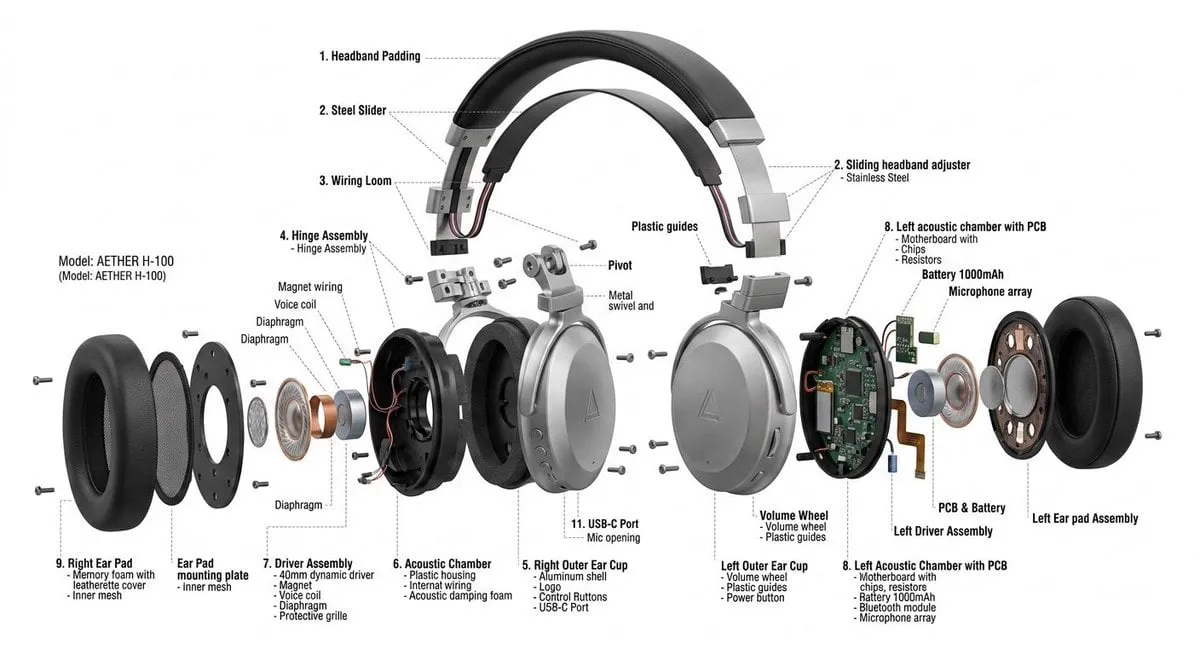
1. What is the single promise of this video? Not a topic — a promise. "A 90-second explainer that shows why noise-cancelling headphones fail on planes" is a promise. "Headphones" is a topic. Promises constrain your shot list; topics do not.
2. Where will it live first? A video designed for YouTube's 16:9 canvas with a 30-second hook behaves differently from one built for a vertical feed. Choosing the primary platform first determines aspect ratio, pacing, text legibility, and where you place your strongest visual.
3. What is the shot budget? Amateur productions generate too much. A tight 8-shot vertical video with one repeatable visual motif outperforms a 40-shot sprawl every time. Set a number and hold to it.
4. What is the retention structure? Write the video as a sequence of curiosity gaps: an opening question, three escalating answers, one contradiction, and a payoff. This becomes your edit skeleton before generation begins.
Once those four answers exist, your shot list writes itself. Each shot gets a purpose label — hook, context, proof, escalation, payoff — and any shot that cannot be labeled gets deleted from the list. That single filter removes most of the waste people experience when generating video.
A useful habit: keep a running "shot bank" document per channel. Every time a visual idea occurs to you, write it down with a one-line description and the kind of scene it belongs to. Over a few weeks you accumulate a library you can pull from when a deadline is tight, and your output stops being improvised under pressure.
Choosing and combining video generation models
Model choice is not a personality trait. It is a technical decision driven by what each shot needs. The creators who struggle most are usually loyal to one tool and then blame the tool when a specific shot type fails.
Selection criteria that actually matter
When you evaluate a generation model for a shot, score it on six axes:
- Motion coherence. Does a subject walking across frame keep its proportions, or does it melt at the midpoint? Test with a single continuous action before committing to a sequence.
- Prompt adherence. Some models interpret camera language well; others ignore it and give you a static medium shot no matter what you ask.
- Identity stability. If your video has a recurring character, this is the make-or-break criterion. Generate the same character five times in different poses and compare faces side by side.
- Text and logo handling. If your video needs signage, packaging, or on-screen typography, test how badly the model mangles letterforms. Most handle it poorly, which means text should usually be added in post.
- Output resolution and upscaling tolerance. A model that produces clean 1080p you can upscale is often more useful than one that produces muddy output at a higher nominal resolution.
- Predictable timing. If you cannot estimate how long a render will take, you cannot plan a production day.
Consistency across shots
The single hardest problem in AI video is continuity. The practical solution is to treat consistency as a data problem rather than a creative one. Build a small reference kit for each project: a character sheet, a location sheet, and a lighting sheet. Character sheets specify wardrobe, hair, and two or three distinctive features. Location sheets specify architecture, color temperature, and one recognizable landmark. Lighting sheets specify the time of day and the direction of the key light.
Then reuse that kit verbatim in every prompt. Do not paraphrase. If your reference says "amber practical lamps, cool blue window light from camera left," that phrase appears in every prompt for that location. Paraphrasing is where continuity dies.
When to use more than one model
A hybrid approach usually beats a single-tool workflow. Use one model for dialogue-free hero shots where stylization is welcome, another for realistic human motion, and a third for abstract transitions and background plates. The cost is interface switching; the benefit is that you stop compromising every shot to fit one model's weaknesses.
The important discipline is to standardize outputs. Decide on one delivery resolution, one frame rate, and one color space, and convert anything that deviates before it enters your timeline. Mixed frame rates are the quiet killer of otherwise good edits.
Prompt engineering for cinematic results
A prompt is not a wish. It is a specification, and it should read like one.
The four-part shot prompt
Write every shot prompt in four blocks, in this order:
- Subject and action. Who or what, doing exactly what, at which point in the action. "A cyclist rounds a wet corner at speed, already leaning into the turn" beats "a cyclist riding."
- Environment and light. Location, time of day, weather, and the quality of light. "Empty industrial street, pre-dawn, sodium streetlamps with visible rain haze" gives the model a physical world.
- Camera. Shot size, angle, movement, and lens character. "Low-angle medium shot, slow dolly forward, 35mm with shallow depth of field" is specific enough to steer composition.
- Treatment. Grade, texture, and finish. "Desaturated teal shadows, fine grain, anamorphic flare on the highlight" finishes the specification.
Keep the four blocks in the same order every time. Consistency in structure produces consistency in output, and it makes troubleshooting trivial: if shots keep coming back flat, the problem is in block three, not the whole prompt.
Camera and lens vocabulary
Learn a small, precise vocabulary and use it repeatedly. Shot sizes: wide, full, medium, close-up, extreme close-up. Angles: eye level, low, high, overhead, dutch. Movement: static, pan, tilt, dolly in, dolly out, tracking, crane, handheld. Lens character: wide-angle distortion, normal perspective, telephoto compression, macro detail, shallow or deep focus.
Two or three terms per prompt is plenty. Prompting "cinematic" adds nothing; prompting "slow lateral tracking shot, telephoto compression, subject held in the right third" adds a specific frame you can cut against.
Avoiding the AI look
The recognizable "generated" aesthetic comes from a predictable set of tells: over-smooth skin, uniform lighting with no contrast, camera movement that never settles, hyper-saturated color, and motion that is slightly too fast for the environment. Each has a fix.
Break the light. Put a strong directional source on one side of the frame and let the other side fall into shadow. Introduce imperfection: rain, dust, lens flare, grain, a slightly dirty surface. Slow your motion prompts — "gentle drift" rather than "dynamic sweep." Choose one dominant color and one accent rather than a full rainbow. And hold shots longer in the edit than instinct suggests; generated footage usually reads better at 2.5 to 4 seconds than at 1.5.
Audio is half the video
Most AI-first creators spend 90% of their effort on image and then drop in a stock music track at the end. That is backwards, because audio is what makes a sequence feel intentional.
Build sound in three layers.
Layer one: voice. If there is narration, record it yourself or cast a consistent synthetic voice and keep it identical across an entire series. Voice consistency builds channel identity faster than visuals do. Normalize to a target loudness, cut breaths only where they distract, and keep the room tone running underneath so the track never feels clipped together.
Layer two: music. Choose music for tempo, not for genre. Match the beat grid to your average shot length: a track at 100 BPM gives you a natural cut point roughly every 0.6 seconds, which is too fast for a documentary feel and useful for a fast vertical edit. Duck the music under narration with a compressor rather than by hand-drawing volume curves.
Layer three: effects and ambience. This is the layer that sells realism. Add room tone to interior scenes, wind to exteriors, footsteps that match the surface, cloth movement on close-ups, and one or two accent sounds at your strongest cuts. Ambience should be felt, not noticed; if a viewer can identify a specific ambience file, it is too loud.
Mix with reference. Play your cut on a phone speaker, on laptop speakers, and on headphones. If the narration vanishes on the phone, your mid-range is buried. Most viewers watch on a phone.
A repeatable production pipeline
A pipeline turns talent into throughput. Without one, every video is a crisis.
Stage one: pre-production (20% of time)
Finalize the promise, the shot list, and the reference kit. Write the script or outline. Lock the aspect ratio and the target runtime. Build your project folder structure before generating anything: /01_script, /02_reference, /03_generations, /04_audio, /05_edit, /06_exports. Boring, but it saves hours.
Stage two: generation (40% of time)
Generate in batches by location and light, not by story order. Shots that share a setup benefit from being generated back to back, because you can carry identical reference language across them. Generate three to five variations of every important shot and pick in the edit — deciding during generation is slower, not faster.
Keep a shot log as you go: shot number, model used, prompt version, and a one-word quality note. When a project runs for two weeks, the log is the only reason you can find anything.
Stage three: assembly and finishing (40% of time)
Assemble to the script, not to the footage you like. Rough-cut for structure, then tighten until every shot earns its runtime. Add sound design, then color, then on-screen text, then captions. Grade last, because grading before the edit is locked means grading twice.
Finishing checks: consistent frame rate, no black frames at cuts, normalized audio, legible captions at the smallest expected screen size, and a thumbnail frame that works as a still image with no context.
Platform fit: YouTube versus short-form
The same footage should not be published identically everywhere. Each surface has its own physics.
YouTube long-form rewards a clear promise in the first 30 seconds, a visible structure, and a payoff that justifies the runtime. Keep a stable visual identity — same intro rhythm, same color treatment, same narration tone — because returning viewers are scanning for recognition.
YouTube Shorts, TikTok, and Reels reward immediate motion, legible on-screen text, and a loop point that makes a second viewing feel natural. Vertical framing means the top and bottom thirds are prime real estate for text and the middle third must carry the action. Cut faster, use fewer words, and never open with a logo.
LinkedIn and X reward clarity over energy. Slower pacing, larger text, and a first frame that reads as informative rather than entertaining perform better there.
A practical workflow: build the long-form master first, then derive verticals by re-cutting the strongest 40 seconds rather than squeezing the entire narrative into 60 seconds. Derivative edits should have their own hook, not a compressed version of the original one.
Quality control and the mistakes that cap reach
Run this checklist before every publish. It takes four minutes and prevents most of the avoidable losses.
- Does the first three seconds contain motion, a face, or a question?
- Is the audio normalized and free of clipping?
- Are captions accurate and inside the safe area?
- Is the aspect ratio consistent across every clip?
- Does any single shot run longer than four seconds without new information?
- Is the thumbnail frame legible as a still at 320 pixels wide?
- Does the title make a specific claim rather than describe a topic?
The recurring mistakes are predictable. Generating before planning. Chasing realism when stylization would be stronger. Using one model for every shot type. Ignoring audio until the final hour. Publishing the same cut to every platform. Over-polishing a two-second shot while the story sags in the middle. Rendering at settings far above what the delivery platform will show.
One more: never let a technical constraint dictate the story. If a shot will not generate correctly after three attempts, rewrite the shot, not the tool settings.
Scaling output without losing quality
Scaling is not about publishing more. It is about reducing the time per publishable minute while protecting consistency.
Build asset libraries. Reusable ambience beds, title animations, transition sounds, lower-third templates, and reference kits for recurring characters. Anything used twice should be saved.
Batch by function. Write all scripts in one session, generate all shots in another, edit in a third, publish in a fourth. Context switching between writing and rendering is expensive.
Use a queue mindset. Line up generation jobs and do other work while they run. If you are watching progress bars, your pipeline is inefficient.
Create series formats. A format — same structure, same visuals, new subject — removes the creative overhead of starting from zero each time and trains your audience to expect the next episode.
Track three numbers. Watch time per video, the percentage of viewers still present at the 30-second mark, and the number of videos you shipped. Attention is the input; shipping frequency is the output. Everything else is commentary.
FAQ
Do I need to generate every shot with AI? No. Hybrid productions — AI for environments and impossible shots, real footage for talking heads and product detail — usually outperform fully generated videos because authenticity in the human moments buys trust.
What is the biggest predictor of whether a video performs? The first three seconds and the audio mix. Viewers forgive imperfect visuals far more readily than a boring opening or a soundtrack that fights the narration.
How many shots should a two-minute video have? Between 20 and 35, depending on pace. Vertical short-form sits at the higher end; explanatory long-form at the lower end.
How do I keep a character consistent across a series? Write one locked character description and paste it verbatim into every prompt. Never improvise a synonym for a wardrobe or facial detail.
Should I upscale everything to 4K? Only if your delivery platform will show it and your editor can handle it. Clean 1080p at a consistent frame rate beats inconsistent 4K every time.
What if a shot refuses to generate correctly? Change the shot, not the settings. Rewriting a shot description takes two minutes; fighting a model can take an afternoon.
How often should I publish? As often as you can sustain the quality standard you set. A reliable weekly schedule builds more audience than an intense month followed by silence.
Is a big model library necessary? No. Three well-understood models, each used for what it does best, will outperform a rotating carousel of unfamiliar tools.
The through-line in all of this is simple: professional video production is a process problem before it is a technology problem. Get the map, the references, the audio layers, and the pipeline right, and the tools become interchangeable. Get them wrong, and no model will save the video.
