

Why Prompting Has Become a Core Creative Skill
Generative tools stopped being a novelty a while ago. What separates a stunning result from a forgettable one is rarely the model — it is the instruction. Prompt engineering is the practice of translating a creative intention into a structured request that a model can interpret reliably, and it has quietly become as fundamental as color grading or sound design.
The shift matters because models have matured. Early generators responded well to short noun phrases: a subject, a style, maybe a mood. Modern image and video systems understand relationships between objects, respect spatial language, follow camera directions, and maintain character identity across multiple outputs. That added capability is only useful if you know how to address it.
This guide is a practical, model-agnostic walkthrough. It covers how to build a prompt from parts, how to adapt your phrasing to different engines, how to keep a look consistent over long projects, and how to turn all of it into a repeatable workflow instead of a series of lucky accidents.
The Anatomy of a Prompt That Actually Works
Think of a strong prompt as a stack of layers. Each layer answers a different question, and the order of those answers sends a signal about priority.
Layer one: subject and action
Be concrete. "A woman" is weak. "A woman in her sixties repairing a wooden fishing net" gives the model a subject, an age, an activity, and an implied setting. Verbs carry more weight than adjectives because they imply posture, motion, and purpose.
Layer two: environment and time
Where and when. Interior or exterior, weather, season, time of day, and what surrounds the subject. Environment is the fastest way to change emotional read without touching the subject at all. A dock at dawn feels hopeful; the same dock at dusk with fog feels elegiac.
Layer three: medium and style
Name the visual language. Photography, oil painting, cel animation, risograph print, architectural render. Then narrow it: "editorial fashion photograph," "1970s Polish poster illustration," "cinematic still from a slow-burn thriller." Style descriptors are dense with associations, so a few precise words outperform a long list of adjectives.
Layer four: camera and composition
Focal length, angle, framing, and depth. "35mm, eye level, medium shot" produces something completely different from "85mm, low angle, tight close-up." Depth language does a lot of heavy lifting: shallow depth of field, deep focus, foreground occlusion, centered symmetry.
Layer five: light
Lighting is the most underrated control in the stack. Named setups — Rembrandt, split, rim, golden-hour backlight, overcast diffusion, single practical lamp — give you a repeatable emotional register across an entire project.
Layer six: constraints
What you do not want. Some engines accept a negative field; others ask you to weave exclusions into the sentence. Either way, keep constraints few and specific. A long exclusion list tends to drag the model toward the very thing you are trying to avoid.
A worked example
Weak: "cyberpunk street, cool, neon."
Stronger: "Rain-slick market alley at night, 28mm at eye level, medium-wide shot, a courier in a worn canvas jacket stepping over a puddle, reflections of magenta and teal signage, heavy atmosphere with visible light shafts, cinematic still, shallow depth of field."
The second version is not longer for the sake of length. Every clause answers a question the model would otherwise guess at.
Matching Your Phrasing to the Model
Different engines have different internal languages. Treating them all the same is the most common source of inconsistent output.
Descriptive versus tag-based systems
Some models reward flowing descriptive sentences that read like a shot list composed in prose. Others respond best to comma-separated keyword clusters where each fragment acts as a weighted concept. Test both on the same idea with the same seed and compare. You will usually discover a clear preference within ten attempts.
Weighting and emphasis
Many engines support emphasis syntax — parentheses with multipliers, brace groups, or an explicit weight channel. Use it sparingly and in single increments. Doubling the weight on a single token often wrecks adjacent elements; nudging it by a small step usually achieves the correction you wanted.
Parameter blocks and aspect discipline
Resolution, aspect ratio, guidance strength, and step count all change the character of a result. High guidance can make an image rigid and over-saturated; low guidance can drift away from your prompt entirely. Find a working band for each model and change one parameter at a time when troubleshooting.
Model-specific quirks worth memorizing
- Natural-language-first engines tend to handle long sentences well but ignore comma spam.
- Diffusion families with strong style priors often need style tokens repeated at the end of the prompt for emphasis.
- Video engines frequently need an explicit motion clause, because a static image prompt gives them nothing to animate.
- Some models interpret brand or artist names as strong style anchors; others reject them. Build a personal map of what works where.
Advanced Control: Consistency Across a Series
A single great frame is easy. Twenty frames that look like they belong together is a craft problem.
Lock your style block
Write a reusable style block — maybe thirty to fifty words covering medium, lens family, lighting logic, and color treatment — and paste it unchanged into every prompt in the project. Vary only subject, action, and framing. This single habit fixes most continuity problems.
Keep a seed register
Record the seed for any output you like. Reusing a seed while editing the prompt lets you isolate what each change did. It is the closest thing generative work has to a controlled experiment.
Character continuity
If a model supports reference images or identity conditioning, use them, but keep the reference clean: neutral background, consistent lighting, no extreme angles. Weak references produce averaged faces. If your engine has no reference channel, describe identity with three or four stable, distinguishing traits and repeat them verbatim in every prompt — changing even the wording of a trait tends to shift the face.
Style references and multi-modal anchoring
Style references are powerful and easy to overuse. One reference for palette and one for lighting is usually plenty. Stacking four references produces muddled output, because the model averages conflicting signals instead of choosing between them.
Build a look bible
Keep a short document: the style block, the seed register, the palette in hex values, the lighting vocabulary, and two or three reference outputs. Anyone joining the project can then reproduce the look without a long briefing.
A Repeatable Workflow From Idea to Finished Piece
Prompting works best when it sits inside a process, not at the center of one.
Step 1: Write the brief in plain language
Before touching a tool, describe the piece in two or three sentences: what it is, who it is for, and how it should feel. This becomes your acceptance criteria later, when you are deciding whether output number fourteen is actually good.
Step 2: Assemble a reference board
Collect ten to twenty images, stills, or frames that capture the tone. Separate them into structure references (composition, lighting) and surface references (texture, palette). Mixing the two categories into one pile is why so many projects end up visually confused.
Step 3: Draft the prompt stack
Build the six layers in order. Write it out fully once, then strip anything that is not doing work. Verbose prompts are not more precise; they just contain more opportunities for the model to misread intent.
Step 4: Generate wide, then narrow
Start with a batch of low-commitment variations to explore composition. Pick the strongest two or three, then refine with small edits — one change per pass. Ten small iterations teach you more than three massive rewrites.
Step 5: Refine what the model cannot fix
Some problems are not prompt problems. Hands, text, and precise geometry are often faster to correct in an editor. Composite, repaint, or mask rather than fighting a model for twenty generations.
Step 6: Finish and archive
Upscale, color correct, and export. Then archive the prompt, seed, model version, and settings alongside the final file. Future you will want to reproduce it, and future projects will want to borrow from it.
Video-Specific Prompting: Motion, Timing, and Continuity
Video adds a dimension that image prompting does not prepare you for.
Describe motion, not just content
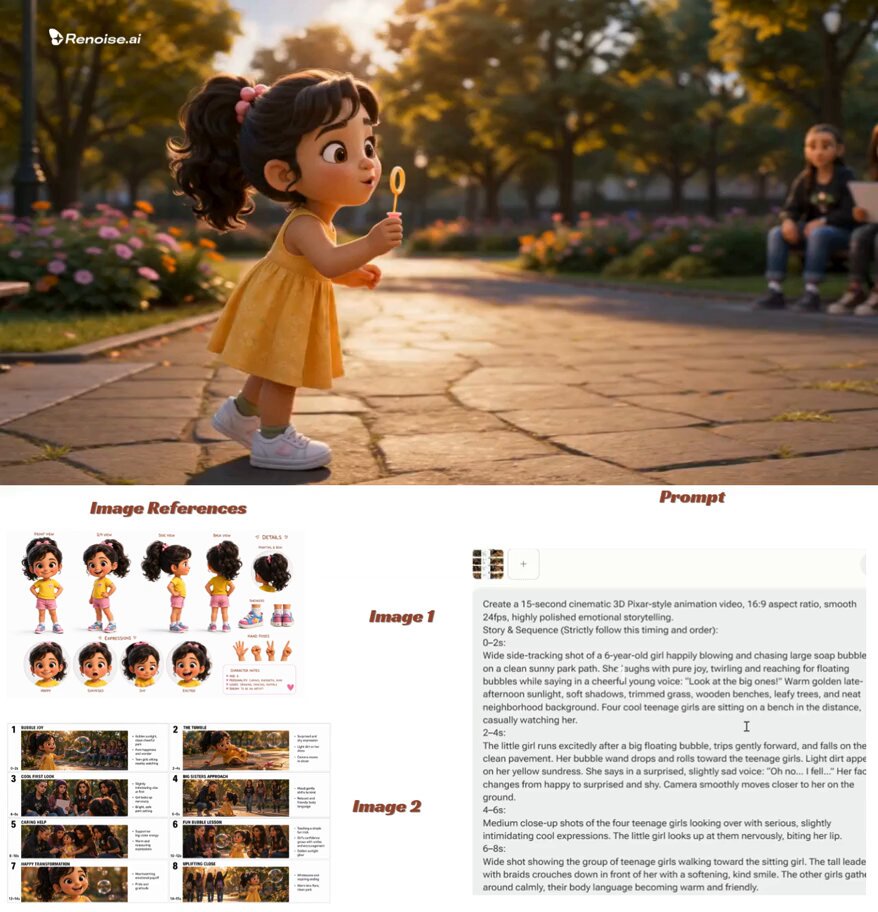
A video prompt needs a stated movement: "camera pushes in slowly," "subject walks left to right across frame," "fabric billows in wind." Without a motion clause, engines either generate a near-static clip or invent chaotic movement.
Break long sequences into shots
Generate in short segments and edit them together. Trying to produce a thirty-second continuous take in one pass usually yields drift: faces change, lighting shifts, backgrounds mutate. Shot-by-shot generation with a shared style block keeps everything coherent.
Control camera language deliberately
Dolly, pan, tilt, crane, handheld, static tripod. Combine one camera move with one subject action per shot. Two camera moves in a single clip reads as an error, not a flourish.
Plan for frame-rate and duration limits
Know your engine's typical clip length and frame rate before you storyboard. Designing a sequence around a five-second constraint produces far better results than discovering the limit halfway through.
Sound is a separate track
Even when a model generates audio, treat it as a scratch reference. Real ambience, foley, and score choices belong in post, where you have actual control.
Continuity checks
Before assembly, line up your clips and check three things: character identity, lighting direction, and color temperature. Fixing these in generation is easier than fixing them in the edit.
Common Mistakes and How to Fix Them
Stacking adjectives instead of specifying. Ten mood words dilute each other. Replace them with one lighting term, one lens term, and one medium term.
Ignoring the negative space. If the model keeps adding clutter, describe the emptiness: "sparse composition with large negative space in the upper third." Describing what should be there beats listing what should not.
Changing five things at once. When a result is wrong, resist the urge to rewrite the whole prompt. Change one layer, regenerate, compare.
Over-relying on artist names. Style borrowing is efficient but generic. Deconstruct the style instead — palette, line quality, contrast curve, texture — and you gain a look that is yours.
Forgetting to check the aspect ratio. Vertical social framing and widescreen cinematic framing need different compositions. A prompt that works in one often fails in the other.
Abandoning a good seed. When something works, save it immediately. Reconstructing a favorite result from memory is a reliable way to lose an afternoon.
Treating the first output as final. First passes are exploration. The quality jump usually happens between generations six and fifteen.
Building a Prompt Library You Will Actually Use
A prompt library is not a folder of random text files. It is a structured asset base.
Organize by layer. Keep separate files for style blocks, lighting vocabulary, camera phrases, subject templates, and negative constraints. Composition becomes assembly rather than authorship, which is exactly what you want under deadline.
Tag every entry. Note which engine it was tested on, which aspect ratios it suits, and how strong its style pull is. A style block that dominates everything it touches needs a warning label.
Version your entries. When you improve a style block, keep the old one. Older prompts remain valid for older projects, and comparing versions teaches you what actually changed.
Add one annotated example per entry. A prompt plus a thumbnail plus two lines about why it worked is worth more than fifty lines of unannotated text.
Review quarterly. Delete what you never reach for. A library with three hundred unused entries is slower than one with forty good ones.
Ethics, Rights, and Practical Guardrails
Prompting is a creative act, but it sits inside a legal and ethical context you cannot ignore.
Respect likeness and identity. Do not generate recognizable real people in fabricated situations without consent. This is both an ethical line and, in many jurisdictions, a legal one.
Be careful with trademarks. Logos, brand characters, and protected designs should stay out of commercial output unless you hold the rights.
Understand your license terms. Different engines grant different commercial permissions, and terms differ between free and paid tiers. Read them before you price a client project.
Disclose where it matters. News, documentary, and educational contexts usually require labeling synthetic media. Audiences forgive transparency far more readily than they forgive deception.
Keep a provenance log. Prompt, model version, seed, and date. It protects you in disputes and makes audits trivial.
Respect the humans in your references. If you build a style reference from a living artist's work, that is a conversation worth having, not a shortcut worth hiding.
Frequently Asked Questions
How long should a prompt be?
Long enough to cover the six layers, short enough that every clause earns its place. Most strong image prompts land between thirty and eighty words. Video prompts are usually shorter, because motion clauses do more work per word.
Do better models make prompt engineering obsolete?
No. Better models raise the ceiling and lower the floor, which means the gap between careful and careless work becomes more visible, not less. Instruction quality still determines outcome quality.
Why does the same prompt give different results?
Seeds, model versions, sampling settings, and platform-side updates all introduce variation. Lock your seed and record your model version if you need reproducibility.
Should I write prompts in English if I work in another language?
English-language training data dominates most engines, so English prompts often perform more predictably. Writing in your own language can produce a distinctive voice that the model has learned less thoroughly, which is sometimes exactly the effect you want. Test both and keep notes.
How do I stop a model from adding unwanted elements?
First, describe the desired state positively. Second, add one or two precise exclusions. Third, if the problem persists, mask and repaint rather than continuing to argue with the prompt.
How many generations should I expect per finished asset?
For a well-prepared prompt, somewhere between ten and thirty attempts, spread across exploration and refinement. If you are hitting sixty, the brief or the prompt structure is usually the bottleneck.
Can I use one prompt for both images and video?
The style layers transfer cleanly. The subject layer needs adjustment and you must add a motion clause. Treat image prompts as the foundation and video prompts as an extension, not a copy.
Where to Go From Here
Start with one project and one style block. Write the six layers deliberately, generate a wide batch, and record everything. Then do it again with a different engine and compare notes.
The compounding effect is real: after a few projects you stop guessing and start directing. Prompt engineering is not a trick for getting better pictures out of a machine. It is the discipline of knowing precisely what you want — and being able to say it clearly enough that any tool can deliver it.
