
Cinematic AI video has stopped being a novelty demo. The models are good enough that the limiting factor is no longer whether a plausible frame can be generated — it is whether a director can describe, in plain language, exactly what should happen in that frame and how it connects to the next one. Prompts have quietly become the screenwriting, storyboarding, and shot-listing layer of a new production pipeline, compressed into a single text field.
That shift has consequences. A prompt is no longer a wish. It is a specification: subject, action, camera, light, texture, duration, and audio, all of it reconciled in a few hundred characters. Teams that treat prompt writing as a creative craft — rather than a slot machine with a keyboard — ship footage that cuts together. Teams that do not end up with beautiful clips that refuse to become a scene.
This guide walks through the practical side of that craft: how to structure cinematic prompts, how to keep characters and lighting stable across shots, how to pick the right generation model for a given beat, and how to fix the failures that appear the night before delivery.
Why the prompt is now the tightest constraint in AI video
Generation quality has commoditized quickly. Multiple vendors now produce photoreal humans, believable water, convincing crowds, and native synchronized audio. When everyone can generate a good-looking shot, the differentiator moves upstream to direction: who is in frame, what they are doing, why the camera moves, and how the cut lands.
That is why prompt engineering matters more, not less, as models improve. A weak prompt on a strong model produces something generic-but-pretty — the AI video equivalent of stock footage. A precise prompt on the same model produces the shot you would have boarded by hand.
There are three practical reasons prompt quality dominates outcomes.
Model behavior is instruction-shaped. Modern video generators respond to filmmaking vocabulary far more reliably than to mood adjectives. Saying "a lonely mood" gives the model almost nothing. Saying "slow dolly-in, 40mm equivalent, subject centered in the lower third, practical window light from camera left, shallow depth of field, cool shadows with warm skin tones" gives it a full set of constraints to satisfy.
Every vague word is a decision delegated to the model. If you do not specify wardrobe, the model invents it — differently in every take. If you do not specify lens character, you get whatever the training data preferred. Vagueness does not buy freedom; it buys randomness.
Prompts are reusable assets. A well-structured shot template can be re-used across a series, a campaign, or a client roster. That is leverage no amount of rerolling can match.
The practical takeaway: write prompts the way you would brief a cinematographer and a first assistant director at the same time — precise on intention, explicit on execution.
The anatomy of a cinematic prompt
Most high-performing cinematic prompts can be decomposed into five slots. Missing a slot is fine if you are intentionally leaving it to the model; missing one by accident is how you get a shot you cannot use.
Slot 1: Subject and action
State who or what is on screen, what they are doing, and the emotional register of the action. Be concrete about physical behavior rather than internal state. "A woman in her thirties in a rain-soaked wool coat walks toward the camera, jaw tight, eyes scanning left" gives a performer something to do. "A woman who feels betrayed" gives the model a mood board.
Include age range, build, wardrobe silhouette, and one distinguishing detail — a scar, a bracelet, a specific jacket color. That distinguishing detail becomes your continuity anchor in later shots.
Slot 2: Shot type, lens, and camera movement
Use standard production language. Shot size: extreme wide, wide, medium, medium close, close-up, extreme close-up. Angle: eye level, low, high, dutch, over-the-shoulder. Movement: static, pan, tilt, dolly in/out, truck, crane, handheld, gimbal glide, whip pan, push-in, pull-out.
Lens language adds realism that generic descriptions cannot. Terms like 24mm wide, 35mm natural, 50mm neutral, 85mm portrait compression, macro, anamorphic with horizontal flare, and shallow depth of field at f/1.8 all push the render toward recognizable photographic behavior.
Slot 3: Lighting and palette
Lighting is the fastest way to make generated footage look intentional. Name the source and its direction: key from camera left through a window, hard practical overhead, soft bounce from below, rim light behind the subject, golden-hour backlight, overcast diffusion, neon sign spill, firelight flicker.
Then constrain the palette: teal and amber, desaturated blue-grey, warm tungsten interior against cold exterior, high-key pastel, low-key with single red accent. Palette control is what separates a scene from a reel of unrelated clips.
Slot 4: Texture, grain, and format cues
Format language signals the model toward a look. "Shot on 35mm, fine grain, subtle halation" reads differently from "clean digital, high dynamic range, sharp" or "VHS texture with chromatic aberration." Choose one and apply it consistently across the whole sequence — mixed texture is the most common reason a generated sequence feels assembled rather than directed.
Slot 5: Duration, pacing, and audio
Specify clip length in seconds and what happens within it. "Five seconds, subject enters frame at second one, holds eye contact at second three, exits frame right by second five" is far easier for a model to satisfy than "a long shot of someone walking."
If your tooling generates audio, describe it: diegetic rain, distant traffic, low synth drone, a single chair scrape, dialogue line delivered flat and quiet. Native audio generation has improved dramatically, and an unmanaged audio layer is a fast way to make an otherwise strong shot unusable.
Shot grammar: writing sequences instead of isolated clips
The most common beginner mistake is prompt-per-clip thinking. Cinematic video is not a collection of shots; it is a sequence of relationships between shots. Prompts should be written at the sequence level, then divided into shots.
Continuity anchors
Pick three anchors per scene and repeat them verbatim in every prompt for that scene: one for the character (wardrobe plus distinguishing detail), one for the environment (location, time of day, weather), and one for the look (lens family, palette, texture). Copy-paste these strings; do not paraphrase them. Small wording changes cause visible drift.
Coverage logic
Board each scene as coverage rather than as a series of pretty frames. A workable default for a short narrative beat: a wide establishing shot to place the audience, a medium shot for the primary action, and a close-up for the emotional turn. Generate two to three variants per shot so you have alternatives in the edit rather than a single forced choice.
Pacing math
Estimate runtime before you generate, not after. A 60-second piece built from 5-second clips needs roughly 12 shots at minimum, plus alternates and a title or two — which realistically means 30 to 40 generations. Knowing that number up front changes how carefully you write each prompt, and it prevents the classic panic of discovering you are short two shots with no time to iterate.
Keeping characters and lighting consistent across shots
Temporal consistency remains the hardest technical problem in AI video, and most of it is solved through process rather than luck.
Lock identity before you lock performance
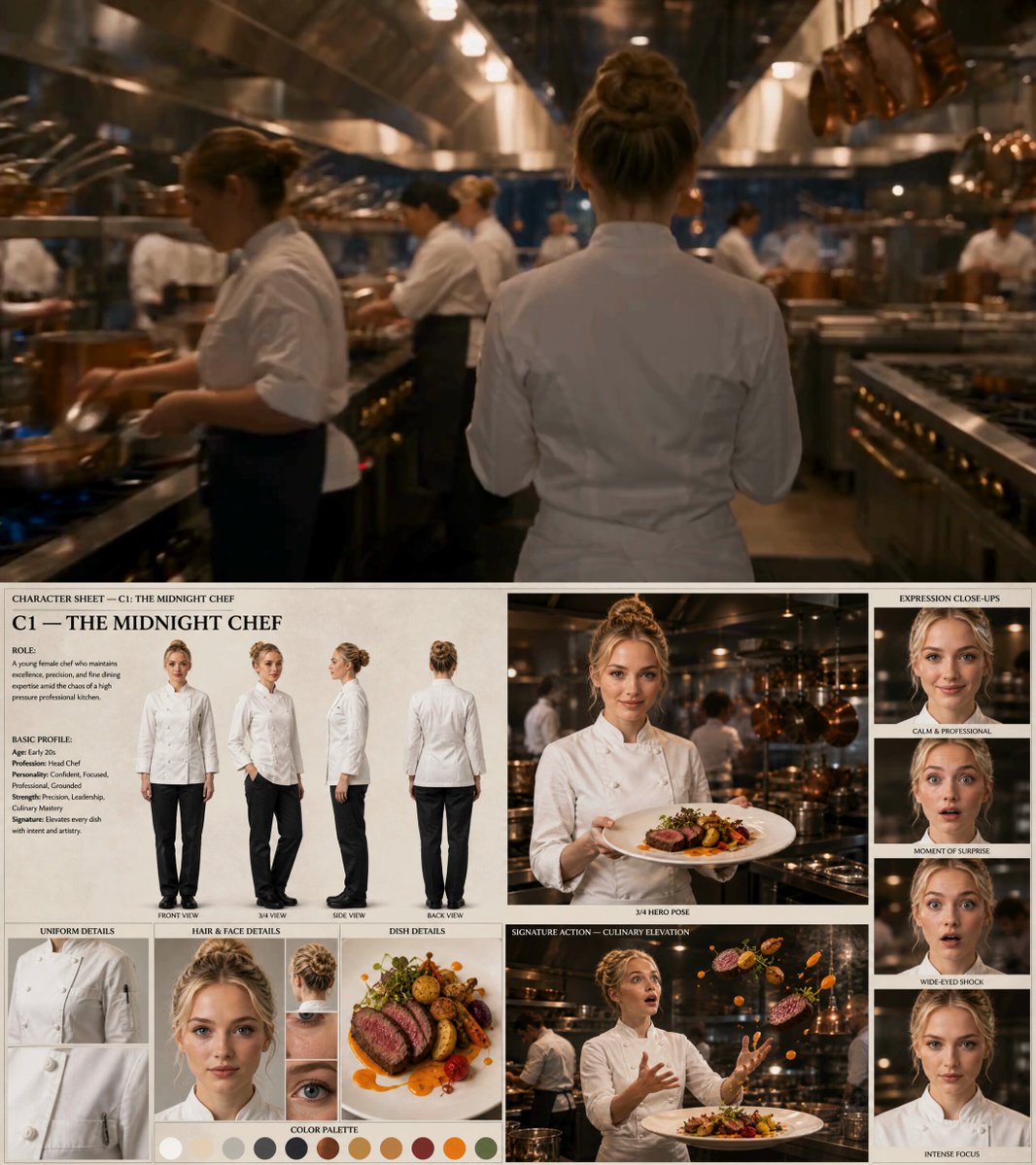
If your platform supports reference images, character locking, or identity conditioning, use it. Generate a clean, well-lit reference portrait or character sheet first — front, three-quarter, and profile — then attach it to every shot featuring that character. Reference-based workflows beat text-only description every time, because the model does not have to guess what your adjectives mean.
Lock environment with the same discipline
Locations drift just as badly as faces. Keep a location reference plus a written environment string, and re-use both. If a scene takes place in a specific room, generate an establishing plate of that room early and reference it, so later close-ups inherit the same window position, wall color, and furniture layout.
Manage light continuity across cuts
Set a light direction and keep it consistent across a scene unless a cut motivates a change. Character keyed from camera left in the wide must also be keyed from camera left in the close-up. The single most jarring inconsistency in generated sequences is a light source that migrates between cuts.
Diagnose drift by type
When consistency fails, identify which kind of drift you have: identity drift (face changes), wardrobe drift (clothing morphs), environment drift (background geometry shifts), or color drift (palette warms or cools). Each has a different fix — reference locking for identity, more explicit costume description for wardrobe, reference plates for environment, and a pinned look string plus a consistent grade in post for color.
Choosing the right model for the shot
Model selection is a shot-level decision, not a project-level one. Serious productions mix engines within a single piece, using each for what it does best.
Realism and narrative depth. Some engines are tuned for photoreal human performance, natural motion physics, and physically plausible environments. These are the default for dialogue beats, emotional close-ups, and any shot where an audience will scrutinize a face.
Precision control and style adherence. Other engines excel when you need a very specific aesthetic: illustration-adjacent looks, stylized animation, precise compositional control, strong adherence to a reference style. Reach for these when the look is the point.
Speed and iteration volume. Fast, inexpensive engines are ideal for previsualization and iteration. Use them to test blocking, camera moves, and pacing cheaply — then re-generate the approved shots on a higher-fidelity engine with the locked prompt. This two-pass approach saves substantial time and money.
Audio-native engines. If a shot depends on synchronized dialogue, footsteps, or ambient sound, prefer an engine that generates audio natively rather than bolting sound on later. It is not just convenience: native audio affects timing and mouth movement.
A simple rule of thumb: test on the fast engine, approve on the beautiful one, and keep the prompt identical between passes so only the engine changes.
A practical end-to-end workflow
Here is a production workflow that scales from a solo creator to a small team.
Step 1: Script to shot list
Break the script into beats, then beats into shots. For each shot, record: purpose (establish, advance, react, transition), shot size, duration, and the single most important thing the audience must notice. If a shot has no purpose, cut it before you generate it.
Step 2: Shot list to prompt sheet
Build a spreadsheet with one row per shot and columns for each prompt slot: subject, action, shot type, lens, movement, lighting, palette, texture, duration, audio, and reference assets. Keep continuity anchors in dedicated columns so you can copy them without retyping. This single artifact eliminates most inconsistency problems.
Step 3: Generation passes
Pass one is previsualization: generate every shot at low cost, cut them together roughly, and watch the sequence end to end. You will find pacing problems here that are invisible in isolation. Pass two is final: regenerate approved shots at higher fidelity with identical prompts, adjusting only for issues the previz exposed. Pass three is pickups: alternates, inserts, and anything the edit demands.
Step 4: Assembly, sound, and grade
Cut to a temp track, then refine. Add sound design before color — audio changes perceived pacing, and you will re-cut once you hear it. Then apply a single unifying grade across all clips: matching contrast curves, black levels, and a subtle film emulation goes further toward making generated footage feel like one film than any single prompt improvement.
Step 5: Quality checklist before delivery
Run the same checklist every time. Do faces hold? Does light direction stay consistent across cuts? Do wardrobe details survive? Is there any frame-to-frame warping in hands, hair, or edges? Does motion physics read correctly — do objects have plausible weight? Is audio synchronized, and are there artifacts at clip boundaries? Does the sequence hold up muted? If yes, ship it.
Mistakes that quietly ruin cinematic output
| Mistake | Symptom | Fix |
|---|---|---|
| Mixing styles across shots | Sequence feels like stock footage | Pin one look string and one grade |
| Paraphrasing continuity anchors | Slow, unaccountable drift | Copy-paste anchor strings verbatim |
| Overloading one prompt | Model satisfies the wrong constraint | One shot, one idea per prompt |
| Ignoring duration | Cut points land awkwardly | Specify seconds and beat timing |
| No previz pass | Expensive reshoots | Test cheap, approve expensive |
| Neglecting sound | Scenes feel lifeless | Design audio before final color |
Prompt patterns worth reusing
The dialogue close-up. Medium close-up, 85mm portrait compression, subject at frame right looking slightly off-axis, key from camera left through a soft window, shallow depth of field, warm skin tones against cool shadows, subtle 35mm grain, five seconds, quiet room tone with a single breath.
The action beat. Wide 24mm, handheld with slight instability, subject entering frame left at a dead run, hard practical backlight creating flare, dust in the air, desaturated palette with a single warm accent, four seconds, diegetic impact sounds and low percussive drone.
The product hero shot. Macro lens on a turntable, subject centered, rim light behind with a soft frontal fill, black seamless background, high-contrast reflections, slow 180-degree rotation, six seconds, minimal ambient hum with a soft whoosh on the turn.
These templates are starting points, not formulas. Swap the anchors, keep the structure.
Where prompt engineering is heading
Two trends are already visible. First, prompt structure is converging toward something resembling a shot specification format — mostly because models respond better to structured input, and because teams need prompts that survive handoffs. Second, the highest-leverage skill is shifting from writing individual prompts to designing reusable prompt systems: template libraries, anchor dictionaries, and look presets that keep a whole series coherent.
That means the job is not disappearing. It is splitting. One role becomes prompt author and shot designer; another becomes pipeline engineer, maintaining references, templates, and quality gates. Productions that treat prompts as disposable text will keep re-solving the same problems. Productions that treat them as versioned creative assets will compound their advantage with every project.
FAQ
How long should a cinematic prompt be?
Long enough to cover all five slots, short enough that no constraint is contradictory. In practice, 60 to 120 words is a useful band for a complex shot. If you are fighting yourself — "handheld" plus "perfectly smooth glide" — cut one.
Do I need film terminology to get good results?
You do not need a film degree, but you do need specificity. Standard terms such as dolly-in, shallow depth of field, and golden-hour backlight are shortcuts to a set of visual decisions. Using them is faster and more reliable than describing the look from scratch.
Why does the same prompt produce different results on different days?
Generation is stochastic, and some platforms apply hidden defaults or content filters. Lock a seed when available, keep your prompt text in version control, and re-run the same settings when you need reproducibility.
How do I stop faces from changing between shots?
Use reference images or identity locking wherever the platform supports it. Where it does not, keep a rigid wardrobe and feature description and prefer tighter shot sizes, which give the model less freedom to invent.
Should I generate audio separately?
Yes if the platform's audio is unreliable, no if it is strong and you need tight lip sync. The pragmatic compromise is native audio for dialogue and performance beats, and separately designed sound for everything else.
How many takes should I generate per shot?
Two to three finished takes per approved shot, plus cheaper previz iterations. Fewer forces you into compromises in the edit; many more wastes time you should spend on the next scene.
Can I mix engines in one project?
Yes, and most strong workflows already do. Match the engine to the shot, then unify the result with a consistent grade and sound design. Audiences notice mismatched color far more than they notice subtle differences in render character.
Getting started this week
If you want to make real progress fast, do three things. Build a prompt template with the five slots and use it for every shot you generate. Create an anchor sheet for your current scene — character, environment, look — and paste those strings verbatim into every prompt. Then run a two-pass workflow on a single 60-second piece: cheap previz, cut it, learn what is broken, and only then spend your final generation passes on the shots that survived.
Cinematic quality in AI video is not a matter of finding the magic prompt. It is a matter of writing the same disciplined specification that a film crew would need to execute a shot — and then holding the sequence, not the clip, as the unit of quality.
