
Most people who feel disappointed by AI video are not using bad models. They are writing bad prompts. A text-to-video engine does not read your sentence the way a human editor would; it parses it as a set of weighted concepts, spatial relationships, motion vectors, and stylistic hints. If your prompt is a vague wish ("a cool cinematic shot of a woman walking"), the model has to guess at every decision you left open, and it will guess differently on every render.
The fix is not to write longer prompts. It is to write structured prompts — a repeatable formula that tells the model who is in frame, what they are doing, where they are, how the camera behaves, how the light falls, what the scene looks like stylistically, and what technical constraints apply. Once you internalize that formula, you stop gambling and start directing.
This tutorial walks through the anatomy of an effective video prompt, gives you fill-in-the-blank templates, covers chaining for multi-shot sequences, explains how to keep a character recognizable across a dozen clips, and finishes with a troubleshooting table for the failures you will hit most often.
Why Structure Beats Length
There is a persistent myth that AI video prompts need to be enormous. In practice, a 400-word prompt is usually worse than a 60-word prompt, because long prompts introduce contradictions. If you say "handheld documentary style" in one clause and "smooth gimbal orbit" in another, the model splits the difference and produces something mushy.
Structure solves three problems at once.
Ambiguity. Every unspecified attribute is a coin flip. "A man in a room" leaves the room, the man, the lighting, the lens, and the mood entirely to chance. "A 40-year-old fisherman in a weathered yellow raincoat, standing in a cramped wooden cabin, warm tungsten lamp from the left, 35mm lens" removes five coin flips.
Prioritization. Models weight the beginning of a prompt more heavily than the end. Putting your subject and primary action first, and your stylistic garnish last, means the essentials survive re-rolls.
Debuggability. When a render fails, a structured prompt tells you which slot failed. If the framing is wrong, you edit the camera slot. If the color is wrong, you edit the lighting slot. With a run-on paragraph, you have no idea what to change.
A useful mental model: your prompt is a shot list, compressed into a paragraph. Directors do not tell a cinematographer "make it look nice." They say "low angle, slow push in, practicals only, 50mm." Do the same.
The Core Anatomy of a Video Prompt
Every reliable video prompt contains up to eight slots. You will not always fill all eight, but you should consciously decide which ones to skip.
Slot 1: Subject
Who or what the shot is about. Be specific about age range, wardrobe, texture, and distinguishing features. "A woman" is weak. "A woman in her late twenties with short bleached hair and a chipped front tooth" gives the model anchors it can reproduce across shots.
For animals and objects, describe material and scale: "a fluffy white ragdoll cat, calm, sitting upright" tells the model far more than "a cat."
Slot 2: Action and Motion
Video models are motion models. A static description produces a stiff clip. Describe the motion verb precisely and include its tempo: walks slowly, sprints, drifts, shudders, turns her head sharply to the left. Add a secondary motion if you want the frame to feel alive — hair moving, fabric rippling, steam rising, rain falling.
Slot 3: Setting and Depth
Where the action happens, plus one or two depth cues. "A narrow alley" is fine; "a narrow alley with wet cobblestones, brick walls receding into fog, a distant neon sign" gives the model foreground, midground, and background to organize.
Slot 4: Camera
Framing, angle, movement, and lens. This is the slot most beginners ignore and the one that most changes perceived quality.
- Framing: extreme close-up, close-up, medium shot, wide shot, full body
- Angle: eye level, low angle, high angle, Dutch tilt, over-the-shoulder
- Movement: static, slow push in, pull back, pan left, tilt up, orbit, handheld follow, crane rise
- Lens: 24mm wide, 35mm, 50mm, 85mm portrait, macro, anamorphic
Slot 5: Lighting
Name the source and the quality. "Golden hour backlight with a soft rim on the shoulders" is a different image from "overcast flat daylight." Practical lights — lamps, neon, fire, headlights — create motivation and depth.
Slot 6: Style and Grade
Film stock, genre reference, color palette, texture. Keep this to two or three elements. "Kodak 500T grain, muted teal shadows, 1990s Hong Kong action" is plenty.
Slot 7: Audio (if supported)
Some engines generate synchronized sound. Specify ambience and one diegetic event: "distant traffic hum, footsteps on wet stone, a door creaking shut." Avoid asking for dialogue unless the model supports lip sync well.
Slot 8: Technical Constraints
Aspect ratio, duration, frame rate, and negative instructions. Negative prompts matter more than people expect: "no text overlays, no extra limbs, no warped faces, no sudden camera jolt."
The Five-Slot Starter Formula
If eight slots feel like too much, start here. This template works across nearly every major text-to-video engine and produces usable first-pass results.
[Subject + wardrobe] [action + tempo], in [setting with one depth cue]. [Camera framing, angle, movement, lens]. [Light source + quality]. [Style reference + color palette].
A filled example:
A lanky teenage skateboarder in an oversized grey hoodie rolls slowly along a cracked seaside promenade, in late-afternoon haze with a chalk-white pier receding behind him. Medium tracking shot, low angle, slow lateral dolly right, 35mm lens. Hard low sun from camera left creating long shadows. Faded 16mm film grain, bleached pastel palette.
Notice what each clause does. The subject is specific enough to cast. The action has tempo ("rolls slowly"). The setting has a depth cue ("receding pier"). The camera is fully specified. Light is directional. Style is short and coherent.
Adapting the formula to short-form vertical content
For vertical social clips, swap the framing slot for phone-native language: "vertical 9:16, handheld selfie distance, slight sway, wide-angle distortion." Vertical formats reward tighter framing and faster motion because the viewer's eye has less room to explore. Also shorten the setting: at 9:16, background detail is mostly cropped away, so spend your prompt budget on face, hands, and the object being held.
Adapting the formula to product and commercial shots
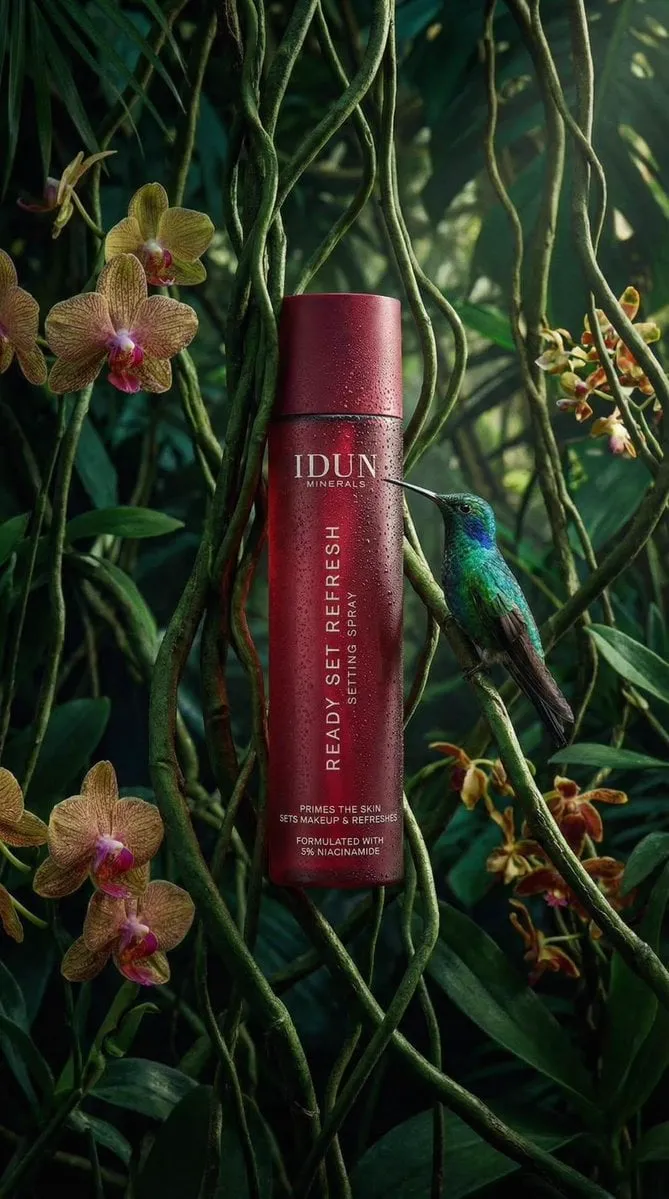
Product renders fail for one reason: the model invents motion. Lock the object down with explicit stillness ("the bottle remains stationary, only the label reflections shift") and put the motion in the camera and the environment ("slow 180-degree orbit, dust motes drifting through a hard key light").
Camera and Lighting Vocabulary That Actually Registers
Models are trained on captions, so they respond best to words that appear in real shot descriptions. Dump poetic adjectives and use craft terms instead.
Reliable camera terms:
| Intent | Say this |
|---|---|
| Intimacy | close-up, 85mm, shallow depth of field |
| Scale | wide shot, 24mm, deep focus |
| Tension | Dutch tilt, handheld, slow push in |
| Reveal | crane rise, pull back, tilt up |
| Energy | whip pan, tracking follow, snap zoom |
| Calm | static tripod, locked-off frame, slow drift |
Reliable lighting terms:
- Key direction: from camera left, from behind, from above, from below
- Quality: hard, soft, diffused, bounced, specular
- Source: tungsten lamp, neon sign, firelight, overcast sky, golden hour sun, screen glow
- Contrast: high-key bright, low-key with deep shadows, single-source with falloff
One warning: stacking three movement instructions ("push in while orbiting and tilting up") usually produces a smeared, incoherent clip. Choose one primary move and, optionally, one subtle secondary move.
Prompt Chaining for Multi-Shot Sequences
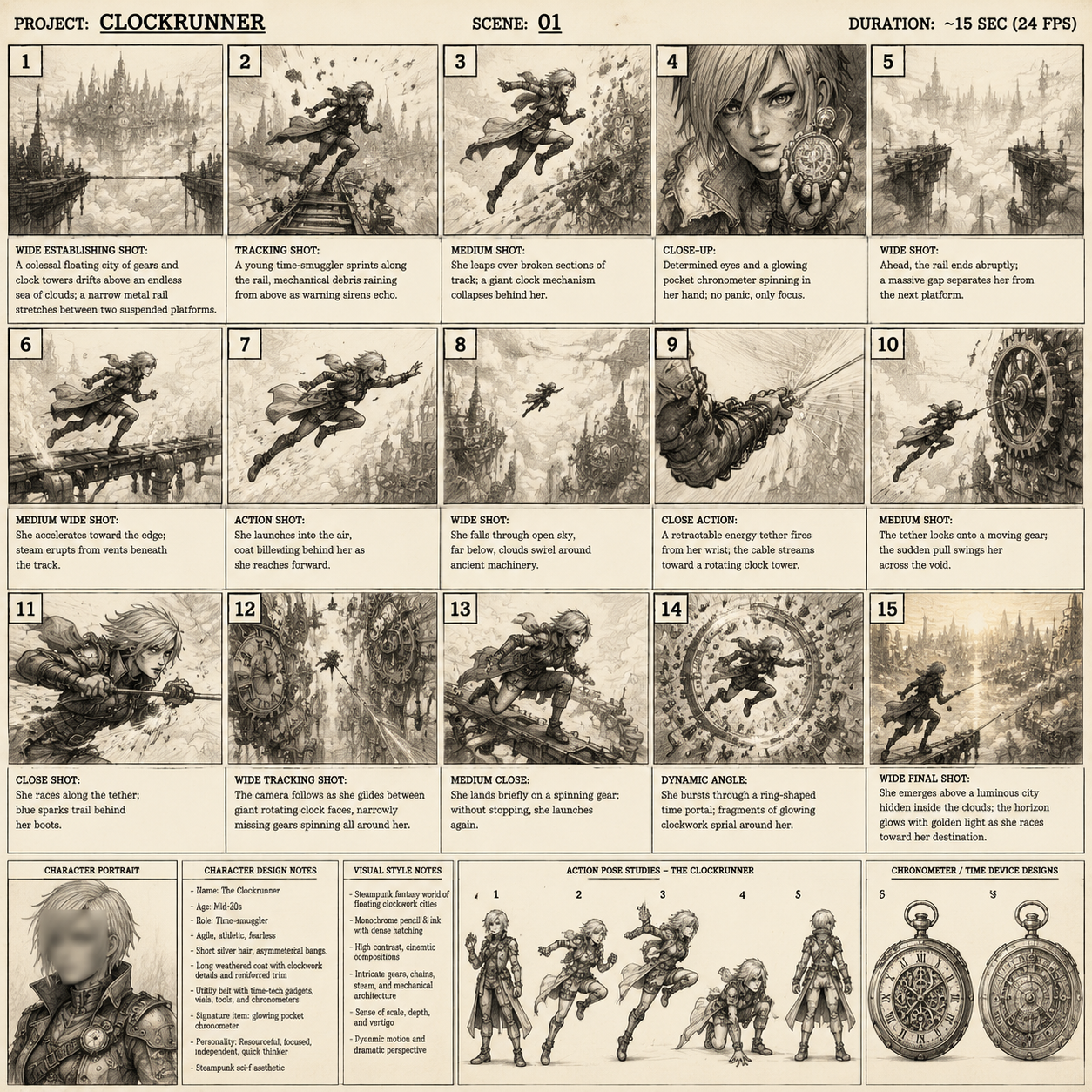
Single clips rarely tell a story. Chaining is the practice of breaking a scene into separate prompts that share a consistent visual world, then cutting them together in an editor.
The chain template
For a three-shot sequence, keep an identical style block and vary only the shot block:
- Establishing: wide shot, character small in frame, environment dominant
- Coverage: medium shot, character mid-frame, action readable
- Detail: close-up on hands or face, emotional beat
Write the shared block once, then copy it verbatim into every prompt:
Shared block: overcast Nordic coastline, desaturated blue-grey grade, soft diffused daylight, 35mm film grain.
Shot 1: A lone woman in a heavy wool coat stands at the edge of a stone jetty, tiny against a vast grey sea. Extreme wide shot, static, eye level, 24mm.
Shot 2: She walks slowly toward the camera, hands buried in pockets, wind pulling at her coat. Medium tracking shot, slow push in, 35mm.
Shot 3: Her face, eyes narrowing against the wind, a single strand of hair across her cheek. Close-up, static, 85mm, shallow depth of field.
Because the shared block is identical, the three clips look like they came from the same shoot. Because the shot blocks differ, the editor has coverage to cut.
Chaining rules that save time
- Change one variable per shot. If you shift framing and location and wardrobe, continuity collapses.
- Carry a color anchor. Mention one recurring element — a red scarf, wet asphalt, sodium streetlights — in every prompt of the chain so the edit feels unified.
- Render the establishing shot first. Lock the look, then reuse its language for coverage and detail shots.
- Keep clips 3 to 6 seconds. Longer generations drift, and drift is death for continuity.
Character Consistency Across Clips
Consistency is the hardest problem in AI video, and prompt engineering only solves part of it. The prompt sets the description; reference images and keyframe conditioning do the heavy lifting.
The character sheet approach
Before generating anything, write a fixed character description and never paraphrase it. Paraphrasing is how characters mutate. Keep the same word order every time:
Character block: a stocky man in his fifties, shaved head, deep forehead lines, small scar above the left eyebrow, navy fisherman's sweater with a rolled collar, grey stubble.
Every prompt in the project starts with this block verbatim. Not "a bald older guy in a sweater" — the same words, same order, every time.
Combining description with reference frames
Most modern engines accept one or more reference images alongside the text prompt. Use two or three: a front-facing portrait, a three-quarter view, and a full-body shot. In the prompt, explicitly bind the reference to the character: "the man from the reference image, wearing the sweater from image 2."
Keyframe conditioning
Some workflows let you supply a start frame and an end frame and let the model interpolate. This is the most reliable consistency tool available. Generate a still of your character in the correct pose using an image model, then use it as the start frame for the clip. The model inherits the face, wardrobe, and lighting from the image and only has to invent motion.
What to do when the face still drifts
- Reduce camera movement; motion blur destroys identity.
- Shorten the clip; identity holds better in the first three seconds.
- Avoid extreme angles, which force the model to hallucinate unseen geometry.
- Avoid heavy style words like "painterly" or "animated" unless the whole project uses them.
How Prompts Differ Across Model Families
Not every engine reads the same grammar. Knowing each family's bias saves a lot of re-rendering.
Cinematic narrative engines
These models are trained for longer, coherent shots with camera language. They reward detailed camera and lighting slots, handle dialogue-adjacent scenes, and respond well to genre references. They are the weakest at fast cuts and chaotic action.
Physics-focused engines
These prioritize believable motion, collisions, cloth, and water. They respond well to tempo words ("accelerates," "settles," "bounces twice") and punish vague action verbs. Style slots have less influence; motion slots have more.
Stylized and anime-leaning engines
These respond strongly to medium declarations ("2D cel-shaded animation," "inked line art") and to named aesthetic references. They often need the style slot moved to the front of the prompt to avoid photoreal bleed.
Image-model-plus-animation pipelines
Here you generate a still first, then animate it. Prompt engineering splits into two jobs: an image prompt for composition and a motion prompt for the animation pass. Keep the motion prompt short — five to fifteen words — because the still already carries the visual information.
Practical takeaway
Maintain a personal prompt library with one saved template per engine. When you switch tools, you switch templates, not just nouns.
An Iteration Workflow That Respects Your Time
Blind re-rolling is expensive. Use a staged loop instead.
- Draft prompt. Fill all slots, even roughly.
- Test at low resolution. Most engines let you preview quickly. Evaluate composition and motion only; ignore texture.
- Diagnose the failure. Is it subject, action, camera, light, or style? Change exactly one slot.
- Lock the look. Once composition works, stop touching the camera and lighting slots.
- Iterate motion only. Adjust tempo words and secondary motion.
- Render final. Re-run the winning prompt two or three times and pick the best take — even identical prompts produce variation, and the third take is often the strongest.
- Save the winner. Copy the final prompt into a notes file with the tool name and settings. Your archive becomes your competitive advantage.
A note on seeds
If your engine exposes a seed, pin it when you are iterating on style, and randomize it when you are exploring composition. Pinning a seed while changing the prompt gives you a clean A/B comparison.
Troubleshooting: Common Failure Modes and Their Fixes
| Symptom | Likely cause | Fix |
| --- | --- |
| Subject morphs mid-clip | Too much movement, too little description | Shorten clip, add wardrobe detail, reduce camera motion |
| Everything looks soft and muddy | Conflicting style terms | Cut style slot to two elements |
| Camera jerks or drifts | Multiple or contradictory movement words | Use one primary move only |
| Extra fingers or limbs | Complex hand action, wide framing | Frame tighter, keep hands still or out of frame |
| Colors shift between shots | No recurring color anchor | Add the same palette phrase to every prompt |
| Model ignores the setting | Setting buried at the end | Move setting directly after the action clause |
| Text appears in frame | No negative prompt | Add "no text, no watermarks, no logos" |
| Motion looks like a slideshow | No explicit motion verb | Add tempo words: drifts, sweeps, pulses |
| Faces look generic | Weak subject anchors | Add one distinctive, reproducible feature |
| Scene feels flat | No depth cue | Add foreground or background element with distance |
Negative prompts worth keeping on hand
Build a reusable negative block: "no text overlays, no watermarks, no duplicate faces, no extra limbs, no warped perspective, no sudden cuts, no flickering." Paste it into every prompt that supports negatives and adjust only if a specific project needs something unusual.
Practice Drills to Build Prompt Fluency
Prompt engineering is a motor skill as much as a knowledge skill. These drills build it fast.
The one-slot drill. Take a winning prompt and change only the lens. Render. Then change only the light direction. Render. You will learn the actual influence of each slot rather than guessing.
The reverse drill. Find a still frame you admire and write the prompt that would produce it. Compare against your own renders to calibrate your vocabulary.
The economy drill. Rewrite a 120-word prompt in 40 words without losing subject, action, camera, or light. Concision forces prioritization.
The chain drill. Storyboard a five-second story in three shots, write the shared block once, and generate all three. Cut them together. If the edit feels incoherent, your shared block was too thin.
Do these for a week and you will out-prompt people who have been generating for months without structure.
Frequently Asked Questions
How long should a video prompt be?
Between 40 and 90 words for most engines. Long enough to fill the essential slots, short enough to avoid internal contradictions. Image-plus-animation pipelines are the exception; their motion prompts should be 5 to 15 words.
Does writing in a different language change the output?
Some engines are trained predominantly on English captions and handle English prompts most predictably. Others support multilingual prompting well. If results feel unresponsive in your language, translate the prompt into English while keeping names and proper nouns intact, then compare.
Can one prompt generate a whole scene with cuts?
Rarely. Most models generate a single continuous shot. Multi-shot scenes come from chaining separate prompts and editing them together. Some newer tools accept shot lists, but the results still need editorial cleanup.
Why does the same prompt give different results each time?
Generation is stochastic. Unless you pin a seed and your engine supports deterministic rendering, each run samples a different path. This is a feature: render three takes and choose the best.
Do I need to describe everything in the frame?
No. Describe what matters and let the model fill the rest. Over-describing background elements steals attention from your subject and often creates visual clutter.
How do I stop characters from changing between shots?
Use a verbatim character block, supply two or three reference images, condition on keyframes where possible, reduce camera movement, and keep clips short. Prompt text alone cannot guarantee identity.
Is prompt engineering still relevant as models improve?
Yes, but the skill shifts. As models internalize more common-sense defaults, prompts get shorter and more intent-focused. The valuable ability moves from "describe the image" to "specify the shot" — camera, timing, continuity, and constraints.
Putting It All Together
A strong AI video prompt is not a poem. It is a compact technical document: subject, action, setting, camera, light, style, audio, constraints. Write it in that order, keep each slot to a handful of precise words, and change only one thing at a time when you iterate.
Start with the five-slot template, practice with the drills, build a personal library of winning prompts per engine, and treat chaining and reference conditioning as your continuity toolkit. The difference between a frustrating session and a productive one is rarely the model you chose. It is whether you told it, clearly and in the right order, what you wanted to see.
