

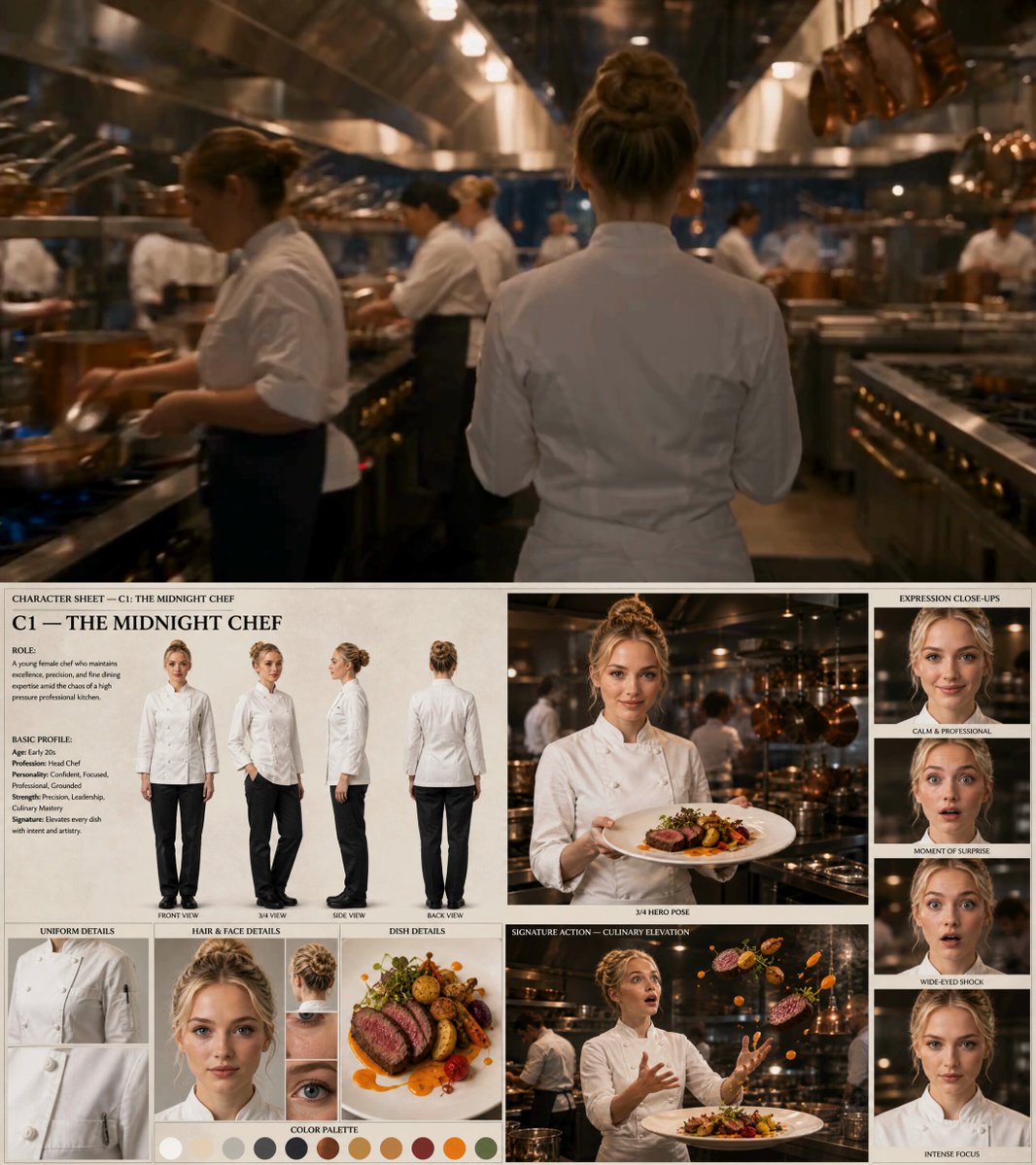

What "Realistic" Actually Means in AI Video
Realism in generated footage is not a single quality. It is a stack of small agreements between what the viewer expects and what the frame delivers: skin that holds up in close-up, fabric that folds instead of melting, a camera that drifts the way a human operator's hands would. When those agreements hold, the audience stops asking how the shot was made and starts following the story. When one breaks, the whole clip reads as synthetic, no matter how sharp the rest of it is.
That asymmetry tells you where to spend your attention. A high-resolution render with a flickering earring gets judged more harshly than a softer render with clean motion. Viewers forgive compression, grain, and stylised colour. They do not forgive objects that change shape between frames, characters who pass through walls, or a hand that grows a sixth finger mid-gesture.
A workable definition of realism has five parts:
- Temporal stability — nothing shimmers, warps, or boils from frame to frame.
- Physical plausibility — weight, momentum, gravity, and collisions behave as the eye expects.
- Material fidelity — skin, hair, water, glass, metal, and cloth respond to light correctly.
- Camera logic — focal length, depth of field, parallax, and movement follow real optics.
- Continuity — identity, wardrobe, lighting, and geography survive a cut.
Every model available today is strong on some of these and weak on others. Choosing well starts with knowing which pillar carries the weight in the shot you are about to make.
Text-to-Video vs. Image-to-Video: Two Different Problems
Many comparisons treat prompt-driven and reference-driven generation as two settings of the same tool. They are closer to two different jobs with different failure modes.
Text-to-video: the model invents everything
Working from text alone, the model decides composition, subject, and motion at the same time. "A cyclist rides through a rainy street at dusk" resolves into a specific framing, rider, location, and pace — all chosen by the model. That freedom is excellent for exploration and risky for continuity, because two prompts written an hour apart can produce two visually unrelated worlds. Text-to-video excels at mood pieces, abstract sequences, and first-pass concepting. It struggles whenever the same person, product, or location must return in a later shot.
Image-to-video: the frame is the contract
The moment you supply a starting image, you remove most of the model's compositional freedom and inherit its constraints. A keyframe locks the wardrobe, the lighting direction, and the subject's features, which makes continuity dramatically easier. The trade-off is that the model now has to animate something it did not design, and that is where artifacts appear: limbs that stretch to follow the reference, faces that drift toward a generic average, backgrounds that breathe.
Where hybrid pipelines win
In practice, the strongest results come from a layered approach. Generate or photograph a keyframe in an image model, then animate it. Use text-to-video for inserts and atmosphere where continuity does not matter. Use image-to-video for anything with a recurring character. Keep a reference sheet for each recurring subject and feed it back into the keyframe stage rather than hoping a video model will remember a face it has never seen.
The Four Pillars Behind Convincing Footage
Temporal coherence
Older generators produced frames independently, so textures crawled and edges vibrated. Modern architectures that treat video as a sequence rather than a stack of stills hold objects together far better. When you evaluate a model, watch a static object for the full clip length: a parked car, a wall, a logo on a shirt. If the edges shimmer, the model is still thinking frame-first.
Motion physics and weight
Realism breaks fastest in movement. Cloth should lag behind the body. Hair should settle. Liquid should splash with mass. Ask a model for a simple action — someone standing up, a glass being set down, a door swinging — and study whether the action completes at a believable speed. Models that rush motion tend to look like footage played at the wrong frame rate; models that drag motion look like they are interpolating rather than simulating.
Optics and camera language
Most viewers cannot name a 35mm lens, but they can feel it. Shallow depth of field, natural bokeh, and believable parallax signal "real camera" instantly. Prompts that specify lens behaviour — "slow dolly in, 50mm, shallow focus, subject sharp against soft background" — often do more for realism than any quality keyword. Equally useful are deliberate imperfections: slight handheld sway, a gentle lens flare, a small focus rack.
Identity and style consistency
A shot is realistic only if the person in it is the same person on either side of a cut. Consistency requires work outside the generation step: locked wardrobe notes, a lighting reference, a fixture list, and a saved set of reference images. Treat consistency as production design rather than a model feature, and you will stop chasing models that promise to solve it alone.
How to Choose a Generation Model Without Guessing
Start from the deliverable, not the demo
Demo reels are optimised to impress in three seconds. Your project is optimised to hold attention for thirty or sixty. Write down the hardest shot first — the close-up, the on-camera line, the water interaction — and test candidates against that shot and nothing else.
Hero tier versus throughput tier
Most teams settle on two tiers. A hero model handles the shots the audience will remember, where you can afford multiple attempts and slow generation. A throughput model handles volume: B-roll, backgrounds, transitions, social cutdowns. Trying to run every shot through the hero tier destroys both your schedule and your budget; running hero shots through the throughput tier destroys your credibility.
| Shot type | Tier | What matters most |
|---|---|---|
| On-camera presenter | Hero | Identity, lip sync, skin |
| Product close-up | Hero | Material fidelity, lighting |
| Establishing landscape | Throughput | Camera logic, stability |
| Background plates | Throughput | Cost per second, speed |
| Social cutdown | Mixed | Vertical framing, pacing |
Think in cost per finished second
Raw generation price is a misleading metric because it ignores the discard rate. A model that costs half as much but needs four times as many attempts is the more expensive option. Track how many generations it takes to land one usable second, multiply by the rate, and compare that number across tools. Keep a simple log per project: attempts, accepted seconds, total spend. Within two projects you will know your real economics.
Check the boring constraints
Before committing, verify aspect ratios, clip length limits, resolution, watermark policy, commercial usage terms, and whether the output can be upscaled cleanly. A model that produces beautiful 16:9 footage but cannot do vertical natively may cost you a full re-render for every social deliverable.
A Repeatable Production Workflow for Realistic Clips
Step 1 — Script the shot, not the scene
Break the piece into shots of five seconds or less. Every shot gets one job: establish, reveal, react, transition. Write the motion in the script itself — "she turns to camera and speaks" is a different generation problem from "she stands still and speaks." Small, motivated movements generate more reliably than broad physical action.
Step 2 — Build a look reference
Collect stills that define lighting, palette, and lens character. Generate keyframes against that reference. For recurring subjects, create three views: front, three-quarter, and profile. Save them with naming conventions that survive a busy week, because the biggest realism killer in real production is not model quality — it is a producer animating the wrong reference.
Step 3 — Generate in disciplined batches
Generate variations of a single shot rather than a scatter of different shots. Change one variable at a time: first framing, then motion, then lighting. Most teams lose hours re-generating shots whose only problem was an unclear reference. Set a hard cap of attempts per shot and move on when you hit it; a slightly imperfect clip in a strong sequence beats a perfect clip that arrives three days late.
Step 4 — Assemble, sound, and finish
Realism is finished in post. Stabilise gently, add grain that matches the source, colour-grade the whole sequence together so shots share a palette, and never skip sound. Room tone, footsteps, cloth movement, and a subtle ambience track do more to sell generated footage as real than any visual tweak. If faces drift, a short insert shot can cover the transition; editing rhythm hides more artifacting than any filter.
Prompt Craft: Directing the Model Like a Camera Crew
Describe the shot before the subject
Lead with framing and camera: "medium close-up, slow push in, eye level." Then describe the subject and wardrobe. Then describe the action. This order mirrors how a real shot is planned and gives the model a structural hierarchy instead of a pile of adjectives.
Use lens and lighting vocabulary
Terms like "soft window light," "golden hour backlight," "practical lamps in frame," "85mm compression," and "shallow depth of field" translate into specific rendering decisions. Vague words like "cinematic" or "high quality" do very little, because every prompt uses them.
Control artifacts with positive guidance
Instead of listing what you do not want, describe the conditions under which the artifact cannot occur: "hands resting on the table, fingers relaxed," "camera locked off on a tripod," "steady, even walking pace." Negative prompts have their place, but positive spatial constraints are usually more effective at suppressing warping and limb errors.
Keep prompts short enough to obey
A prompt with fifteen competing details produces an average of all of them. Two or three decisive elements per shot, plus a style anchor repeated across a sequence, will beat an overstuffed paragraph almost every time.
Common Mistakes That Make AI Video Look Fake
- Faces held too long in close-up. Skin detail is the hardest thing to generate. Cut away before the audience studies it.
- Fast, complex motion. Running, fighting, and crowded scenes still strain most models. Use framing and cuts to imply action instead of rendering it end to end.
- Mismatched lighting between shots. A warm close-up next to a cool wide shot reads as two different films. Grade the sequence as a unit.
- No sound design. Silence makes generated movement feel weightless. Add texture, even minimal, to every shot.
- Over-reliance on one take. Treat generation like filming: cover the scene from two angles so you have editing options.
- Ignoring foreground depth. Scenes with nothing between the camera and the subject look flat. Add a foreground element — a chair back, a plant, a passing shoulder.
- Upscaling artifacts. Aggressive sharpening on an unstable clip amplifies flicker rather than hiding it.
- Inconsistent frame rate. Mixing 24 and 30 fps clips in one sequence creates a subtle wrongness viewers feel but cannot name.
Quality Control Checklist Before You Publish
Watch every clip three times, each time looking for something different. On the first pass, follow the subject: does identity hold, do hands behave, does hair and clothing respond to motion? On the second pass, ignore the subject and watch the background for crawling textures, warping edges, and objects that appear or vanish. On the third pass, watch the whole sequence muted, checking continuity of light direction, palette, and screen direction across cuts. Then watch it once more with sound only, and ask whether the audio is doing its share of the illusion. If a shot fails on two of these passes, replace it — patching rarely works.
Where Realistic Generation Is Heading
Three shifts are already visible. First, longer usable shots: models are getting better at holding coherence past the ten-second mark, which reduces the need to hide cuts. Second, native audio: generation that produces footsteps, ambience, and dialogue in the same pass removes a whole class of sync problems. Third, control layers: depth maps, pose references, and camera trajectories are turning generation from a slot machine into a controllable camera. For teams, the implication is straightforward — the winners will not be the people with access to the newest model, but the people who build a repeatable pipeline around whichever model is good enough this month.
FAQ: Realistic AI Video Generation
Can generated footage pass as camera footage?
In short shots with simple motion and good sound design, yes. Longer takes, complex physical action, and extended close-ups on faces still reveal the synthetic origin to attentive viewers.
Is text-to-video or image-to-video better for realism?
Image-to-video generally wins for realism and continuity because the keyframe locks composition, wardrobe, and lighting. Text-to-video is better for exploration, atmosphere, and shots where continuity does not matter.
How long should a generated shot be?
Three to six seconds covers most needs. Anything longer increases the chance of drift, and cuts are cheaper than re-generations.
Do I need a separate image model?
It helps. A dedicated image model gives you precise control over the keyframe, which is the single biggest lever on the final quality of an animated clip.
Why do hands and faces still fail?
They contain the most fine detail and the most viewer scrutiny. Design shots that avoid prolonged close-ups on hands, and use framing, foreground elements, and cuts to redirect attention.
What post-production steps matter most?
In order: sound design, colour grading across the sequence, gentle stabilisation, and grain matching. Ultra-sharp upscaling is usually the least valuable step.
How do I keep a character consistent across shots?
Lock the reference: three views of the face, fixed wardrobe notes, a lighting reference, and a saved style anchor repeated in every prompt. Then check continuity at the cut, not inside the shot.
What is the fastest way to improve results today?
Shorten your shots, simplify the motion, add foreground depth, and put sound under everything. Those four changes improve perceived realism more than switching models ever will.
