
Why short-form vertical video rewards process over luck
Every creator has the same story. A clip that took ninety seconds to assemble outperforms a video that consumed two full days. The instinct is to call it luck, then chase that luck for a month and burn out. The better reading is that short-form vertical video rewards a specific kind of preparation: fast execution inside a repeatable system.
Reels, TikTok, and similar vertical feeds are structurally different from long-form video. There is no patience buffer. The viewer arrives mid-scroll, decides in roughly two seconds, and either stays or leaves. That means the editor's job is not only to make something beautiful, but to make something that survives a decision window measured in heartbeats. Beautiful footage with a slow opening loses to mediocre footage with a sharp opening, every time.
AI generation tools have changed what is expensive in this pipeline. Concept art, B-roll, stylized backdrops, and impossible camera moves used to be budget line items. Now they are prompt iterations. The scarce resources are attention, taste, and time. This guide walks through a neutral workflow for planning, generating, editing, and publishing short-form vertical video, using AI tools where they genuinely help and manual editing where they do not.
The three layers of a short-form video pipeline
Before touching any tool, separate the work into three layers. Most creators collapse them, which is why projects stall halfway. When something breaks, you need to know which layer failed.
Layer one: the story layer
This is the idea, the hook, the single promise the video makes, and the beat structure that delivers it. It exists entirely on paper or in a notes app. Nothing in this layer requires software. A strong story layer can be summarized in one sentence: "Person tries X, it fails twice, the third attempt surprises them." If you cannot summarize your video that way, you do not have a story layer yet — you have footage.
Layer two: the generation layer
Here you create or capture the raw material: live-action clips, AI-generated shots, screen recordings, product footage, stock inserts, and stills. This is where AI video models earn their place, handling shots that would be impractical to film. Treat generation as manufacturing: you are producing a defined list of assets with known specifications, not exploring.
Layer three: the finishing layer
The finishing layer is editing, sound design, captions, color, and export. It is where rhythm is built and where most of the perceived quality lives. A rough generated shot can be rescued by tight cutting and good audio. A perfect shot with lazy pacing cannot.
Planning before prompting: shot lists, scripts, and hook banks
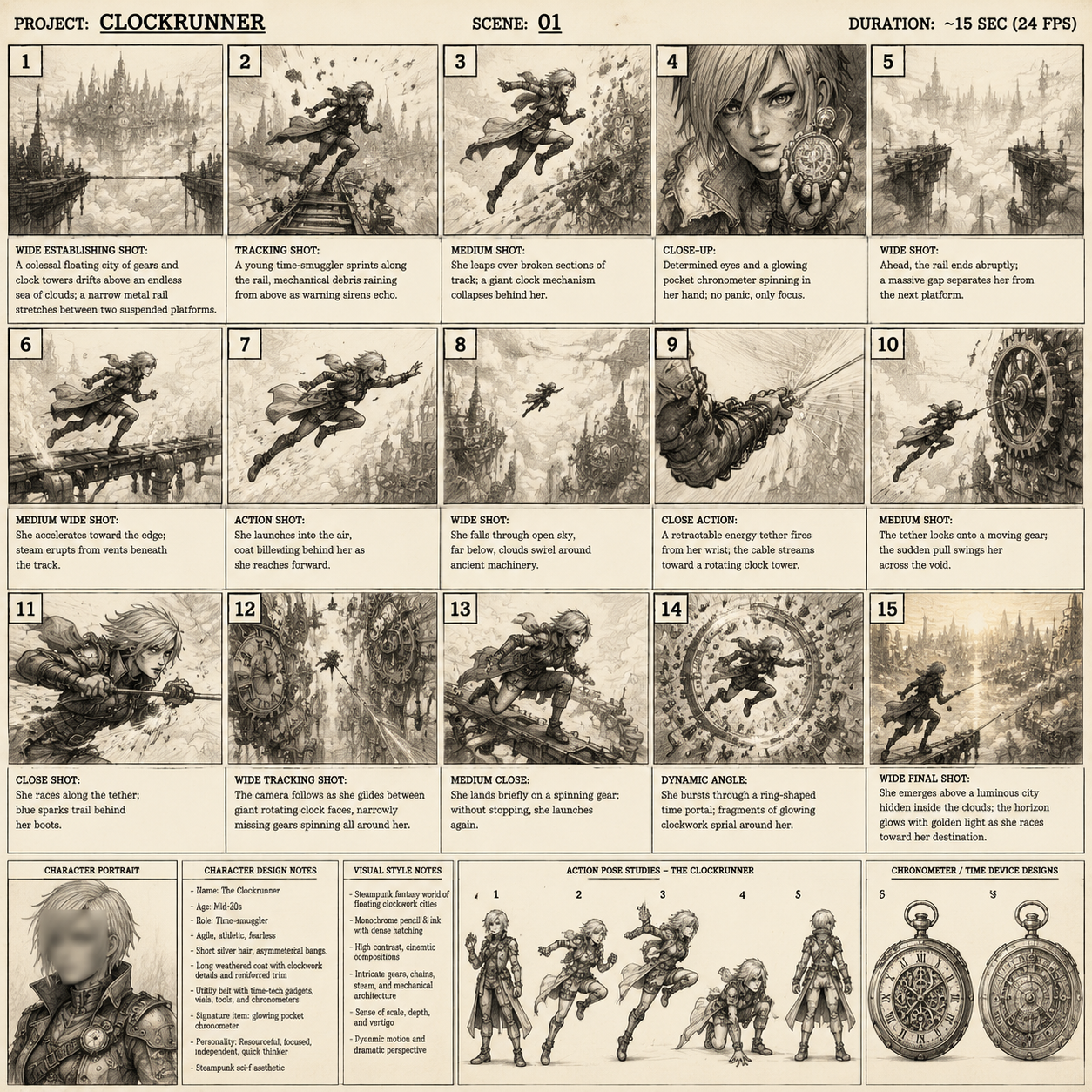
The single highest-leverage habit in short-form production is writing a shot list before generating anything. A shot list is a table with four columns: shot number, what the viewer sees, what the viewer hears, and the duration in seconds. For a thirty-second video, that is typically eight to twelve lines. It takes ten minutes and saves hours of aimless generation.
Keep a hook bank. Whenever you notice yourself stopping mid-scroll, write down the first line of that video verbatim in a running note. Over a few weeks you build a library of opening structures you can adapt: a contradiction, a number, a confession, a visible result shown before the explanation. Hooks are reusable patterns, not one-time strokes of genius.
Write the script for the ear, not the eye. Read every line out loud. If you stumble, the audience will too. Aim for sentences under twelve words and cut every clause that does not advance the promise. For voiceover-driven videos, target roughly 2.5 to 3 words per second of runtime; that gives you a realistic length budget before you start trimming.
Finally, decide the payoff before you generate a single frame. The ending determines what the opening should tease. Generating first and hoping an ending appears is the most common way short-form projects die.
Choosing the right generation approach for each shot
Not every shot deserves the same method. Mixing techniques deliberately, rather than by accident, is what separates a coherent video from an AI demo reel.
Text-to-video, image-to-video, and hybrid
Text-to-video is fastest for establishing shots, abstract transitions, and any frame where exact composition matters less than motion and mood. Image-to-video gives you control: generate or photograph a still you like, then animate it. It is the better choice when a specific product, face, or layout must appear precisely. Hybrid workflows usually win: build stills first, animate the ones that need motion, and cut the rest in as static frames with a slow push-in added in the editor.
Matching tool strengths to shot type
General-purpose video models handle cinematic motion well. Specialized tools handle specific jobs better: lip-sync and talking-head generation, background removal, upscaling, frame interpolation, and object cleanup. Rather than committing to one platform, keep a small toolkit and assign each tool a role. A practical division looks like this: one model for hero shots, one for fast B-roll, one upscaler, one audio cleanup tool. Fewer tools, used deeply, beats a dozen half-learned ones.
Iteration budget: how many takes per shot
Decide in advance how many generations a shot is allowed. Three is a reasonable default for B-roll, six for a hero shot. When you exceed the budget, the problem is almost never the model — it is the prompt or the shot concept. Change one variable at a time: subject, camera move, lighting, or framing. Changing three variables at once teaches you nothing about which one mattered.
Keeping characters and visual style consistent across a series
Consistency is what turns a collection of clips into a channel. Viewers recognize a face, a color palette, and a rhythm before they recognize your name.
For recurring characters, lock a reference image set: front, three-quarter, and profile views, in consistent lighting. Feed those references into every generation rather than re-describing the person in words. Descriptive prompts drift — hair length changes, jawlines shift, clothing mutates. References anchor.
For style, define a compact visual contract and write it down: lens feel, color temperature, contrast level, and motion speed. Something like "35mm, warm highlights, low contrast shadows, slow handheld drift" is enough to keep a series coherent. Reuse the same phrases across prompts and the same color grade in the editor. Consistency comes from repetition, not from variety.
Audit every five videos. Line up your last five posts side by side, mute them, and look at thumbnails and first frames. If they could belong to five different creators, tighten the contract.
Editing for retention: hooks, pacing, and transitions
This is where the video is actually won. Generation gives you material; editing gives you momentum.
The first two seconds
Your opening frame must contain motion, a face, or a legible text statement. Static wide shots lose. If your best moment happens at second twenty, show a two-frame flash of it at the start, then rewind. This is not a trick; it is a promise. The viewer needs a reason to believe the next twenty seconds are worth their time.
Cut the first second ruthlessly. Most AI-generated clips begin with a soft ramp-in. Trim to the first frame where motion is fully underway. The same applies to the ending: cut as soon as the payoff lands.
Cutting rhythm and the jump cut
Short-form pacing is roughly one visual change every 1.5 to 3 seconds, with variation. Constant fast cutting becomes noise; constant slow cutting becomes boredom. Build a pattern: three quick cuts, one held shot, two quick cuts, one held shot. Held shots are where emotion and information land.
Jump cuts are an asset, not a flaw, in talking-head content. Remove breaths, pauses, and filler words. Keep the rhythm of speech natural by leaving small gaps — cutting everything produces an unnerving staccato that reads as artificial.
Transitions that feel invisible
Match cuts beat zoom transitions. Find a shape that repeats across two shots — a hand, a doorway, a circle — and cut on the match. For generated footage, use motion-direction continuity: if the camera drifts left in shot A, begin shot B drifting left. When a hard cut feels jarring, a one- to two-frame whip or a quick scale punch smooths it more elegantly than a stock transition.
Text, captions, and sound: the invisible retention layer
A large share of vertical video is watched with sound off, at least initially. Captions are not optional. Burn them in, keep them to three to five words per line, and place them above the lower UI zone where platform buttons sit.
On-screen text does different work than captions. Use short overlays for structure — a number, a step label, a contradiction — and never for full sentences. Keep one idea per overlay, and keep each overlay on screen long enough to read twice. If a viewer has to pause, you have lost the scroll.
Audio design carries more weight than most creators admit. Three layers work well: a music bed, a voice track, and accent effects. Duck the music by several decibels under speech so the voice always sits forward. Add a subtle whoosh or click at cut points to smooth the edit — it signals rhythm even when the visuals are busy.
Record voiceover in a small, soft room with a blanket or curtains nearby. A cheap microphone in a treated space beats an expensive one in an echoey kitchen. Clean the audio before you color the video; bad sound ruins good footage faster than the reverse.
A repeatable weekly production workflow
Batch the work by layer instead of finishing one video at a time. A weekly cycle that produces three to five posts looks like this.
- Monday — ideation. Write ten hooks, pick five, and draft a one-sentence promise for each. Kill anything you cannot summarize.
- Tuesday — shot lists. Turn each promise into eight to twelve shots with durations and audio notes.
- Wednesday — generation. Build all stills and clips in one session. Stay inside your per-shot iteration budget and stop when it is spent.
- Thursday — assembly. Edit all five videos with minimal polish. Get them to eighty percent and stop.
- Friday — finishing. Captions, overlays, sound, color, and export in one pass. Do not re-edit structure at this stage.
- Weekend — publish and review. Schedule posts, then log retention data: where viewers dropped, which hooks worked, which overlays were ignored.
- Next Monday — feed the loop. Promote your two best hooks into the next week's batch and retire the two worst.
Batching matters because context switching is expensive. Switching between prompt iteration and caption timing all day long destroys the focus each task needs.
Common mistakes and the quality checks that prevent them
The same failures appear again and again. Watch for these.
- Generating before writing. If you do not know the ending, you are not ready to prompt.
- Overloading the first frame. Three simultaneous text overlays, a logo, and a face is not a hook; it is clutter.
- Uniform pacing. Identical cut lengths read as mechanical, even when the shots are good.
- Ignoring the safe zone. Captions hidden behind platform UI are invisible captions.
- Chasing one perfect shot. A video with nine good shots and one weak one outperforms a video with one perfect shot and eight filler shots.
- Skipping the mute test. Watch your final export with sound off. If it does not communicate, fix it.
Run a pre-publish checklist: hook visible in the first second, captions burned in, audio peaked correctly, no dead frames, export settings matched to the platform's vertical aspect ratio, and the payoff delivered before the final second.
FAQ
How long should a short-form video be?
Long enough to deliver the promise, short enough that no second is filler. Most informational clips land between twenty and forty-five seconds. Story-driven clips can run longer if retention holds.
Do I need AI video generation at all?
No. It solves specific problems: shots that are expensive to film, impossible camera moves, stylized worlds, and fast B-roll. If you can film it quickly, filming usually looks better.
What is the fastest way to improve my editing?
Cut your last video to eighty percent of its length without losing information. Tightening forces you to identify what actually matters.
How many generations should I allow per shot?
Set a budget of three for supporting shots and six for hero shots. If you exceed it, change the concept or the prompt, not the model.
Why do my videos look inconsistent across a series?
You are probably describing your style in new words each time. Write down a short visual contract and reuse the exact same phrasing and color grade.
Should captions be animated word by word?
Word-by-word captions can boost engagement but also increase visual noise. Use them for high-energy content and calmer line-based captions for instructional or emotional videos.
How do I know if a hook works?
Look at your two-second retention rate. If a large share of viewers leave in the first two seconds, the problem is the opening frame or the first spoken line — not the rest of the video.
