

Why smart video marketing is a workflow problem, not a tool problem
Most teams treat AI video as a purchasing decision. They compare generation models, run a handful of test prompts, crown a winner, and assume the rest will sort itself out. Then reality lands: four hooks for the same product, three aspect ratios, subtitles in two languages, and a variation for a different audience segment, all before the campaign window closes. The model did not fail. The workflow did.
Smart video marketing is the practice of designing the full chain rather than obsessing over a single node. It begins with an audience promise and ends with a measurement loop. In between sit the decisions that determine whether the finished video earns attention: which shots carry the message, how long each one holds, where the brand appears, what the first two seconds promise, and how quickly a viewer understands something worth staying for.
Three shifts make this urgent. Production cost has collapsed, so volume alone is no longer a differentiator; structure and taste are. Attention has fragmented across feeds, so the opening two seconds carry more weight than the following twenty. And audiences now read generic creative as noise while reading relevance as a recommendation. In that environment, a well-organized workflow beats a marginally better model every time.
So the useful question is not whether AI can generate a video. It is whether AI can help a team generate the right video repeatedly, on schedule, without diluting the brand. That question has an answer, and the answer is operational rather than technical.
The four layers of a modern AI video stack
Think of your setup as four cooperating layers. Weakness in any single layer shows up as weak engagement, no matter how strong the others look in a demo.
Model layer
This is the generation layer: image models that produce keyframes and style references, and video models that turn those keyframes into motion. The layer changes fast. What matters is not loyalty to one model but knowing which model suits which shot: a slower cinematic render for a hero moment, a fast model for the twenty variants you will throw away during exploration.
Direction layer
Direction is where most AI video projects quietly fail. Generation without compositional intent produces footage that looks impressive and says nothing. A direction layer means a shot list, a camera plan, notes on movement, and a rule for what each shot must communicate. Director-style assistants can suggest framing and narrative structure, but the decisions still need an owner: someone empowered to reject a beautiful shot that does not serve the story.
Personalization layer
Personalization is the assembly logic that turns a master edit into audience-specific versions. It includes dynamic text overlays, swap-in product shots, alternate hooks, region-specific talent or settings, and localized voice. Built well, this layer lets you ship twelve relevant videos for roughly the effort of one and a half.
Measurement layer
The measurement layer closes the loop. Retention curves, hook rate at three seconds, completion rate, click-through, and downstream conversion all reveal which creative modules deserve more budget. Without it, AI video marketing becomes an endless creative hobby rather than a compounding channel.
Choosing the right generative video model for each job
Model choice should follow the shot, not fashion. A practical way to sort the field is by three axes: realism and stability, iteration speed, and specialization.
Cinematic realism and shot stability
For hero shots, you want models that hold a subject identity, obey camera language, and avoid melting edges during motion. High-fidelity image models are excellent for keyframe design and look development, while the more cinematic video models handle longer, smoother movement and lighting continuity. Use these sparingly: they are the shots that carry the brand, and they deserve the extra render time.
Speed, iteration volume, and iteration economics
Exploration needs models that return results quickly enough to test ten ideas before lunch. Fast, lightweight video models are ideal for hook testing, transitions, and social-native motion graphics. The best practice is to separate exploration from production deliberately: iterate fast and cheap, then re-render only the winning concept at higher quality.
Specialized and regional models worth tracking
A growing group of specialized models targets specific aesthetics: stylized character motion, physics-heavy action, anime or illustration looks, or regionally popular visual styles. Some shine at character consistency across shots; others excel at product-turntable motion or legible on-screen text. Keep a short list and revisit it quarterly, because capability shifts quickly and yesterday's compromise may already be solved.
A decision checklist that saves rework
Before committing to a model for a shot, answer: How long does the shot need to hold? How complex is the motion? Does a recurring character or product appear? Which aspect ratios are required? What is the turnaround? Are commercial usage terms acceptable for this client? Is the team already fluent with this model prompt style? Any negative answer sends you back a layer, usually to keyframes or the storyboard, rather than forward into a longer render.
Scene consistency: the hardest problem in AI video
Ask any team what breaks a campaign and you will hear the same answer: consistency. Faces drift between shots, jackets change color, lighting temperature jumps, and a product that looked matte in shot one turns glossy in shot four. Viewers may not name the problem, but they feel it as cheapness, and cheapness kills trust faster than a weak hook.
Four techniques solve most of it. First, adopt a keyframe-first workflow: approve stills for every shot before animating anything. Second, lock a reference set, one canonical image per character, product, and location, and reuse it in every prompt. Third, keep a continuity sheet listing wardrobe, props, time of day, and lens choice, then check it at every generation. Fourth, fix the remainder in the edit: a consistent color grade, matched grain, and unified sound design can pull slightly mismatched shots into a coherent whole.
For recurring characters, choose models with strong identity retention and prefer shorter shots cut together rather than long continuous takes. If a shot keeps drifting, do not fight it. Split it into two simpler shots and join them with a motivated cut. Audiences forgive a cut; they do not forgive a face that changes shape mid-sentence.
From brief to storyboard: prompts that survive editing
A prompt is not a brief. The brief defines audience, promise, proof, and payoff. The storyboard translates that into six to ten shots with a job for each. Only then does prompting begin, and only then does generation become efficient instead of exploratory gambling.
A prompt template that works across models covers subject, action, setting, lens, lighting, camera movement, duration, and style, in that order. For example: a cyclist in a matte black jacket lifts a compact espresso maker from a pannier, morning light, 35mm lens, shallow depth of field, slow push-in, three seconds, muted documentary grade. Compare that with a vague two-word idea and you can predict which one survives an edit.
Write prompts for editability. Leave headroom for text overlays, avoid filling the frame edge to edge, and plan where a cut can land. Generate coverage deliberately: a wide for context, a medium for product action, a close-up for detail, and a reaction or hands-on shot for proof. That four-shot kit is enough to build a fifteen-second ad with a clear arc, and it scales to longer pieces without changing the underlying logic.
Adaptive creative: turning one campaign into many variants
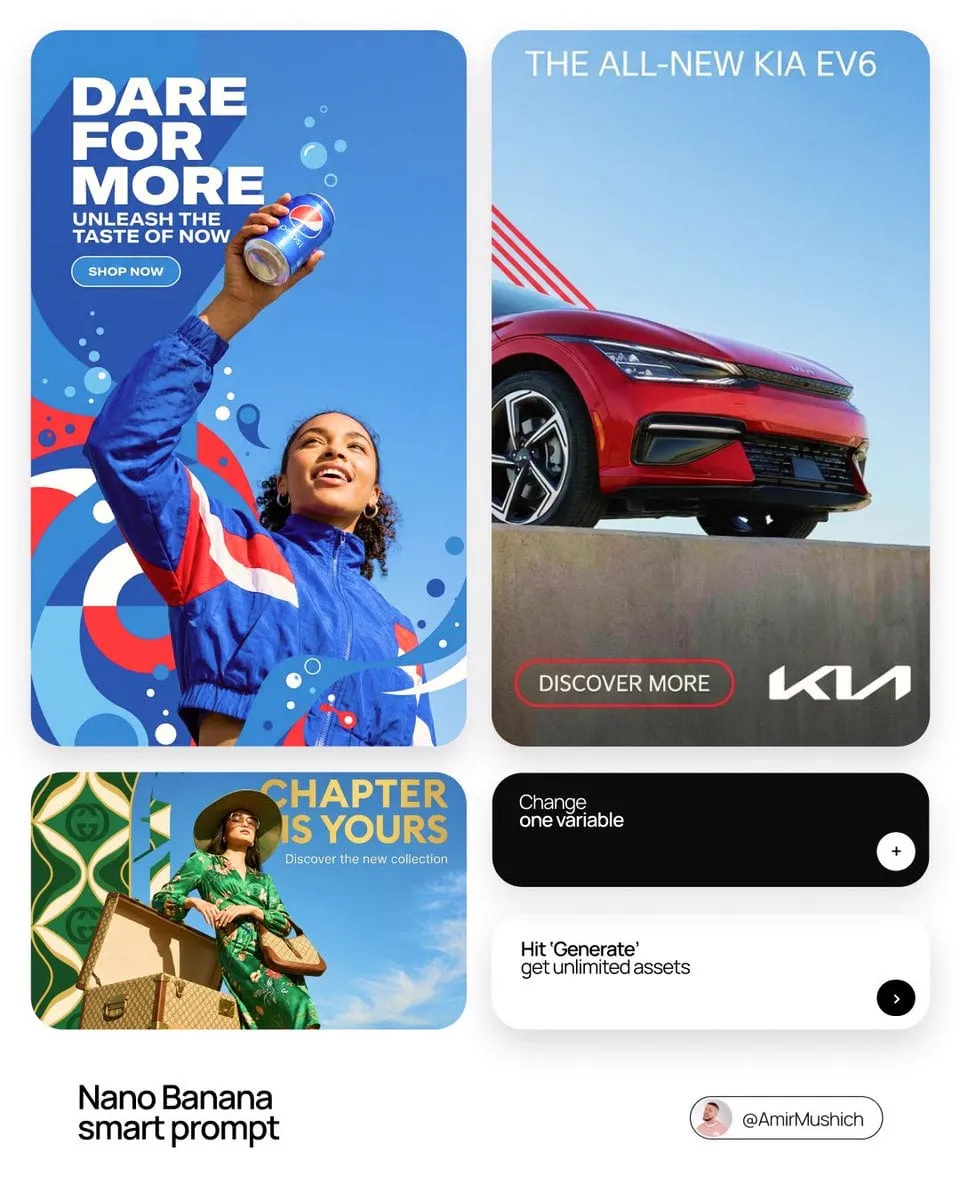
Adaptive creative is the multiplier. Instead of making one video and boosting it, you build a modular master and reassemble it per audience. The modules are predictable: hook, problem, product action, proof, offer, call to action. Once those modules exist as clean, separately editable sequences, personalization becomes assembly rather than production.
Personalization at its simplest means swapping the first three seconds and the closing frame while keeping the middle intact. A skincare campaign might run one hook about dull skin, one about sensitivity, and one about post-workout redness, each pairing with the same product sequence and a slightly different closing line. A software campaign might swap the interface footage for the teammate persona most relevant to the viewer. A retail campaign might swap the location shown behind the same offer.
Keep the swap surface small and the brand frame fixed. When every version shares the same type system, color, and sound signature, recognition compounds instead of resetting. And when you localize, treat it as adaptation rather than translation: change currency, gestures, humor, and on-screen talent where it matters, and re-record voice rather than relying on stiff dubbing that flattens delivery.
A practical production workflow, step by step
Here is a sequence that holds up under deadline pressure and repeats without reinvention.
Step 1: Define one measurable objective
Pick a single metric per campaign: three-second hook rate, completion rate, or click-through. A campaign trying to optimize everything optimizes nothing, and a brief with two objectives usually produces creative with none.
Step 2: Write the brief and shot list
One page: audience, insight, promise, proof, tone, duration, ratios. Then the shot list, with a job for every shot and a note on whether it will be generated, filmed, or pulled from archive. Assign owners before generation starts.
Step 3: Design keyframes and references
Generate and approve stills. Lock the reference set. Settle the look before spending time on motion, because a look approved in motion is a look you cannot change without re-rendering everything.
Step 4: Animate, select, and discard
Generate in batches. Expect a hit rate between one in four and one in ten for motion shots, and plan render volume accordingly. Tag every usable clip immediately with shot number, character, and take; untagged libraries become unusable within a week and quietly destroy the speed advantage you built.
Step 5: Assemble, sound, and finish
Edit for rhythm, not for the sake of the footage. Add sound design early, because audio fixes pacing problems that picture edits cannot. Apply a unified grade, then review on a phone at small size, since that is where most of the audience will actually meet the work.
Step 6: Version, localize, and export
Produce the ratio and localization set from the approved master. Keep a naming convention that encodes audience, hook, ratio, and language so performance data can be attributed correctly later instead of guessed at.
Testing and measurement: the numbers that matter
Measure at four levels. Creative level: which hook holds viewers past three seconds, and which module causes drop-off. Format level: how vertical, square, and landscape compare inside the same placement. Audience level: which segments respond to which personalization variable. Business level: cost per qualified action, not cost per view.
Then apply discipline to interpretation. Small samples lie, so do not declare a winner on forty impressions. Change one variable at a time; if you swap hook, music, and caption style together, you learn nothing usable. Let winners run long enough to confirm, then promote the pattern rather than the file: if a problem-first hook wins twice, make it the default and test new alternatives against it. That is how creative learning accumulates instead of resetting every flight.
Common mistakes and how to avoid them
Workflow mistakes
Generating before writing the brief. Rendering hero shots for concepts that were never validated. Keeping no reference library, so every session restarts from zero. Skipping versioning, which makes performance data useless. Each of these costs days, and all four disappear behind a simple checklist.
Creative mistakes
Leading with the logo. Delaying the product until the final second. Using one long take where two cuts would hold attention better. Chasing visual spectacle with no narrative job, which produces footage that impresses peers and bores buyers. Finally, forgetting sound: viewers on silent feeds still respond to rhythm, motion, and on-screen text that carries the message without audio support.
Governance and brand safety
At scale, consistency becomes a policy question. Keep a locked brand kit of colors, type, and logo placement. Maintain a disclosure rule for synthetic or altered footage where regulation or platform policy requires it. Store consent and licensing for any real person likeness. Define a fast approval path, so speed never becomes a shortcut to publishing something that later needs a retraction.
FAQ
Do I need several generation models, or can one do everything?
One model can cover most of a campaign, but a two- or three-model setup is more efficient: a fast model for exploration, a cinematic model for hero shots, and a specialized model for recurring characters or stylized sequences.
How do I keep characters consistent across shots?
Approve a keyframe per character, reuse the same reference images and seeds where possible, keep a continuity sheet, prefer short shots cut together, and finish with a unified grade.
How many variants should one campaign produce?
Start with three hooks against one master body. If the hook variable moves the primary metric, expand to five or six. Volume without a hypothesis dilutes learning.
Can small teams run this workflow?
Yes. A two-person team can manage a brief, a shot list, keyframes, an edit, and three variants in a week once the reference library and templates exist. The library is the asset that makes speed possible.
What should I automate first?
Keyframe generation, caption and overlay creation, aspect-ratio versions, and reporting dashboards. Keep the brief, the final cut, and brand approval human, because those carry taste and accountability.
How do I prove ROI to stakeholders?
Tie each campaign to one metric, track it per hook and per module, and report cost per qualified action alongside creative learnings. When the same module wins twice, that pattern, not the individual video, is the result worth presenting.
