
Why AI-Assisted Scripting Changes Short Film Production
Short films are a compression exercise. You have minutes, not hours, to establish a world, introduce a character, create tension, and land an ending that feels earned. That compression is exactly where an AI writing partner is most useful — not because it can invent genius ideas, but because it can hold structure, enforce consistency, and generate variations faster than a human can type them.
The real shift is not generation speed. It is pre-production depth. A solo filmmaker with a weekend can now build a beat sheet, a look bible, a shot list, and a prompt library before lunch, then spend the rest of the time actually shooting or rendering. The bottleneck moves from "can I produce this?" to "do I know what I want?"
That is the whole game. Every section below is designed to answer that question before you commit to expensive rendering time or a shoot day.
What a Cinematic Short Film Script Actually Needs
A cinematic script is not a novel with camera angles. It is a technical and emotional instruction set. Before you open any AI tool, know which of these artifacts you actually need.
The logline and the dramatic question
A logline is one sentence: character, situation, obstacle, stakes. The dramatic question is what the audience is waiting to see resolved. "Will the night-shift paramedic forgive herself?" is a dramatic question. "A paramedic has a hard night" is a topic.
Write both by hand. AI can refine phrasing, but if you outsource the dramatic question, the film will feel like a mood board rather than a story.
A beat sheet before a screenplay
For anything under fifteen minutes, a beat sheet is more valuable than a full script. Beats force you to confront pacing: how long does the audience wait for the inciting incident? Where does the midpoint turn? What is the image that closes the film?
A workable structure for a short:
- Cold open (0–10%): an image or action that establishes tone without explanation.
- Setup (10–25%): who wants what, and what stands in the way.
- Inciting incident (25%): the disruption that makes the situation unsustainable.
- Escalation (25–65%): two or three complications, each raising cost.
- Turn (65–80%): a reversal or revelation that recontextualizes everything before it.
- Resolution image (80–100%): a visual that rhymes with the cold open.
Visual language written into the page
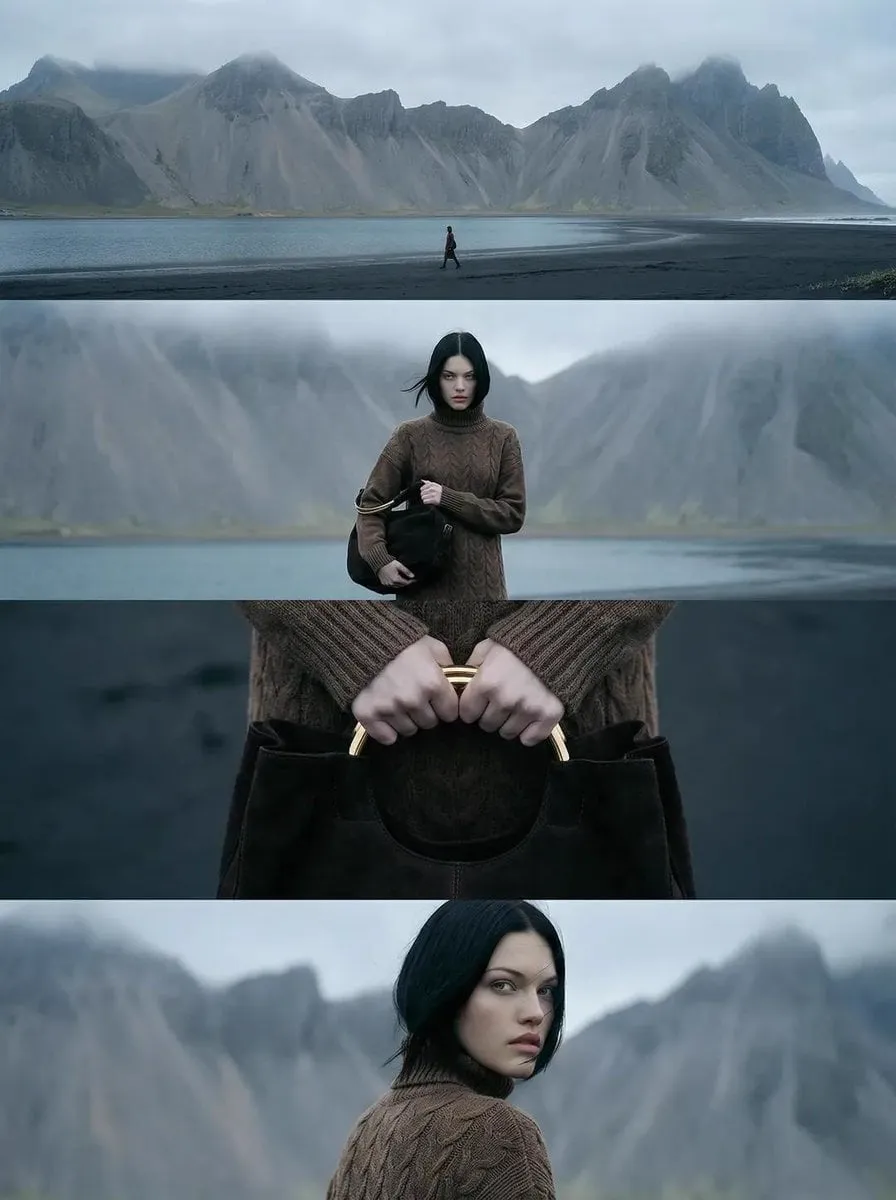
Cinematic scripts describe what the camera can see and hear. Lighting, movement, texture, silence. Lines like "she is sad" are unusable downstream. "She stands in the doorway; the kitchen light behind her is the only source, her face half in shadow" gives a director, a storyboard artist, and a video model the same information.
As a working rule: every scene heading should carry at least one sensory or visual constraint. It costs nothing at the script stage and saves enormous rework later.
Build a Story Bible Before You Generate Anything
A story bible is the single source of truth that keeps a film from drifting. When you generate images or clips separately, drift is the default state — characters change faces, jackets change colour, rooms change layout. The bible is your defence.
Look references and tone rules
Collect eight to twelve reference images. Label them by function: key light reference, colour palette, texture, composition, costume. Then write three tone rules in plain language — for example, "no camera movement faster than a slow push," "practical sources only, no unmotivated light," "all interiors are warm; all exteriors are desaturated."
Character sheets that survive across shots
For each principal character, record: age range, build, hair, wardrobe (including a single distinguishing accessory), posture, and resting expression. The accessory matters more than you think — a scar, a ring, or a ribbon is a continuity anchor that reads instantly in a small frame and helps image and video tools hold identity across shots.
Locations, props, and continuity anchors
List every location with its time-of-day variants and the fixed geometry you must not violate: where the window is, which side the door opens, what colour the counter is. Then list props that change state across the film — a phone battery, a cigarette, a bandage — and track them scene by scene.
The Iterative Drafting Loop, Step by Step
This is the core workflow. It is deliberately sequential: each step reduces ambiguity for the next one.
Step 1 — Constrain the premise
State four things: genre, runtime, shooting or rendering constraint, and the emotional effect you want on the audience. Example: "neo-noir, six minutes, single apartment location, ends with unease rather than resolution." Constraints are generative. They eliminate the infinite blank page problem.
Step 2 — Expand beats, not pages
Give your AI partner the premise and the beat sheet, and ask for five alternative beat structures. Do not ask for a script yet. You are shopping for shape. Read them, steal the strongest two turns, and discard the rest. Combine manually — hybrid structures are almost always stronger than any single generated one.
Step 3 — Write dialogue last
Dialogue is where AI output is most recognisable and most generic. Write the scene in action first, with no speech at all, and check whether it still works. If it does, add dialogue only where it carries information the visuals cannot. Short films are usually better with less talking than the first draft suggests.
Step 4 — Convert scenes into shot lists
For each scene, list shots in order: establishing, coverage, inserts, transitions. Mark which shots are essential and which are optional. In a generated-video pipeline, the optional list is your buffer when a shot refuses to render convincingly.
Step 5 — Run a continuity pass
Read the whole script backwards, one scene at a time, checking props, wardrobe, time of day, and emotional progression. Backwards reading exposes gaps that forwards reading glosses over because your brain fills them in.
Translating Script Beats into Video Prompts
A shot's prompt is a compressed version of the script's visual instruction. If the script did its job, the prompt almost writes itself.
The shot description template
Use a fixed order so nothing gets forgotten:
- Subject and action — who, doing what, in one clause.
- Shot size and angle — wide, medium, close, low angle, over-the-shoulder.
- Camera movement — static, slow push, handheld drift, crane down.
- Lighting — source, direction, quality (hard, soft, practical).
- Lens and depth — wide with deep focus, long lens with compressed background.
- Environment and atmosphere — weather, haze, dust, time of day.
- Mood and grade — cool desaturated, warm amber, high contrast.
Consistency in this order does two things: it makes prompts comparable across shots, and it makes inconsistencies obvious when you read a full sequence side by side.
Camera, light, and lens vocabulary
Learn twenty terms and use them precisely. Camera: static, push in, pull out, pan, tilt, track, crane, handheld. Light: key, fill, backlight, rim, practical, motivated, hard, soft, bounced. Lens: wide, normal, long, macro, shallow depth of field, deep focus. Vague language produces vague motion; precise language produces repeatable results.
Failure modes to watch for
- Shot-to-shot drift: the same character reads as a different person. Fix by locking wardrobe and a distinguishing feature into every prompt.
- Motion soup: too many simultaneous movements — pushing in while panning while a subject walks. One primary camera move per shot.
- Literal-minded output: prompts describing emotion rather than visible behaviour. Describe the body, not the feeling.
- Overstuffed frames: three subjects, two actions, and a complex background. Simplify to one idea per shot.
Matching Tools to Stages of the Pipeline
Different stages need different strengths. Pick per task rather than committing to one tool for everything.
| Stage | What you need | What to look for |
|---|---|---|
| Structure and beats | Reasoning over narrative logic | Long-context models that hold a whole outline |
| Dialogue polish | Ear for rhythm and subtext | Models that can mimic a supplied voice sample |
| Look development | Consistent stills | Image tools with reference-image conditioning |
| Motion tests | Physical believability | Video tools with camera-control parameters |
| Voice | Performance, not narration | TTS with pacing and emotion controls |
| Assembly | Rhythm | Any editor that supports markers and proxies |
Run a small test before committing: same character, same location, three different shots. If identity holds across all three, the tool is viable for your film. If it does not, no amount of prompting will rescue a twenty-shot sequence.
Assembling the Cut: Sound, Pacing, and Color
Generated footage rarely cuts together on its own. Three passes fix most of it.
Pass one — structure. Cut for story only. Ignore colour and audio. Remove any shot that does not advance or complicate. Short films are almost never too short.
Pass two — rhythm. Tighten every shot by ten to twenty percent. Set cuts on motion, on breath, or on sound. Where a cut feels abrupt, the problem is usually the outgoing shot being too long, not the incoming one being too short.
Pass three — cohesion. Apply a single grade across the film, unify sound with room tone under every scene, and add one recurring sonic element that ties the whole piece together. Consistency of grade and ambience is what makes disparate shots feel like one film.
Mistakes That Sink AI-Assisted Short Films
Starting with visuals instead of structure. A beautiful sequence with no dramatic question is a demo reel. Structure first, always.
Chasing the tool instead of the film. New capabilities arrive constantly. If your story works, it works with whatever you have.
No written style rules. Without them, every new session restarts the aesthetic from zero, and the film looks assembled rather than directed.
Ignoring sound design. More than half of perceived production value lives in audio. Poor sound makes good images look cheap; strong sound makes modest images look expensive.
Skipping the continuity pass. Small errors — a jacket changing colour, a window switching sides — break immersion faster than any technical flaw.
A Practical Production Week
- Day one: premise, logline, dramatic question, beat sheet.
- Day two: story bible, look references, tone rules, character sheets.
- Day three: scene pass in action only; dialogue where necessary.
- Day four: shot list, prompt library, tool tests.
- Day five: generate principal sequences; regenerate only the failures.
- Day six: edit passes, sound design, grade.
- Day seven: watch with someone who has no context, take notes, make one final trim.
Frequently Asked Questions
Do I still need to write anything myself?
Yes, and the parts that matter most: the dramatic question, the turn, and the ending image. Those three decisions determine whether the film works. Everything else can be drafted, expanded, or polished collaboratively.
How long should a short film script be?
Roughly one page per minute in standard screenplay format, so five to fifteen pages for most shorts. In a generated-video pipeline, budget by shot count instead — twenty to forty shots is a realistic range for a strong five-minute piece.
How do I keep characters looking consistent?
Lock three things and repeat them verbatim in every prompt: wardrobe, a distinguishing physical detail, and the lighting setup. Add one reference image per character and reuse it rather than describing the face in prose.
Can AI write a script without a beat sheet?
It can, but the result usually drifts toward generic structure and tidy resolutions. A beat sheet is the cheapest way to keep authorship in your hands.
How many versions should I generate?
Three to five per stage is the useful range. Beyond that, you are no longer choosing between ideas — you are avoiding a decision. Set a hard limit and move to the next stage.
What if my best shots do not fit the script?
Keep them, then rewrite the script around them. A great shot is evidence of what the film actually wants to be. Adjust the plan rather than discarding the material.
Final Checklist Before You Render
Confirm that your logline fits in one sentence, your beat sheet has a clear turn, every scene heading carries a visual constraint, each principal character has a locked wardrobe anchor, every location has fixed geometry, your shot list marks essentials versus buffers, and your prompt template is applied identically across the whole sequence. When all seven are true, production becomes a matter of execution rather than guesswork — and that is the difference between an AI-assisted short film that impresses and one that merely exists.
