
What an AI Director Assistant Actually Does
An AI director assistant sits between your creative intent and the generative tools that produce the final footage. Instead of simply turning a text prompt into a clip, it behaves like a virtual collaborator with a working knowledge of cinematography: framing, lens choice, blocking, coverage, continuity, and pacing. You describe a scene, and the assistant helps you decide how that scene should be shot before any pixels are rendered.
That distinction matters. A raw video generator answers the question "what does this look like?" An AI director assistant answers "how should this be filmed, from which angle, with what lens, in what order, and why?" The result is not just a prettier clip but a coherent sequence of shots that can be edited together into something that feels directed rather than assembled.
In practice, these assistants typically handle several layers of the job:
- Shot interpretation. They read your script, outline, or scene description and break it into discrete shots with suggested framing and duration.
- Composition guidance. They apply classical composition principles — rule of thirds, leading lines, headroom, negative space — automatically or as editable suggestions.
- Technical recommendations. They suggest aspect ratios, lens lengths, camera movement, and lighting descriptions that match the mood of the scene.
- Generation orchestration. They translate directorial decisions into prompts that image and video models can actually follow, then queue the renders.
Think of it as pre-production compressed into an iterative loop. What used to require a director, a cinematographer, and a storyboard artist brainstorming over printed frames can now happen in minutes, with the human still making every meaningful creative call.
Why Shot Design Is the New Creative Bottleneck
Generative video models have become astonishingly good at producing attractive single images and short clips. The bottleneck has shifted. Most creators no longer struggle to make something; they struggle to make something that hangs together as a film, an ad, or a narrative sequence.
Three forces explain this shift:
Demand for volume. Marketing teams, solo creators, and independent filmmakers all face pressure to publish more visual content, faster. When you need thirty shots instead of three, ad-hoc prompting breaks down. You need a system.
The coherence problem. A montage of beautiful clips that do not match in tone, lens language, or lighting reads as AI-generated immediately. Viewers forgive imperfect images; they do not forgive incoherent storytelling.
The skill gap. Many people using AI video tools have never studied cinematography. They know what looks good when they see it but lack the vocabulary to request it. An AI director assistant bridges that gap by converting intent like "tense confrontation" into concrete choices like "tight over-the-shoulder framing, shallow depth of field, low-key lighting, slight handheld shake."
This is why shot design — not raw generation — is where modern AI video workflows are won or lost. The teams that treat the assistant as a directing partner, rather than a fancy prompt generator, consistently produce work that holds up in a timeline.
Pre-Production: From Script to Shot List with AI
The most valuable phase for an AI director assistant is pre-production, before you spend significant time or rendering resources. Here is how a typical script-to-shot-list pass works.
Step 1: Feed the narrative, not just a prompt
Give the assistant the scene in narrative form — a script excerpt, a beat sheet, even a paragraph of intent like "a lone traveler reaches a valley at dawn; relief, then unease." Narrative input lets the assistant infer emotional arcs, which drive shot selection far better than visual descriptions alone.
Step 2: Let it propose coverage
A good assistant will respond with proposed coverage: a wide establishing shot to set geography, a medium to introduce the subject, inserts for detail, and close-ups for emotional beats. Review these suggestions the way you would a cinematographer's first treatment. Ask: does each shot earn its place? Is there redundant coverage? Is the emotional peak actually a close-up, or buried in a wide?
Step 3: Lock the shot list
Convert accepted suggestions into a structured shot list. For each shot, record:
- Shot size (extreme wide, wide, medium, close-up, insert)
- Camera angle and height (eye level, low, high, overhead, Dutch)
- Lens feel (wide 18–24mm, normal 35–50mm, telephoto 85mm+)
- Movement (static, pan, tilt, dolly, handheld, drone)
- Lighting and time of day
- Duration estimate
- The generation prompt derived from all of the above
This document becomes your single source of truth. When a shot fails in generation, you revise the list, not your memory. When a client asks for changes, you edit a row instead of re-prompting from scratch.
Step 4: Storyboard cheaply before rendering
Many workflows benefit from generating still-frame storyboards first — low-cost image renders of each planned shot — before committing to video generation. Reviewing twelve stills takes seconds; reviewing twelve video clips takes minutes and burns far more resources. Only promote shots to video once the storyboard reads well as a sequence.
Composition Intelligence: Applying Cinematography Principles Automatically
The core technical value of an AI director assistant is composition intelligence: the automatic application of principles that human cinematographers train for years to internalize.
Framing and balance. The assistant can place subjects on third-lines, balance foreground and background elements, and manage headroom so close-ups do not feel cramped or floaty. In prompting terms, this means phrases like "subject positioned on the left third, expansive negative space to the right" become default rather than afterthought.
Depth construction. Flat AI images are a common giveaway of amateur work. A director assistant encourages layered compositions — foreground occlusion, mid-ground subject, background context — and writes prompts that request "foreground branch framing the frame," "shallow depth of field separating subject from background," and similar depth cues.
Lens language. Different stories demand different lens feels. An intimate drama lives at 35–50mm with shallow focus; an action chase benefits from longer telephoto compression; a sweeping landscape wants ultra-wide geometry. The assistant maps your scene's emotional register to lens choices and encodes them consistently across the sequence.
Motivated lighting. Rather than the generic "cinematic lighting" that plagues AI prompts, a directing-oriented assistant proposes motivated sources: "hard afternoon sun from camera left casting long shadows," "cool practical neon from below." Motivated light is what makes generated frames feel like they exist in a physical world.
Shot-to-shot grammar. Beyond single frames, the assistant enforces continuity grammar: matching eyelines across a conversation, varying shot sizes between cuts (avoiding jump-cut-inducing similar framings), and preserving screen direction so movement flows logically. This sequence-level thinking is what separates a real director assistant from a prompt enhancer.
You should still exercise editorial judgment. Composition rules are defaults, not laws — a deliberately centered, symmetrical frame can be more powerful than a rule-of-thirds crop when the story calls for formality or unease. The best workflow treats the assistant's suggestions as a professional first pass that you accept, override, or push against with intent.
Choosing the Right Generative Model for Each Shot
No single video or image model is best at everything. Part of directing with AI is matching each shot in your list to the model most capable of executing it. A thoughtful assistant streamlines this decision, but you should understand the criteria yourself.
Match model strengths to shot requirements
Consider the common categories of shots and what they demand:
- Photorealistic establishing shots need models with strong realism, fine texture rendering, and reliable handling of natural light. Models in the Flux family and comparable high-fidelity systems excel here, as do text-to-video systems known for realistic b-roll.
- Complex physics and motion — water, cloth, crowds, camera moves through space — favor advanced video models such as Sora-class systems, which reason about temporal consistency and 3D plausibility better than earlier generations.
- Character consistency across shots is the hardest problem. Here you want platforms and models with explicit consistency features: reference-image conditioning, character locks, or LoRA-style fine-tuning. Tools associated with Runway and Kling have pushed hard on keeping a character recognizable across generated clips, and that capability should weigh heavily in your choice for any narrative project.
- Stylized or animated looks may favor specialized models over general-purpose ones. Matching the model's inherent aesthetic to your project's style guide saves enormous correction time.
- Fast iteration shots — storyboard frames, tests, drafts — should run on cheaper or faster models. Save premium generation for shots you have already approved in draft.
A decision framework
For each shot, ask four questions:
- Does this shot feature a recurring character or product that must stay identical? Prioritize consistency-capable tools.
- Is motion complexity the defining feature? Prioritize temporally strong video models.
- Is it a still composition that will be animated later? A high-quality image model plus image-to-video animation may give more control than direct text-to-video.
- How many revisions will it likely need? Route high-uncertainty shots to cheap fast models first.
Documenting these choices in the shot list keeps the whole sequence coherent. Mixing drastically different model aesthetics within one scene is a fast route to an inconsistent final cut.
Directing Camera Movement and Blocking in Prompts
Camera movement is where AI video most often goes wrong, and where directorial input pays off most. Vague prompts produce drifting, weightless motion. Precise, physically motivated instructions produce shots that feel filmed.
Specify movement with intent
Instead of "camera moves through the scene," direct it: "slow dolly-in from a low angle, accelerating slightly in the final second," or "handheld tracking shot following the subject from behind at walking pace, natural micro-shake." Each movement should have a narrative reason — dolly-ins for revelation, lateral tracks for pursuit or parallel action, cranes for scale, static frames for stability and tension.
Block your subjects explicitly
Blocking means deciding where subjects are and how they move within the frame. State it plainly: "the woman enters frame left, walks to the window, pauses, turns her head toward camera." Generative models handle multi-beat blocking imperfectly, so keep movements to one or two beats per generation and stitch longer actions from multiple shots.
Respect motion budgets
Current video models generate clips of a few seconds. Design within that constraint: plan shots as short, purposeful units, and use your edit — not the generation — to create longer continuous actions. Professional AI films are almost always assembled from many short, controlled takes rather than few long, uncontrollable ones.
Use start and end frames where available
Image-to-video workflows that let you supply a first frame (and sometimes a last frame) turn camera direction from suggestion into specification. Compose your keyframes with an image model first, then instruct the video model on how to travel between them. This hybrid approach is currently the most reliable way to get exactly the move you designed.
Maintaining Character and Scene Consistency
Consistency is the make-or-break factor for narrative AI video. Viewers will accept stylization but not a protagonist whose face changes between shots. Build consistency into the process from day one.
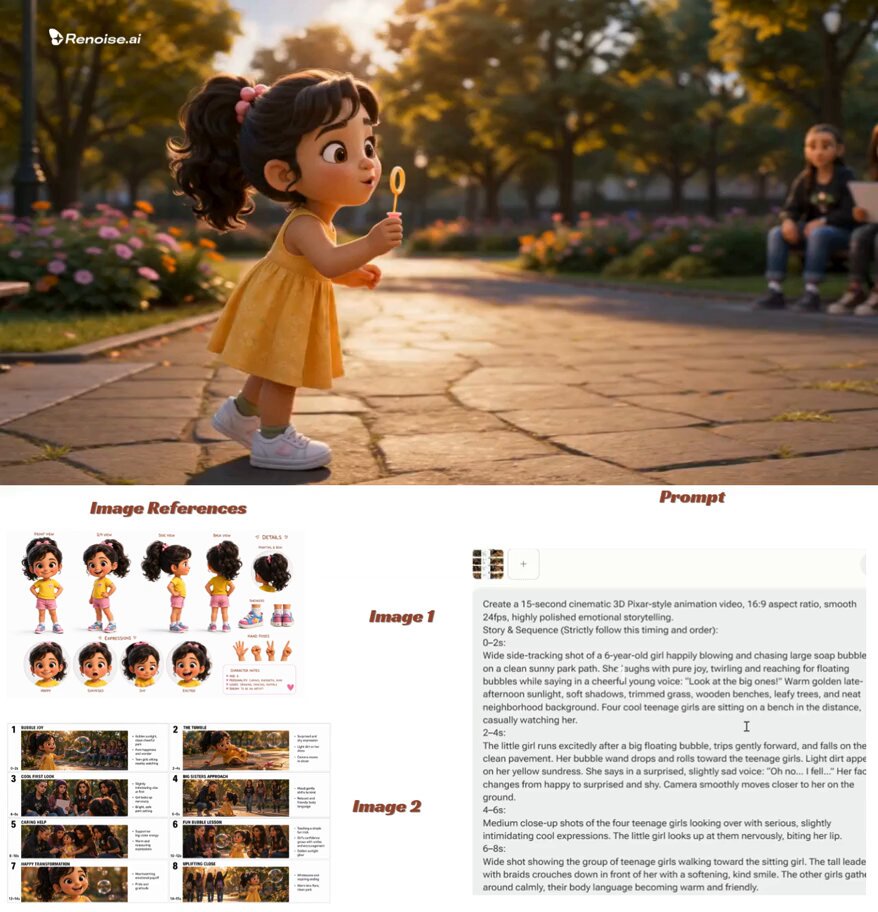
Create a character sheet before generating scenes. Generate a set of canonical reference images of your character from multiple angles, in their core wardrobe, under neutral light. Lock these as your reference assets. Most serious platforms now support reference-image conditioning; some let you train lightweight adapters (LoRAs) that encode a specific character or style. Whichever mechanism you use, always generate from the same canonical references rather than re-describing the character in text.
Standardize the world alongside the character. Consistency problems are not limited to people. Lock your location descriptors, color palette, lighting philosophy, and time of day in a written style block that is prepended to every prompt. If scene three happens at golden hour, every prompt for scene three should contain the same golden-hour language — not "warm lighting" in one prompt and "sunset glow" in another, which models may interpret differently.
Grade in post, not in prompt. Rather than asking each generation to match a color grade precisely, generate neutrally and apply a unified grade across all shots in editing. A shared LUT or color treatment hides minor model-to-model discrepancies better than prompt-level adjectives ever will.
Plan pickups. Even with perfect discipline, some shots will drift. Keep your character references, style block, and shot list organized so regenerating a replacement shot is a five-minute task rather than an afternoon of archaeology.
A Practical End-to-End Workflow
Here is a condensed workflow you can adopt immediately, whether you are producing a thirty-second ad or a short film.
- Write the scene intent. One paragraph per scene: who, where, what changes emotionally. No visual language yet.
- Generate the shot list. Run the intent through your AI director assistant to produce coverage: shot sizes, angles, movements, durations. Edit the list by hand — cut redundant shots, escalate the emotional peak.
- Define the visual bible. One short document: character reference images, palette, lens philosophy, lighting rules, aspect ratio. Every prompt will inherit from this.
- Storyboard as stills. Render every shot as a still frame using a fast, cheap image model. Review the storyboard as a sequence in your editor, timed to rough durations. Rearrange, cut, and re-render stills until the sequence reads.
- Promote to video selectively. For each approved still, choose the video model by the criteria above and generate the motion — using start frames, explicit movement language, and one or two blocking beats per clip.
- Assemble a radio cut first. Edit with placeholder video against your final audio, music, or voiceover. Timing problems are cheaper to fix here than after final renders.
- Unify in post. Apply one color grade, consistent sharpening, and a sound design pass. Sound is half of perceived production value and costs almost nothing to add.
- Log your prompts. Keep the final prompt for every accepted shot in your shot list. Future episodes, revisions, and pickups will thank you.
Creators working at scale should also think about queueing and automation. Platforms built on structured task queues — the pattern popularized by modern AI video backends — let you submit batches of shots, monitor render progress, and retry failures without babysitting. If you regularly produce sequences of more than ten shots, batch submission and a visible render queue will save hours per project.
Common Mistakes When Directing AI Shots
Even experienced creators fall into predictable traps. Avoid these and your output quality will jump immediately.
Prompting images instead of directing shots. "Beautiful cinematic landscape, dramatic lighting, 8K" is an image prompt. A shot prompt includes framing, angle, lens, movement, blocking, and narrative purpose. If your prompt could describe a poster, it will not direct a scene.
Skipping the storyboard stage. Rendering video before the sequence reads as stills wastes resources and locks you into bad timing. Stills are cheap and fast; treat them as mandatory.
Ignoring continuity grammar. Cutting from a left-facing close-up to a left-facing close-up of the same size creates jarring jump cuts. Vary shot sizes, respect eyelines, and maintain screen direction across your list.
Overloading single generations. Asking one clip for three character actions, a camera move, and a lighting change produces mush. One clear idea per generation; combine complexity in the edit.
Neglecting audio. Silent AI footage always feels incomplete. Music, ambient sound, and foley transform generated clips into scenes. Budget time for it.
Chasing one perfect generation. The professional mindset is coverage, not lottery tickets. Generate three takes of an important shot, choose in the edit, and move on. Perfectionism per shot kills project momentum.
Frequently Asked Questions
Do I need filmmaking experience to use an AI director assistant? No, but basic literacy in shot sizes and camera movement helps you evaluate suggestions. The assistant supplies vocabulary you lack; your taste decides what stays.
Can AI-directed shots replace live-action footage? For many use cases — ads, social content, concept films, previsualization — yes. For projects requiring specific real performances or products, AI shots work best as previsualization, inserts, or stylized sequences alongside live action.
How long does a full shot-designed sequence take to produce? A practiced creator can take a one-page scene from intent to edited, graded sequence in a day. The storyboard pass is usually under an hour; video generation and revision take the remainder.
What is the single highest-leverage habit to adopt? Write and maintain a real shot list. Nearly every AI video failure traces back to improvised, shot-by-shot prompting instead of planned, sequenced direction.
Which tools should a beginner stack? Start with one platform that offers a director-assistant layer, strong image generation for storyboards, at least one high-realism video model, and one consistency-capable model for characters. Add specialized tools only when a specific shot demands them.
An AI director assistant does not replace the director in you — it removes the translation layer between your imagination and the machine. Learn to think in shots, let the assistant handle the technical encoding, and the gap between what you envision and what you publish shrinks with every project.
