
Film and video production are at a turning point. For most of the industry's history, a cinematic image was the product of expensive cameras, skilled crews, and patient post-production. That model still exists, but it is no longer the only path. Generative AI has opened a second path where a single creator can describe a scene in text, refine it with references, and watch it become motion footage in minutes. This is not a distant fantasy; it is the current reality of production. The cinematography of the future is being built now, and understanding how it works is the difference between being displaced by it and directing it.
The Production Landscape Is Shifting
The economics of film production are changing faster than most studios want to admit. Complex CGI used to require millions in budget and months of render time. Today, text-to-video and image-to-video pipelines can produce usable moving images from a prompt in a fraction of that time and cost. The shift is not about replacing the entire film industry overnight. It is about making the early stages of production dramatically cheaper, which changes who gets to make films and how quickly ideas can be tested.
The market data points in one direction. Spending on AI in media and entertainment is growing at a compound rate that outpaces most other production costs, and the adoption is no longer limited to tech companies. Independent creators, marketing teams, and even traditional studios are building generative steps into their workflows. The practical consequence is that a filmmaker can now validate a visual idea before committing a single dollar to a location scout or a camera rental. That changes the risk profile of the entire creative process.
The Architecture Behind AI Film Production
The core of modern AI film production is not a single magic model. It is an architecture made of modular pieces that work together. Understanding that architecture helps you make better decisions about which tools to use and how to combine them.
A Library of Specialized Models
One general-purpose model is rarely enough. The current landscape rewards a library of specialized tools, because different shots demand different strengths. A photorealistic model excels at live-action style footage, while an anime model handles stylized characters, and a physics-aware model manages complex motion. The same scene can be generated with several models and the results compared for the mood, style, and level of control you need. The winning workflow treats model selection as a creative decision, not a technical afterthought.
Compute Management and Render Queues
Generative video is computationally expensive. Behind every prompt is a GPU farm, and how that compute is managed determines whether your project takes minutes or hours. Production systems handle this with task queues: jobs are submitted, prioritized, and distributed across available resources. For a solo creator, this shows up as render time and queuing. For a studio, it shows up as capacity planning. The practical lesson is to batch your generation work, run the heavy jobs during off-peak hours, and always keep the next prompt ready while the current one renders.
Keeping Scenes Consistent: Keyframes and Fusion
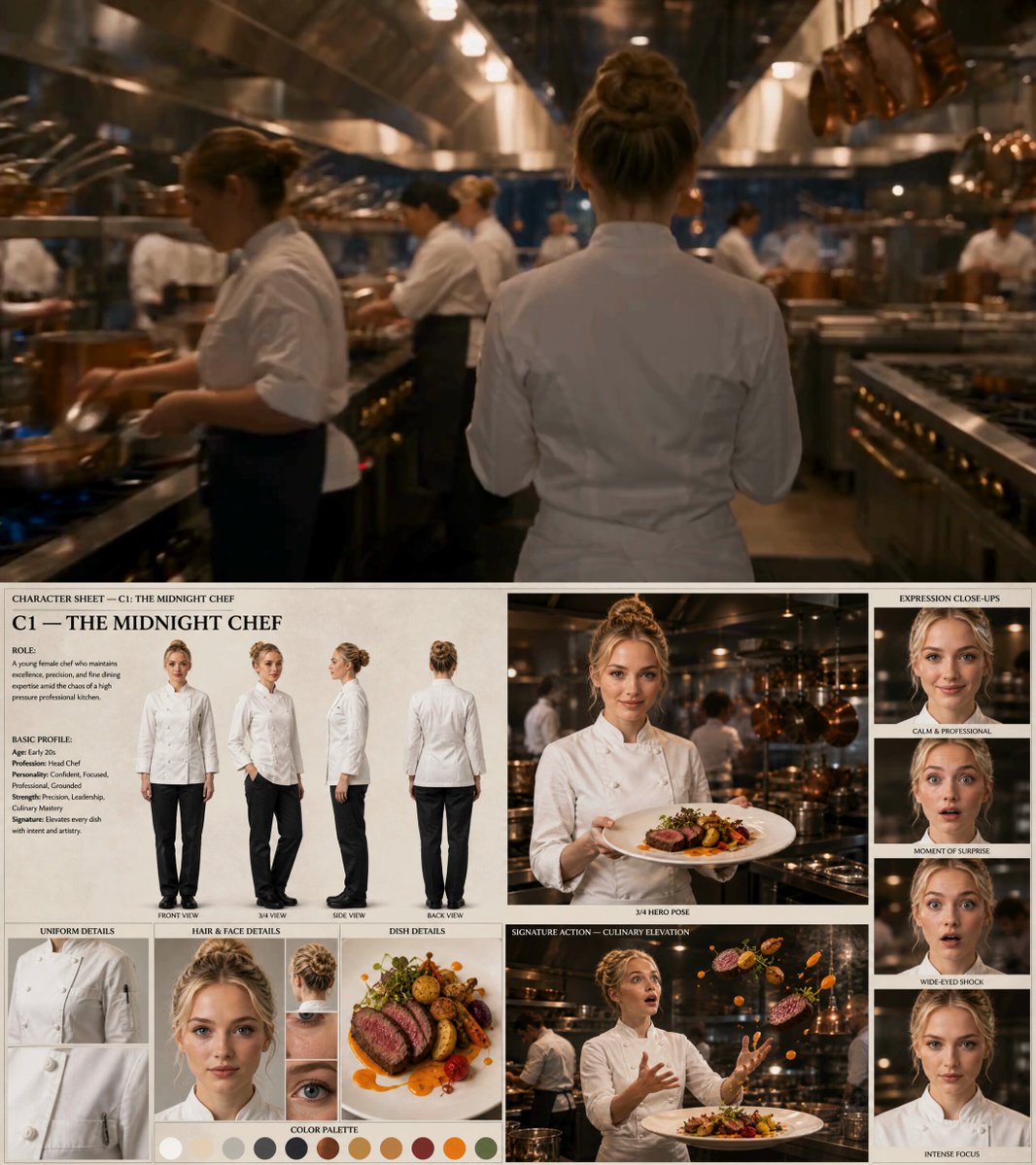
The oldest problem in generative video is consistency. Generate one shot of a character and it looks right. Generate a second shot and the character has a different face, costume, or skin tone. The solution that works today is keyframe fusion: you lock the first and last frames of a shot, or feed reference images of the character into the model, so that the animation between the keyframes stays on target. This is the difference between a lucky sequence of images and a film where the audience believes the same person walked from one scene to the next.
From Concept to Commercial Video: A Workflow
A practical workflow connects the architecture to a finished product. It usually looks like this.
Start with a written treatment: the story, the mood, and the key visual moments. This is the blueprint that every prompt will reference. Next, create a visual reference board. Collect images that define the character, the lighting, and the world. These references become the input for the generative models, grounding every shot in the same visual language.
Then generate the keyframes. For each shot, produce the first frame and the last frame, and approve them before animating anything. This is where most of the creative control lives; if the keyframes are wrong, the motion will be wrong too. After the keyframes are approved, run the motion generation, review the result, and iterate on the specific frames that failed. Finally, assemble the shots in an editor, add sound, and grade the result. The whole loop is fast enough that you can explore three completely different visual approaches in a single afternoon.
The workflow is not finished when the shots are rendered. Assembly, sound, and finishing still matter as much as they ever did. Generative footage needs the same editorial discipline as any footage: the right shot at the right length, a sound design that supports the image, and a grade that unifies the palette across shots generated by different models. The mistake is to treat the AI output as finished. It is raw material, excellent raw material, but raw material nonetheless. The finishing pass is where a sequence of impressive clips becomes a film.
The AI Director: When the Tool Suggests the Shot
The most interesting development in AI film production is not better pixels; it is the emergence of the AI agent director. This is a layer of software that acts less like a render engine and more like a creative collaborator. Give it a scene description and it can suggest shot compositions, camera angles, and narrative structure. It can translate a director's intent into concrete cinematic recommendations, and it can iterate with you on the framing until the shot matches your vision.
The value is not that the tool replaces the director. It is that the tool externalizes cinematic knowledge. A new creator can ask for a close-up that builds tension and receive a composition that actually does that, learning the principles of cinematography through practice. A seasoned director can use the same tool to generate options quickly and then apply taste to select among them. The agent director is best understood as an accelerator of the creative conversation, not a replacement for the person having it.
The New Economy: Custom Models and AIGC Creators
Beyond the craft of making films, AI is reshaping who owns the means of production. The most visible sign is the rise of custom models. A creator can train a model on their own character designs, product, or art style, and then use that model across every shot. This is how brands keep their identity consistent across AI-generated campaigns, and how animators protect their visual signature.
The same capability creates a market. Custom models can be published, shared, and licensed, turning a stylistic asset into a revenue stream. Independent creators who build a recognizable AI aesthetic can monetize it directly, either by licensing the model or by producing commissioned work faster than traditional pipelines allow. This is the seed of a genuine creator economy for generative media, where the scarce resource is not compute but taste, consistency, and audience.
The shift also changes distribution. A creator with a strong custom model can produce a consistent series, a trailer, a lookbook, and a social campaign from the same visual asset, and each piece reinforces the others. The model becomes the studio; the creator becomes the brand. This is why the most forward-looking filmmakers are investing in their own models early, while the cost of training is still falling, rather than waiting for the trend to mature.
What This Means for Directors and Studios
For directors, the shift changes the skills that matter. The craft of framing, lighting, and pacing remains essential, but it is now expressed through prompts, references, and review workflows rather than only through camera operations. Directors who understand cinematic fundamentals will produce dramatically better AI work than those who do not, because the fundamentals are what the models cannot infer for you.
For studios, the opportunity is in restructuring production. Pre-visualization, concept testing, and iteration become cheap enough to do continuously. The teams that adapt will shorten their development cycles and de-risk their investments. The teams that resist will find their competitors shipping more creative, more varied work at a fraction of the cost. The technology does not force a choice, but the market eventually does.
The Human Pass: Why Review Still Matters
Generative tools are fast, but they are not tasteful by default. The shots that look spectacular in isolation can fail in sequence: a character who drifts subtly between scenes, a light source that changes direction, a gesture that reads wrong in context. Review is the part of the workflow that protects the audience's belief in the world you built, and it cannot be delegated to the model.
The human pass is the discipline of watching the assembled cut as an audience member and fixing what breaks the illusion. Build review into the workflow deliberately. After each batch of generations, watch the shots in order, not as separate clips. Check three things: continuity of character and setting, consistency of light and color, and rhythm of the edit. Keep the reference sheets and keyframes at hand, because most continuity fixes mean regenerating with a stronger reference, not patching in post.
The second part of the human pass is editorial judgment. Generative tools can produce dozens of versions of a shot; they cannot tell you which one belongs in the story. Selecting the take that serves the narrative, cutting for rhythm, and knowing when to stop iterating are human decisions. The teams that produce the best AI films are not the ones that generate the most; they are the ones that select the best. Finally, keep the audience in mind. A film is not a tech demo. If a shot exists only to show what the tool can do, it probably does not belong in the film. Every frame should earn its place through story value. The human pass is what keeps generative abundance from becoming creative noise.
FAQ
Will AI eliminate traditional film crews? Not soon, and not entirely. Physical production, performance capture, location work, and sound recording still require human presence and judgment. What changes is the balance: more of the visual exploration happens before the shoot, and more post-production work can be generated rather than built manually.
How do I keep characters consistent across shots? Use reference images and keyframe fusion. Lock the character's appearance in a reference sheet, feed it to the model for every shot, and review the keyframes before generating motion. If a shot drifts, regenerate that shot with a stronger reference rather than fixing it in post.
What hardware do I need to start? For using existing services, a mid-range laptop and a browser are enough. For local generation, you will want a GPU with substantial memory. Start with cloud-based tools and only invest in local hardware when your workflow demands it.
Is AI-generated footage safe for commercial use? Depends on the tool's license and the source material you feed it. Generated output is generally usable, but train your models only on material you own or have rights to, and check the commercial terms of every service you use.
How long does a one-minute AI film take? With a clear treatment and references, a rough cut can be assembled in a day. Polishing, sound, and color can take several more days. The bottleneck is rarely generation speed; it is the number of iterations needed to match the vision.
Can I use AI-generated footage in a paid commission? Yes, but check the license of the models and services you used, and be transparent with the client about the production method. Some clients have policies about AI content, and some markets require disclosure. Clarify expectations before the project starts.
What skills should I learn to stay relevant? Storytelling, editing, and cinematic fundamentals matter more than ever. The models handle rendering; you handle direction, selection, and narrative. Learn to communicate visual intent precisely, whether through prompts, references, or shot lists.
Conclusion
AI is not the end of cinematography; it is the expansion of who gets to practice it. The future of film production combines a library of specialized models, disciplined consistency through keyframes, and an intelligent directing layer that turns taste into shots. The economics shift in favor of iteration, the creator economy grows around custom models, and the craft itself moves from camera operation to visual direction. The filmmakers who thrive will be the ones who treat AI as a partner in the creative process, keeping the fundamentals of storytelling and image-making at the center while the tools handle the repetition.
