

Short-form video is the most demanding format in content creation right now. Audiences decide within the first two seconds whether to keep watching, platforms reward consistency over occasional hits, and creators who want to grow need to publish frequently. That combination — high frequency plus high quality — is exactly where traditional production breaks down. Filming, editing, and finishing a polished video every day is simply not feasible with conventional methods.
AI video generation changes the math. It compresses the production pipeline from days to minutes, which makes daily publishing realistic. But speed alone is not enough. A channel that posts ten mediocre clips a day still loses to a channel that posts three great ones. The real skill in 2025 is building a workflow that delivers both: speed where it matters and quality where the audience notices.
This guide walks through a complete, repeatable system for creating short videos with AI — from planning and generation to consistency, editing, and measurement — so you can scale output without watching quality collapse.
Why short-form video changed the production game
Short-form video is no longer a trend; it is the primary way most people consume video content. Platforms built around vertical, quick-fire clips dominate attention, and the algorithm rewards exactly one behavior: watch time. More videos, watched all the way through, equals more distribution.
For creators, this creates a brutal pressure cycle. To grow, you publish more. To publish more, you need faster production. To keep audiences, every video still needs to feel intentional — a clear hook, a payoff, and decent production values. The bottleneck is no longer ideas or creativity; it is the time and cost of turning an idea into a finished video.
This is where AI tools fit. Modern generation models can turn a script into usable footage in minutes, and image-to-video workflows give creators control over composition that early text-to-video tools lacked. The result is a production environment where a single person with a laptop can sustain the output of a small studio.
The real bottleneck: speed versus consistency
Ask any creator who has tried to scale with AI what the hardest part is, and the answer is rarely "generating the video." It is consistency. One clip looks great. The next clip, the main character looks different. The third clip, the style shifts. Before long, the channel has no visual identity, and audiences can feel it even when they cannot name it.
Consistency problems come in three forms. Character consistency: the same person or mascot looks different across videos. Style consistency: the color grade, lighting, and art direction drift between clips. Subject consistency: the product, location, or visual motif changes shape from one video to the next.
Each of these problems has a mechanical fix, but the fixes only work if they are built into the workflow from the start. Retro-fitting consistency after generating twenty clips is a nightmare. Designing it in at the beginning costs almost nothing.
A repeatable AI short-video workflow in seven steps
This workflow is designed for a solo creator or a small team producing several videos per week. Each step has a clear output, so you always know where you are and what comes next.
Step one: build a content calendar. Decide the topics for the week, not one video at a time. Batching ideas reduces decision fatigue and lets you reuse setups, characters, and style assets across multiple videos — which improves consistency by default.
Step two: write scripts in a template. Short-form scripts follow a predictable shape: hook, setup, payoff, CTA. Write the hook first and make it specific. "Here is how AI changed my workflow" is weak; "I made this video in 14 minutes with AI, here is exactly how" is strong. Keep the script between 60 and 120 words for a typical clip.
Step three: define your style anchors. Before generating anything, establish three reference points: your color palette, your lighting mood, and your on-screen character or presenter if you use one. Save these as images. Every generation in this project uses them as input.
Step four: generate with a shot list. Break the script into shots and generate one clip per shot. For each shot, prefer image-to-video with a strong reference frame over pure text-to-video. This is the single biggest quality lever in the entire workflow.
Step five: generate multiple takes. Never accept the first output. Generate three to five candidates per shot and pick the best. This sounds wasteful, but it is the cheapest insurance you can buy, and it is where the difference between "AI-looking" and "produced" content comes from.
Step six: edit for rhythm, not just correctness. Assemble the best takes, then cut aggressively. Short-form audiences forgive imperfect visuals far more than they forgive slow pacing. Trim every frame that does not serve the hook, the payoff, or the CTA.
Step seven: export with a fixed preset. Keep the same resolution, frame rate, and color settings for every video. A consistent technical baseline makes your channel feel like one body of work instead of random clips.
Choosing the right model for the job
One model does not serve every shot, and treating generation as "one tool, all videos" is the fastest way to a flat, repetitive channel. Instead, match the model to the task. Four categories cover most short-form needs.
Photoreal generation is for lifestyle, product, and talking-adjacent content where realism matters. These models handle skin, light, and physical motion well and are the default for anything that claims to show real life.
Stylized and animated generation is for explainers, character-led content, and brands with a distinct look. Stylized output also ages better and hides small generation errors that are obvious in photoreal work.
Image-to-video is the workhorse. You produce a strong keyframe with an image model, then animate it. This gives you total control over composition and details, and it is the technique behind most professional-looking AI channels.
Fast iteration models are for hooks, test shots, and b-roll. They produce quickly and cheaply, which is exactly what you want when you are testing five hook variations in an afternoon.
A practical rule: use the cheapest model that meets the quality bar for that shot, and reserve the expensive, high-detail work for the opening hook and the payoff moment — the two frames that determine whether the video succeeds.
Keeping characters and style consistent
Consistency is a system, not a hope. Three practices, applied together, keep a channel looking unified.
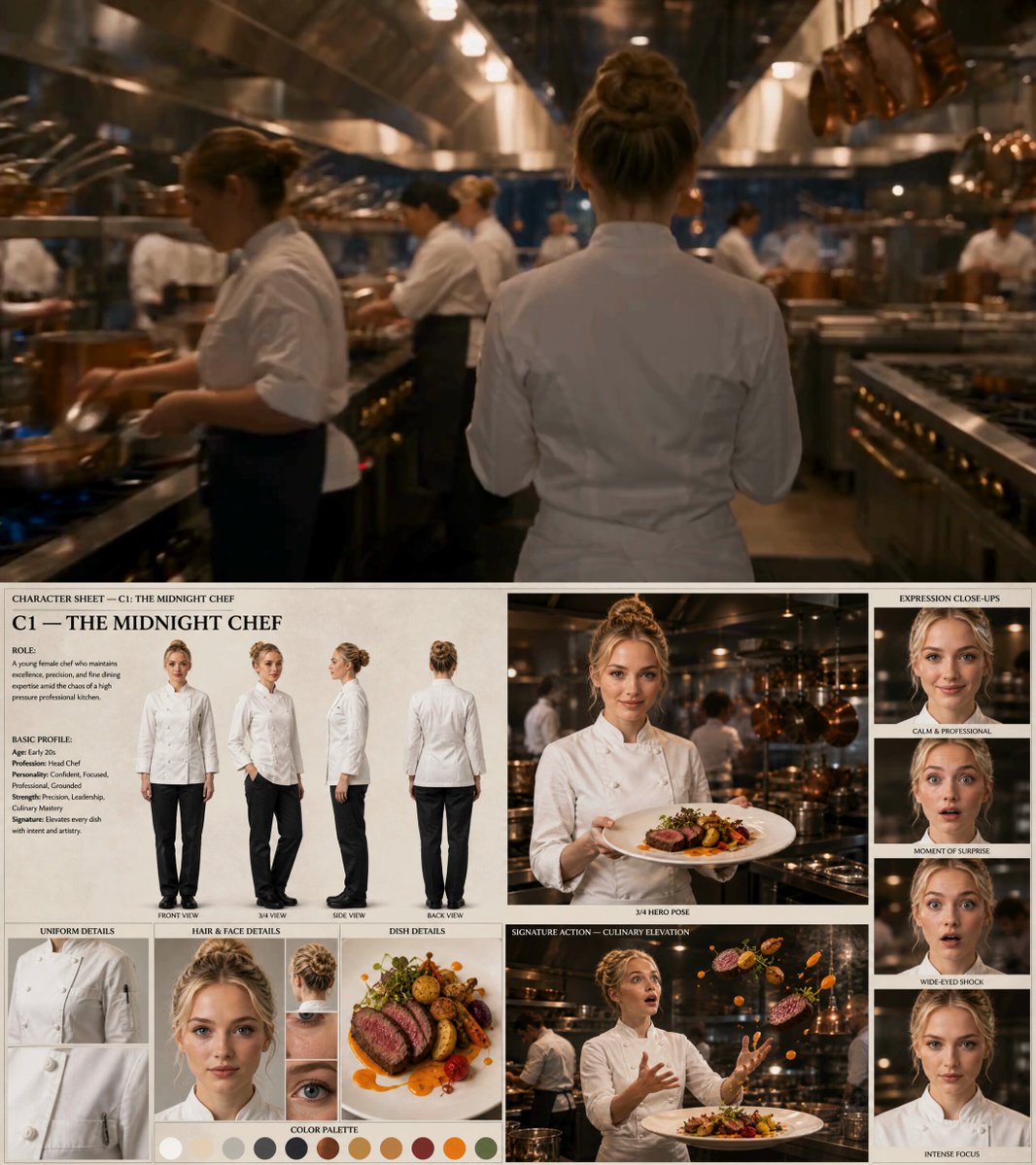
First, lock your character. If your channel has a recurring character, presenter, or mascot, create a definitive character sheet: front view, side view, full body, and close-up, all with the same features and wardrobe. Every video starts from this sheet, and every character shot uses it as a reference image.
Second, lock your world. Define the recurring locations and props with reference images too. A kitchen that appears in ten videos should look like the same kitchen every time. If your content is location-independent, define a visual signature instead — a color grade, a lighting style, or a recurring object — and carry it through every video.
Third, keep a style bible per project. A simple folder per project with your reference images, approved shots, and the prompts that produced them. When something drifts, you can diagnose it in minutes instead of guessing. When a model updates and changes its output style, the bible tells you exactly what needs to be regenerated.
Tools that fit the workflow
The tool landscape changes quickly, but the roles stay the same. You need an image generator for keyframes and anchors, a video generator for motion, and an editing tool for assembly. Most creators add a voice tool for narration and a caption tool for on-screen text.
The image generator is the most important choice because every other stage depends on its output. A good keyframe makes a good video; a mediocre keyframe makes a bad video no matter how good the motion model is.
The video generator matters most for motion quality. Test with the same prompts you actually use, not with marketing demos, and keep a personal benchmark of the results.
The editing tool should be fast. You are not cutting a feature film; you are assembling short clips under time pressure. Pick software you can operate without thinking, and automate exports with presets.
Measuring what works
Speed and quality are means, not ends. The goal is a channel that grows, which means you need feedback: which videos keep viewers, where they drop off, and what the next video should be.
Look at three numbers per video. Completion rate tells you whether the payoff matched the hook. Watch-through at the midpoint tells you whether the middle holds attention. And the ratio of followers gained per view tells you whether the audience you are attracting is the audience you want.
Use the numbers to make one change at a time. If completion is low, fix the hook. If the middle drops off, tighten the pacing. If the wrong audience is showing up, adjust the topic and the style anchors. The point of measurement is not vanity metrics; it is a feedback loop that makes the next video better than the last.
Batching: planning a week of videos in one sitting
The single biggest productivity lever in this workflow is batching. Instead of producing videos one at a time, with all the context-switching that implies, block out a few hours once a week and run the entire pipeline for multiple videos in sequence.
Here is what a weekly batch looks like in practice. On the planning day, you decide the week's topics, write all the scripts, and define the style anchors once. On the generation day, you produce keyframes for every video, then animate them shot by shot. Because all videos share the same anchors and the same prompt structures, the generation flows without rethinking the style each time. On the editing day, you assemble every video in sequence, using the same export preset.
Batching creates three compounding advantages. First, setup costs are paid once: the style anchors, the prompt templates, and the project folders are built for the whole batch, not per video. Second, quality becomes more consistent, because every video in the batch is generated under the same conditions and judged against the same references. Third, you learn faster: when all of this week's videos share a hook format, you can see clearly which format worked across the batch instead of comparing videos that have nothing in common.
The practical rule is to separate thinking from making. Never plan while you generate, and never generate while you edit. Each phase has a different mode of attention, and switching between them costs more time than most creators realize.
Common mistakes
Even experienced creators hit the same walls. The first is accepting first takes. One generation per shot is the fastest way to a mediocre channel. The second is changing style mid-project. A new model or a new color grade can feel exciting, but if it breaks continuity, it costs you more than it gains. The third is over-editing. Too many cuts, transitions, and effects make AI content look like AI content. Clean, confident assembly reads as more professional. The fourth is ignoring audio. A decent voiceover and clean background music lift the perceived quality more than any visual trick.
FAQ
How many videos can one person realistically produce per week with AI? With a batched workflow, three to five polished clips per week is realistic for a solo creator; more with experience and reusable assets. The limit is usually planning and editing time, not generation.
Do I need a visible presenter for short-form growth? No. Faceless channels work well with strong hooks, good voiceover, and consistent visuals. The key is a recognizable visual identity, not a face.
Is AI-generated content penalized by platforms? Platforms reward watch time and engagement, not the production method. AI content that people watch fully performs well; lazy, repetitive AI content performs poorly. Quality is the algorithm.
How do I avoid the "AI look" that audiences dislike? Use image-to-video with strong references, vary camera angles, edit for rhythm, and add sound design. The AI look comes from generic prompts, static compositions, and weak audio — all fixable in the workflow.
What should I start with? One channel, one content format, and one visual identity. Master the loop of planning, generating, editing, and measuring before expanding. Depth beats breadth in the first three months.
Building the habit
The workflow in this guide is not complicated, but it is a system, and systems only work when they are repeated. Set a fixed publishing schedule, batch your planning, and review your numbers weekly. Speed and quality are not opposites; they are the two sides of a workflow that is designed before you generate the first clip.
Start with one video. Not a perfect video — a complete video, made with anchors, shot lists, and multiple takes. Then make another one, and another. The consistency that grows your channel is the same consistency that grows your skill.
