
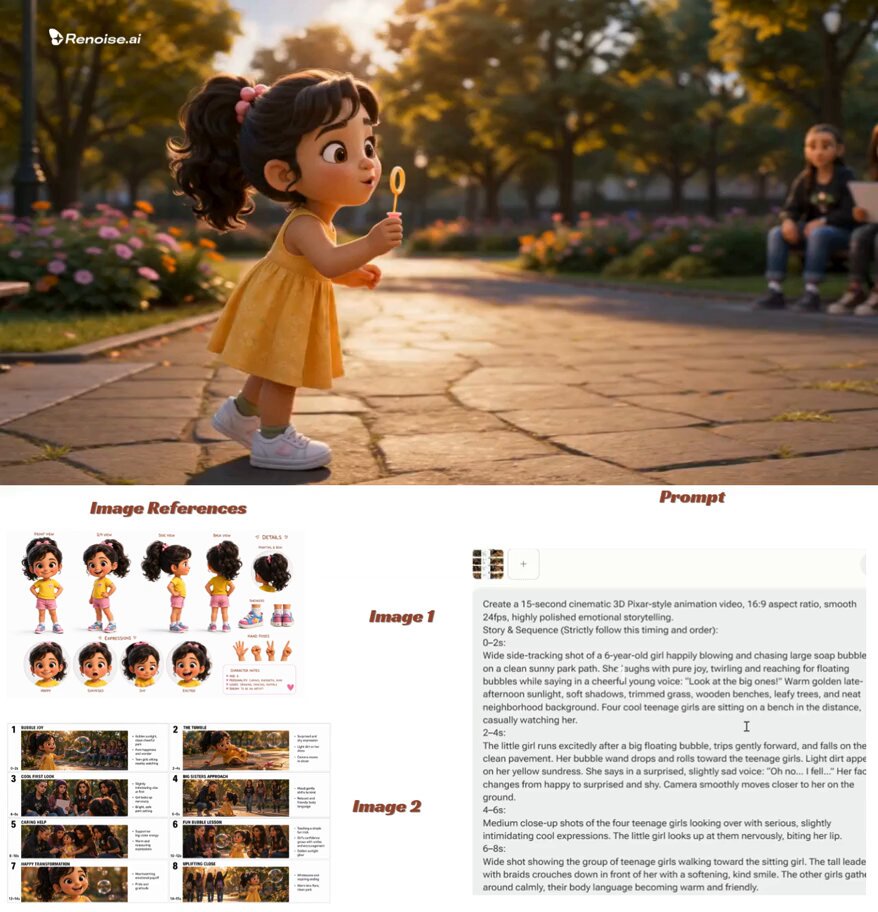
Character consistency is the problem every AI filmmaker meets in the first week. You generate a beautiful protagonist, start the next scene, and suddenly they have different eyes, a different jacket, a different nose. It is frustrating, it is expensive, and it is the single most common reason AI video still looks amateur. The good news is that consistency is not magic and not luck — it is a system. This tutorial walks through that system step by step: how to design a character so a model can actually hold on to it, how to build references, and how to keep face, wardrobe, and motion stable across an entire project.
Why Character Consistency Is the Hardest Part of AI Video
Traditional animation solved consistency with model sheets: standardized drawings that every artist copied for every frame. Generative AI needs something similar, but it cannot just look at a drawing; it needs the identity of the character encoded in a way it can reproduce.
The difficulty is that a model generates each image as a fresh problem. Nothing about a generation remembers the previous one unless you give it a bridge. Without a bridge, every scene is a first meeting with a stranger. The entire discipline of consistency is building and maintaining that bridge: reference images, stable prompts, and strict rules about what can and cannot change.
Step 1: Design the Identity Before the First Prompt
Consistency begins long before the first generation. You need to know exactly who the character is in visual terms. Write down the fixed attributes and keep them where you can reference them in every session:
- Face: bone structure, eye shape and color, nose, mouth, any scars or marks
- Body: height, build, posture
- Hair: style, color, length, and how it behaves
- Wardrobe: base outfit, colors, fabrics, accessories
- Palette: the colors that belong to this character and the ones that never appear
The rule is simple: anything not in the list can change; anything in the list cannot. If the character changes their jacket in episode three, that is a story decision you make deliberately, not a drift the model decided on its own.
Step 2: Build a Reference Set
Once the identity is defined, generate the model sheet. Produce at least three keyframes of the character in one session: a front view, a three-quarter view, and a full-body view. Use the exact same style tokens and color descriptions for all three.
Check the set for internal consistency before you use it. If the three keyframes disagree with each other, every later shot will inherit the disagreement. Regenerate until the set is stable; this is the cheapest point in the project to fix problems.
Step 3: Use Reference Fusion, Not Just Text
Text descriptions alone will not hold a character steady. The reliable method is to feed the model your keyframes as reference images and let it fuse them into a consistent identity. This is the AI equivalent of handing the animator a model sheet.
When you move to a new scene, reuse the same reference set rather than describing the character from scratch. The reference is your bridge; keep it constant and the character stays the same person.
Step 4: Lock the Face and Physical Parameters
Faces are where viewers notice drift first. Protect the face with an extra rule: every prompt that shows the character's face should include the same facial descriptors, in the same order, with the same wording. Small wording changes are a hidden cause of drift, because the model responds to phrasing, not just meaning.
For physical parameters, decide once and do not revisit: proportions, age, posture. If the character appears in a wide shot and a close-up in the same scene, both prompts must share the same physical description or the model will adjust the body between shots.
Step 5: Keep Wardrobe and Accessories Stable
Costume is a character's second face. Define the base outfit in a block of text you reuse verbatim, including fabric, fit, and colors. Accessories are easy to lose: if the character wears glasses, the prompt should mention them every time, or they will quietly disappear.
For projects where costumes change, keep a wardrobe sheet: one outfit per scene or episode, each described in its own reusable block. Swap blocks deliberately; never let the model improvise between outfits.
Step 6: Manage State Changes Deliberately
A character who is identical in every way is boring. The trick is controlling what changes. Light, camera angle, and emotion are state — they can and should vary, but they should vary with intent.
If a scene moves from daylight to dusk, say so explicitly and describe the new light. If the character goes from calm to angry, describe the expression and the physical signs. What you must not do is let state changes happen invisibly, because the viewer reads unexplained change as broken continuity.
Step 7: Maintain Temporal Coherence in Motion
Consistency in stills is step one; consistency in motion is the finish line. When characters move, the model has to hold identity while changing pose, expression, and position.
Plan motion with keyframes at the extremes: the start of the movement and the end. Shorter segments also help — a two-second clip is easier to keep consistent than a ten-second one, and you can assemble the final sequence from verified pieces. Review motion clips at full quality before rendering the whole scene.
A Repeatable Production Checklist
For every scene, run the same list:
- Reference set attached and unchanged
- Fixed attributes copied verbatim from the identity sheet
- Wardrobe block matching the scene's outfit
- State changes described explicitly
- Motion keyframes planned at extremes
- Segment length kept short enough to verify
Common Failures and Fixes
Failure: the face changes between scenes. Fix: reuse the same reference set and the same facial wording in every prompt.
Failure: the costume shifts color. Fix: lock the wardrobe block verbatim and stop describing the outfit from memory.
Failure: the character looks right in stills but breaks in motion. Fix: shorten segments and add keyframes at the extremes of the movement.
Failure: the style drifts between episodes. Fix: create a style sheet — palette, texture, lens — and apply it in every session.
Choosing the Right Tool for the Job
Consistency work happens across different tools, and each has a role. A still-image model is where the character is born: identity sheets, keyframes, and wardrobe studies are all stills work, where you can iterate cheaply. A video model is where the character lives: motion, expression, and scene work. The mistake is trying to design the character inside the video tool, where iteration is slow and expensive.
Test your pipeline before production. Generate the identity sheet in the still tool, confirm the references are stable, then run one short motion test in the video tool. If the motion test holds the identity, the pipeline works. If not, fix the references before touching the scene — never debug consistency during a deadline.
Consistency Across Episodes and Seasons
A character that holds for one scene is good; a character that holds for a season is a franchise. Long projects need their own discipline: an episode-level sheet, a style bible, and a continuity log.
The episode sheet records what changes in this episode and why — a new outfit, a new location, a time of day. The style bible holds the permanent rules: palette, lens language, texture, and the identity sheets for every recurring character. The continuity log records what was actually rendered, so you never have to guess why a scene looks the way it does. Before each new episode, review the log and update the sheets; the ten minutes spent here prevents hours of regeneration later.
Practice Project: Build One Character in Five Scenes
The fastest way to learn is a small, contained project. Design one character and put them in five different scenes: a morning kitchen, a street at noon, a subway car, a rooftop at dusk, a bedroom at night. The character's identity stays fixed; only the state changes.
For each scene, run the checklist: reference set attached, identity copied verbatim, wardrobe block correct, state changes described, motion keyframed, segment short. When the character survives all five scenes without drifting, you have the skill. Then change the character and run it again — the discipline, not the tools, is what you are training.
Beyond Characters: Keeping Worlds Consistent
The same system that holds a character together also holds a world together. Locations, vehicles, and props drift exactly the way faces do, and viewers notice. Give every recurring location a reference set and a reusable description block, just like a character: the layout, the palette, the light.
Treat props the same way. If a character always carries a specific bag, the bag needs a reference, or it will quietly change shape between scenes. Worlds with a consistent identity make characters more believable, because the environment stops distracting from the story. The investment is the same as character work — a few references and a few reusable blocks — and the payoff is the same: viewers stay in the illusion instead of being pulled out by a chair that moved.
Working with Voice and Expression
A consistent face is not enough if the character acts inconsistently. Voice and expression are part of identity too. Define how the character speaks: the vocabulary, the rhythm, the emotional range. In prompt terms, that means describing the character's behavior and mood in the same fixed vocabulary across scenes, so the model renders a person with a temperament, not just a face.
Plan expressions as deliberately as costumes. If the character smiles in one scene and frowns in the next, the change should come from the story, not from a vague prompt. Describe the expression, the eyes, and the posture in the same structured way you describe the face. Viewers read emotional consistency instantly; a character whose mood swings without reason feels broken even when the face is perfect.
The System in One Paragraph
Everything in this tutorial reduces to a single idea: give the model a stable identity and let everything else vary deliberately. The identity is your reference set and your verbatim blocks; the deliberate variation is your state changes, wardrobe swaps, and expression choices. When the stable part is stable and the variable part is intentional, the character survives scenes, episodes, and even seasons. When either side is left to chance, the character falls apart. That one idea, applied consistently, is the whole craft of character consistency in AI video.
Putting the Checklist to Work
The checklist at the end of the tutorial is not a formality; it is the tool that makes the system fast. When every scene starts from the same list, the decisions are made in seconds instead of minutes, and nothing gets forgotten under deadline pressure. Print it, keep it next to your workspace, and tick each item out loud before rendering. The habit feels slow for the first few scenes and becomes automatic by the tenth — and automatic is exactly where consistency comes from.
FAQ
How many reference images do I need?
Two to four keyframes are usually enough: front, three-quarter, and full body. Consistency between the references matters more than quantity.
Why does my character change even when I reuse the same prompt?
Prompt wording matters, but so do the model version and the reference images. If anything in the pipeline changed, the output can drift. Keep the reference set and style tokens frozen for the whole project.
Can I fix a character that has already drifted across many scenes?
It is usually cheaper to regenerate the affected scenes with a proper reference set than to repair them. Invest in the reference set first, then re-render.
Do I need to understand embeddings and models to do this?
No. The practical system — identity sheet, reference set, verbatim blocks, explicit state changes — works at the prompt level. Understanding the internals helps you debug, but it is not required to produce consistent characters.
Conclusion
Consistent characters are not produced by a cleverer model; they are produced by a disciplined workflow. Design the identity before generating, lock references, reuse verbatim descriptions, and manage every change deliberately. It takes a few extra minutes per scene and saves hours of regeneration. Start with one character and one scene, run the checklist, and you will see the difference immediately — the person in scene five will finally be the person from scene one.
