
Why Fashion Marketing Runs on Video
Fashion has always sold a feeling before it sold a garment. A slow pan across raw denim, a model turning into golden-hour light, the sound of a heel on marble — these are emotional arguments, and video is still the most persuasive way to make them. What has changed is not the appeal of motion but who can afford to produce it, how fast, and how many versions they can ship.
Three market forces push in the same direction. First, social platforms reward volume and novelty, and fashion is a category where novelty is literally the product. Second, catalogs churn constantly: new drops, restocks, capsule collections, seasonal colorways. Static photography ages badly the moment a size sells out or a color is discontinued. Third, shoppers now expect motion everywhere — on product pages, in paid placements, inside email thumbnails — and a still image competes for a fraction of the attention a well-cut clip earns.
Generative video tools have collapsed the distance between a moodboard and a finished clip. A seasonal campaign that once required a photographer, stylist, location scout, crew, and a week of post-production can now be prototyped in an afternoon and iterated a dozen times before the next internal review. The shift is less about cheaper production than about frequency and specificity: publishing more variations aimed at narrower audiences without the cost curve punishing experimentation.
The conclusion is not that every brand needs a fully synthetic pipeline. It is that AI video has become a practical layer in fashion marketing — useful for concepting, useful for localization, useful for catalog-scale output, and occasionally good enough to carry a campaign on its own.
What AI Video Actually Changes in the Production Chain
AI video does not replace the whole chain; it compresses specific links in it. Knowing which links matters, because applying automation in the wrong place produces expensive novelty instead of useful output.
A traditional fashion video moves through concepting, casting, scheduling, shooting, editing, color, sound, and approvals, with days lost at every handoff. Generative pipelines compress the middle. Concepts become animatics the same day they are written. Alternates become nearly free, so a director can present five treatments instead of one. Approvals happen on moving images rather than static boards, which surfaces problems earlier and cheaply.
What does not compress is judgment. Deciding which take is on-brand, whether knitwear drapes believably, and whether a clip will actually sell remain human tasks. Teams that treat generation as the entire job end up with a large folder of unusable footage and no campaign.
A useful mental model: use AI where volume wins — catalog coverage, localization, variant testing, rapid concepting, social cutdowns — and use real production where a single flawless image carries the brand narrative, such as a flagship launch or a craftsmanship story. Most healthy pipelines are hybrids, and the ratio shifts by product category. Accessories and basics tolerate synthetic imagery well. Tailoring, leather, and technical outerwear punish it quickly because shoppers scrutinize structure, stitching, and hardware.
Visual Consistency: The Foundation of Brand Identity
A fashion brand is remembered for a look, not a single image. If one clip is warm and grainy and the next is cool and clinical, the brand reads as noise. Consistency is the hardest thing to maintain when output scales, and it is the single biggest reason AI production pipelines succeed or fail.
Style Specs Beat Vibes
The practical method is to treat visual style as a specification rather than a feeling. Build a one-page style spec covering palette, contrast, lighting direction, lens character, wardrobe rules, casting direction, and a list of forbidden elements. Write it in plain language: soft window light from camera left, 35mm framing, muted greens and warm neutrals, no glossy reflections, no visible logos on background props. Attach three to five reference images. This document is your quality control, and it survives team changes in a way that taste alone does not.
Reference Sets and Multi-Image Blending
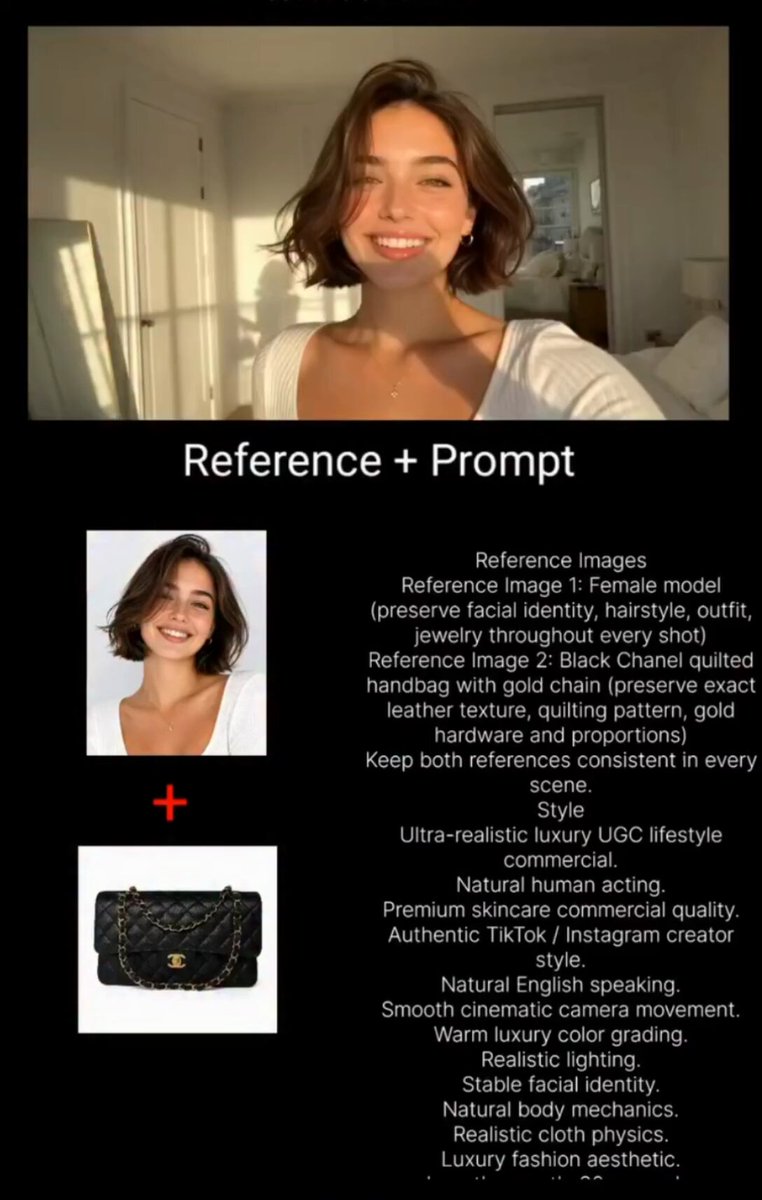
Consistency also depends on how you feed the model. Reference-based generation and multi-image blending let you combine several inputs — a garment flat, a model reference, a location plate — so that a single item stays recognizable across many shots. Keep the reference set small and stable. Swapping in a new reference image mid-campaign is the fastest way to introduce subtle identity drift that nobody notices until the whole set is assembled.
Shot Grammar and Camera Direction
Consistent color is only half the job. A campaign also needs consistent shot grammar: how subjects are framed, where the eye lands, how much negative space sits above a shoulder. Describing camera behavior explicitly — a slow dolly-in, a locked-off medium shot, a handheld turn away from the lens — produces far more usable output than hoping a text prompt implies it. Build a reusable shot library with named categories: hero, detail, movement, lifestyle, packshot. Reuse the same camera language every season so the cuts feel like one brand.
Running Several Generation Models Like a Crew
Most teams eventually work across multiple generation models because each has a different strength. One handles fabric texture and fine detail, another handles human motion, a third is fast enough for draft iterations. Treat them like a crew with specialties rather than competitors. Keep a simple routing table that maps shot types to tools, and re-test that table every few months as capabilities shift. Draft broadly with the fast model, finish with the precise one, and never let a single vendor become the only way your team can ship.
Personalization at Scale: From Segments to Individual Shoppers
Personalization used to mean inserting a first name into an email. With generative pipelines, it can mean inserting a garment. The structural advantage of AI production is that the marginal version is cheap, which changes what is worth making.
Real-Time Signals and Dynamic Product Substitution
A catalog feed, browsing history, wishlist activity, and live inventory can drive variants automatically. The same core clip is re-rendered with the product the shopper actually viewed, in the colorway that is in stock, with a headline written for that segment. Assembly platforms handle sequencing and delivery; the generative layer handles the visual substitution.
The practical constraint is asset hygiene. Dynamic substitution only works if product images are clean, consistently lit, and correctly tagged. Brands that skip that step end up with personalized videos showing the wrong color, which damages trust faster than a generic ad ever could.
Metrics That Justify the Effort
Measure the metrics tied to business outcomes — three-second view rate, hold rate, click-through, add-to-cart, and return rate — and stop staring at raw view totals once a campaign has enough volume. The advantage of fast production is that you can act on the data inside the same campaign cycle: losing hooks get replaced, winning framings get extended, and underperforming variants get retired quietly. Return rate deserves special attention in fashion because a beautiful clip that oversells a fabric produces refunds, not revenue.
Trend Detection and Proactive Content
Styling trends surface in search data, social saves, and resale listings weeks before they reach mainstream retail. Teams that monitor those signals can publish reactive content while interest is peaking instead of documenting it afterward. Keep the bar low: a trend-reactive clip does not need a full production, it needs to be on time and visually on-brand.
Speed, Cost, and Where the Savings Should Go
Speed is the visible benefit; what you do with it determines whether AI production is a real advantage or just a busier calendar.
Cost savings rarely appear as pure profit. Mature teams reinvest them in four directions. More localized versions for different markets and languages, including subtitled and dubbed variants. More product coverage, including lower-margin items that never justified a shoot but still drive discovery. Faster testing of creative concepts before committing to full production. And more room to reserve real photo and video shoots for hero pieces where craft is the message.
The fourth point protects the brand. If every asset becomes synthetic, the visual language flattens and shoppers begin to sense sameness even when they cannot name it. Keeping a proportion of genuinely photographed work in the mix sustains texture, imperfection, and the small human details that fashion audiences respond to.
An End-to-End Campaign Workflow
This is a repeatable loop that works whether you are producing ten clips or three hundred. It assumes a small team: one art director, one editor, one analyst, and a shared asset repository.
Step 1: Translate the Brief into Visual Rules
Convert the creative brief into a one-page style spec. Palette, lighting, lens, movement, wardrobe, casting direction, forbidden elements, and reference images. If two people cannot apply the spec independently and land in roughly the same place, it is not specific enough yet.
Step 2: Build the Shot List and Asset Pack
Write the shot list in plain language, one line per shot, with duration targets and aspect ratio notes. Then gather assets: clean product images on neutral backgrounds, approved model references, logo files, licensed music beds, voice options, and any legal notes about likeness. Missing assets are the most common cause of stalled pipelines. Audit the pack before you generate anything.
Step 3: Generate Wide, Review in Batches
Produce three to five options per shot rather than one. Review in batches against the style spec, not one clip at a time against personal preference. Reject anything with anatomical artifacts, unstable fabric, warped logos, or shifting background geometry immediately — those flaws are cheap to fix at this stage and expensive after editing. Score each batch on a simple scale so decisions stay comparable across reviewers.
Step 4: Finish with Sound, Captions, and Platform Cuts
Finish in an editor. Add sound design, captions, and a music bed. Music and pacing are what make generated footage feel intentional rather than synthetic; a clip that looks slightly artificial often reads as a real commercial once the sound sits underneath it. Export native cuts: vertical, square, and widescreen, plus a short bumper and a fifteen-second paid version.
Step 5: Measure and Feed the Loop
Track performance by variant, not by campaign total. Log which hooks, framings, and product angles won, then write those findings back into the style spec and shot library. After two or three cycles, the spec becomes a genuine competitive asset because it encodes what actually sells for your audience.
Choosing Tools Without Locking Yourself In
Evaluate tools on four criteria: consistency of output across a batch, controllability of camera and subject, export flexibility, and how easily assets move between systems. Ignore demo reels, which showcase curated best cases rather than typical results. Ask for sample batches, not highlights.
Practical guardrails that keep a pipeline portable:
- Keep prompts, style specs, and shot libraries in your own repository, not inside a vendor's interface.
- Store raw outputs, selected takes, and approvals in a shared asset manager with a strict naming convention.
- Run a quarterly comparison between your current models and one alternative on the same shot list.
- Avoid workflows that only one interface can operate; if a tool disappears, the campaign should survive.
- Budget human review time explicitly. It is the most underestimated line item in every AI production plan.
A Realistic First Month
Week one: build the style spec and the reference set, and generate twenty test clips to calibrate expectations. Week two: pick one product category and one channel, then produce ten finished clips with sound and captions. Week three: publish, measure by variant, and note which shots underperformed. Week four: rewrite the spec based on evidence and repeat at double volume. If the loop holds at ten clips, it will hold at a hundred. If it breaks at ten, scaling will only multiply the problem.
Mistakes That Undermine AI Fashion Video
- Chasing novelty over the catalog. A spectacular clip that sells nothing is an expensive experiment. Judge output by whether it moves product.
- Ignoring fabric physics. Knitwear, silk, satin, and structured tailoring move differently. Test motion on a single garment before committing to a full sequence.
- Identity drift. Faces, logos, and garment details must stay stable across shots. Drift is usually caused by inconsistent references, not by the model.
- No style spec. Without written rules, every team member generates in a different direction and the campaign fragments.
- Skipping sound. Silent generated footage looks like a test. Sound design makes it a commercial.
- Over-automating approvals. Faster production means more output, which means review capacity must scale at the same rate as generation.
- Personalizing before your data is clean. Wrong colorways and out-of-stock products in a personalized clip cost more trust than a generic ad.
- Treating one tool as the pipeline. Vendor dependency turns a temporary capability gap into a permanent bottleneck.
Rights, Disclosure, and Brand Safety
Three areas deserve a written policy that legal reviews once and the team applies continuously.
Likeness and model consent come first. If a real person's image is used as a reference, obtain written permission that explicitly covers synthetic derivatives and defines the duration and scope of use. Second, asset provenance: know whether your tools permit commercial use and whether your inputs — images, music, voices — are properly licensed. Third, disclosure: some markets and platforms require labels on synthetic media, and audiences generally accept AI production that does not pretend to be documentary photography. A short internal checklist prevents most problems, and a clear internal rule about never misrepresenting a product's real appearance prevents the rest.
FAQ
Does AI video replace fashion photographers and models?
Not wholesale. It takes over some catalog and volume work and expands what small teams can produce. Hero campaigns still benefit from real craft, real fabric, and real light, and audiences reward that difference more than teams expect.
How do I keep a model's face consistent across a campaign?
Use reference-based generation with a locked reference set, generate in batches from the same seed and style spec, and compare takes side by side for identity drift before selecting finals. Never mix reference sets within one campaign sequence.
What resolution and aspect ratio should I produce first?
Master at the highest quality your pipeline supports, then export platform cuts. Design vertical first if social is the primary channel, because retrofitting a widescreen composition into a vertical frame usually means losing the shot.
How much of a campaign can realistically be automated?
Concepting, variant generation, resizing, captioning, assembly, and delivery can be heavily automated. Selection, sound, and brand judgment should stay human. The split is roughly mechanical versus editorial.
Is AI video content penalized by platforms?
Generally no, provided you follow disclosure rules and do not misrepresent how a product looks. The bigger risk is audience skepticism of visibly synthetic footage used for products where texture and fit matter most.
How do I convince stakeholders to fund the experiment?
Pick one product, one spec, one channel, and ten clips. Measure three-second view rate, hold rate, and add-to-cart against your existing benchmark. A small controlled test is easier to approve than a pipeline redesign.
What is the biggest hidden cost?
Review time. Generation is fast; selecting, checking, and finishing is where the hours go. Plan for it, staff for it, and the pipeline will feel predictable instead of chaotic.
Should smaller brands bother?
Smaller brands often benefit most, because they can publish at a frequency that previously required an agency. Start with catalog clips and social cutdowns, then reinvest the saved time in one properly produced hero asset per season.
