
Why short-form video rewards a system, not luck
Short-form video has become the default way people discover creators, products, and ideas. Instagram Reels and YouTube Shorts both feed viewers an endless stream of vertical clips, and neither algorithm cares whether a clip took three hours or three minutes to produce. What it cares about is whether people watch to the end, watch again, and send it to a friend.
That single fact should change how you work. Instead of treating every upload as a one-off creative gamble, treat short-form as a production line: a repeatable sequence of research, scripting, generation, editing, publishing, and reading the results. The creators who post consistently are rarely the most gifted editors. They are the ones with the least friction in their process — the ones who can go from idea to published clip without a week of procrastination.
AI video tools have removed a large chunk of that friction. You can now draft a concept, generate several visual variants, produce a voiceover, caption the entire clip, and export platform-native files in a single afternoon. But tooling alone does not make a video trend. The difference between a clip that dies at 400 views and one that reaches 400,000 is usually structure, pacing, and a clear reason for the viewer to keep watching.
This guide walks through a complete, reusable workflow for making trending-style videos for Reels and Shorts. It covers what the platforms reward, how to research trends without chasing every one, how to script for very short runtimes, how to choose the right AI generation approach, and how to build a weekly rhythm you can sustain without burning out.
What Instagram Reels and YouTube Shorts actually reward
Before optimizing anything, it helps to understand the signals both platforms collect. They are similar in spirit but different in emphasis, and knowing the difference prevents you from cross-posting lazy duplicates.
Retention, rewatches, and the first second
Both platforms weigh completion rate heavily, which is why a 12-second clip with 90 percent completion often outperforms a 60-second clip with 30 percent. The first second does most of the work: if the opening frame looks like every other clip in the feed, the viewer swipes before your hook even lands.
Practical implications:
- Put movement or a visual change in frame one — a subject entering, a zoom, a text reveal, or a hard cut.
- Front-load the promise. Do not explain the setup; show the payoff first and explain afterward.
- Design for loops. If the final frame connects back to the first, viewers watch twice without noticing, and the algorithm reads that as strong engagement.
Where the two platforms diverge
Instagram Reels tends to favor polished, aesthetic-driven content with strong audio culture, trending sounds, and a socially shareable feel. YouTube Shorts favors searchable, curiosity-driven clips and rewards channels that already publish long-form content, because the Shorts feed often pulls viewers back toward a channel's library.
| Dimension | Instagram Reels | YouTube Shorts |
|---|---|---|
| Primary discovery | Feed, Explore, audio trends | Shorts shelf, search, subscriptions |
| Strongest hook style | Visual + trending audio | Question or curiosity gap |
| Text overlay | Light, stylish, minimal | Explicit, explanatory, keyword-friendly |
| Best reuse | Native vertical edit | Native vertical edit, different caption |
| Long-term value | Brand recall, follower growth | Searchable evergreen traffic |
A useful rule: create one master edit, then produce two platform-native variants with different hooks, captions, and text overlays. Re-uploading the identical file with the same caption to both platforms wastes a second opportunity.
Step 1 — Trend research that fits your niche
Trend research fails when it becomes doom-scrolling. The goal is not to see everything; it is to notice repeatable patterns that you can adapt within your own subject matter.
Build a two-layer trend radar
The first layer is fast: trending audio, trending formats, popular transitions, and whatever memes are spreading through the week. The second layer is slow: evergreen questions people in your niche keep asking, common misunderstandings, and recurring complaints. The fastest way to make a video that spreads is to combine both — a fast format carrying a slow, useful idea.
A simple routine that takes 20 minutes a day:
- Scroll the Reels and Shorts feeds for ten minutes with a notes app open. Record formats, not topics.
- Write down the hook line for any clip that stops you. Hooks are reusable; subjects are not.
- Note the audio. Save it, but check whether it is still rising or already peaking.
- Once a week, group your notes into two or three patterns and pick the one that fits your niche naturally.
Convert a trend into your own angle
Copying a trend exactly produces forgettable content. Adaptation produces recognizable content. Use these transformations:
- Swap the subject, keep the structure. A "three things I wish I knew" format works for cooking, coding, fitness, and finance.
- Invert the expectation. Trends often have an obvious punchline; a reverse take feels fresh.
- Add specificity. "Cheap meals" is generic; "meals I make when the fridge is nearly empty" is a scene.
- Narrow the audience. Speaking to a precise group of people increases shares dramatically, because viewers send clips to people who match the description.
If a trend requires context you cannot explain in two seconds, it is probably a bad fit. Skip it without guilt; there is always another one next week.
Step 2 — Scripts built for 15, 30, and 60 seconds
Short-form scripts are not shortened long-form scripts. They are structured around attention, not information density.
The three-beat script
Most strong short-form clips follow a three-beat structure:
- Hook (0–2 seconds). A visual or verbal pattern interrupt that makes the viewer stop.
- Tension (2–12 seconds). A question, a problem, a surprising claim, or a visible process that is not yet resolved.
- Payoff + loop (final seconds). The resolution, plus a line or frame that sends the viewer back to the beginning.
For a 15-second clip, beat two is a single sentence. For 30 seconds, you can add one example. For 60 seconds, you can add a mini-demonstration — but only if the pacing stays tight. Anything longer than 60 seconds in a shorts-first format needs a very strong reason to exist.
Hook patterns that hold attention
The first frame does most of the work, but the first sentence does the rest. Patterns that reliably hold:
- The contradiction: "Everyone says post more. Posting more nearly killed my channel."
- The visible result first: show the finished outcome, then rewind.
- The open loop with a timer: "Watch what happens in the last three seconds."
- The named audience: "If you edit on a laptop with no GPU, this is for you."
- The number promise: "Three settings, one of which you are definitely using wrong."
Avoid opening with greetings, channel introductions, or "in this video." They are the three most common ways to lose the first second.
Step 3 — Choosing the right AI video approach
There is no single best AI video tool. There are three broad approaches, and each fits a different kind of content.
Text-to-video, image-to-video, and edit assistants
- Text-to-video turns a written prompt into a generated clip. Best for abstract visuals, b-roll, mood pieces, and concepts that cannot be filmed easily.
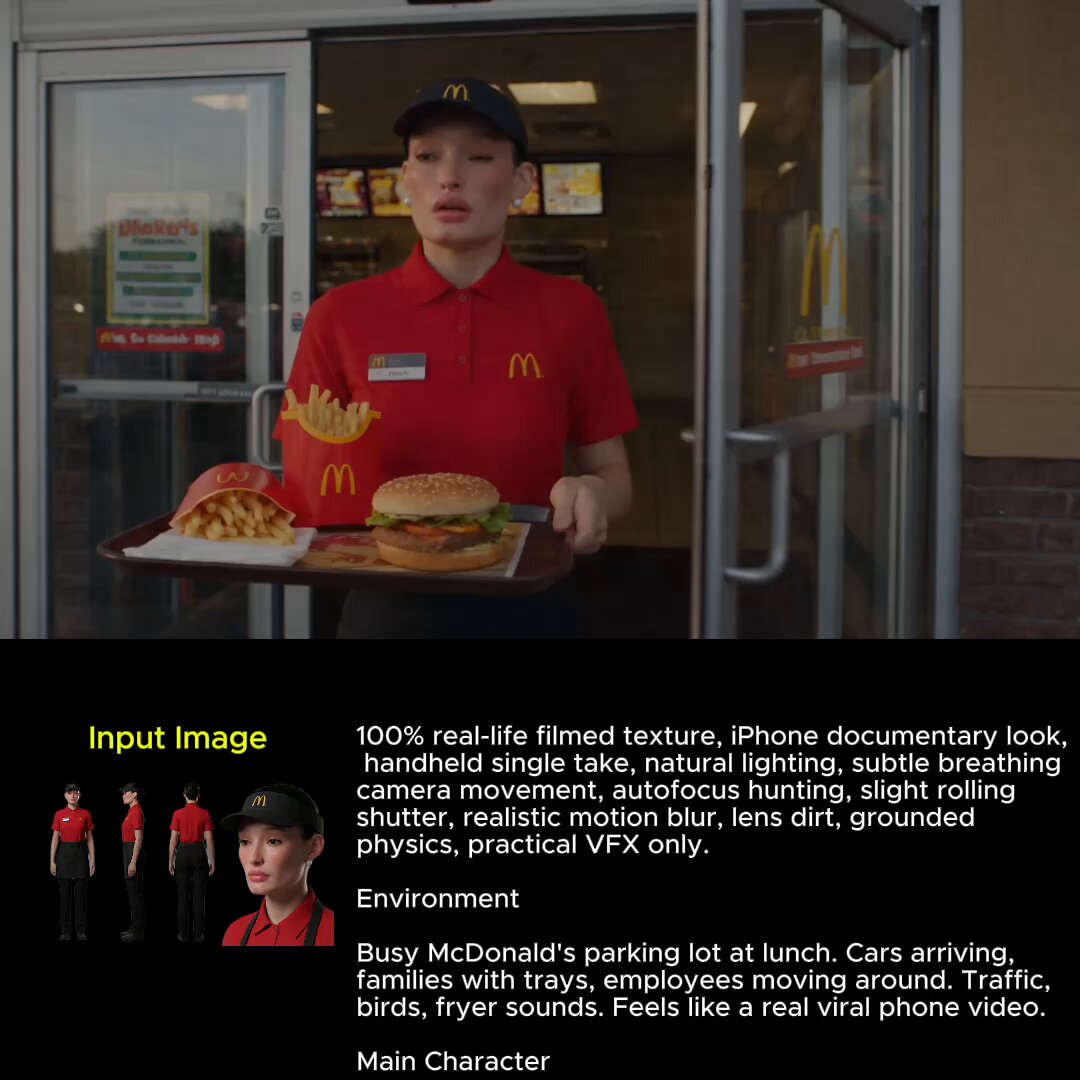
- Image-to-video animates a still image. Best for character-driven content, product shots, and maintaining a recognizable visual identity across many clips.
- Edit assistants handle the unglamorous work: cutting to a beat, removing silences, auto-captioning, reframing to 9:16, generating thumbnails, and producing alternate hooks.
Most successful short-form workflows blend all three. Generation supplies the visual world; editing assistants supply the speed.
Keeping characters and style consistent
Consistency is the hardest part of AI video, and inconsistency is what makes a clip feel cheap. Practical techniques:
- Lock a reference image for every recurring character and reuse it rather than re-describing the person in text.
- Keep a written style block — lighting, lens, color grade, camera movement — and paste it into every prompt.
- Generate in the same aspect ratio and resolution from the start. Cropping a horizontal generation into vertical ruins compositions.
- Treat voice as part of the character. Reusing the same voice model across episodes builds recognition faster than any logo.
A useful test: show three frames from three different clips to someone unfamiliar with your work. If they can tell all three belong together, your consistency is working.
Step 4 — The production pipeline from prompt to rough cut
Once the script exists, the production stage should be mechanical. Here is a sequence that scales.
- Break the script into shots. One line equals one shot, roughly. A 30-second clip usually needs 5–8 shots.
- Mark which shots are generated and which are filmed. Generated shots handle scale and imagination; filmed shots handle faces, hands, and products where realism matters.
- Generate in batches, not one at a time. Produce three variants per shot and pick the cleanest. Waiting on single generations kills momentum.
- Record or synthesize the voiceover. Read at a slightly faster pace than feels natural. Short-form viewers expect energy.
- Assemble a rough cut with no effects. Get the timing right before styling anything. If the rough cut is boring, effects will not save it.
- Add music and sound design. Sound is half the retention. A whoosh on a cut or a soft impact on a text reveal makes a clip feel produced.
Keep a project folder with a naming convention: episode-03_shot-02_v2.mp4. When you are producing multiple clips per week, file hygiene is the difference between a smooth edit and an hour of scrolling through unnamed downloads.
Step 5 — Editing, captions, and platform-native formatting
This is where most AI-generated clips either come alive or fall apart.
Pacing. Cut on motion. If a shot is static for more than two seconds, either add a slow push-in or cut earlier. In short-form, a cut every 1.5–3 seconds reads as energetic rather than chaotic.
Captions. Assume sound is off for a significant share of viewers. Burn in captions, keep them to two lines maximum, and position them above the bottom UI area so platform buttons never cover the words. Auto-captioning tools get you 90 percent of the way; the remaining 10 percent — names, jargon, punctuation — still needs a human pass.
Text overlays. Use them for the hook line and any key number. Keep typography to one or two fonts and one accent color. Text that matches your brand is the cheapest branding available.
Safe zones. Both platforms overlay interface elements at the bottom and right edge. Keep key visuals and text in the central safe area, especially if the clip will run as a paid promotion.
Export settings. Vertical 9:16, 1080×1920, high bitrate. Do not upscale a low-resolution generation at the end; generate at final resolution. Export separate files per platform with different hooks and captions.
Thumbnail or cover frame. For Shorts, the cover frame affects click-through from the channel page. Choose a frame with a face, clear text, or obvious motion — not a blurry mid-transition.
Step 6 — Publishing cadence, testing, and reading the data
Consistency beats intensity. Three to five clips a week, published on a predictable schedule, outperforms a burst of twelve clips followed by two weeks of silence.
Test one variable at a time. Common variables worth testing: hook style, clip length, caption placement, music versus silence, and talking-head versus generated visuals. Change one per batch so you can attribute results.
Read the right metrics. Views are vanity. Look at average watch time, the retention graph's drop-off point, shares, saves, and follows per thousand views. If retention collapses at second four, your hook is the problem. If it collapses at second twenty, your middle is the problem.
Reuse what wins. A clip that performs well is raw material, not a finished asset. Re-edit the winning concept with a different hook, a different example, or a different visual treatment four to six weeks later. Audiences forget faster than creators expect, and the second version often outperforms the first.
Respond to comments with video. The questions people ask in comments are free scripts. Answer one in a 20-second clip and you get both relevance and a natural call to conversation.
A sustainable weekly production rhythm
A workflow only matters if it survives a busy week. A rhythm that works for a solo creator:
- Monday — research and planning (45 minutes). Review your trend notes, choose three concepts, write one-line hooks for each.
- Tuesday — scripting (45 minutes). Write all three three-beat scripts back to back. Batching keeps you in one mental mode.
- Wednesday — generation and recording (2 hours). Generate all visuals for all three clips in batched sessions. Record voiceover in a single sitting.
- Thursday — editing (2 hours). Assemble, caption, and export. Finish one clip fully before starting the next.
- Friday — publish and schedule. Post one, schedule the rest, and write platform-specific captions.
- Weekend — data review (20 minutes). Note what overperformed, what underperformed, and one hypothesis for next week.
Total: roughly seven hours a week for four to five published clips. That is sustainable, and sustainability is what makes trends catchable — you have to still be posting when the right format arrives.
Common mistakes that quietly kill reach
Chasing every trend. Spreading yourself across unrelated formats confuses the recommendation system about who your audience is. Two or three recurring formats work better than ten random ones.
Over-producing the first frame. A cinematic opening that takes three seconds to establish context loses viewers before the hook. Start mid-action.
Ignoring audio. Muffled voiceover, unbalanced music, or a sudden loud section at the start drains retention faster than weak visuals.
Generic AI visuals. Prompts like "a person walking in a city, cinematic" produce interchangeable footage. Specificity — one subject, one action, one lighting condition — produces usable shots.
Identical cross-posting. The same file with the same caption on both platforms leaves performance on the table. Change the hook and the caption at minimum.
Posting without a next step. If a viewer loves the clip, they should know what to do: follow, watch the related clip, or check a link. Silence at the end of a high-retention clip is a wasted moment.
Never reviewing. Posting daily without ever reading retention graphs is production without learning. Twenty minutes of review per week compounds faster than any editing trick.
FAQ
How long should a Reel or Short be?
Start at 15–30 seconds. That range gives you enough room for a hook, a tension beat, and a payoff while keeping completion rates high. Move to 45–60 seconds only when your retention data shows viewers staying past the 30-second mark.
Do I need to film anything if I am using AI video generation?
Not necessarily, but hybrid workflows perform better. Generated shots are ideal for scale, environments, and abstract concepts, while filmed or photographed elements ground the clip in reality. Even a close-up of your hands or desk can make an otherwise synthetic clip feel trustworthy.
How consistent does my content need to look?
Enough that a returning viewer recognizes you within a second. That usually means a consistent voice, a consistent caption style, and a consistent color treatment. It does not mean every video has to look identical.
How many clips should I test before changing my approach?
Give any format at least five to eight published clips before judging it. Individual clips are noisy; patterns emerge across a batch.
What matters more, the hook or the visuals?
The hook. A great hook with average visuals will outperform beautiful visuals with a slow opening almost every time. Fix the first second before you upgrade the render quality.
Can one workflow serve both Instagram Reels and YouTube Shorts?
Yes, with one extra step. Produce a single master edit, then create platform-native variants with different opening frames, different caption text, and captions written for how each platform's audience searches and scrolls.
How do I keep up with trends without losing hours a day?
Cap research at 20 minutes daily and record only formats and hooks, never full videos. Once a week, spend 30 minutes turning those notes into three concepts. Everything else is optional.
What is the fastest way to improve retention?
Watch your own clip muted and time how long it takes to become clear what the video is about. If the answer is more than two seconds, cut the opening and start later. That single edit fixes more retention problems than any effect or transition.
