
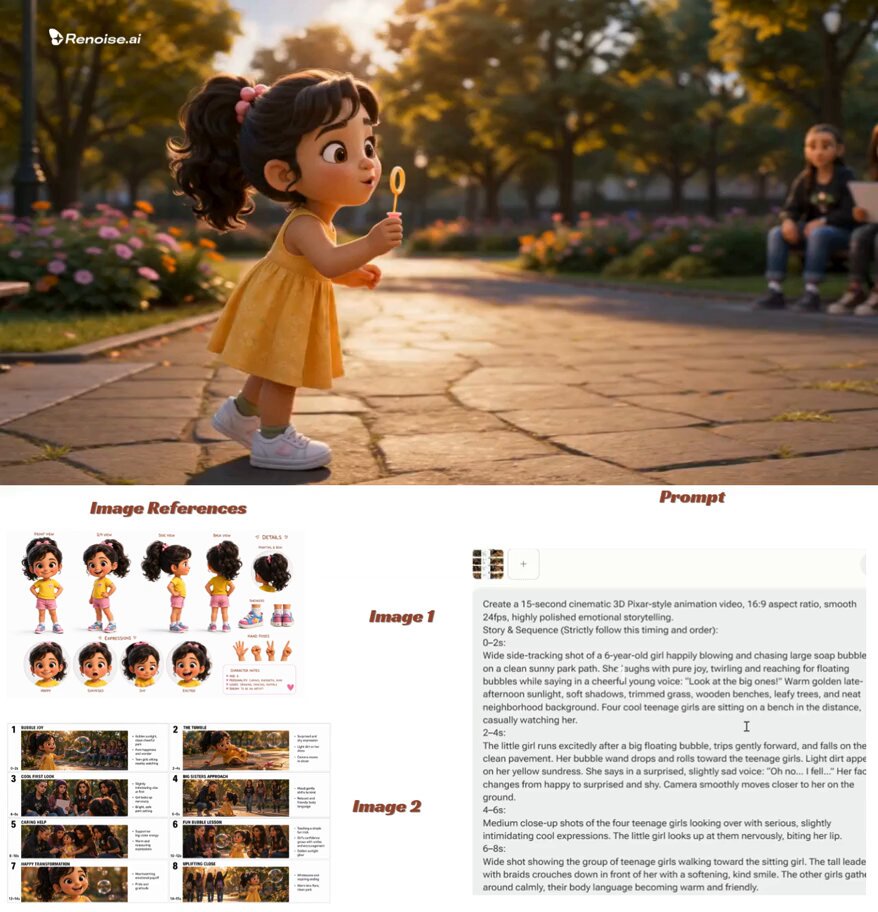
There is a specific feeling you get the first time you watch AI-generated images move in real time. Not a rendered clip that took five minutes to compute — actual movement, responding to input, appearing before your eyes as if the model were drawing live. It feels like watching the future arrive, one frame at a time.
Real-time AI animation is the convergence of two trends that have been building for years. The first is the explosion of generative models capable of producing cinematic-quality video. The second is the engineering push to make that generation fast enough to be interactive — fast enough for a live stream, a game, a stage performance, or an editor who needs instant feedback. Together, they are changing what "animation" means: from a slow, offline process into an immediate, responsive medium.
This article explains the technology behind real-time AI animation, the models and platforms that make it possible, the practical uses that exist today, and the limits that still separate the impressive demo from the seamless product.
What Real-Time AI Generation Actually Means
Let us be precise about the term, because "real time" is used loosely. In the context of AI animation, real time means that generation keeps pace with consumption. A viewer watches 30 frames per second; if the model produces frames at that rate or faster, the experience is live. If it produces one frame per second, you get a slideshow that feels delayed.
There are different degrees of real time. Interactive real time means the model reacts to user input quickly enough to feel responsive — a few hundred milliseconds of latency is acceptable. Live broadcast real time means the output streams continuously without visible gaps, which is a much harder bar. Near real time means generation is fast enough to preview and iterate comfortably, even if the final render still takes minutes.
Each degree has different applications. A VJ projecting AI visuals at a concert needs true live generation. A filmmaker testing camera angles needs near real time: fast feedback on the direction, then a longer render for the final shot. A gamer exploring an AI-generated environment needs interactivity measured in milliseconds.
The important shift is psychological as much as technical. When generation is slow, you plan carefully and accept waste. When it is fast, you iterate — you try twenty variations because each one costs seconds, not hours. Speed changes the creative process itself, not just its efficiency.
From Diffusion Models to Temporal Coherence
The foundation of modern AI animation is the diffusion model, but real-time video required solving problems that image diffusion never faced.
An image diffusion model generates a single frame by denoising random noise according to a prompt. A video diffusion model must generate a sequence of frames that agree with each other — the same character, the same lighting, the same world — across time. This is called temporal coherence, and it is the hardest problem in the field.
Early video models cheated by generating frames independently and stitching them together. The result was flicker: each frame looked plausible alone, but the sequence shimmered like a bad signal. The breakthrough came from training models on video data directly, so they learn not just "what a face looks like" but "how a face moves." These models maintain identity and motion consistency because they have seen the relationship between frames, not just the frames themselves.
The second breakthrough was efficiency. Real-time generation requires models small enough to run quickly and optimized enough to use hardware fully. Techniques like step distillation — training a model to produce good results in fewer denoising steps — cut generation time dramatically. Combined with specialized hardware and clever caching, this brought generation from minutes down to seconds, and for some tasks, to interactive speed.
The result is a ladder of capabilities: fast draft models for preview, higher-quality models for final renders, and research prototypes pushing toward true live generation. Understanding which rung you are on prevents disappointment — you should not expect a final-quality render at interactive speed today, but you can expect fast, useful previews.
The Architecture Behind Speed and Scale
Real-time generation is not only a model problem; it is an infrastructure problem. The difference between a model that works in a demo and a platform that works at scale is architecture.
A typical generative platform is built in layers. The backend is modular — generation, user management, storage, and billing are separate services that can scale independently. When a viral moment hits, the generation queue can absorb the load without taking down the content service. This separation is invisible to users and essential to operators.
The generation queue is the heart of the system. Video generation is slow compared to serving a web page, so requests are queued, prioritized, and processed asynchronously. The user submits a job, the system reports progress, and the finished asset appears when ready. For near-real-time previews, the queue is replaced by a direct path — fast models on warm hardware, returning results in seconds.
The data layer keeps everything coherent. It stores user projects, generation history, and reference assets — the character sheets and style guides that keep a series consistent. Without this layer, every generation starts from zero and the creator loses the thread of their work.
The delivery layer gets results to users fast. Large video files need efficient encoding, content delivery networks, and sensible caching. A brilliant pipeline is invisible if the output takes minutes to load. In practice, the platform that feels fast is usually the platform with the best infrastructure, not the best model.
None of this is glamorous, but it is the difference between a reliable tool and a toy. If you are building a generative product, invest in this foundation early.
The Model Landscape in Practice
For creators, the model landscape can be organized into a few practical families, each with a different job.
The premium family delivers cinematic quality. Flux, Runway, and the Sora line set the standard for realism, camera language, and physical plausibility. These models are the choice for hero shots and final renders, where quality matters more than speed.
The consistency family focuses on keeping characters and scenes stable. Models like Kling excel at prompt adherence and character consistency — they do what you ask and keep doing it across shots. This family is essential for series production and brand work, where a character must look the same in every episode.
The control family adds technical precision. These models support multi-image reference and keyframe control, so you can lock the start and end of a movement or feed several angles of a character. They are the workhorses of directed animation — when you know exactly what you want, they deliver it.
The speed family is the newest and most relevant to real-time work. These are optimized models designed for fast iteration and interactive preview. They may not match premium quality, but they run in seconds, which makes them the right tool for exploration and live applications.
The practical pattern is to move between families: use speed models to explore, control models to direct, and premium models for the final render. A creator who masters this workflow can move from idea to finished video faster than a traditional production can schedule a first meeting.
AI Director Agents: From Tool to Collaborator
One of the most interesting developments is the rise of "director agents" — AI systems that do more than execute a prompt. They interpret the intent, propose a cinematic approach, and manage the complexity of a scene on the creator's behalf.
Think of the difference between a camera and a cinematographer. A camera records what you point it at; a cinematographer advises on light, lens, and movement. A director agent sits at that level: you describe the story beat, and it suggests the composition, the pacing, the camera movement, the emotional arc.
In practice, this means you can describe a scene at a higher level — "the hero realizes the truth and the camera slowly pulls back as the music drops" — and the agent translates that into the concrete parameters the models need. It does not remove the creative decisions; it removes the mechanical translation work between vision and prompt.
Director agents also help with consistency. Because they operate across a project rather than a single generation, they can carry the style guide forward — the same lighting keywords, the same character references, the same pacing rules from shot to shot. This turns consistency from a discipline you must remember into a property of the system.
The honest caveat is that director agents are early. They work best within a defined style and can produce generic results when given too much freedom. Use them as collaborators — direct them, correct them, and over time they learn the patterns you prefer. The goal is not automation of your taste; it is amplification of your workflow.
Live Visuals, Streaming, and Interactive Experiences
Real-time AI animation is not a laboratory curiosity; it has working applications today.
Live visuals for events are the most visible use. VJs and stage designers use AI generation to create visuals that react to music, crowd energy, and performance cues. The output does not need to be indistinguishable from pre-rendered footage — it needs to be alive, surprising, and synchronized with the moment.
Streaming is a natural home for the technology. Streamers can generate backdrops, overlays, and transitions on the fly, reacting to chat and gameplay in real time. A stream that changes its visual identity based on viewer input is memorable in a way a static overlay never is.
Games and interactive art push the boundary further. Procedurally structured worlds with AI-generated surfaces can respond to player action, creating environments that no two players experience identically. Interactive installations — in museums, storefronts, public spaces — use the same technology to make the audience part of the artwork.
Prototyping is the quiet but powerful application. Directors, editors, and designers use fast generation to test ideas before committing to expensive production. A costume test, a lighting study, a camera move — each takes seconds instead of days, which means more ideas get tested, and the ideas that survive are better.
A Practical Workflow for Real-Time Animation
If you want to work with this technology today, here is a practical workflow that matches current capabilities.
Start with the concept, not the tool. Write down what the animation must do: who is in it, what moves, what mood, what format. This brief will guide every technical choice.
Then use a fast model to explore. Generate quick drafts of the scene — different compositions, different movements, different moods. This stage should feel like sketching: dozens of variations, most of them discarded, a few promising ones saved.
Once you have direction, switch to a control-focused model. Feed the reference images, set the keyframes, lock the movement. This stage is where you get precise — the character's face, the camera path, the timing of the action.
Then render the final with a premium model. This is the slow stage, and it should be, because it is the only stage whose output the audience will see. Use the drafts to make all the creative decisions first, so the final render is not a gamble but a confirmation.
Throughout the process, keep a style document: the keywords, the references, the settings that make your project coherent. Every serious practitioner keeps one, and it is the difference between a portfolio of experiments and a body of work.
The Limits That Remain
It is worth being honest about the gap between demos and products, because the disappointment usually comes from unmet expectations.
The first limit is computational cost. Real-time generation is expensive in hardware and energy. "Real time" does not mean "cheap" — it means "fast enough," and that speed has a price. Live applications in particular need specialized infrastructure that most creators do not own.
The second limit is quality. Fast models are not yet as good as slow models. The best real-time previews still fall short of premium renders in realism, stability, and detail. The workflow described above exists precisely because of this gap — you use speed where speed matters and quality where quality matters.
The third limit is the uncanny plateau. AI-generated motion still breaks under close inspection: hands, water, complex interactions. In an interactive context, where the audience watches for a long time, these failures are harder to hide than in a short clip. Robustness is an ongoing engineering challenge, not a solved problem.
The fourth limit is aesthetic sameness. Models trained on similar data produce similar results. Breaking out of the default look requires deliberate direction — custom styles, unusual prompts, strong art direction. The technology amplifies vision; it does not supply it.
Frequently Asked Questions
Is real-time AI animation available to everyone? Parts of it are. Fast generation is available through many platforms, and interactive previews are becoming common. True live generation remains specialized and infrastructure-dependent.
Do I need a powerful computer? For cloud-based tools, no — the heavy computation happens on the provider's servers. For local real-time generation, yes, you need serious hardware. Decide which mode fits your needs.
Can I use this for commercial live events? Yes, with attention to tool licenses and latency guarantees. Test thoroughly before the event; live failure is not recoverable.
Will real-time generation replace traditional animation? It replaces parts of the pipeline — rendering, prototyping, background generation. It does not replace direction, story, or design. The medium is new, not the craft.
How do I stay current? The field moves monthly. Follow model releases, test your workflow regularly, and rebuild your playbook as the capabilities shift.
The Bottom Line
Real-time AI animation is where the generative revolution stops being about producing assets and starts being about having conversations with a medium. When generation is fast enough to respond, it changes how you think: you iterate instead of plan, explore instead of commit, and treat the model as a live collaborator rather than a slow render farm.
The technology is not finished. Quality, cost, and robustness still limit what is possible. But the direction is clear, and the practical applications — live visuals, streaming, prototyping, interactive art — are already here. The creators who will benefit most are not the ones waiting for perfection. They are the ones experimenting with the imperfect present, learning the workflow, and building the style that will define the medium when it matures.
