

Why Text-to-Video Became a Marketing Default
A marketing team used to need four separate skill sets to produce a single 20-second ad: a copywriter, a storyboard artist, a videographer, and an editor. Today, a small team can start from a written brief and reach a finished, platform-ready cut in a single afternoon. That shift is not about replacing craft — it is about compressing the distance between an idea and a reviewable draft.
The reason text-to-video matters for marketers is simpler than the technology behind it. Marketing is an iterative discipline. Most campaigns do not fail because the first idea was weak; they fail because the team could only afford to test one idea. When video generation becomes cheap and fast, the number of concepts you can put in front of real audiences goes up, and so does the chance that one of them lands.
This guide is a practical walkthrough. It covers how the pipeline works, how to write prompts that behave consistently, how to keep a brand character recognizable across shots, how to choose the right generation approach per campaign goal, and how to quality-check the output before it reaches a client or a paid channel.
What Text-to-Video Actually Does — and What It Does Not
Before building any workflow, it helps to be precise about the division of labor.
The parts that are genuinely automated
- Visual ideation. Turning a written scene description into a plausible frame or short clip.
- Variation. Producing eight versions of the same scene with different lighting, lensing, or wardrobe.
- Motion interpolation. Extending a still into a short, believable camera move.
- Format adaptation. Re-framing the same content for vertical, square, and widescreen placements.
- Subtitle and caption drafting. Converting a script into timed on-screen text.
The parts that still need a human
- Strategy. Deciding what the video is supposed to make someone do.
- Narrative judgment. Knowing which of the eight variations is actually good.
- Brand safety. Catching a visual that undermines tone or makes a claim you cannot support.
- Final polish. Sound design, pacing, and the small edits that separate "fine" from "memorable."
Teams that treat generation as a replacement for judgment tend to produce a high volume of forgettable assets. Teams that treat it as a fast draft engine tend to ship more campaigns with the same headcount.
Mapping the Pipeline: From Brief to Published Cut
A reliable text-to-video workflow has six stages. Skipping any one of them tends to surface as rework later.
Stage 1 — Write the brief as a script, not a concept
"Show our product as innovative" is not a brief a video system can act on. "A close-up of hands opening a matte-black box on a concrete counter; morning light from the left; slow push-in; no faces" is. Convert every abstract claim into a describable image.
Stage 2 — Break the script into shots
A 30-second spot is roughly 8 to 14 shots. Write each shot as a single row in a table with four columns: shot number, duration, visual description, and on-screen text or voiceover. This table becomes your prompt source and your editing blueprint at the same time.
Stage 3 — Generate still frames first
Generating stills before motion is the single highest-leverage habit in this workflow. Stills are fast, cheap to review, and easy to regenerate. Approving a look at the still stage prevents you from discovering in post that the entire sequence has the wrong mood.
Stage 4 — Animate approved frames
Once a frame is approved, animate it with a modest, motivated camera move: a slow push, a lateral slide, a gentle handheld drift. Large, dramatic moves tend to expose artifacts.
Stage 5 — Assemble and set rhythm
Lay shots on a timeline, then cut to a beat. Most social video works best with a visual change every 1.5 to 3 seconds. Where you have no acceptable shot, use a text card rather than a weak generation.
Stage 6 — Adapt and export
Re-frame to 9:16, 1:1, and 16:9. Rebuild captions for silent viewing. Export at each platform's preferred bitrate.
Writing Prompts That Behave Like Camera Directions
The most common reason generated footage looks amateurish is that the prompt describes a subject but not a shot. Professional-looking output comes from describing the camera, the light, and the lens at least as carefully as the content.
A four-part prompt structure
- Subject and action — who or what, doing what, in what state.
- Shot specification — framing (extreme close-up, medium, wide), angle (eye level, low, overhead), and movement (static, push-in, tracking).
- Lighting and palette — time of day, direction of light, color temperature, contrast.
- Texture and realism cues — film grain, shallow depth of field, 35mm, documentary feel, matte finish.
A weak prompt reads: "A woman using a laptop in a café."
A working prompt reads: "Medium close-up, eye level, of a woman in her thirties typing on a laptop at a café window; soft overcast light from the left; muted teal and warm wood palette; shallow depth of field; gentle handheld drift."
The second version is not more creative. It is more specific, which is what generation systems respond to.
Negative instructions worth keeping on hand
Keep a short block of exclusions you paste into every prompt: distorted hands, extra fingers, warped text, watermark artifacts, oversaturated skin tones, logo-like shapes, blurry faces in the foreground. Most quality problems in marketing video are the same five problems repeated.
Consistency through locked language
If three shots are meant to feel like the same scene, the lighting and palette lines in their prompts must be word-for-word identical. Change only the subject and framing lines. This single habit does more for visual continuity than any post-production color pass.
Keeping a Brand Character Recognizable Across Shots
Brand ambassadors, mascots, recurring presenters, and product heroes all share the same problem: they must look like themselves in every frame. Text prompts alone rarely guarantee that.
Reference-driven generation
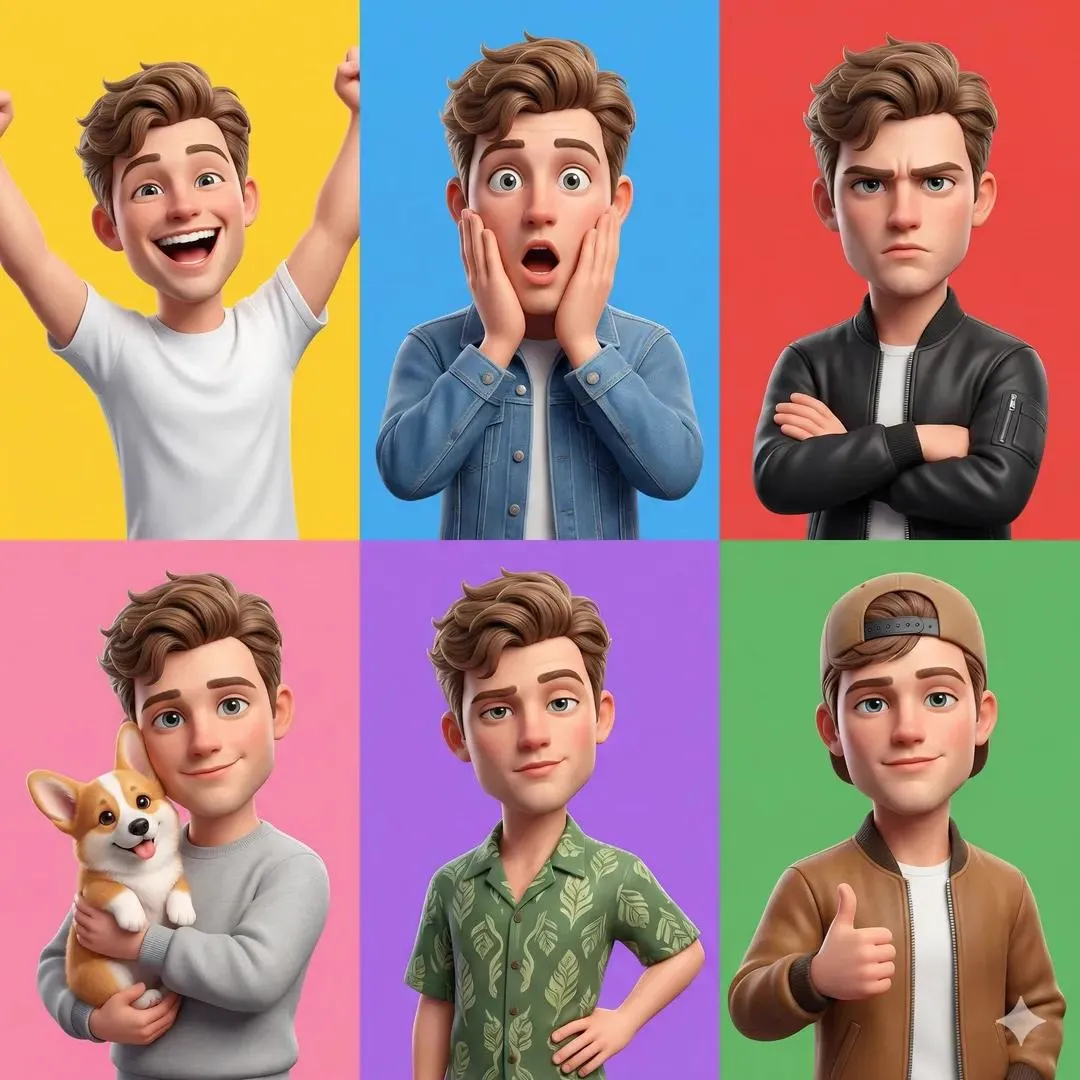
Use a small set of approved reference images — front, three-quarter, and profile — and generate new shots with those references attached. This is the practical version of "character consistency," and it works far better than trying to describe a face in words.
The wardrobe and prop lock
Write down the exact clothing, accessories, and props the character wears, and never vary them within a campaign. Viewers read continuity through small details: the same jacket, the same watch, the same mug. Changing a shirt color between shots is enough to make an audience feel something is off without knowing why.
Build a character sheet file
Keep a one-page document per recurring character containing:
- The canonical reference images
- The fixed description paragraph used in every prompt
- Wardrobe rules and forbidden variations
- Voice and tone notes for any scripted dialogue
- Two approved sample shots to compare future generations against
This file pays for itself the first time a new team member has to produce a matching shot.
Matching the Generation Approach to the Campaign Goal
Not every campaign needs photorealism, and not every campaign can afford the render time that photorealism requires. Match the approach to the job.
Hero and brand films
Prioritize realism, slow camera work, and controlled lighting. Budget more time per shot, generate more variations, and expect to reject most of them. Fewer, better shots beat a fast montage here.
Performance and social ads
Prioritize speed, strong opening frames, and legible on-screen text. Generate in batches, accept a slightly stylized look, and optimize for the first two seconds. Visual polish matters less than a clear hook.
Stylized and niche campaigns
Illustrated, animated, retro, or otherwise stylized looks are often easier to hold consistent than realism, because audiences do not apply the same uncanny-valley scrutiny. If a brand's identity is illustration-led, leaning into that style usually produces more coherent results than chasing live-action realism.
Practical decision criteria
| Question | Lean realistic | Lean stylized |
|---|---|---|
| Is the product physical and detail-critical? | Yes | — |
| Is the audience skeptical of AI visuals? | Yes | — |
| Is the campaign volume extremely high? | — | Yes |
| Is the brand identity already illustrative? | — | Yes |
| Is the deadline under 48 hours? | — | Often yes |
A Worked Example: 30-Second Product Launch
To make this concrete, here is how a hypothetical launch spot comes together.
Brief. Launch a stainless-steel water bottle to a fitness audience. Tone: clean, calm, confident. Deliverables: 30-second hero cut, three 10-second vertical cuts.
Shot list (condensed).
- Macro of condensation on brushed steel, static, 3s
- Hand lifting the bottle from a gym bench, low angle, 2s
- Wide of a runner tying laces, bottle in foreground, 3s
- Close-up of the lid opening with a soft click, 2s
- Pour into a glass, backlit, 2s
- Over-the-shoulder shot of drinking mid-stride, 3s
- Bottle on a windowsill, golden hour, 4s
- Logo card with tagline, 2s
Prompt build. Shots 1, 4, and 7 share an identical lighting line: "warm directional light from camera left, soft falloff, neutral steel highlights, clean background." Shots 2, 3, and 6 share a second lighting block for the gym environment. Only the subject and framing lines change.
Review gate. The team approves stills for all eight shots before a single clip is animated. Two stills are rejected for reflections that read as warped text on the steel. Those two are regenerated with an added negative instruction about mirrored text.
Assembly. Total runtime lands at 26 seconds, so a 3-second opening text card is added. Vertical cuts are rebuilt from the strongest three shots with new captions.
Cost of skipping steps. If the team had animated first, the two flawed stills would have become two flawed clips, and re-rendering them would have pushed the deadline past the campaign window.
Quality Control: The Pre-Publish Checklist
Run every video through the same gate before it leaves the team.
Technical checks
- No warped text, mirrored logos, or unreadable signage in frame
- Hands and faces hold up when paused at any frame
- Consistent lighting and color temperature across sequential shots
- No flicker or morphing artifacts during camera moves
- Captions are accurately timed and readable without sound
Brand checks
- The product appears correctly; packaging text is legible where required
- The brand character matches the approved character sheet
- Color palette sits within the brand's range
- Tone matches the audience and channel
Compliance checks
- No claims that cannot be substantiated
- No incidental depiction of real, identifiable people or trademarks
- Disclosures present where required for the market and platform
- Music and voice rights cleared for the intended usage
The compliance step is the one teams skip most often, usually right before a launch. Put it in the checklist and assign an owner.
Where AI Video Fits in a Wider Marketing Stack
Text-to-video is strongest when it feeds an existing system rather than replacing it.
- Brief and planning tools produce the script and shot list that generation consumes.
- Asset libraries hold approved reference images, logos, and brand kits.
- Editing software assembles shots, sets rhythm, and handles audio.
- Captioning and localization tools create multi-language variants from one master cut.
- Analytics platforms tell you which hook, length, and thumbnail actually performed.
The feedback loop matters more than any individual tool. If a vertical cut outperforms the hero spot, that is the market telling you where to invest next round. The practical setup is a monthly review where performance data becomes the next brief.
Common Mistakes and How to Avoid Them
Chasing realism everywhere. Photoreal generation is slow and unforgiving. Use it only where detail is central to the message.
Describing content without describing the camera. If the prompt does not specify framing and movement, the result will feel like stock footage.
Changing prompt language between related shots. Small wording differences produce large visual differences. Lock the shared lines.
Reviewing animations instead of stills. Fixes are ten times cheaper at the still stage.
Ignoring the first two seconds. For social placements, the opening frame determines most of the performance.
Generating without reference images. For any recurring character, references are not optional.
Skipping sound design. Clean audio and a deliberate music bed make generated video feel intentional rather than assembled.
Treating one output as the deliverable. The real deliverable is a system: prompt templates, a character sheet, a shot-list format, and a checklist that any team member can reuse.
Frequently Asked Questions
How long does a text-to-video marketing spot take to produce?
A 30-second spot with 8 to 12 shots typically takes one to three working days for a small team, including stills review and one round of revisions. Rush jobs are possible, but the quality of the stills review step is usually what gets sacrificed.
Do I need video editing experience?
Basic timeline editing is enough. The most valuable skills in this workflow are writing precise visual descriptions and knowing how to cut to a rhythm. Both improve quickly with practice.
How many prompts should I test before committing to a look?
Generate at least four variations for any hero shot. For background or transition shots, two is usually sufficient. Testing more variations at the still stage is almost always cheaper than fixing a sequence later.
Can generated video replace live-action shoots entirely?
It can for many social and performance formats, especially product-focused and abstract concepts. Scenes requiring genuine human performance, real locations, or specific people still tend to benefit from filming.
How do I keep a spokesperson consistent across a whole campaign?
Use reference images rather than text descriptions, lock wardrobe and props in a written character sheet, and reuse identical lighting lines across every prompt in the sequence. Then compare each new generation against two approved sample shots before accepting it.
What is the biggest risk in AI-generated marketing video?
Inconsistent visual identity. A single off-palette shot or mismatched character reads as carelessness to an audience, even when they cannot articulate why. A prompt template plus a strict review gate is the reliable fix.
Should captions be burned in or uploaded separately?
Burn them in for platforms where most viewing is silent and the caption style is part of the creative. Upload separate caption files where the platform supports them and accessibility or search indexing matters.
How do I measure whether AI video is working for us?
Track the same metrics you already use: three-second view rate, hold rate, click-through, and conversion by placement. The advantage of this workflow is volume, so judge it on how many winning concepts you find per month, not on whether a single asset outperforms a filmed spot.
Getting Started This Week
Pick one campaign that is already on the calendar and rebuild its first 15 seconds using the pipeline above. Write the shot list, generate stills only, and review them as a team. Do not animate anything until the stills are approved.
Once that works, formalize the three assets that make the workflow repeatable: a prompt template with fixed lighting and palette blocks, a character sheet for every recurring visual identity, and a pre-publish checklist with a named owner for compliance.
The teams that get the most from text-to-video are not the ones with the fanciest tooling. They are the ones that turned a burst of experimentation into a documented process — and then kept using it.
