
Why AI Commercial Video Is a Workflow Problem, Not a Tool Problem
Generative video has collapsed the cost of producing footage. A shot that once required a crew, a location permit, a stylist, and a full day of lighting can now be produced in minutes from a text prompt or a single reference image. That shift is real, and it has changed how brands plan budgets, how agencies pitch concepts, and how small teams compete with large production houses.
What it has not changed is what makes a commercial sell.
Persuasion still comes from structure: a clear promise, visible proof, and a frictionless next step. Generative tools sit on top of that structure. When a spot underperforms, the diagnosis is rarely "the model rendered an ugly frame." It is usually that the opening did not earn attention, the product did not read clearly on a phone screen, or the offer arrived after the viewer had already scrolled away. Those are editorial and strategic failures, and generating more footage will not repair them.
The practical consequence is that AI commercial production should be treated as a pipeline with distinct stages: brief, shot plan, generation, assembly, quality control, and testing. Each stage has its own failure modes and its own decision criteria. Teams that keep the stages separate ship faster, spend less time re-rendering, and can tell the difference between a creative problem and a technical one.
A useful mental model: a generative model is a camera crew that never gets tired and never asks questions. It will produce exactly what you describe, including the parts you described badly. Direction remains your job.
Start With the Brief: Defining the Job the Video Must Do
Most weak AI commercials are weak before generation begins. The brief was vague, so the prompts were vague, so the footage was generic, so the edit had nothing to work with. Fixing the brief costs an hour and saves days.
The one-sentence promise
Write a single sentence that states who the video is for, what they get, and why it matters. For example: "For commuters who hate soggy lunches, this container keeps food crisp for six hours." If you cannot say it in one sentence without adding "and also," the commercial is trying to do two jobs and will do neither well.
Placement and duration constraints
Feed video, six-second bumpers, fifteen-second pre-roll, thirty-second brand spots, and landing-page hero loops all have different contracts with the viewer. A bumper has time for one idea. A thirty-second spot can carry a small narrative arc. Decide the placement first, then decide duration, then design the script around those constraints.
Also lock the aspect ratio before you generate anything: 9:16 vertical for social, 1:1 for feeds, 16:9 for connected TV and web embeds. Reframing generated footage after the fact often destroys composition, because the model placed the subject exactly where you would then crop it out.
The reference board
Collect six to ten reference frames or clips that match the feeling you want. Instead of copying them, translate them into words: where is the light coming from, how compressed is the lens, how saturated is the color, how fast does the camera move. That vocabulary becomes the raw material for your prompts. A reference board is not decoration; it is a shared language between the strategist, the editor, and the model.
Choosing the Right Generative Approach per Shot
There is no single best generative method. There is only the right method for a specific shot. Professional AI pipelines mix three approaches on the same timeline.
Text-to-video, image-to-video, and video-to-video
Text-to-video works best for establishing shots, environmental B-roll, textures, abstract transitions, and atmosphere. You describe a scene and accept variation between takes.
Image-to-video is the workhorse for product hero shots. Start with a high-resolution product photograph on a clean background, then animate subtle motion: a slow push in, a glint sweeping across a surface, steam rising from a cup. Because the first frame is fixed, the product stays recognizable across multiple shots.
Video-to-video and re-timing are useful when you already have footage. Use them to change time of day, alter weather, apply a consistent visual treatment, or slow a moment down. This is often the cheapest path to a cohesive look.
When real footage still wins
Hands manipulating small objects, precise packaging text, a real person delivering a testimonial, and anything tied to a regulated claim are still safer with a camera. The mature approach is hybrid: shoot the proof shots, generate the world around them, and grade everything to match.
Matching tools to shot types
Build a short internal cheat sheet: which model handles photoreal humans, which handles stylized motion, which handles long coherent camera moves, which holds product shape best. Test every new model with the same three-shot benchmark: a product macro, a person speaking to camera, and a complex moving shot. Fifteen minutes of benchmarking saves hours of wasted generation later.
Prompting for Commercial Intent
Prompting for advertising is different from prompting for art. You are not chasing surprise; you are chasing control and repeatability.
The five-part prompt skeleton
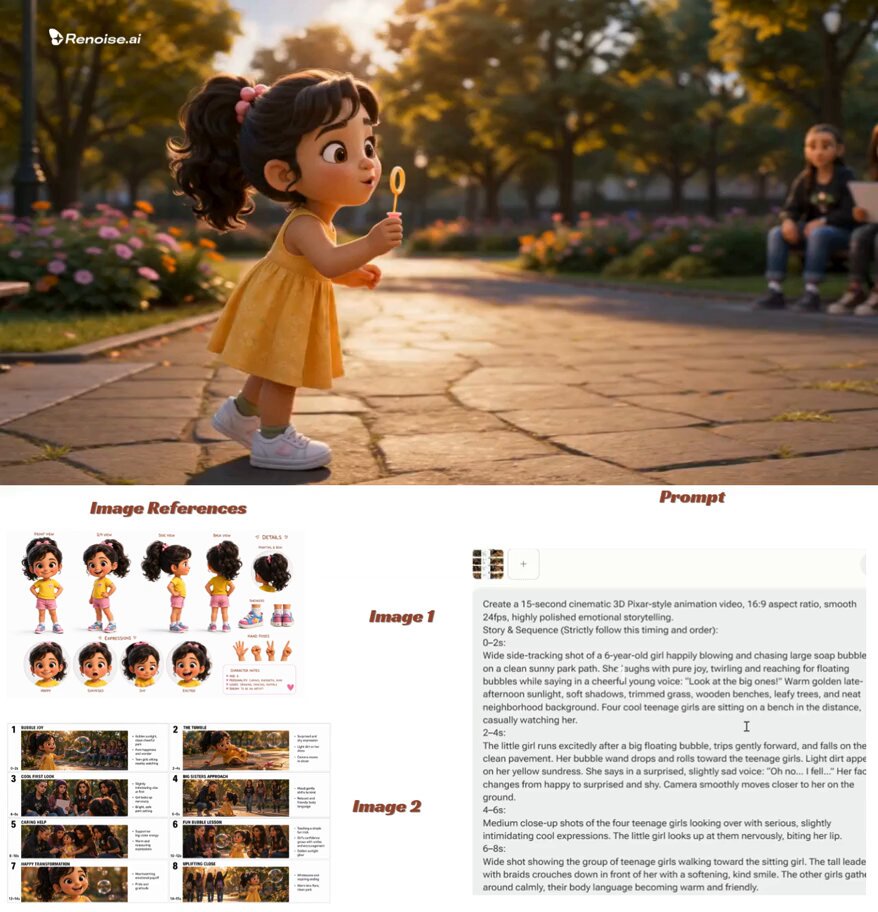
Structure every prompt in five parts:
- Subject — the product or person and its defining traits.
- Action — what happens during the shot, described as one continuous motion.
- Environment — location, props, background activity, time of day.
- Camera — framing, angle, movement, lens character.
- Light and style — key direction, contrast, color palette, grade.
A finished example: "Matte black insulated bottle on a wet stone countertop, condensation forming and one droplet sliding down the side, bright kitchen with soft morning window light from the left, shallow depth of field, slow dolly in, 35mm lens, natural color, subtle film grain, vertical framing."
Product fidelity and consistency
Models love to invent. That is a liability when your product has a specific shape, finish, or logo. Name the invariant features explicitly: "single amber indicator light," "brushed aluminum body," "no text or labels on the surface." Then composite real branding in post-production, where you control typography and accuracy.
Camera, light, and motion vocabulary
Words that reliably work: slow dolly in, locked-off tripod, shallow depth of field, handheld micro-shake, practical rim light, volumetric haze, soft window key, overcast daylight. Words that mostly waste tokens: "cinematic" on its own, "high quality," "masterpiece," "award-winning." Replace adjectives of quality with physical descriptions. If motion looks warped, reduce intensity and describe the movement as measured and slow.
Building a Shot List That Edits Itself
A shot list is not paperwork. It is the reason your edit comes together in an afternoon instead of a week.
Hook, proof, offer
Structure your list in three acts. The hook is the first one to three seconds: a pattern interrupt, an unusual visual, a question, a bold claim. The proof section shows the product doing the thing you promised. The offer closes with a concrete next step.
For a fifteen-second spot, budget roughly: one hook shot, three or four proof beats, one call-to-action shot. For a thirty-second spot, add a character or context beat that makes the promise personal.
Coverage without waste
Generate three variants of each critical shot and one variant of each utility shot. Critical shots are the hook and the product hero; you need alternatives there. Utility shots are transitions and background textures; one good take is enough.
Track everything in a simple sheet: shot ID, prompt, seed, model, take number, and a verdict. Two weeks later, when the campaign needs a fresh hook, that sheet becomes a searchable library.
Continuity rules
Keep a continuity sheet listing wardrobe, product position, time of day, and which side of the frame the subject faces. Reuse seeds where the tool allows it. If a shot breaks continuity and cannot be re-rendered in time, change the angle entirely rather than cutting between two mismatched frames.
Post-Production: Turning Clips Into a Commercial
This is where generated assets stop being demo reels and start being advertising.
Rhythm and the first three seconds
Cut on motion, not on beats of dialogue. Use J-cuts and L-cuts so audio leads or trails the picture and the pacing feels natural. Front-load the promise; do not save it for the end.
Run a silent scroll test: watch the edit on a phone, muted, at arm's length, while half-distracted. If you cannot follow the value proposition, fix the visual hierarchy before touching the sound.
Sound, voice, and music
Write voiceover for the ear, not the page: short sentences, concrete nouns, numbers spoken naturally. Use a synthetic voice for scratch tracks, then decide whether brand tone requires a human read for the final. Choose music by tempo relative to your average cut length — fast cuts need a faster bed, or the edit fights the track. Sound design carries texture: a click, a pour, a snap, a whoosh. It is often the difference between "AI-looking" and "real."
Add captions. A large share of viewing happens muted, and captions also improve comprehension on small screens.
Finishing: grain, color, and cadence
Apply one grade across every shot so generated and filmed material sit in the same world. Add light grain to soften the hyper-clean look that some models produce. Match frame rates across clips — mixing 24fps and 30fps in the same sequence creates a subtle judder that viewers feel without naming. Finally, check motion cadence at playback speed; generated motion sometimes looks correct frame-by-frame but unnatural in real time.
Quality Control, Compliance, and Brand Safety
A single artifact can undo an otherwise strong spot, especially in paid placements where viewers are already skeptical.
The artifact checklist
Before delivery, scan every shot for: malformed hands and fingers, unstable teeth and eyes, garbled or morphing text, impossible reflections, objects that change shape between frames, physics that break (liquid, fabric, smoke), and flicker across cuts. Watch the edit once at normal speed, once at half speed, and once with the sound off.
Claims, disclosures, and platform policy
Substantiate every claim you make on screen. Avoid before-and-after framing without context in categories like health, finance, and beauty. Where disclosure of synthetic media is required by law or platform policy, add a short, honest label rather than hiding it. Do not present a synthetic person as a real customer or expert.
Rights, likeness, and safe defaults
Do not generate recognizable living people without consent. Avoid brand names and trademarks inside prompts. Keep provenance notes for every asset: model, version, prompt, date, and who approved it. Those notes protect you in review processes and make it possible to reproduce a winning look months later.
Testing, Iteration, and Learning Loops
AI production is cheap enough that testing should be routine, not exceptional.
Variant design
Change one variable per test cycle: the hook framing, the first line of voiceover, the offer wording, or the call to action. Generate three or four variants and keep everything else identical. If you change the hook, the music, and the offer simultaneously, the results tell you nothing.
Metrics that matter
Hook rate (three-second view rate) tells you whether the opening works. Hold rate and completion tell you whether the body sustains attention. Click-through rate and cost per acquisition tell you whether the offer and audience match. Cheap views with no conversion usually mean the wrong audience or a weak offer, not a weak edit.
Iteration cadence and the asset library
A sustainable weekly rhythm: generate on Monday, edit on Tuesday, launch on Wednesday, read data on Friday, brief the next round on Monday. Keep a reusable library of hooks, product macros, transitions, and sound effects so each cycle starts from a stronger baseline than the last.
Common Mistakes and a Compact Production Timeline
Most avoidable failures fall into a handful of categories:
- Briefing in adjectives instead of a single promise and a specific audience.
- Generating before locking aspect ratio and duration.
- Making the product a background element in its own commercial.
- Using quality adjectives instead of physical descriptions in prompts.
- Generating one take of the hook and twenty of the B-roll.
- Skipping the grade, so generated and filmed shots look like different projects.
- Launching without captions, sound design, or a muted viewing test.
- Never testing variants because the first version "looked fine."
A workable five-day cycle looks like this:
| Stage | Time | Output |
|---|---|---|
| Brief and promise | 2 hours | One-sentence promise, audience, placement |
| Shot list and continuity sheet | 3 hours | 8-12 numbered shots with prompts |
| Generation and selection | 1 day | 2-3 takes per critical shot |
| Assembly and sound | 1 day | First cut with music, voice, captions |
| QC and compliance review | 2 hours | Approved master plus variants |
| Launch and measurement | Ongoing | Hook, hold, CTR, conversion data |
FAQ
Do I need a full production team to make AI commercials?
No, but you need three roles covered by someone: a strategist who owns the promise, an editor who owns rhythm and sound, and a reviewer who owns quality control and compliance. On small teams, one person can hold two of those roles, but not all three on the same pass.
Which is better, text-to-video or image-to-video?
Image-to-video for anything product-specific, because the first frame anchors shape and color. Text-to-video for environments, textures, and atmosphere, where variation between takes is an advantage rather than a risk.
How many takes should I generate per shot?
Three for critical shots (hook, product hero, call to action) and one for utility shots. More than that usually means the prompt or the shot concept is unclear, not that you need more options.
How do I stop AI video from looking artificial?
Unify the grade, add light grain, match frame rates, layer real sound design, and cut faster on motion. The "AI look" is more often a finishing and sound problem than a generation problem.
Can I use AI commercials in paid campaigns?
Yes, provided you substantiate claims, follow platform disclosure rules, avoid synthetic endorsements, and keep provenance records. Check each platform's synthetic media policy before launch, since requirements differ.
What should I test first?
The hook. It has the largest effect on distribution and the cheapest fix. Once the hook works, test the offer wording, then the call to action.
How long does a first AI commercial take?
With a locked brief and a prepared shot list, a fifteen-second spot can go from concept to launch in about a week. Most of that time is editing, sound, and review, not generation.
